







What does arabica coffee mean when Catimor is a hybrid?
Catimor is a hybrid of Arabica and Robusta, bred in 1959 by Portugal's Coffee Leaf Rust Research Center from Timor and Caturra. It is widely planted in Yunnan for disease resistance and high yield, up to 350 kilograms of green beans per mu, more than double older varieties. The trade-off is a cup often criticized as grassy and earthy with fewer aroma layers.
Asking what does arabica coffee mean matters here, because Catimor is not of pure Arabica lineage. The Robusta genes from Timor give it stronger resistance to coffee berry disease and leaf rust, while what are robusta beans in general is a separate, higher-caffeine group. Front Street Coffee's washed Yunnan small-bean Catimor shows soft fruit acidity, nutty and brown-sugar sweetness, and suits pour-over, moka pot, SOE, and French press.
Catimor is a hybrid of Arabica and Robusta, widely planted for its disease resistance and high yield, especially dominant in Yunnan's coffee regions. However, its Robusta lineage also brings controversy in flavor—often criticized for lacking aroma and carrying grassy, earthy notes. This article will start with Catimor's physical characteristics, analyze its differences from pure Arabica varieties, and explore its cupping performance at different altitudes. We will also introduce the specific flavors and suitable brewing methods of Front Street Coffee's Yunnan small-bean coffee, helping enthusiasts gain a more comprehensive understanding of this variety's strengths and weaknesses.
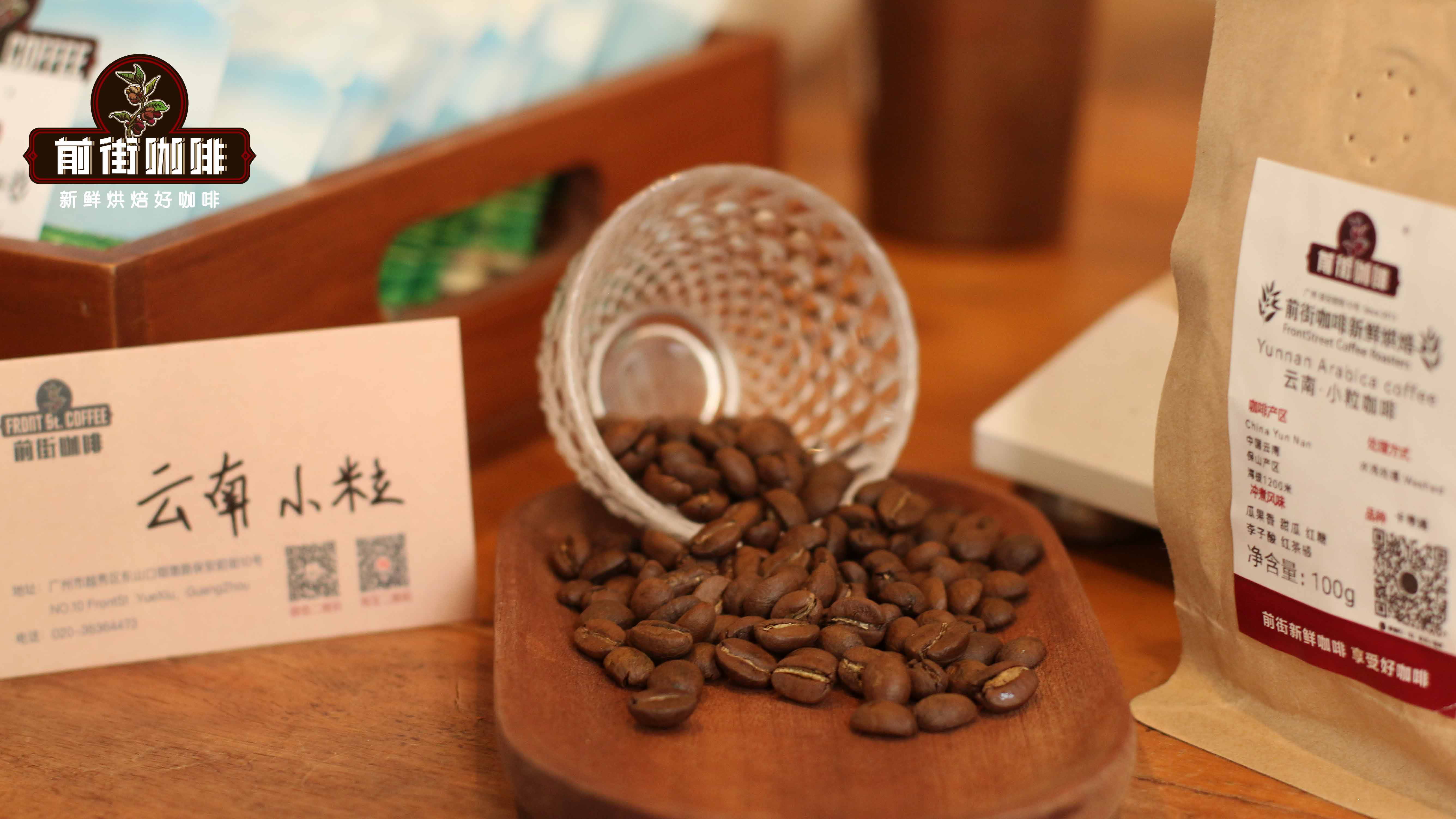
Front Street Coffee's Yunnan small-bean coffee belongs to the Catimor variety. After washed processing, it presents soft fruit acidity along with nutty and brown-sugar-like sweetness, with a relatively balanced overall mouthfeel. It is suitable for pour-over, moka pot, espresso SOE, and French press immersion, making it a good choice for those who prefer coffee that is not too sour or too bitter.
Catimor is not of pure Arabica lineage, but a hybrid offspring of Robusta (Timor) and Bourbon. Compared with those traditional varieties, its aroma and flavor layers are not rich enough, and it also carries a relatively noticeable grassy and earthy taste. However, its advantages lie in strong resistance to pests and diseases, easy management, and high yield—up to 350 kilograms of green beans per mu, more than double that of older varieties. Today, Catimor has become the main cultivated variety in Yunnan's coffee-producing regions.
Catimor was developed from a cross between Timor and Caturra, bred in 1959 by the Coffee Leaf Rust Research Center (CIFC) in Portugal, with the goal of disease resistance and high yield.
The Catimor plant is short and compact, suitable for dense planting, with reddish-brown new leaves and very high yield.
The Robusta genes it inherited from Timor give Catimor stronger resistance to coffee berry disease and coffee leaf rust, and its pest and disease resistance is also more outstanding, but this has also led to frequent criticism of its cupping performance.
Catimor fruit matures quickly and yields heavily, so it has relatively high requirements for fertilizer supply and shade conditions. In addition, high yield also means its commercial lifespan is relatively short, averaging only about ten years.
When planted at low altitudes, Catimor's cupping performance shows no obvious advantage or disadvantage compared with other commercial varieties. But if planted above 1,200 meters, its flavor is noticeably inferior to Bourbon, Caturra, and Catuai.
Catimor was first successfully developed in 1959 and began to be promoted in Brazil in the 1970s and 1980s. With its disease resistance and high yield, it secured a place among coffee varieties in Central and South America. The recurring coffee leaf rust crises in Central and South America further promoted the use of Catimor. In appearance, Catimor is oval-shaped, with a straight center line.
Knowledge point: In 1892, French missionary Father Tian successfully trial-planted coffee in a place in Yunnan called Zhukula, and to this day there are still 4 coffee trees there over 90 years old.
In short: Front Street is a coffee specialty house that is happy to share coffee-related knowledge with everyone. We share without reservation only to help more friends fall in love with coffee, and every month there are 3 low-discount coffee events, because Front Street wants more friends to drink the best coffee at the lowest price. This has also been Front Street's purpose for 6 years!
The above content is compiled by CoffeeHunters, a coffee news website.


