







How do Kenya's famous coffees differ by region?
Kenya splits into seven main coffee regions, with Nyeri, Kirinyaga and Murang'a supplying most specialty lots. Washed AA beans from Nyeri show intense berry-like acidity and a full body, supported by red volcanic soil and altitudes from 1,200 to 2,300 meters. Kirinyaga and Murang'a sit on the same Mount Kenya and Aberdare foothills, so their cups overlap in structure while differing in sweetness and aroma.
Regional labels are a guide, not a rule. Altitude, variety and processing shift the final result just as much as geography does. Nyeri's main crop runs October to December, with a smaller fly crop from June to August, and common varieties include SL-28, SL-34, Ruiru 11 and Batian. Smallholder cooperatives dominate production there, while large estates remain relatively rare across the region.
Kenya is one of Africa's most iconic coffee-producing countries, famous for its intense berry-like acidity and a staple in specialty coffee shops worldwide. But describing flavor by country alone can no longer satisfy coffee lovers' curiosity, as Kenya is in fact divided into multiple regions, each with its own character. This article outlines Kenya's seven major regions, focusing on the three specialty regions of Nyeri, Kirinyaga, and Muranga, and, drawing on Front Street Coffee's cupping practice, compares the flavor differences of their washed AA coffees, while reminding readers that regional flavors are not absolute—altitude, variety, and processing method all affect the final result.
For more specialty coffee knowledge, please follow our WeChat official account: FrontStreet Coffee
Kenya is one of the most common coffee-growing countries in the world, and after Ethiopia, another highly iconic coffee calling card for Africa. Its bright, intense berry-like acidity has captured the palates of a great many coffee lovers, making Kenyan coffee an almost permanent fixture in many cafés.
As a coffee-producing country, Kenya is something we habitually sum up with berry notes. But as the specialty coffee wave advances, consumers pay more and more attention to regional information, and talking only at the country level no longer seems to satisfy everyone's desire to explore coffee's origins.
So how are Kenya's coffee-growing areas divided internally? And what flavor characteristics do the major regions each present?
What are Kenya's main coffee regions ?
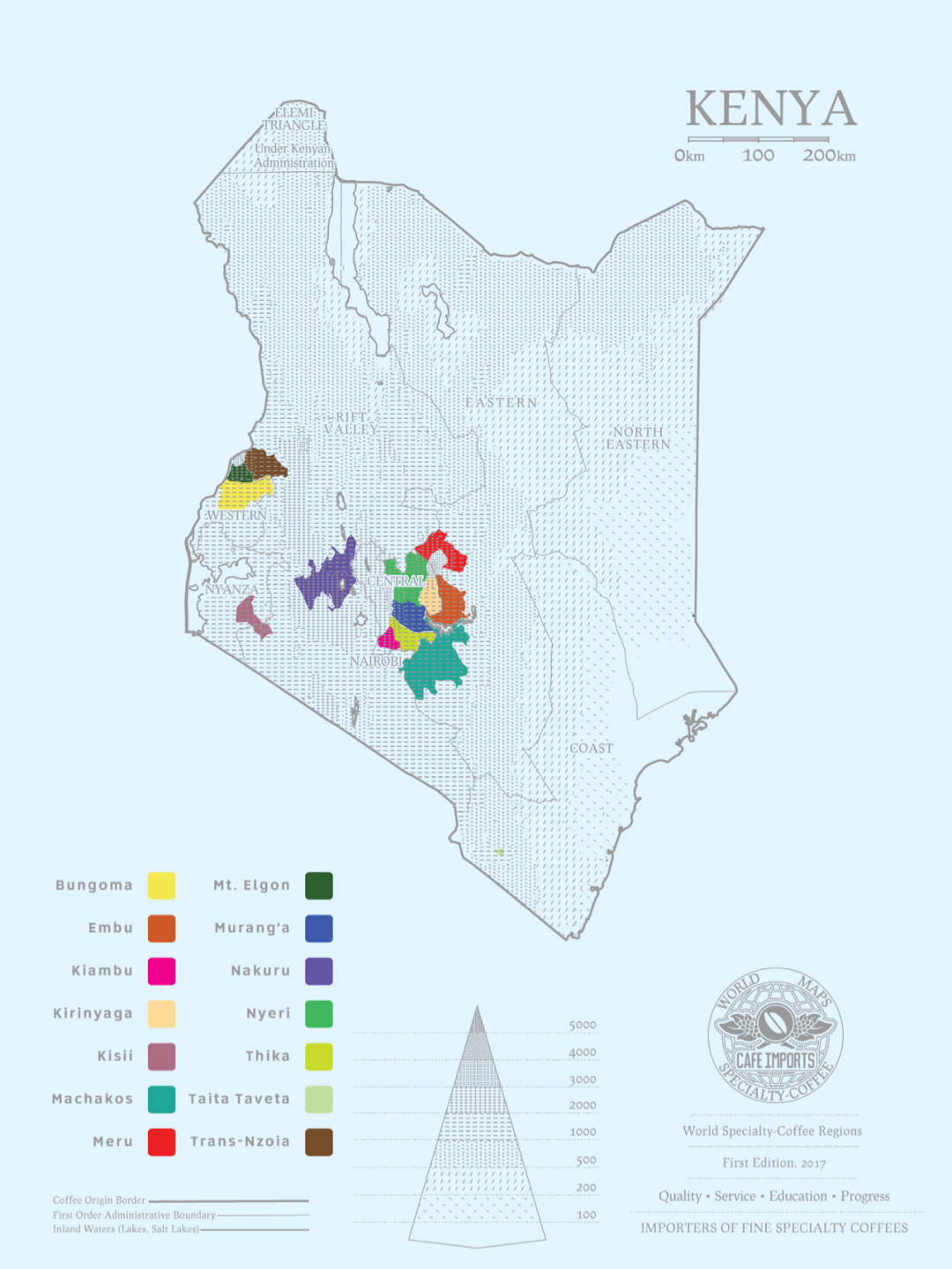
Kenya's seven most renowned coffee regions are: Thika, Kirinyaga, Mt. Kenya West, Nyeri, Kiambu, Ruiri, and Muranga. Among them, the foothills of Mount Kenya and the Aberdare Range are the core growing areas.
Specialty coffee mainly comes from the following regions: Nyeri, Kirinyaga, and Murang'a.
Nyeri
The Nyeri region is located in central Kenya and is home to the extinct volcano Mount Kenya. The red soil here nurtures Kenya's finest coffee. Agriculture holds an extremely important place in the area, and coffee is its most important crop. The Nyeri region is dominated by cooperatives formed by smallholder farmers, with large estates being relatively rare.
Altitude: 1,200 to 2,300 meters
Harvest period: October to December (main crop), June to August (fly crop)
Varieties: SL-28, SL-34, Ruriu11, Batian.
Muranga
The Muranga region belongs to Central Province and has about 100,000 coffee farmers. This inland region was among the first settlement sites chosen by missionaries, because the Portuguese forbade them from living in the coastal areas. It likewise benefits from volcanic soil, and smallholder coffee farmers also outnumber estates.
Altitude: 1,350 to 1,950 meters
Harvest period: October to December (main crop), June to August (fly crop)
Varieties: SL-28, SL-34, Ruiru11, Batian
Kirinyaga
The Kirinyaga region lies on the slopes of Mount Kenya, adjacent to the Nyeri region, and is world-renowned for coffees with intense flavor, rich layers, and a solid mouthfeel, and together with Nyeri is regarded as one of Kenya's two top regions today. Most producers in this area are smallholder coffee farmers who join cooperatives; the cooperatives take on a coordinating role and provide washing stations, to which farmers deliver their coffee cherries for processing.
Kirinyaga originally referred to Mount Kenya itself, but during the British colonial period the name was considered a tongue-twister, so the mountain was renamed "Mt Kenya" and "Kirinyaga" fell out of use. Mount Kenya is Africa's second-highest peak; though located in the tropics, its summit is snow-covered year-round, and the original meaning of Kirinyaga is precisely "white peak." Mount Kenya is not only a UNESCO protected area; the wildlife that gathers to feed on its surrounding foothills and grasslands also makes it a popular spot for tourists. According to Front Street's research, Kirinyaga comes from the Kikuyu people and means "white mountains," regarded as the dwelling place of the gods. The Kikuyu are Kenya's most populous ethnic group, accounting for one-fifth of the total population.
Altitude: 1,300 to 1,900 meters
Harvest period: October to December (main crop), June to August (fly crop)
Varieties: SL-28, SL-34, Ruiru11, Batian.
What flavors do these Kenyan regions each have?
To clarify the characteristics of these regions, Front Street Coffee tried sourcing coffees from several Kenyan regions separately, with the bean list as follows:
These coffees are all from the new 2020 crop, all processed with the 72-hour washed method, and all of the SL28 and SL34 varieties.
Cupping was used to minimize human interference and restore the coffee's own quality and flavor.
After a round of cupping, the flavor profiles followed their own directions according to each region:
The three coffees from the Nyeri region share a profile of berry-like flavors, moderate sweetness, honey, and cream.
The Kagumoini from the Muranga region showed distinct berry-like flavors, slight floral notes, and slight green tea notes.
The two from the Kirinyaga region shared berry-like flavors and moderate sweetness, and displayed distinct roasted nut flavors once cooled.
Combining this with Mr. Hsu Pao-lin's flavor descriptions of Kenyan regions in "Bean Seeker 2":
Coffees from the Nyeri region have bright blackberry, a thick oily body, citrus, and even floral notes.
Coffees from the Muranga region present bright acidity and a thick mouthfeel.
Coffees from the Kirinyaga region have bright fruit acidity, a medium oily body, and refined sweetness.
At this point the general outline of regional flavors can be seen, but Front Street Coffee needs to remind you that these are not universal formulas, and one should not develop the habit of matching flavors to a region on sight. With a little thought, one can conclude that "not all coffees from the Nyeri region are bright blackberry, thick oily body, citrus, and even floral notes."
The final flavor of a cup of coffee must be considered comprehensively in terms of region (climate, cultivation methods, soil), processing method, coffee variety, storage method, and other factors. Even for the same region, same variety, and same processing method, as long as the growing altitude differs, the taste will also differ.
In the cupping, the three in the Nyeri group showed a declining trend in acidity. As altitude increased, the coffee's acidity in the cupping also increased, and the acidity of high-altitude coffee was more lifted; low-altitude coffee beans saw their overall acidity decline at low temperatures, turning from lively to dull, while the high-altitude coffee in the same group, although its acidity dropped slightly at low temperatures, still retained full-bodied acidity. So not all coffee beans from the Nyeri region can maintain a lasting bright fruit acidity.
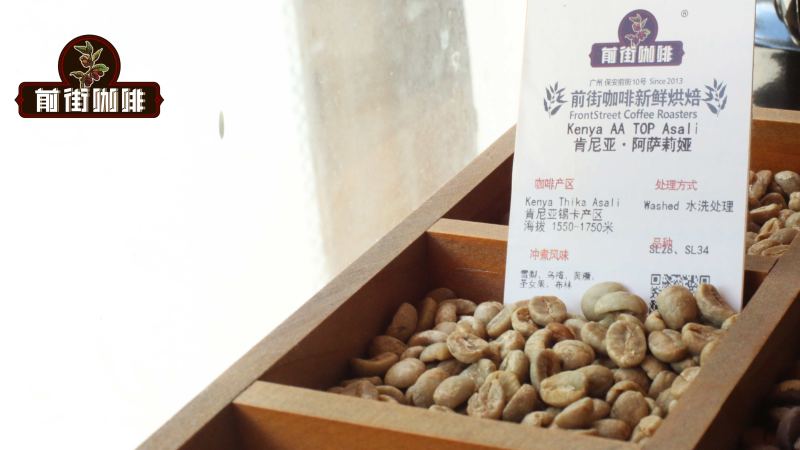
Besides the above three regions, an Azalia coffee bean that Front Street sourced also showed excellent flavor performance, produced in Thika, Kenya's capital, with not only clear floral notes but also rich cherry tomato acidity, making it a daily staple coffee for many friends. Those interested can buy it at Front Street stores or the Front Street Tmall flagship store.
The above content is compiled by CoffeeHunters, a coffee news website.


