







How long should pour-over coffee brewing time be
Pour-over coffee brewing time is the contact window between grounds and water, and it decides how much flavor dissolves into the cup. A workable baseline is a total brew of about 2 minutes: 15 grams of coffee, a 1:15 ratio for 225 grams of water, a V60 dripper, and three pours. Longer contact builds a fuller mouthfeel, shorter contact gives a thinner, weaker cup.
Brewing time is not a single number, because grind size, water temperature, dose, and pouring speed all push it around. Finer grinds and hotter water extract faster, so they need less time; coarser grinds and cooler water need more. Baristas rinse the filter paper first so it sits snug against the dripper before the first pour begins.
How long should the brewing time for pour-over coffee actually be controlled to? This question seems simple, but in reality, it involves the combined effects of multiple variables such as the dripper structure, coffee dose, pouring speed, and grind size. Brewing time is essentially the contact duration between coffee grounds and water, directly determining the degree of flavor compound dissolution. This article will start from the principles of extraction, analyze each factor affecting brewing time one by one, and share a basic brewing recipe commonly used at Front Street Coffee stores—15 grams of coffee, 1:15 coffee-to-water ratio, V60 dripper, three-stage pouring, total time about 2 minutes, suitable for beginners to imitate and practice.
For more specialty coffee knowledge, please follow the WeChat public account: Front Street Coffee
With the continuous advancement of the third wave of specialty coffee, pour-over coffee has gained increasingly widespread popularity among enthusiasts. Many people are keen to brew pour-over coffee at home, so is pour-over coffee difficult to operate? In fact, mastering the brewing method of pour-over coffee is not a difficult task.
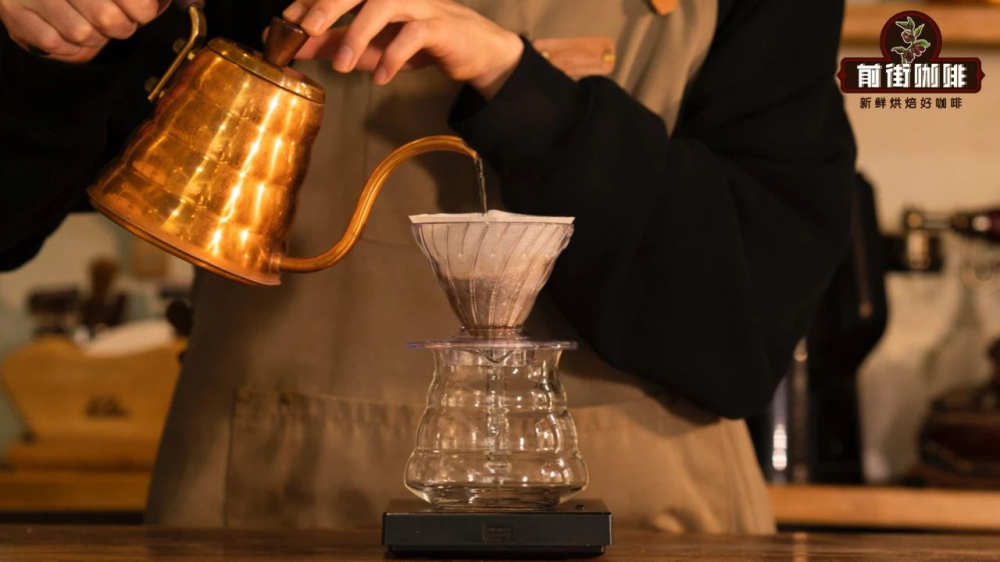
When baristas at Front Street Coffee prepare pour-over coffee, they usually weigh 15 grams of coffee beans, use a 1:15 coffee-to-water ratio, and finally pour 225 grams of water. Depending on the characteristics of the coffee beans, they choose a Hario V60 dripper or a Kono dripper. Before each brewing, they first rinse the filter paper with a small amount of water, so that the filter paper fits more snugly against the dripper.
The variables affecting the flavor of pour-over coffee mainly include the following: grind size, water temperature, coffee-to-water ratio, extraction time, etc. Specifically, the finer the grind, the more concentrated and intense the coffee flavor; the coarser the grind, the weaker the coffee flavor tends to be. The higher the water temperature, the stronger the coffee taste; the lower the water temperature, the lighter the coffee taste. The larger the coffee-to-water ratio, the thinner the coffee taste; the smaller the coffee-to-water ratio, the heavier the coffee taste. The same applies to extraction time: the longer the time, the richer and more solid the coffee mouthfeel; the shorter the time, the thinner and weaker the coffee taste.
Why is brewing time so critical?
The brewing process of coffee is essentially an extraction process, with water acting as a solvent to dissolve flavor compounds from the coffee grounds. All influencing factors directly or indirectly affect the extraction efficiency of coffee. Extraction time, or brewing time, refers to the duration of contact between coffee grounds and water. The longer the contact time, the more ample time the water has to dissolve and extract substances from inside the coffee grounds, resulting in a stronger taste, and vice versa.
What factors affect the brewing time of pour-over coffee?
Dripper structure
The structure of the dripper is the primary factor determining the brewing time of pour-over coffee. Drippers with different structures have significant differences in the speed of filtering coffee. Take the two drippers offered by Front Street Coffee as examples: the V60 dripper and the Kono dripper. The V60 dripper uses a larger filter hole and spiral exhaust ribs. This design makes the V60 dripper filter quite quickly, generally leaning more toward drip extraction, which can enhance the layering of the coffee.
The design features of the Kono dripper include shorter and straight ribs and a smaller filter hole. These characteristics make the Kono dripper filter more slowly, and the overall brewing time will be longer than that of the V60 dripper. Therefore, when brewing with the Kono dripper, the water and coffee grounds soak for longer than with the V60 dripper, resulting in a fuller mouthfeel.
Coffee dose
Besides the dripper, the amount of coffee grounds also affects the flow rate of the coffee liquid, thereby indirectly affecting the brewing time of pour-over coffee. Taking Front Street Coffee store offerings as an example, 15 grams of coffee grounds are used. The more coffee grounds, on the one hand, require a longer pouring time, and on the other hand, the thicker the coffee bed, the slower the flow rate.
Imagine this: using the same pouring speed of 10 grams per second and a 1:15 coffee-to-water ratio, 15 grams of coffee grounds require pouring 225 grams of water, taking 22.5 seconds; while 20 grams of coffee grounds require pouring 300 grams of water, taking 30 seconds.
Pouring speed
Pouring speed is even easier to understand: the faster the pouring, the shorter the brewing time and the weaker the coffee taste; conversely, the slower the pouring, the longer the brewing time and the more pronounced the coffee taste.
Grind size
Finally, grind size is also a factor affecting the brewing time of pour-over coffee. I wonder if any of you have had this experience: after pouring water for pour-over coffee, the entire coffee bed turns into a muddy mess, and the coffee liquid cannot filter smoothly, as if blocked. This is the most extreme case of grind size affecting brewing time—coffee grounds that are too fine cause the flow rate to be too slow.
The effect of coffee grind size on brewing time can be understood as the issue of gaps between particles. The finer the coffee grounds, the smaller the gaps between particles, the harder it is for water to pass through these gaps, and the slower the flow rate; conversely, the coarser the coffee grounds, the larger the gaps between particles, the easier it is for water to flow through the gaps, and the faster the flow rate.
How long should pour-over coffee actually be brewed?
After the above series of introductions, we now understand that the brewing time of coffee is actually influenced by many factors together, just as the final flavor of pour-over coffee is also constrained by multiple factors. This is the result of a combination of factors working together. No single factor is a fixed standard; these factors can derive various brewing recipes through different permutations and combinations, such as fine grind fast brew, coarse grind slow brew, etc.
The same applies to brewing time. But for beginners who have not yet understood the effects of each factor on brewing, the brewing recipe of Front Street Coffee is very suitable for you. Baristas at Front Street Coffee often share with customers: Front Street Coffee's brewing method is the most basic, most fundamental, and also very easy-to-imitate brewing recipe, with the aim of allowing everyone to brew at home the taste they enjoy in a café.
Front Street Coffee's brewing recipe is the result of years of joint practice by multiple baristas: use a V60 dripper, 15 grams of coffee grounds, a 1:15 coffee-to-water ratio, a medium-fine grind size, 90 degrees Celsius water temperature, pour in three stages, with a final brewing time of 2 minutes. Around 2 minutes, the coffee liquid has just completely filtered through, and removing the dripper ends the brewing.
In the first stage, pour 30 grams of water for blooming, with a blooming time of 30 seconds; then at 1 minute and 15 seconds, pour all the remaining 185 grams of water, so the entire brewing process is completed in about 2 minutes to 2 minutes and 10 seconds.
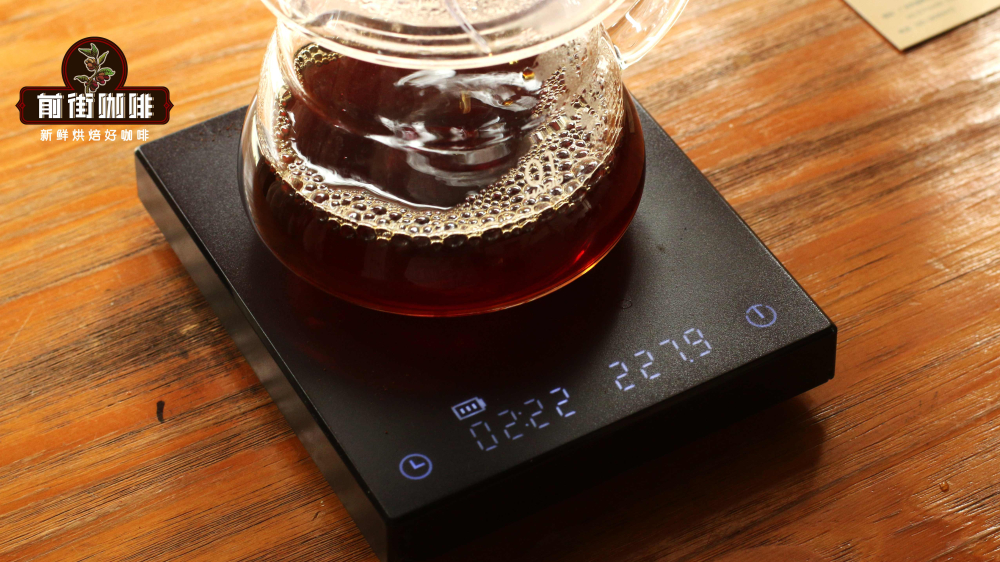
If you cannot complete the pouring all at once during operation, you can also achieve it through staged pouring. In the second stage, pour to 125 grams, wait 10 seconds, then pour to 225 grams of water, with a total extraction time of about 2 minutes.
This brewing time is a choice based on the selected grind size and coffee-to-water ratio. Less than 2 minutes, the coffee taste will seem insufficient; more than 2 minutes by too much, it is prone to producing a bitter taste.
The above content is compiled by CoffeeHunters, a coffee news website.


