








How Do You Set Espresso Parameters for Blending Coffee Beans?
Espresso has no single fixed recipe, so extraction is adjusted to the coffee on hand. Six variables drive the result: dose, brew ratio, extraction time, flow rate, pressure, and water temperature. Dose follows the filter basket, roughly 7-9 g for a single and 18-20 g for a double, since too little coffee leaves a loose puck that under-extracts and too much slows or blocks the flow.
Bean condition, grinder performance, and the machine's pressure and temperature stability all shift the outcome, so the same blend can taste different between operators. Measuring concentration and extraction yield against golden cup data gives a reference point when tuning blending coffee beans, and the same variables, rather than a moka pot, guide each adjustment.
Want to make a balanced espresso at home, but always troubled by unstable flow rate and flavors that swing between sour and bitter? In fact, there is no universal fixed set of parameters for espresso extraction—the condition of the coffee beans, the performance of the grinder, and the machine's pressure and water temperature can all cause deviations in the result. This article starts from six dimensions—dose, brew ratio, extraction time, flow rate, pressure, and water temperature—and systematically sorts out how to customize a suitable extraction plan for the blend you have on hand, with specific references based on Front Street Classic Blend and Strawberry Candy Espresso. It also includes methods for measuring espresso concentration and extraction yield, helping you use golden cup data to assist your adjustments and ultimately find the cup you truly enjoy.

To get more specialty coffee knowledge, welcome to follow our WeChat public account: Front Street Coffee (FrontStreet Coffee)
Friends who have seen Front Street's educational content may have noticed that Front Street gives fairly clear extraction times when discussing pour-over coffee, but rarely does so when it comes to espresso. The reason is that espresso extraction is affected by far more than bean freshness and grind size—the coffee machine's brand and model, extraction pressure, and whether the water temperature is stable can all make a noticeable difference in the final taste. Even with the same blend, if a different person operates it, the result may be completely different. That being the case, how do we determine what parameters to use for the blend we have on hand?
How to customize suitable espresso extraction parameters for the blend you have on hand?
Coffee dose
The dose basically depends on the capacity of the filter basket, and it is not recommended to put in too little or too much coffee relative to the basket's specification. The dose directly affects how compact the puck is: under the same tamping force, too little coffee makes the puck looser, water passes through quickly, and under-extraction is likely; too much coffee makes the puck too dense, the flow rate slows, and the coffee liquid may even struggle to flow out. Front Street Coffee (FrontStreet Coffee) usually uses these doses: 7-9g for a single espresso, 18-20g for a double espresso, with slight adjustments based on the beans' condition each day.
Espresso brew ratio
The ratio here refers to the ratio of coffee grounds weight to coffee liquid weight, usually falling between 1:1.5 and 1:2.5, with 1:2 being the most common, for example 17g of grounds extracting 34g of coffee liquid. The ratio is affected by two variables: dose and water amount. When the ratio is too low, the coffee tastes very heavy and thick, and is prone to the bitterness brought by over-extraction; when the ratio is too high, the mouthfeel becomes weak and thin, and there will also be a sharp acidity caused by under-extraction.
For beginners practicing making espresso, you can start with a classic blend, such as Front Street. Front Street Classic Blend Coffee Beans. It is composed of beans from three origins—Brazil, Indonesia, and Vietnam—and uses a medium-dark roast. When the brew ratio is controlled between 1:1.9 and 1:2, the flavors of nuts, caramel, butter, and dark chocolate are more prominent, and the crema is richer. Whether making latte art or an Americano, it can show a rich aroma.
When home users choose beans for espresso, it is best to avoid dark-roasted beans with excessive bitterness and light-roasted beans with sharp acidity. If you are a beginner just getting into espresso, you can try the medium-roast Front Street. Strawberry Candy Espresso. This is an espresso recipe designed specifically for people who prefer floral and fruity notes, blending coffee beans from three origins—Costa Rica, Colombia, and Ethiopia. It has aromas of rose, citrus, grape, and dried blueberry, and when paired with milk it also presents a strawberry gummy-like note.
Extraction time
Extraction time refers to the entire process from locking in the portafilter and pressing the extraction button to the end of extraction. There are two main factors affecting the time: grind size and ratio. The ratio is relatively easy to understand—the higher the ratio, the more water needs to flow out, so the time is naturally extended. Grind size determines the coarseness of the coffee grounds, and the coarseness directly affects how dense the puck is: the finer the grounds, the tighter the puck after tamping, the harder it is for water to penetrate, and the longer the time, which easily causes over-extraction.
The freshness of the coffee beans also changes the extraction time. Beans that are too fresh have accumulated a large amount of carbon dioxide inside. Under a high-pressure environment, the oils and carbon dioxide undergo an emulsification reaction, the extraction time is extended, and a large amount of yellow foam is released. Conversely, if the beans are not fresh, their water absorption capacity decreases, water passes through faster, the extraction time shortens, and the resulting espresso often has thin crema.
Flow rate
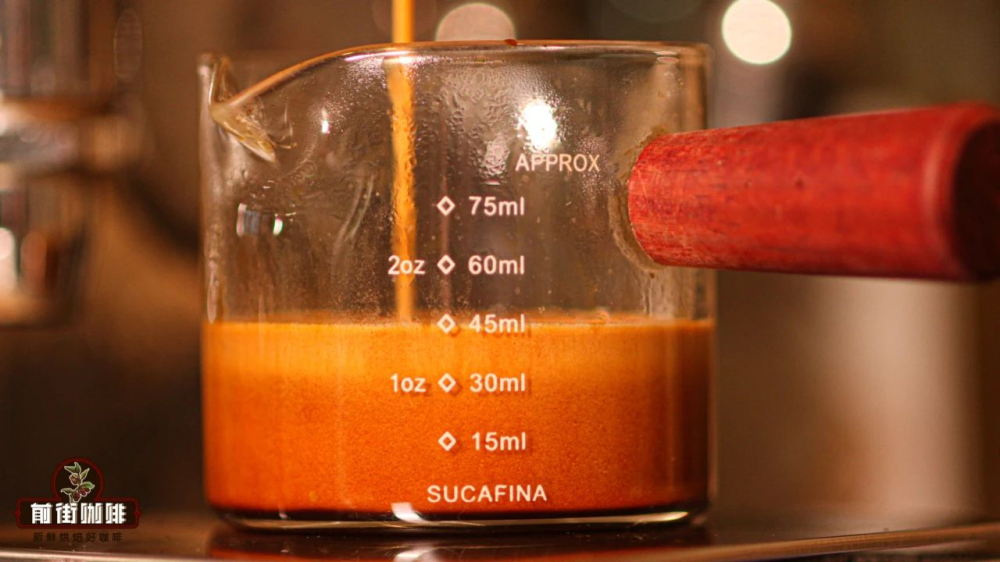
Flow rate is the speed at which the coffee liquid flows out. All the extraction parameters we set are ultimately meant to bring the flow rate into the ideal range. Espresso should drip its first drop about 5 seconds after pressing the extraction button, and then flow out evenly and continuously. In general, Front Street uses 18-20g of grounds to extract 35-40ml of coffee liquid, with extraction time controlled between 27-30 seconds. Whether the flow rate is too fast or too slow can directly reflect whether the grind size and ratio are appropriate.
For example, Front Street uses 20g of grounds to extract 40g of coffee liquid, with a brew ratio of 1:2. If the time is shorter than 20 seconds, it means the flow rate is too fast and the coffee is most likely on the sour side. At this point, you can increase the dose by 0.5~1.0g, or make the grind finer. If the time is longer than 35 seconds, it means the flow rate is too slow. If the coffee still tastes bitter, it is over-extracted, and you need to reduce the dose by 0.5~1.0g, or directly make the grind coarser.
Pressure
The extraction pressure of a coffee machine is usually maintained at around 9 bar, and this is mainly determined by the machine's performance. Insufficient pressure lowers extraction efficiency, while excessive pressure easily causes over-extraction. Therefore, when choosing a coffee machine, remember to compare the parameters—the more expensive one is not necessarily the more suitable one.
Water temperature
Water temperature is generally controlled between 90 and 94 degrees Celsius. If the water temperature is too high, over-extraction is likely and the coffee tastes bitter; if the water temperature is too low, under-extraction is likely, resulting in sharp acidity in the coffee.
How should you adjust when espresso flow rate is too fast or too slow?
The flow rate of espresso is determined by multiple factors, including grind size, tamping force, and the condition of the coffee beans. Grind size is one of the key factors affecting flow rate—the coarser the grind, the faster the flow; the finer the grind, the slower the flow. A flow rate that is too fast may also be caused by insufficient tamping force. The condition of the coffee beans also affects flow rate, such as roast level and freshness (degassing situation).
Therefore, when the espresso flow rate is too fast or too slow, you might as well troubleshoot one by one and adjust the parameters as soon as possible. It is recommended to start with the condition of the coffee beans, because this step is the easiest to check; then confirm whether the extraction parameters are accurate, including dose, liquid yield, and tamping force. You can prioritize adjusting the brew ratio and change the flow rate by increasing or decreasing the dose, as this is the most efficient adjustment. After all these factors have been ruled out, then adjust the grind size.
How do you calculate whether espresso concentration falls within the appropriate extraction yield range?
Concentration refers to the proportion of "extracted coffee substances" in a cup of coffee relative to the total amount of coffee liquid. The concentration of espresso usually ranges between 8% and 12%. Extraction yield refers to the proportion of "extracted coffee substances" relative to the weight of the coffee beans, generally between 18% and 22%.
| How to measure espresso concentration?
First calibrate the concentration tester and zero it with pure water. Then stir the freshly extracted espresso, use a titration tube to take coffee liquid from the center, place it in the concentration tester, press the measurement button, and measure multiple times until the value stabilizes. | How to calculate espresso extraction yield?
Extraction yield = concentration × coffee liquid weight ÷ coffee bean weight.
We use Front Street. Rich and Mellow Espresso Moka Pot Coffee Beans—Front Street Classic Blend Coffee Beans, extracting 40ml of coffee liquid from 19g of grounds in 28 seconds. The concentration measured with a coffee concentration meter is 8.97%. Then the extraction yield is (8.97×37)÷19≈18.44%. In other words, the concentration of this espresso extraction is 8.97% and the extraction yield is 18.44%, making it an espresso within the golden cup range.
Does falling within the golden cup range guarantee that it tastes good?
Of course not. Coffee within the golden cup range is not necessarily a delicious cup of coffee. Coffee itself is a very personal and very subjective beverage. Constantly trying and constantly searching for the flavor you like is the right direction. The golden cup is merely a reference system for us to adjust coffee.
The above content is compiled by CoffeeHunters, a coffee news website.


