







What Separates Red Label and Blue Label Panama Geisha?
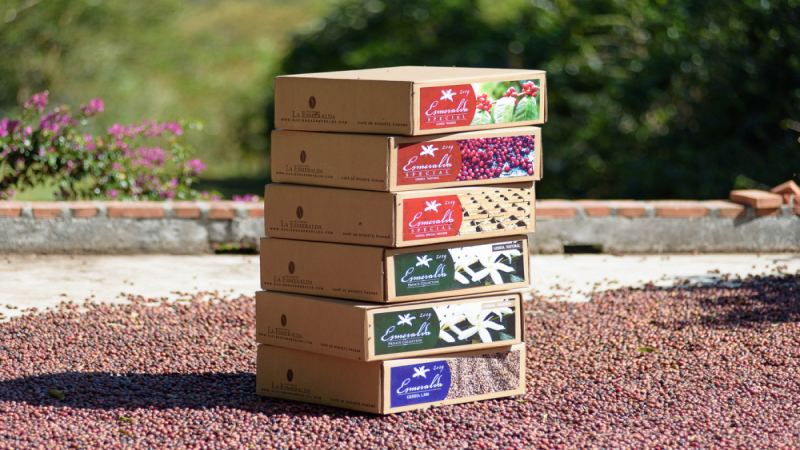
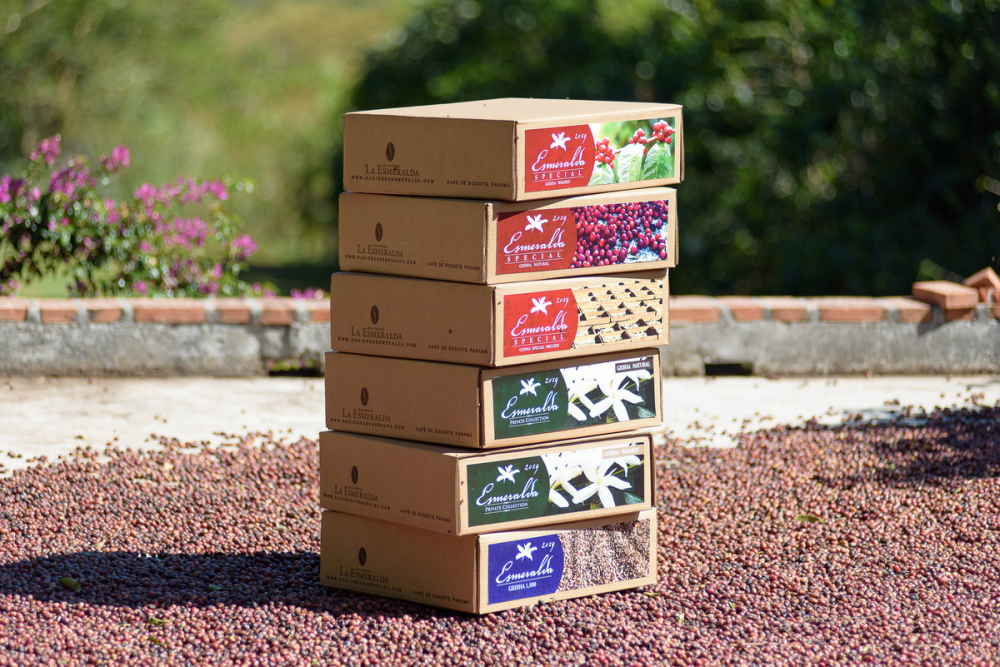
Hacienda La Esmeralda grades its Panama geisha coffee under four labels: Auction, Red Label, Green Label and Blue Label. Red Label is the strictest of the non-auction tiers, tied to high-altitude plots and top cup scores, while Blue Label is a more accessible tier with lower altitude requirements and looser traceability.
The Peterson family built this system for the geisha coffee beans grown in the Boquete and Candela areas, where cool air gathers along the central mountain range and creates a distinct microclimate. Knowing which label a lot carries tells buyers how much altitude, cup score and processing information stands behind the bag.
Panama's Hacienda La Esmeralda Geisha coffee beans are renowned in the specialty coffee world, but many coffee enthusiasts remain confused about the grading labels of Red Label, Blue Label, Green Label, and Auction. How exactly does the Peterson family define these different labels? What quality standards and growing conditions does each represent? This article, from Front Street's perspective, systematically sorts out the grading logic of Hacienda La Esmeralda Geisha, explains in detail the specific differences between Red Label and Blue Label in terms of altitude requirements, cup scores, processing methods, and traceability information, and also includes Front Street's recommended Red Label pour-over parameters and brewing steps, helping you truly understand the value of this top-tier Geisha.
Friends who know something about Geisha probably know that Panama's Hacienda La Esmeralda has always used its own unique grading system, and quite a complete one at that. For the Geisha variety alone, the Peterson family has successively created four brand labels, commonly called in China Auction, Red Label, Green Label, and Blue Label. However, many beginners who are just getting into Geisha only know that these "labels" are all Geisha, but do not understand what each one means. Today, Front Street will guide everyone through a careful review of the connections between them.
Why is Hacienda La Esmeralda so famous?
Panama is located in Central America, with Costa Rica and Colombia on its left and right sides, surrounded by countries that produce high-quality coffee. At the end of the 20th century, the United States helped Panama build the canal, and a large number of Americans came to Panama to settle and look for business opportunities. The owner family of Hacienda La Esmeralda was precisely among the American elites who put down roots here during that period. Panama's mountain range runs east to west, and cold air gathers along the central mountain range in areas above 6,500 meters in altitude, creating a unique microclimate in the Boquete and Candela areas. The temperature, fertile soil, and abundant rainfall here all provide superior natural conditions for growing high-quality coffee such as Geisha.
Panama's coffee-growing area is not large, mainly concentrated in the highlands of the west bordering Costa Rica. The three major producing regions are Boquete, Volcan, and Renacimiento. Hacienda La Esmeralda is located in Boquete, near the Baru volcano. The volcanic soil is rich in nutrients, supplying a great deal of nourishment for the growth of the coffee trees.
The reason Panama Geisha became known to the world traces back to Hacienda La Esmeralda winning first place in the Best of Panama (BOP) green bean competition in 2004. Twenty years later, Geisha has long been recognized as a high-quality coffee variety, and "achieving Geisha freedom" has become a common wish among many enthusiasts. When talking about Geisha, most industry professionals, including Front Street, agree that high-quality Geisha from Panama's high-altitude producing regions can be considered top-grade. In order to experience the legendary "orange blossom honey rhyme," Front Street has acquired beans from quite a few estates over the years, and Geisha has accounted for a considerable proportion of those from Panama. When Geisha from other estates was successively taken off the shelves because green beans sold out, Hacienda La Esmeralda still steadily held the "C" position, which shows just how significant its standing is.
Why does Hacienda La Esmeralda grade Geisha?
In 1997, third-generation estate owner Daniel began participating in estate management, when the specialty coffee wave was rising. Daniel learned cupping techniques and cupped the first harvest of Geisha in 2003, classifying the Geisha coffee trees according to altitude. When harvesting again the following year, Daniel's family sent the Geisha that showed floral and fruity acidity in cupping to that year's Best of Panama competition, ultimately winning first place with an outstanding score.
After Geisha won the championship, the Peterson siblings carried out more systematic management of the Geisha coffee trees on the estate and launched four major labels: Auction, Red Label, Green Label, and Blue Label. From a broader regional perspective, the Geisha planting areas are divided into three major plots: Canas Verdes, Jaramillo, and El Velo. To ensure that each lot can be traced to its source, Peterson further subdivided each major plot into several smaller plots. Buyers who purchase Geisha can check the specific growing plot information through the lot number.
As consumers, we usually distinguish grade levels by the color of the product trademark: if the label features a large red coffee flower, it is Esmeralda Special (Red Label); if the coffee flower on the label uses a green background, it represents Private Collection (Green Label); Esmeralda Auction, which can only be obtained through bidding, uses a gray background.
In addition, about a few years ago, Hacienda La Esmeralda also introduced a grade called "Blue Label." As the name suggests, it refers to Geisha with a blue background on the brand label. Its English name is "Geisha 1500," referring to Geisha coffee beans grown at altitudes between 1,400 and 1,500 meters, harvested as a blend of beans from different plots across the estate's three sub-estates, and only washed processed. Because Hacienda La Esmeralda wanted to further elevate the brand positioning of Geisha, the Blue Label lots were officially discontinued between 2019 and 2022, and since then the estate's Geisha has retained only three grades.
Front Street notes that this "label" naming convention exists only in the Chinese-language context. In other words, if you switch back to their English names, you may no longer be able to tell who is who or which one is more premium than another. Hacienda La Esmeralda's Red Label Geisha is officially named "Esmeralda Special," translated into Chinese as "翡翠特选," and is the highest-quality Geisha coffee bean produced by the estate. It not only requires a cupping score of 91 points or above, but each lot also comes with detailed "origin information." The word "red" in Red Label is taken from the background color of this product's trademark, and the same is true for Green Label and Blue Label, with the aim of making it easier for domestic consumers to remember and distinguish them.
Many newcomers ask Front Street: It is also Geisha, yet a cup of Esmeralda Red Label costs 75 yuan, even Blue Mountain is cheaper than it. Where exactly does this Geisha's high price come from?
In fact, Red Label has always been the symbol of Hacienda La Esmeralda's highest quality. Its standards require that the growing altitude must be above 1,600 meters, the cupping score must be no less than 91 points, and it must carry complete traceability information. Friends who are familiar with it know that each lot of Esmeralda Red Label comes with a lot number, which can be used to track detailed information such as the growing plot, altitude, latitude and longitude, tree age, harvest date, processing method, and cupping flavor.
For example, the Red Label currently listed by Front Street comes from the Trapiche plot of Canas Verdes, a sub-estate of Hacienda La Esmeralda. The fruit was harvested on February 13 this year and underwent 25 days of slow natural drying, which brought the coffee a rich aroma with flavors such as jasmine, cranberry, passion fruit, citrus, and cinnamon.
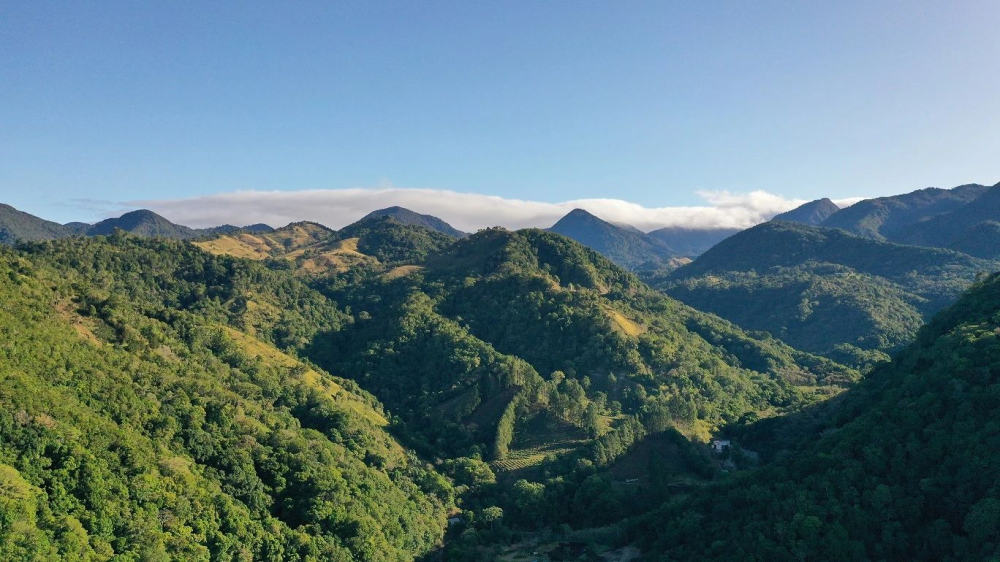
Canas Verdes estate is usually transliterated in China as 坎纳斯维迪斯, while in Spanish it can be understood as "green reeds" or "green fields." Half of Canas Verdes was purchased together with Jaramillo in 1967. After Geisha rose to fame in 2004, the Peterson family began successively acquiring small surrounding planting plots. The entire growing area is located on the eastern slope of the Baru volcano, with a wide altitude range, distributed from 1,500 meters to 2,050 meters.
Canas Verdes has annual rainfall of about 3,500 milliliters, an average daytime temperature of 16 to 23°C, and an average nighttime temperature of 10 to 15°C. The highly complex terrain, volcanic soil, and significant temperature difference between day and night together give Geisha its fragrant and overflowing character. At present, the Geisha-growing area of Canas Verdes contains a total of 11 small plots: Lino (flax), Coronado (crowned), Fundador (founder), León (León), Montaña (mountain), Trapiche (sugarcane), Jacinta (Jacinta), Cabaña (cabin), Tumaco (Tumaco), as well as Nido (nest) and Colga (Colga).
Front Street believes that if you want to taste the refined floral and fruity flavors of Red Label Geisha, the brewing stage must not be done carelessly. Considering that naturally processed coffee has rich and varied fruit flavors, accompanied by a slight vinous note and sweet fermented aroma, the parameters and technique should not only highlight the sweet-and-sour taste of floral and fruity flavors, but also enhance the coffee's overall body and richness. Front Street's approach is to increase the coffee-to-water ratio, raise the water temperature, add more pours, and pour in a small circular stream around the center.
Coffee dose: 15 grams
Coffee-to-water ratio: 1:16
Grind size: EK43s setting 10
Dripper: V60
Water temperature: 93°C
Pulse pouring: four pours (30g/70g/70g/70g)
For the first pour, add 30g hot water and let it bloom for 30 seconds. Be careful to ensure that all coffee grounds can contact the water and are in a consistent pre-extraction state;
After 30 seconds, use a small stream of 4ml/s, starting from the center and spiraling in a small circle, to pour the second stage of 70g. The purpose is to let the coffee continue degassing while raising the coffee bed to three-fifths of the dripper. Finish pouring in about 45 seconds, with the scale showing 100g;
When the liquid level drops and is about to expose the coffee bed, begin pouring the third stage of 70g, also maintaining a slow small stream of 4ml/s. At this point, the circling range can be slightly larger than in the second stage, with the aim of bringing out more sweet substances. Finish pouring in about 1 minute 10 seconds, with the scale showing 170g. Be careful not to pour too quickly, so as to avoid pushing the water level too high.
When the coffee bed is exposed again, pour the final stage of 70 grams, using the same technique as the second stage. Try to control the stream so it does not spiral too widely, otherwise it is easy to disturb the coffee bed and cause insufficient extraction. The final total water amount is 240g, poured in about 1 minute 35 seconds.

The pour-over Esmeralda Red Label Geisha has a fresh entrance with jasmine, citrus, and tropical fruit acidity. The flavor layers present different faces as the temperature changes, and the overall mouthfeel is smooth, with a pleasant tea aroma in the finish.
The above content is compiled by CoffeeHunters, a coffee news website.


