







Why Does the Sidamo Coffee Region Taste So Distinct?
Sidamo sits in southern Ethiopia, where coffee trees grow on highland plots between roughly 4,600 and 7,200 feet, close to Kenya. The area's acidity balances softness and intensity with delicate floral notes. Guji and Arsi, the two main sub-regions, each bring their own terroir expression, and Huakui coffee has become the most recognized name tied to Sidamo flavor.
Ethiopia ranks sixth among coffee growing nations. In 2017 it produced about 470,000 tons of green coffee bean output, yet exported only around 160,000 tons, so most coffee stayed home. Eight producing regions make up the national landscape, and Sidamo yields roughly 225,000 bags a year, processed mainly by the sun-dried method at G1 grade.
Sidamo is one of the most representative specialty coffee regions in southern Ethiopia, known for its acidity that balances softness and intensity alongside delicate floral notes. This article systematically reviews Sidamo's geographical environment and the terroir conditions of its two major sub-regions, Guji and Arsi, explains in detail the origins and naming logic of Huakui coffee, and introduces the complete sun-dried processing method and the G1 grade standard. It also shares Front Street Coffee's understanding of roasting freshness, along with the specific brewing parameters and flavor performance of Huakui coffee and sun-dried Arsi, providing coffee enthusiasts with a complete Sidamo flavor guide.
For more specialty coffee knowledge, please follow the WeChat official account: Front Street Coffee (FrontStreet Coffee)
As the birthplace of coffee, Ethiopia possesses countless variety resources, and the flavor differences between different regions are quite significant. The country ranks sixth among global coffee-producing nations, and data shows that in 2018, approximately one hundred million people worldwide depended directly or indirectly on the coffee industry for their livelihood, with Ethiopian coffee workers accounting for one-fifth of that total. In 2017, the country's green coffee bean production was approximately 470,000 tons, with exports of about 160,000 tons, meaning that more than half of the production never left the country and was consumed by domestic consumers.
Coffee has long been deeply embedded in Ethiopia's social fabric, a tradition that has continued for hundreds of years. The country's coffee landscape is mainly composed of eight producing regions: Lekempti, Limu, Illubabor, Djimmah, Harar, Teppi/Bebeka, Sidamo, and Yirgacheffe.
When mentioning the Yirgacheffe region, people naturally think of Yirgacheffe coffee; and when it comes to Sidamo, Huakui coffee is an unavoidable name.
Sidamo
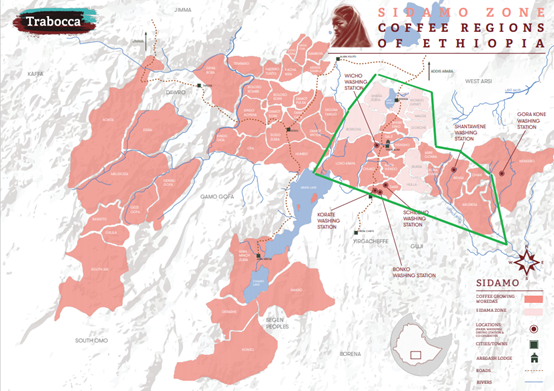
In Ethiopia's specialty coffee landscape, Sidamo occupies a pivotal position. The quality of coffee flavor is inextricably linked to the growing environment. Sidamo's coffee trees grow in the highland region at the southernmost tip of Ethiopia, at altitudes between 4,600 and 7,200 feet (located in Sidamo Province), adjacent to Kenya, situated southeast of Jimma and directly south of the capital, with an annual production of approximately 225,000 bags (60 kg per bag). The greatest advantage of this land lies in the fact that soil fertility is maintained through the cycling of organic matter—fallen leaves from surrounding trees and residual plant roots serve as natural fertilizers. It is precisely for this reason that coffees from different towns exhibit distinct differences and their own characteristics.
The Sidamo region has two of the most well-known coffee-growing areas: Guji and West Arsi.
Sidamo coffee's green beans have a faint grayish tone on the surface, and the bean sizes are not uniform—some are large and some are small. Its acidity can be soft or intense, its body can be heavy or light, and it combines sweetness with spice, making it one of the representatives of garden coffee from the southern Ethiopian highlands. Front Street believes that what sets Sidamo apart from general African coffees is: it possesses clear fruity acidity, a smooth mouthfeel, and delicate floral aromas.
Guji Producing Region
When discussing the Guji producing region, Huakui coffee is inevitably mentioned. The Guji region originally belonged to Sidamo, but in 2010 the Ethiopia Commodity Exchange (ECX) independently designated it as a new producing region. Guji is located southeast of Yirgacheffe, with complex and varied terrain featuring towering mountains, valleys, and plains interspersed throughout. The geology of this area consists of nutrient-rich black soil (Vertisol), with soil depth approaching two meters and an average altitude exceeding 1,800 meters. The significant diurnal temperature variation brought by the geographical conditions provides a complete terroir foundation for the local production of high-quality specialty coffee.
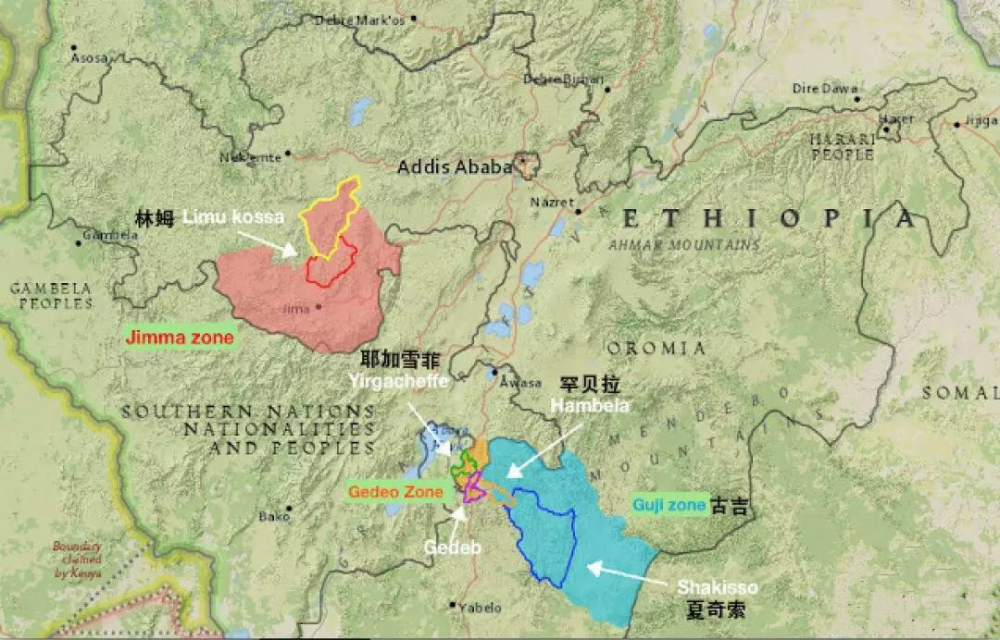
This bean, Huakui, is produced in Hambella, located within Guji, Ethiopia's largest coffee-producing region, and administratively under Oromia State. Hambella's western side faces Yirgacheffe's Kochere across a mountain, with a highland of 3,200 meters in altitude and approximately 30 kilometers in width lying between the two regions. Hambella's southeast, north, and east sides border Guji's Shakiso, Uraga, and Kercha sub-regions respectively, making it the highest-altitude coffee sub-region in Ethiopia. Front Street believes that it is precisely this growing environment that gives Huakui coffee such outstanding flavor performance.
Currently, the Hambella producing region has nearly 20 processing plants of various scales. In 2017, Ethiopia's DW Green Bean Company sent coffee beans to the TOH (the Taste Of Harvest) green bean competition hosted by the African Coffee Association, and a sun-dried lot from the "Buku Abel" processing plant won the TOH Ethiopia championship with its rich strawberry and cream aromas. That same year, this batch of green beans was introduced to the domestic market by Beijing green bean trader Hongshun, and Li Jianfei used this bean to win second place in the 2017 World Brewers Cup China region. Among the many Geisha competition beans, this Ethiopian bean stood out remarkably, thus earning the title "Huakui." (Geisha in Japanese means geisha, while Huakui refers to the top-ranking geisha, thereby highlighting the exceptional quality of this bean.)
Coffee is essentially an agricultural crop and is naturally affected by climate and environment, so its flavor changes from year to year. To distinguish between them, naming conventions such as Huakui 2.0, Huakui 3.0, Huakui 3.1, Huakui 4.0, Huakui 5.0, and Huakui 6.0 came into being.
Arsi Coffee Producing Region
Arsi is another important specialty coffee producing region in Sidamo. West Arsi is located between the famous Yirgacheffe coffee-growing area and Hararge, at altitudes ranging from 1,900 to 2,200 meters, in the western part of the Sidamo region. The name of this area originates from a branch of the Oromo people who have long resided here. West Arsi is composed of three woredas (Ethiopia's third-level administrative divisions): Arsi, Bale, and East Shewa. Approximately 88.52% of West Arsi's population is Oromo, which is of great significance in coffee history—they were the earliest tribe in human history to drink coffee, and half of Ethiopia's coffee production comes from this region.
Coffee cultivation in the Arsi region is mainly based on smallholder farming, with an average farm size of about 2 to 3 hectares per household, but even so, this is slightly larger than the 1.5 to 2 hectares commonly found in most parts of Ethiopia. Although local coffee-growing techniques are still in the development stage, compared to other regions, Arsi's cultivation technology is advancing very rapidly. Coffee farmers do not need to hire temporary or full-time workers, instead relying on family members to help with coffee selection. This allows them to better control coffee quality, and processing stations typically pay extra for fully ripe red cherries, greatly motivating coffee farmers.
Sidamo Coffee Bean Sun-Dried Processing Method
Most coffee beans from the Yirgacheffe region use washed processing, while the Sidamo region mainly uses sun-dried processing. Front Street believes that the sun-dried processing method gives Sidamo region coffee beans rich fruity aromas and a smooth mouthfeel.
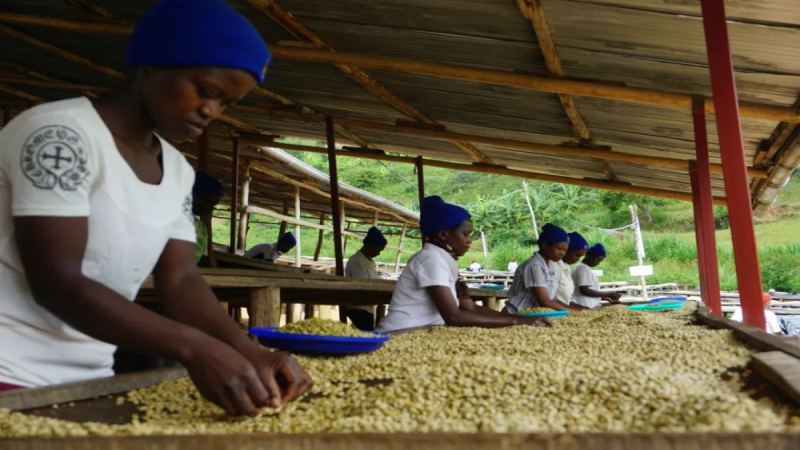
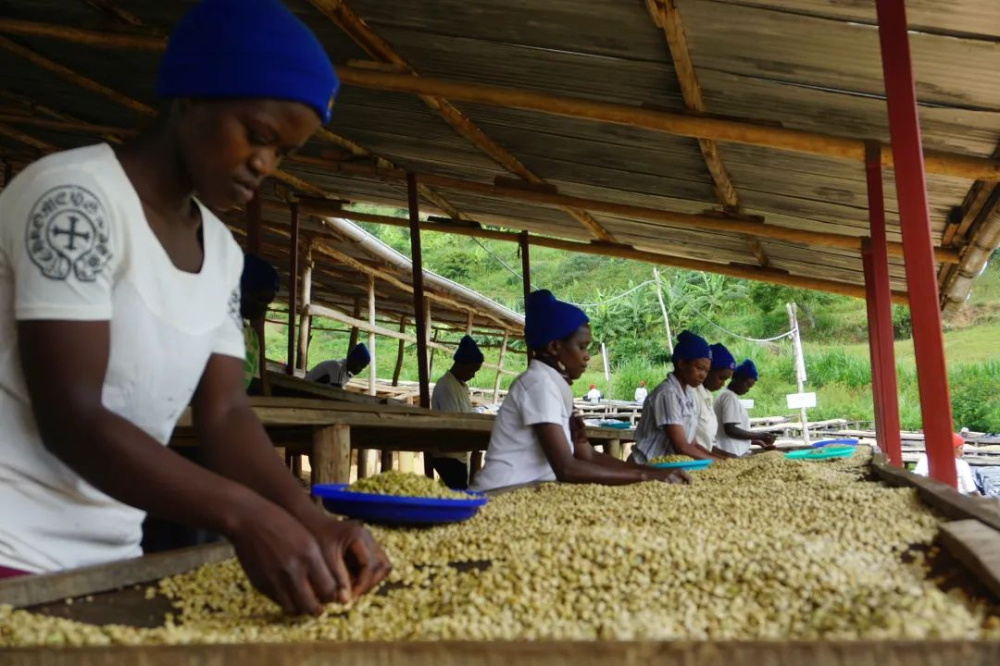
Every coffee harvest season, coffee farmers in the Sidamo region pick only ripe red cherries, placing them one by one into baskets. The harvested coffee cherries are uniform in size, consistent in ripeness, and free of other impurities. During processing, defective beans as well as unripe or overripe cherries are first removed through manual sorting. Then the coffee cherries are spread flat on raised wooden frames or entire drying racks for sun-drying, which prevents the beans from touching the ground and absorbing off-flavors.
During the drying period, constant turning is required to ensure the coffee beans lose moisture evenly; every three to five days, coffee farmers manually pick out defective and moldy beans. After the fruit skin dries and hardens, a hulling machine is used to remove the dried hard fruit skin. After obtaining the green coffee beans, in pursuit of perfect flavor, coffee farmers perform one final sorting. It is precisely for this reason that this sun-dried Sidamo can achieve the highest grade G1.
Front Street Brewing Recommendations:
Faced with such excellent coffee beans, how can one brew a delicious flavor? Front Street believes that the freshness of coffee beans is a crucial factor—only fresh coffee beans can maximize the rich flavors of coffee. Coffee beans shipped by Front Street Coffee (FrontStreet Coffee) are all within 5 days of the roasting date, because Front Street deeply understands the major impact freshness has on flavor. Front Street's roasting philosophy is "Freshly roasted good coffee," ensuring that every customer who places an order receives the freshest product when they get their coffee. The resting period for coffee is approximately 4 to 7 days, so by the time customers receive it, it is exactly at its optimal flavor state.
Of course, some customers need Front Street to grind the coffee for them, which is also no problem, but Front Street needs to remind: once coffee beans are pre-ground into powder, they no longer need to go through the resting process, because the pressure from carbon dioxide inside the packaging during transport can also round out the coffee's flavor, so after receiving the ground coffee, you can immediately brew a cup to taste. However, ground coffee needs to be brewed as soon as possible, because powder oxidizes quickly upon contact with air, and the coffee's flavor dissipates at an accelerated rate, greatly diminishing the taste. Therefore, Front Street recommends buying whole beans and grinding fresh for each brew, so as to better appreciate the coffee's flavor.
Front Street's Brewing Parameters for Huakui Coffee:
V60 dripper, water temperature 90°C, water-to-coffee ratio 1:15, coffee dose 15g, grind size (80% passing through China's No. 20 standard sieve)
Using staged extraction, first use twice the coffee dose in water for the bloom, i.e., 30 grams of water for a 30-second bloom. The purpose of the bloom is to allow the coffee grounds to release internal carbon dioxide gas, thereby making the subsequent extraction more stable. Pour water in a circular motion with a slow stream until reaching 125 grams for the first stage, continue pouring until 225 grams and stop, then remove the dripper after the water in the dripper has completely dripped through. Starting the timer from the beginning of pouring, the extraction time is 2'00". Finally, swirl the entire cup of coffee to mix evenly, pour into a cup, and it is ready to drink.
[Front Street 2025 New Harvest Season Sidamo Huakui Coffee Flavor]: Floral, berry, citrus, plum sweet-tartness, mango juice, honey, with a finish of black tea sweetness.
[Sun-Dried Arsi Coffee Flavor]: At high temperatures it presents a berry juice-like mouthfeel, and as it gradually cools it reveals a finish of plum, nectarine, mango, and honey.
For professional coffee knowledge exchange and more coffee bean information, please follow Coffee Workshop (WeChat official account: cafe_style)
For more specialty coffee beans, please add private WeChat Front Street Coffee (FrontStreet Coffee), WeChat ID: qjcoffeex
The above content is compiled by CoffeeHunters, a coffee news website.


