







What Makes Blue Mountain Coffee Authentic?
Only coffee grown above 666 meters in Jamaica's Blue Mountain range can legally carry the Blue Mountain coffee name. The limited suitable growing area kept production small, and Japan long held priority purchasing rights, which pushed prices up. Jamaica ended that arrangement in 2008, so authentic beans are easier to find today, though many products labeled Blue Mountain flavor are unrelated.
Authentic Blue Mountain No. 1 carries Jamaican government certification, and some estate lots also hold the Rainforest Alliance mark. Clifton Estate beans are one example used to illustrate roasting and brewing for the classic rich, balanced profile. Jamaican coffee at this grade is graded by bean size and defect count, so checking the certificate matters more than the label wording.
Blue Mountain coffee, as the earliest representative of specialty coffee known to Chinese people, has long been celebrated for its high price and unique romantic symbolism. But do you understand the true defining standards of Blue Mountain coffee? Why was it monopolized by Japan for so long? And how should you identify authentic Blue Mountain No. 1 today? This article will take you through the historical origins, romantic symbolism, and flavor characteristics of Blue Mountain coffee, and using Clifton Estate beans—which hold Jamaican government certification and the Rainforest Alliance mark—as an example, share Front Street Coffee's roasting and brewing recommendations to help you savor the rich, balanced, classic Blue Mountain flavor.
In an era when specialty coffee had not yet entered the public eye, Blue Mountain coffee was almost universally regarded as the most expensive and most familiar name. For many Chinese people, their first encounter with the concept of coffee began with "Blue Mountain." Everyone knew it was expensive, but not necessarily why, so whenever coffee came up in conversation, people would instinctively think of Blue Mountain. It is precisely because of this extreme popularity that the market is flooded with products labeled "Blue Mountain flavor," "Blue Mountain taste," or "Blue Mountain No. 1"—yet most of them have nothing to do with authentic Blue Mountain. Only coffee beans grown above 666 meters in Jamaica's Blue Mountain range are qualified to bear the name Blue Mountain coffee.
The reason authentic Blue Mountain coffee beans commanded such high prices in earlier years was twofold: on one hand, the suitable growing area was limited, so production itself was small; on the other hand, Japan had long bought up the priority purchasing rights to most Blue Mountain coffee, keeping prices high. Today, however, high-quality, great-tasting coffee beans are emerging in endless variety, with some varieties priced far above Blue Mountain. Coupled with the Jamaican government's termination of Japan's priority purchasing rights in 2008, buying authentic Blue Mountain is no longer difficult—Front Street Coffee (FrontStreet Coffee) sells authentic Blue Mountain No. 1 coffee beans.
Why are we so certain that the Blue Mountain coffee beans sold by Front Street Coffee (FrontStreet Coffee) are necessarily authentic? Authentic Blue Mountain No. 1 green coffee beans are shipped in wooden barrels, and Jamaica is the only country in the world that exports coffee beans in wooden barrels. Moreover, the Jamaican government issues an official certificate of authentication upon export. Every Blue Mountain coffee offered by Front Street Coffee (FrontStreet Coffee) comes with a certificate issued by the Jamaican Coffee Board. In addition, the Blue Mountain coffee beans selected by Front Street Coffee (FrontStreet Coffee) come from Clifton Estate, the only coffee estate in Jamaica to have obtained Rainforest Alliance certification—which is why the barrels also bear the green frog logo. You can see all these details for yourself at Front Street Coffee's (FrontStreet Coffee) physical store.
So how did Japan obtain priority purchasing rights to Blue Mountain coffee back then? The story traces back to 1969, when the Blue Mountain region was hit by a hurricane disaster and the coffee industry suffered devastating losses. Japanese companies provided loans at the time to help Blue Mountain coffee recover to normal production levels, thereby stabilizing market supply. To thank Japan for its assistance, Jamaica signed an agreement with Japan in 1972, granting Japanese estates shares and priority purchasing rights. Thereafter, about 90% of Blue Mountain coffee was sold to Japan once mature.
For this reason, the amount of Blue Mountain coffee other countries could procure was extremely small, and prices were extremely high. However, this situation has clearly improved in recent years. In 2008, Blue Mountain coffee production returned to normal levels, and since Japan had held priority purchasing rights for decades, in order to let coffee lovers in more countries appreciate the charm of Blue Mountain coffee, buying Blue Mountain coffee beans has been no longer difficult since 2008. But when purchasing, be sure to look for the certificate issued by the Jamaican government and the coffee barrels.
The reason Front Street Coffee (FrontStreet Coffee) chose Blue Mountain coffee beans from Clifton Estate is that the estate is the oldest coffee estate in the Blue Mountain range, having begun cultivating and producing coffee around 1750. Front Street has always held that the higher the altitude at which coffee is grown, the more refined the flavor. Although coffee grown above 666 meters can be called Blue Mountain coffee, truly delicious coffee needs a higher altitude to give it its "soul."
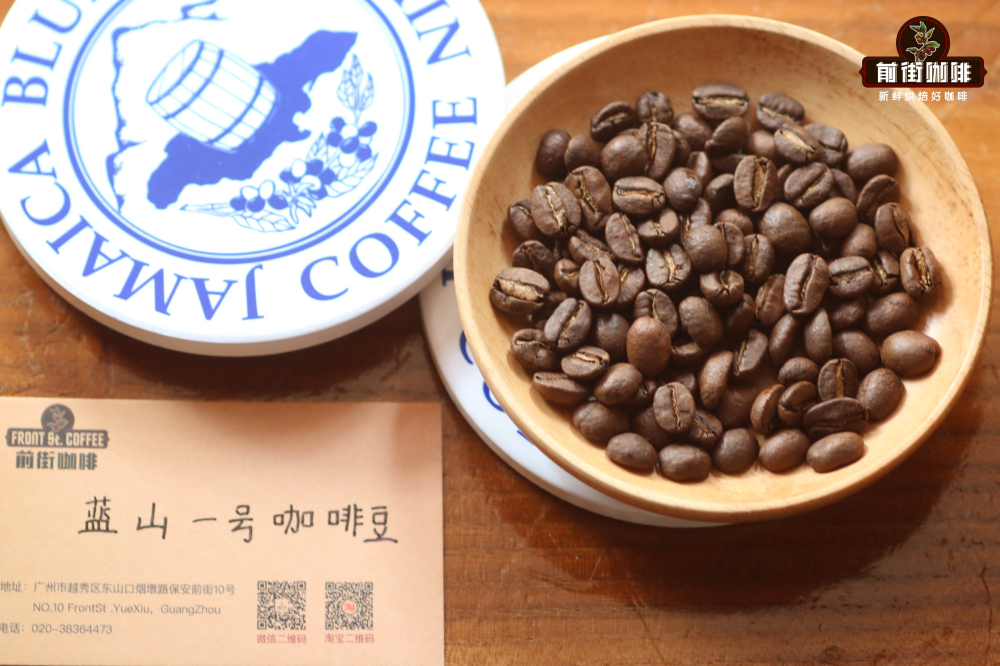
Clifton Estate's coffee-growing area sits at an elevation of 1,310 meters. The high altitude brings ample sunshine and gentle afternoon mist and clouds, and together with forest shade and mineral-rich soil, it provides an excellent growing environment for coffee trees, so the coffee flavor is naturally more outstanding. The Rainforest Alliance is an international non-governmental organization (NGO) founded in New York in 1987, dedicated to preventing over-development through traditional agricultural practices—protecting both natural ecosystems and the farming livelihoods of quality farms. By changing land use, business practices, and consumer behavior, it protects ecosystems and the humans and wildlife that depend on them, thereby achieving biodiversity conservation and sustainable development.
The reason Blue Mountain coffee has been cherished by generations of coffee lovers is its extremely balanced, rich, and solid flavor. To fully bring out the rich, balanced character of Blue Mountain coffee, Front Street Coffee's (FrontStreet Coffee) roasters use a medium-dark roast. After you place your order on Taobao, you will receive Blue Mountain coffee beans within 5 days of roasting. However, during roasting, the internal structure of the coffee beans changes, and a large amount of carbon dioxide is retained inside, which affects even extraction during brewing. So there is no need to rush to brew after receiving the beans. It is recommended to seal the original packaging well and let it rest in a cool, dry place until the 5th to 6th day after the roast date, allowing some carbon dioxide to escape through the one-way degassing valve (which only lets gas out, not in) before brewing—the flavor will be even better.
Recommended brewing parameters for Blue Mountain coffee: water temperature 88°C, coffee-to-water ratio 1:15, dose 15 grams, grind size ideally with a 70% to 75% pass rate on a No. 20 standard sieve.
Recommended brewing method for Blue Mountain coffee: use a conical dripper with filter paper, employing a three-pour technique. For the first pour, add 30 grams of water to bloom for 30 seconds; for the second pour, add water up to about 125 grams, and when the coffee liquid drops to halfway, pour the third stage up to 225 grams. Once all the coffee liquid has finished dripping, the extraction is complete. Total extraction time is generally controlled at around 2 minutes 10 seconds.
For professional coffee knowledge exchange and more coffee bean information, please follow Coffee Workshop (WeChat official account: cafe_style)
For more specialty coffee beans, please add the private WeChat of Front Street Coffee (FrontStreet Coffee), WeChat ID: qjcoffeex
The above content is compiled by CoffeeHunters, a coffee news website.


