








What bean-to-milk ratio should latte brewing use?
A latte balances espresso and milk at a reference ratio of about 1:5 to 1:8. The character comes mainly from the coffee beans, the milk, and how well extraction and integration are handled. Most espresso blends pull as heavy nutty and chocolate notes under milk; a few bring out milk sweetness and a rounder, less bitter cup.
Bean selection sets the base. A blend of Brazil, Indonesia and Vietnam at a darker roast builds crema and holds up in milk, while a honey-processed Costa Rica Tarrazu with Ethiopia and Colombia gives floral and strawberry-gum aromatics. Milk is steamed to temperature and thickness before pouring, and three pouring points govern how the latte art integrates.
Latte seems simple, but every shop's version tastes different. The key lies in the quality of the coffee beans and milk, the ratio between them, and the details of extraction and integration. This article starts with coffee bean selection, introduces the flavor profiles of several Front Street espresso blends, analyzes the principles of choosing milk, and provides a reference ratio of 1:5 to 1:8. It also explains espresso extraction parameters, milk steaming temperature and thickness, and three key points of pouring technique, helping coffee lovers make a balanced, beautifully latte-arted cup at home.

For more specialty coffee knowledge, please follow: Front Street Coffee
Front Street has always believed that the core factors determining whether a latte tastes good are simply the quality of the coffee beans and milk themselves, the ratio between the two, and whether the extraction and integration steps are done properly.
Making a latte isn't difficult—it's on the menu of almost every coffee bean brand—but the taste varies enormously. The most fundamental reason is that each shop uses different milk and coffee beans.
The flavor of the coffee beans directly shapes the overall character of the latte. Most espresso blends, when made into iced lattes, present heavy nutty and chocolate notes with a prominent coffee taste. A few beans can also bring out the sweetness and richness of the milk. The Sunflower Warm Sun blend used in Front Street stores is designed to highlight the rich notes of caramel chocolate and vanilla cream.
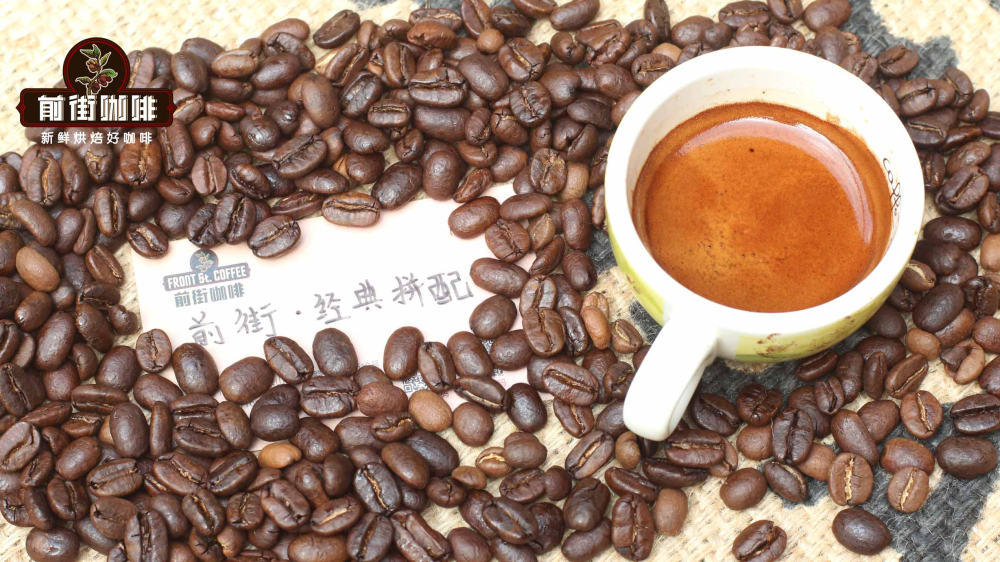
If you prefer a rich, aromatic profile, Front Street Classic Espresso Blend is the top choice. This bean combines beans from Brazil, Indonesia, and Vietnam, using a dark roast to maximize the coffee's aroma and easily produce a thick, dense crema. It works well for both Americanos and lattes, and can be purchased on the Front Street Taobao store or Front Street Tmall flagship store. Clearly, the choice of espresso beans has a huge impact on latte flavor.
If you enjoy sweet-and-tart fruity notes, we recommend Front Street Strawberry Candy Espresso Blend. It features the honey-processed Front Street Costa Rica Tarrazu, paired with Ethiopia—the birthplace of coffee—and added Colombian beans. The resulting espresso is not harsh, and after extraction through the coffee machine it has good crema, a dense texture, and aromas of roses, strawberry gummies, and raisins with a sweet-and-tart sensation.
Milk selection is equally crucial. For whole fresh milk alone, there are over a dozen common varieties on the market—some with a heavy milky taste, some rich and mellow, and some as light as water. The standard for choosing milk is not "the richer the better" or "the stronger the milky taste the better," but rather whether it can harmonize with the coffee. Too heavy a milky taste will overpower the coffee's own flavor, while milk that is too watery will make the latte bland.

Front Street believes there is no fixed ratio for a latte—it all depends on the flavor expression of the espresso and how well it matches the milk. However, the approximate range is between 1:5 and 1:8.
The espresso beans currently used by Front Street are the Front Street Classic Blend, composed of Brazilian Red Bourbon and Indonesian Mandheling, plus a small amount of Robusta. It has moderate bitterness, with flavors leaning toward dark chocolate, roasted chestnut, cream, and caramel. This bean is less intensely bitter than traditional espresso beans, and when paired well with milk, you can taste a dense milk-chocolate flavor. When Front Street makes a latte with this bean, the coffee-to-milk ratio is 1:6—40g of espresso liquid plus 240ml of steamed milk.
Third point: the specific steps
Extracting a proper espresso and steaming fine, dense milk foam are the foundation of a good latte. For espresso extraction parameters, Front Street recommends 20g of coffee grounds extracting 40g of coffee liquid, with the time controlled at 25-30 seconds. For milk steaming thickness, steam milk from a 5-tenths full pitcher to 6-tenths full, and keep the temperature between 55-60 degrees.
Next comes integration. Only when the milk and espresso are fully mixed will the coffee taste consistent; if the integration is uneven, the first sip might taste strongly of milk while the next tastes strongly of coffee.
A good integration first shows as the crema on the surface mixing evenly with the milk foam, with a uniform color across the liquid surface—what is commonly called the "golden ring." Second, the coffee surface should be fine and smooth, with no large bubbles.
Pouring techniques
① First, the "hardware" must be up to standard! Both the espresso and the milk foam need to be good quality—the espresso should have thick, viscous crema, and the milk foam should be fine and highly fluid. Many integration problems come from milk foam that is too thick, with poor fluidity, causing the foam to float on the surface. Before integrating, swirl the coffee cup and the milk pitcher to increase the liquid's fluidity, which also improves the success rate.
② The height of the pitcher spout during integration. When pouring latte art, you need to lower the spout close to the coffee surface so that white milk foam appears. The same principle applies during integration: if too low, a large amount of milk foam will float on the surface, causing uneven integration; if too high, the surface bubble problem mentioned earlier will occur.
Generally, the pitcher spout is about 5 to 10 centimeters from the coffee surface. Everyone has different habits—there is no completely fixed standard for height and distance.

③ Pouring technique. The common method is to stir in one direction: hold the coffee cup with your left hand and the milk pitcher with your right hand, offset the two hands by half a circle to make opposing circular motions—the alternating high-and-low stirring force easily mixes the coffee and milk thoroughly. How large a circle? Front Street recommends making the largest circle possible without hitting the walls of the cup. The hand holding the coffee cup should gradually straighten.
The above content is compiled by CoffeeHunters, a coffee news website.


