







What Makes Guji Huakui Different From Geisha Coffee?
Huakui is a sun-dried Ethiopian heirloom coffee from the Buku Abel processing station in Guji, known for intense strawberry and cream aromas. A lot from that station won the 2017 TOH Ethiopia green bean competition, which is how the name Huakui, meaning champion, came about.
That same year a competitor placed second at the World Brewers Cup using Huakui, at a time when geisha coffee dominated the competition stage, which brought the bean wider attention. Guji was once part of Sidamo, and its bright fruit acidity leans toward strawberry jam and passion fruit rather than the citrus and jasmine often found in Yirgacheffe.
Huakui coffee beans are a highly sought-after Ethiopian specialty bean in recent years, famous for their intense strawberry and cream aroma. They come from the sun-dried lot of the Buku Abel processing station in the Guji region and once won the TOH green bean competition championship. This article will sort out the origin of the name Huakui, the regional terroir, the sun-dried processing flow, the cup profile differences across vintages, and share Front Street Coffee's roasting parameters and hot pour-over and iced pour-over extraction plans to help you brew a cup of Huakui coffee full of juicy texture.
Front Street Sidamo Huakui is a quite popular specialty coffee bean, produced in the Guji region of Ethiopia. Guji was originally part of Sidamo, but because of its outstanding flavor it was later separated into an independent region, though many people still habitually classify Huakui under Sidamo. Front Street has tested beans from multiple Ethiopian regions, including Yirgacheffe, which together with Sidamo is known as one of Ethiopia's two major specialty coffee regions.
When comparing Front Street Yirgacheffe and Front Street Sidamo, the flavor differences between the two are clearly distinguishable. Both are Ethiopian beans, and their fruit acidity is relatively bright, but Front Street Yirgacheffe's acidity leans more toward citrus and lemon notes with jasmine floral aroma, while Front Street Sidamo's acidity leans toward strawberry jam and passion fruit, with a hint of creamy texture.
Origin of the name "Huakui" In 2017, the Ethiopian green bean company DW sent a batch of coffee beans to the TOH (the Taste Of Harvest) green bean competition hosted by the African Coffee Association. One sun-dried lot from the "Buku Abel" processing station won the TOH Ethiopia championship with its intense strawberry and cream aroma. This lot was subsequently introduced into China by a Beijing green bean trader and was named "Huakui" because of its championship status.
In the same year, Beijing's Li Jianfei won second place in the China region of the 2017 World Brewers Cup with this Huakui coffee, further boosting Huakui's popularity. At that time, the Geisha variety dominated the mainstream, and most competitors almost all chose Geisha, yet this Ethiopian heirloom variety Huakui defeated many Geisha coffees to take second place (although second place was not achieved by Huakui's quality alone, Huakui's high quality was undoubtedly an important factor), so many people believed this Huakui was comparable to Geisha.
Afterward, DW added processing stations in Dimtu, the core production area of Hambella, including "Buku Abel," "Buku Saysay," "Haro Soresa," and "Tirtiro Goye," with an annual output of about 1,100 tons.
From the perspective of the growing region and processing stations, among these processing stations only the sun-dried coffee beans from the "Buku Abel" processing station in the Guji region can be called "Huakui."
The Guji region once belonged to Sidamo, but in 2010 it was made an independent new region by the Ethiopia Commodity Exchange (ECX). It is located southeast of Yirgacheffe, with complex terrain covering towering mountains, valleys, and plains. The soil is fertile black soil (Vertisol), nearly two meters deep, with an average altitude of more than 1,800 meters. The significant diurnal temperature difference brought by its geographical characteristics gives the area the terroir conditions to produce high-quality specialty coffee.
As Huakui continued to sell well in the Chinese market, DW expanded several times in the Hambella region. Huakui in subsequent years also used the "Huakui X.0" label, such as Huakui 2.0 in 2018, Huakui 3.0 in 2019... and Huakui 6.0 in 2022. Coffee is an agricultural product, and Huakui from different years will have subtle flavor differences.
Today Huakui has developed to 8.0. Front Street compared several batches of Front Street Huakui coffee beans, and from roasting to cupping found that: the flavor of Front Street Huakui 4.0 is very close to the original Huakui, but its body and aftertaste are not as good as the 2017 original; 2021 Front Street Huakui 5.0 leans toward rich citrus and berries; 2024 Front Street Huakui 8.0 is even better in tropical fruit aroma.
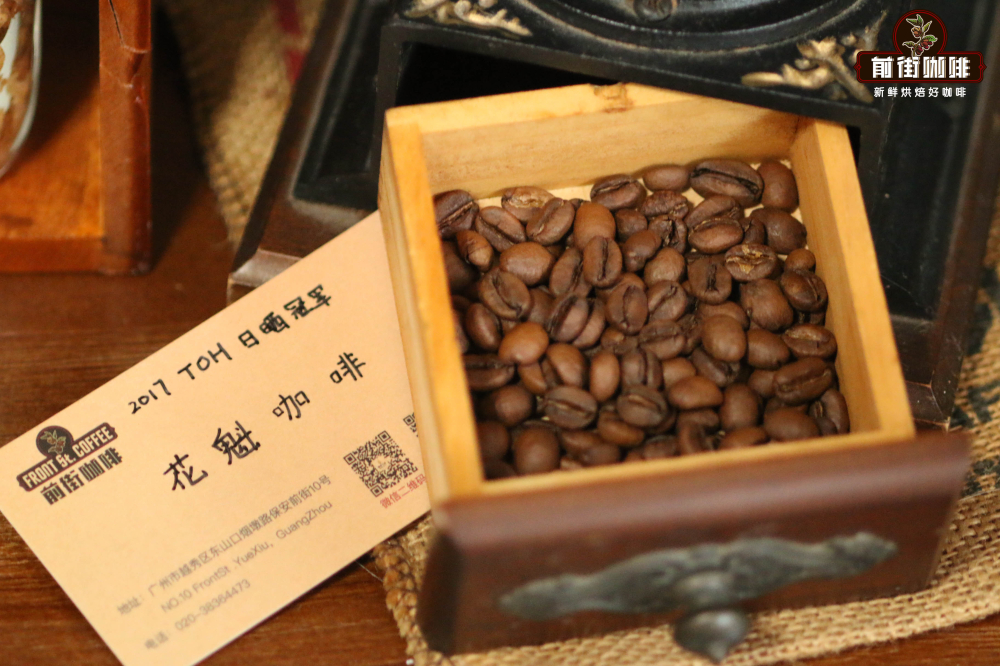
In the coffee beans of Front Street Huakui from the above two years, Front Street found that the flavor is very close to the original Huakui, but the body and aftertaste are not as good as the 2017 original. Surprisingly, sometimes green beans completely identical to the original Huakui can still be identified from these two batches of green beans. As for Huakui 3.1, Front Street found in cupping that it deviates relatively far from the original Huakui flavor and is instead closer to Geisha (not Panama Geisha, but a Geisha style similar to that of Gesha Village; the two are actually completely different), and Front Street Coffee (FrontStreet Coffee) also confirmed this change from the green bean merchant. Front Street Huakui 6.0, originally scheduled to arrive at port in April 2022, was delayed due to the pandemic. Therefore, Front Street Huakui 5.0 from 2021 is introduced first, and an evaluation will be made after the new Huakui 6.0 arrives at port.
Front Street Coffee (FrontStreet Coffee) Huakui 5.0 coffee beans Country: Ethiopia Region: Sidamo Guji region Altitude: 2250-2350m Variety: local heirloom Processing method: sun-dried
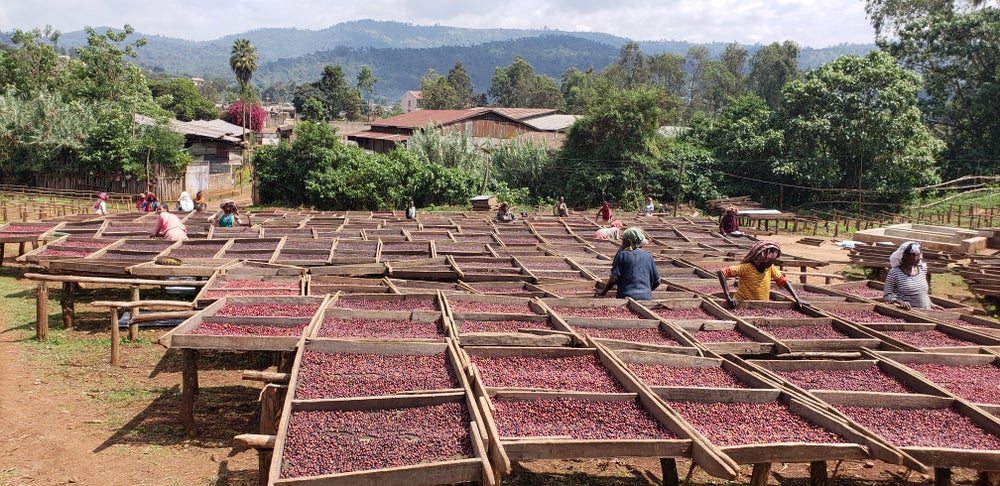
Huakui coffee beans — sun-dried processing
During the annual harvest and processing season (December to January), the coffee cherries picked by farmers must reach a sugar content of 30 or above before sun drying can begin. In the first two days of sun drying, the humidity of the red cherries must be maintained so that the fruit sugars ferment fully. The high altitude allows the processing station's nighttime temperature to drop to around 12°C, and it will not over-ferment due to excessively high temperatures. When the temperature is higher at noon, shading is provided in time to avoid sunburn on the red cherries; at night, thick plastic sheeting is used to wrap them to prevent sudden rain.
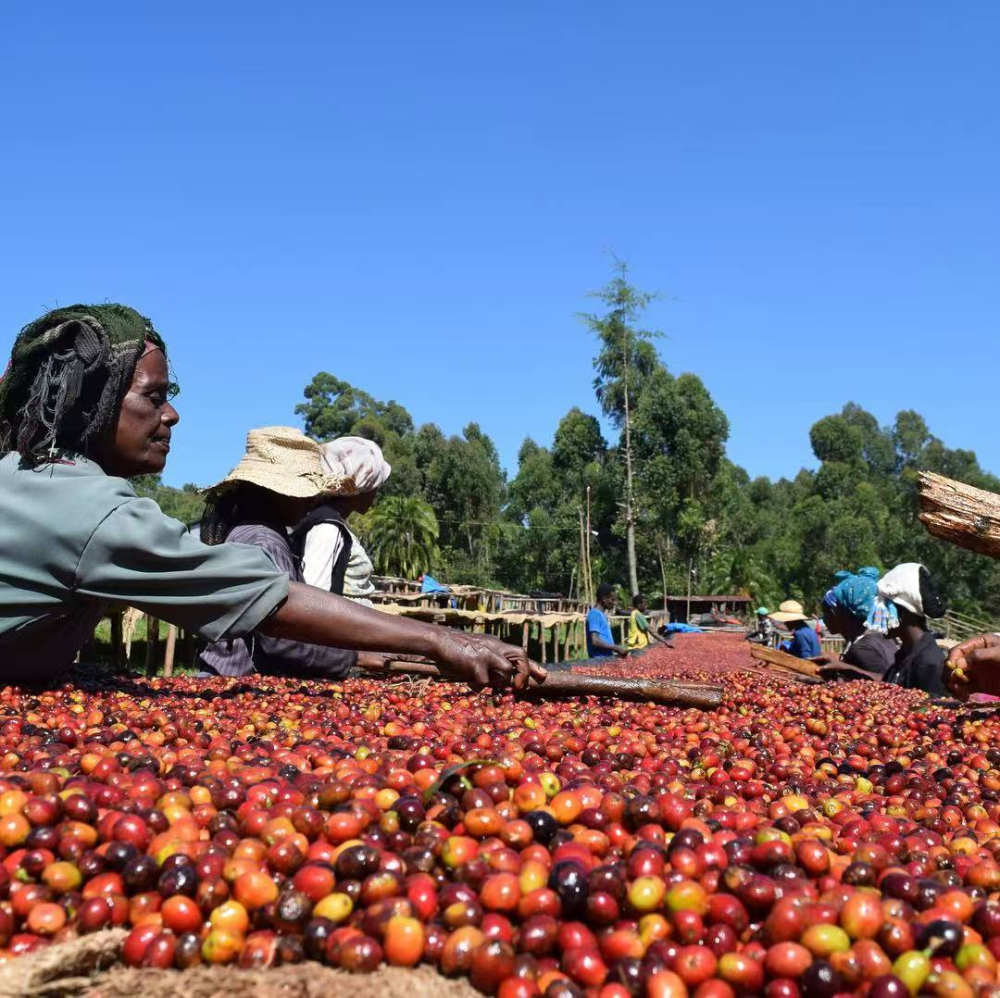
In this way, the red cherries ferment and dehydrate at a relatively low temperature. After 18 days of sun drying, when the moisture content of the green beans drops to about 13%, the process is stopped, and they are put into jute bags and stored under natural conditions of 12-22°C and 45-55% humidity for about 50 days of green bean resting and further dehydration. When the moisture content reaches about 11%, they are transported to the processing station for hulling, screening, and sale.
Front Street Coffee (FrontStreet Coffee) roasting parameters
To highlight the floral-fruity profile and aroma of Front Street Huakui, Front Street uses a medium-light roast, preserving aroma by extending the dehydration phase. Beans are charged at 175°C, the turning point is 96.2°C, the heat is 120, and the damper is set at 3 to allow the drum to heat up steadily. At 6 minutes it reaches the yellowing point and enters the middle phase, and the heat is raised to 140. At 9 minutes 50 seconds it enters first crack, and the beans are dropped 1 minute 40 seconds after first crack, with a drop temperature of 196°C.
Front Street Coffee (FrontStreet Coffee)'s summary of Huakui cupping flavors from previous years:
[Front Street Huakui G1] Smooth, passion fruit, fermented wine aroma, jackfruit, strawberry. [Front Street Huakui 2.0] Overall clean, more pronounced berry aroma, with nutty notes, richer mouthfeel. [Front Street Huakui 3.0] Light strawberry jam, black tea tea-like quality, short sweet aftertaste. [Front Street Huakui 3.1] Floral, creamy, tropical fruit, caramel, long-lasting sweet finish. [Front Street Huakui 4.0] Citrus acidity, full berry juice texture, lemon black tea tea-like quality, long-lasting sweetness.
[Front Street Huakui 5.0] Citrus acidity, berry aroma, creamy mouthfeel.
Front Street Coffee (FrontStreet Coffee) barista's brewing suggestions Front Street recommends brewing with freshly roasted coffee beans to experience the rich flavors to the greatest extent. The beans shipped by Front Street Coffee (FrontStreet Coffee) are all within 5 days of roasting, because Front Street deeply understands that freshness has a great impact on flavor. Front Street's roasting philosophy is "freshly roasted good coffee," so that every customer who places an order receives the freshest coffee. The coffee resting period is about 4-7 days, so when customers receive it, it is at its peak flavor.
Front Street Huakui 8.0 is known for its rich berry aroma and high sweetness. Front Street chooses a medium-light roast (with slight adjustments for different batches), hoping to better present the "Huakui flavor." This roast level does not overly change the high hardness of high-altitude beans, so during brewing a certain extraction rate needs to be increased to show a fuller flavor hierarchy. Here, a relatively high water temperature and a finer grind are used to stimulate more aromatic substances.
Brewing device: HARIO V60
Dose: 15 grams of coffee
Ratio 1:15
Water temperature: 90°C
Grind size: medium-fine grind (80% passing rate on China standard No. 20 sieve)
In the first stage, pour 30 grams of water and bloom for 30 seconds, then pour 95 grams (the electronic scale shows about 125 grams), finishing in about 1 minute; when the water level drops to 2/3 of the coffee bed, pour the remaining 100 grams (the electronic scale shows about 225 grams), finishing in about 1 minute 35 seconds. Dripping is completed at 2 minutes 10 seconds; remove the dripper and finish extraction.
In addition to the regular hot pour-over, Front Street also noticed that many friends like refreshing iced pour-over. Below, Front Street still uses Front Street Ethiopia Huakui 8.0 as an example to demonstrate how to brew a cup of full-bodied, juicy Huakui iced pour-over at home.
Coffee beans: Front Street Ethiopia · Huakui 8.0
Dose: 15 grams
Coffee-to-water ratio: 1:11 (160 grams hot water)
Ice: 75 grams
Grind size: fine granulated sugar (EK43s setting 9.5, C40 grinder about 22)
Dripper: Hario V60
Three-pour method: 30 grams, 90 grams (+ stirring), 45 grams.
Before pouring, put the ice cubes into the server and add all the coffee grounds. The first stage bloom remains unchanged, keeping a small stream and pouring 30 grams in circles from the center outward.
After 30 seconds, pour 90 grams of hot water in circles with a larger stream while raising the water level; when the timed scale shows 120 grams, stop pouring, use a small spoon to draw 5 circles along the dripper wall in the same direction, then wait for the coffee liquid to slowly flow down.
When the water in the dripper is about to reach the bottom, use the same small-stream circling technique as the first stage to pour the remaining 45 grams of hot water until all the coffee liquid has dripped through, then remove the dripper to end extraction. The time should fall at about 1 minute 55 seconds to 2 minutes 5 seconds.
The Front Street Huakui 8.0 iced coffee brewed this way has a full flavor, leaning overall toward yellow stone fruit notes. Because of the added stirring motion, the coffee has not only rich fruit acidity but also a clean, moist sweetness. Chilled by the ice, it is like drinking a refreshing glass of grape juice.
The above content is compiled by CoffeeHunters, a coffee news website.


