







Can you brew Golden Mandheling coffee before it finishes resting?
Golden Mandheling can be brewed before its resting period ends, but the cup will taste flatter and less settled, because the beans are still releasing gas. Waiting through the rest lets the fuller, cleaner body and longer finish that this Indonesian specialty coffee is known for come through, so resting and technique both matter for a good result at home.
Brewing a consistent cup depends on matching water temperature, grind size, coffee-to-water ratio and pouring technique to the bean, and on adjusting them between dark and light roasts and between pour-over and espresso. Compared with Lintong Mandheling, Golden Mandheling shows a fuller, cleaner taste and better balance, with acidity kept very low.
As a representative of Indonesian specialty coffee, Golden Mandheling is favored by coffee lovers for its full-bodied, clean taste and long-lasting finish. But to brew an ideal cup of Golden Mandheling at home, besides choosing the right beans, you also need to master key parameters such as water temperature, grind size, coffee-to-water ratio, and pouring technique. At the same time, many friends ask: can you brew coffee beans that haven't finished their resting period yet? In this article, Front Street will focus on PWN Golden Mandheling coffee beans, breaking down everything from the bean's background and processing method to the three-pour brewing technique, and explaining the relationship between the resting period and coffee flavor, to help you more confidently enjoy a good cup of coffee at home.
As the saying goes, good tea needs a good pot, and an excellent cup of coffee is likewise inseparable from suitable brewing equipment—though this is only one link in the chain. Front Street has always believed that to make good coffee, besides properly resting the beans, proficiency in brewing technique is equally key; only with both can you achieve a satisfying pot of coffee.
As specialty coffee continues to spread, more and more enthusiasts are no longer satisfied with just drinking a cup in a shop, but prefer to experience the fun of brewing at home themselves. Coffee beans are divided into dark roasts and light roasts, and coffee also differs between pour-over and espresso; with different equipment and different beans, the grind size and brewing plan must naturally be adjusted accordingly. If you want to consistently brew a good cup of coffee, Front Street believes this knowledge is well worth mastering in advance.
Golden Mandheling belongs to the ranks of Indonesian specialty coffee. Compared with Lintong Mandheling, its taste is fuller, cleaner, with a longer finish, and its overall balance is more outstanding. Some people describe Golden Mandheling as the taste of an old man, while Front Street feels that Mandheling's fullness carries a kind of masculine character. Top-grade first-class Mandheling has very low acidity, with a faint acidity resembling flowers and fruit, plus the signature heavy body of Indonesian coffee and the unique experience of sweetness returning amid bitterness, and is thus deeply pursued by coffee fans who favor full-bodied tastes.
Golden Mandheling Coffee
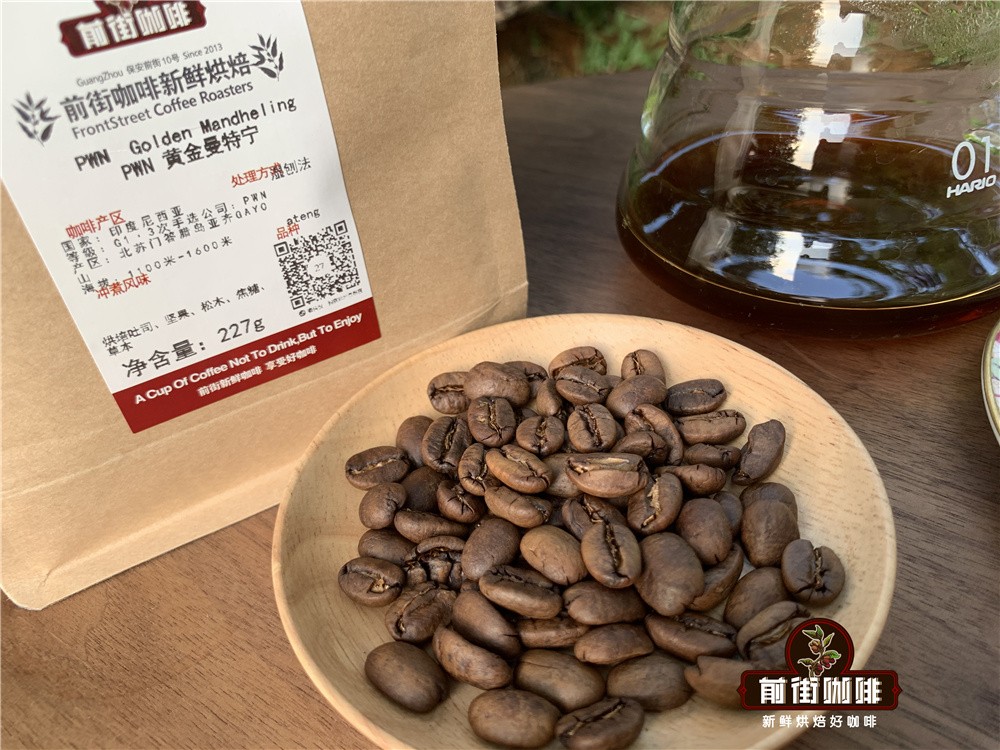
Among Indonesian coffees, Mandheling is one of the highest-selling beans in Front Street's daily drinker lineup, and is also the representative coffee of this producing country. Golden Mandheling goes a step further, belonging to the specialty grade within Mandheling. Sumatra is the main producing area of Indonesian specialty Arabica; what is usually called Mandheling refers to Arabica beans produced around Lake Toba in north-central Sumatra, at an altitude of about 900 to 1,200 meters, and in the Aceh region at the northernmost tip of Sumatra, at an altitude of about 900 to 1,600 meters. The suitable altitude, combined with a tropical rainforest climate, keeps the island's temperature at 25 to 28 degrees Celsius year-round, with evenly distributed seasons and no obvious dry season, providing quite ideal growing conditions for coffee trees.
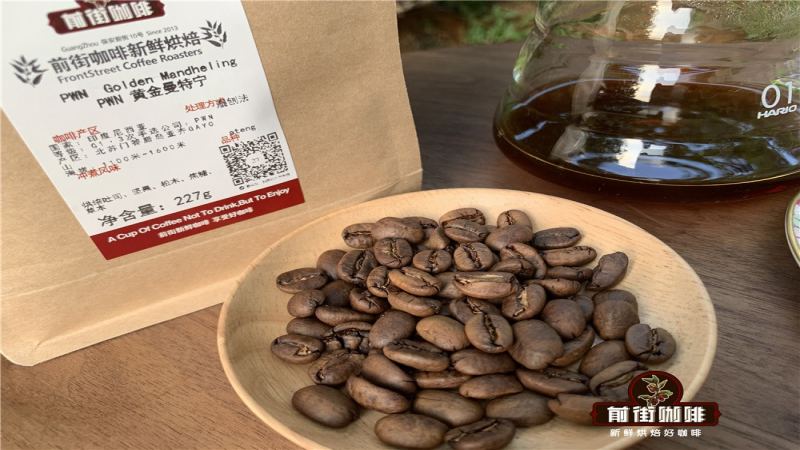
The Golden Mandheling coffee beans selected by FrontStreet Coffee come from PWN company; the beans of the new crop are produced in the GAYO mountains of Aceh, North Sumatra. After harvesting and drying, PWN Golden Mandheling undergoes one machine screening and three rounds of pure hand sorting, ensuring a specification of 18 mesh or above, with no more than 3 defective beans in a 300-gram green bean sample, belonging to the highest grade G1 level. PWN's beans are darker green in color, with a neat, flat bean shape.
Golden Mandheling Coffee Variety
The variety labeled on Front Street's Lintong Mandheling coffee is Tim Tim Ateng, while the variety labeled on Golden Mandheling is Ateng. Ateng is a hybrid variety between Arabica and Robusta, divided into several subtypes, and is widely cultivated in Sumatra and other small Indonesian islands. What Indonesia calls Tim Tim is what we commonly call Timor, a branch of Catimor, while Ateng is the local customary name.
Golden Mandheling Coffee Processing Method
Wet hulling is the processing method unique to Mandheling coffee beans. Sumatra is the largest island in Indonesia, located on the equator with a tropical rainforest climate, high temperature and humidity, and abundant rainfall; small coffee farmers often plant beans among primitive mountains and wilds. The island is rich in water resources and warm year-round, but the local weather is mostly cloudy and rainy, with frequent typhoons, making it hard to meet the good weather required for sun-drying; combined with limited local economic conditions, which cannot bear the higher cost of the washed method, the highly regionally distinctive wet hulling method was thus derived.
Next, Front Street will break down one by one the parameters for brewing Golden Mandheling coffee:
FrontStreet Coffee believes that to brew a good pot of coffee, you mainly start from four aspects: water temperature, grind size, coffee-to-water ratio, and brewing technique.
1. Water Temperature
When doing pour-over, FrontStreet Coffee chooses different water temperatures according to the roast level. During roasting, the substances inside the coffee beans are somewhat lost as the roast deepens, so dark-roasted beans usually use lower water temperatures to avoid extracting too many off-flavors. For medium-light roasted beans, FrontStreet Coffee recommends a water temperature of 90 to 91 degrees Celsius; for medium-dark roasts, 88 to 89 degrees Celsius is recommended.
For this Golden Mandheling coffee bean, the flavor is known for its full body, and to highlight its full-bodied character, FrontStreet Coffee uses a medium-dark roast to process it.
2. Grind Size
Grind size is likewise related to roast level. So-called grind size refers to the size of the coffee particles, which directly affects the contact time between coffee and water. The finer the coffee grounds, the more substances are extracted in the same amount of time, but over-extraction is also easy; conversely, the coarser the grounds, the fewer substances are extracted in the same amount of time, making under-extraction likely.
Moreover, everyone's grinder is different, so the parameters naturally differ too. Here Front Street suggests buying a No. 20 cupping calibration sieve, with an aperture of 0.85 millimeters. Take 10 grams of coffee beans, adjust to a roughly suitable grind size and grind into powder, pour into the sieve and sift, then weigh the sifted coffee grounds (be sure to sift until no more coffee grounds can pass through).
A pass-through rate of 70% to 75% (that is, 7 to 7.5 grams sifted from 10 grams of grounds) is the most suitable grind size. For pour-over, the pass-through rate for light roasts is 80%, and for medium-dark roasts 75%. If it exceeds the suitable sifting rate, adjust the grind coarser appropriately; if it falls short, adjust finer appropriately.
3. Coffee-to-Water Ratio
This is the pour-over coffee water-to-coffee ratio and extraction taste differences that FrontStreet Coffee has summarized based on the SCAA Golden Cup extraction theory:
【Bold Taste】1:10~1:11, i.e. 1:12.5~1:13.5 under the Golden Cup standard 【Moderate Taste】1:12~1:13 (i.e. 1:14.5~1:15.5 under the Golden Cup standard) 【Light and Fresh】1:14~1:16 (i.e. 1:16.5~1:18.5 under the Golden Cup standard)
A ratio of coffee bean grams to brewing water between 1:14.5 and 1:15.5 is most likely to fall into the golden range of 18% to 22% extraction yield and 1.15% to 1.35% concentration under the Golden Cup standard.
Therefore, FrontStreet Coffee suggests that when brewing this Golden Mandheling, you might as well use the foolproof 1:15 coffee-to-water ratio.
4. Brewing Technique
Finally, pour-over technique is also quite important; common ones include the three-pour method, one-cut flow, and drip method. FrontStreet Coffee suggests beginners use the three-pour method, because this technique is suitable for light-roasted, medium-light, and medium-dark roasted coffee beans. The segmented extraction of the three-pour method can clearly present the front, middle, and back flavors of the coffee, better ensuring a complete expression of flavor. Below, FrontStreet Coffee will demonstrate how to do pour-over three-pour brewing.
Three-Pour Brewing Technique : (Front Street's three-pour brewing method for Golden Mandheling coffee)
Front Street believes the fine flavor of Golden Mandheling coffee lies in its balance of acidity, sweetness, and bitterness, and its high body. In terms of roasting, Front Street chooses a medium-dark roast to highlight the coffee bean's nutty, pine, and herbal notes. Using a KONO dripper can achieve better body. Water temperature 88 degrees Celsius, coffee-to-water ratio 1:15, dose 15 grams, grind size at 75% pass-through rate on the China No. 20 standard sieve.
First Pour: Blooming (to help degassing)
First wet the KONO dripper to make the filter paper fit the dripper more tightly, pour out the water in the sharing pitcher, and at the same time add 15 grams of coffee grounds, then bloom with 30 grams of water for 30 seconds. Many coffee lovers don't understand why pour-over requires blooming? Actually, it's because during the roasting process that turns green beans into roasted beans, a series of chemical reactions and physical changes occur, and after reaching a certain degree, a large amount of gas (mostly carbon dioxide) accumulates inside the beans.
Generally speaking, the fresher the beans and the closer to the roast date, the more obvious the bubbling during blooming. Dark-roasted beans also release more gas during blooming than light-roasted beans. FrontStreet Coffee's coffee beans are all freshly roasted, so guests are usually advised to rest the beans for three days first, letting carbon dioxide release first, so that during brewing, problems of instability and under-extraction can be avoided.
After the gas is released during blooming, the coffee particles can absorb water evenly, helping the uniformity of subsequent extraction. A good bloom not only lets the coffee grounds degas quickly, fully, and evenly, but also lets them quickly contact water, helping extraction become more uniform. This is precisely the purpose and significance of pour-over blooming.
Second Pour
After blooming for 30 seconds, begin the second pour, pouring in a small stream in circles from the center until 125 grams, then stop. To make the water column's penetrating force concentrated, the circling range should be small, about the size of a one-yuan coin, then gradually circle outward. For the second pour, pay attention to the water amount, trying not to exceed the height of the coffee bed—that is, when the water column circles close to the filter paper, you can stop pouring.
Third Pour
When the coffee bed drops to the halfway point of the dripper, pour the second segment with the same technique until 225 grams, and after all dripping is complete, remove the dripper.
Starting from the third pour, observe the extent of the water level dropping, also circling from the center to pour water, with the water amount not exceeding the height of the coffee bed. At this point you will also see that the foam ratio has filled the surface; the third pour needs to increase the tumbling of coffee particles, so that all settled particles are turned over, thereby dissolving out soluble substances.
The tumbling particles will gradually come to rest as water is stopped, and at this point you must rely on the flow rate brought by the dropping water level to create friction between the coffee particles. So once water is stopped, the coffee grounds will sink, causing clogging, so pay special attention to the rhythm of pouring. If you stop pouring too many times, it amounts to letting the coffee grounds soak in water the whole time, and the final extraction will produce astringency and off-flavors.
Time from the start of pouring, the extraction time is 2 minutes 00 seconds. Then shake the whole cup of coffee evenly, and pour into a cup to taste.
【Front Street PWN Golden Mandheling Coffee Flavor】: The coffee has varied layers overall, full-bodied and clean, with rich nutty and caramel aromas, a chocolate note, a long-lasting finish, and high balance.
FrontStreet Coffee Brewing Suggestions
To brew a good cup of coffee, besides good equipment, you also need good beans, and you also need to rest the beans well. If the beans are not well rested, you can still brew, but the flavor will not be as good as well-rested beans and it will be hard to fully show their charm; only with well-rested beans can you taste the perfect flavor.
Front Street has always believed that the freshness of coffee beans is an important part of brewing. The coffee beans shipped by FrontStreet Coffee are all within 5 days of the roast time, because Front Street deeply knows the huge impact of freshness on flavor. Front Street's roasting motto is "Freshly roasted good coffee," so that every customer who places an order can get the freshest beans when receiving the coffee. The resting period of coffee is about 4 to 7 days, so when guests receive it, it is exactly at its best flavor.
Of course, some customers need Front Street to help grind the coffee, which is also no problem, but Front Street must remind: once coffee beans are ground into powder in advance, they no longer need resting, because during transport the pressure produced by carbon dioxide inside the packaging can also make the coffee flavor rounder, so once you receive the coffee grounds you can immediately brew a cup. But the coffee grounds need to be brewed promptly and completely, because after contact with air they oxidize faster, and the flavor dissipates more quickly too, so the taste will not be as good. Therefore Front Street suggests buying whole beans and grinding fresh for each brew, so you can better taste the coffee's flavor.
No matter which brewing method is used, as long as you are proficient enough, you can brew out the perfect flavor of the coffee beans. Enjoying a delicious cup of coffee at home is truly a delightful thing.
For professional coffee knowledge exchange and more coffee bean information, please follow Coffee Workshop (WeChat public account cafe_style)
For more specialty coffee beans, please add the private WeChat of FrontStreet Coffee, WeChat ID: qjcoffeex
The above content is compiled by CoffeeHunters, a coffee news website.


