







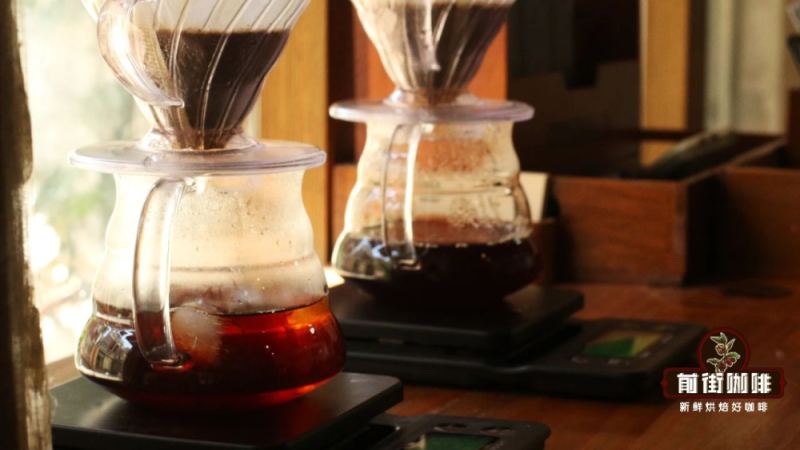
How do pour-over coffee variables shape the cup?
Pour-over coffee lets the brewer control five core parameters: coffee-to-water ratio, coffee dose, grind size, water temperature, and brew time. Adjusting any one of them shifts the flavor direction noticeably. Front Street Coffee's brewing notes use Yirgacheffe Kochere for light roasts and Golden Mandheling for dark roasts to show how each variable changes extraction and the final cup.
Roughly 30 percent of a coffee bean's substances can be dissolved, but extracting all of them does not produce good taste, so the goal is controlled extraction rather than maximum extraction. Light-roasted beans generally pair with higher water temperatures, faster-flow drippers, and finer grinding, while dark roasts call for lower temperatures. These coffee description words matter when comparing one-pour, three-stage, and stirring methods.
The reason pour-over coffee is so fascinating is that every variable can be actively adjusted, thereby changing the final flavor direction. This article starts from Front Street Coffee's brewing experience, systematically sorting out the five core parameters of coffee-to-water ratio, coffee dose, grind size, water temperature, and time, and combines three pouring techniques—one-pour, three-stage, and stirring method—using Yirgacheffe Kochere and Golden Mandheling as case studies to explain the differences in brewing strategies for light-roast and dark-roast coffee beans respectively. Whether you are a beginner just getting into pour-over or an enthusiast hoping to further understand the logic of extraction, this guide can help you build a clear brewing framework and consistently reproduce a good cup of coffee at home.
For more specialty coffee knowledge, please follow: Front Street Coffee (Frontsteet Coffee)
What truly attracts people to pour-over coffee is that almost every step can be controlled by yourself. At Front Street, customers often chat after finishing their coffee about trying to brew at home but finding it hard to get the hang of—having to keep the water flow steady while also minding the grind, with so many variables that it is easy to lose track of one while focusing on another. That said, Front Street actually thinks this is precisely what makes pour-over the most interesting: even if you only slightly adjust one condition, the flavor in the cup will change noticeably.
There are all kinds of ways to brew coffee, and the pour-over method can be traced back to the early 20th century, when it was invented by a German woman, Melitta. Coffee beans undergo varying degrees of transformation during roasting, and beans of different roast levels also have their own ways of being handled during brewing. Pour-over usually uses single-origin, single-variety coffee beans, and each bean has its own unique personality. Front Street designs brewing plans according to the characteristics of the bean itself—for example, light-roasted beans are often paired with higher water temperatures, faster-flow drippers, and finer grinding. Below, Front Street will explain the specific operations and precautions of pour-over coffee.
Coffee-to-Water Ratio About 30% of the substances in coffee beans can be dissolved out, but extracting all 30% does not equal good taste. According to the golden cup extraction standard proposed by the SCAA Specialty Coffee Association of America, the ideal extraction yield falls between 18% and 22%, meaning that from 10 grams of coffee grounds, 1.8 to 2.2 grams of substances are extracted; and the TDS concentration of drip coffee is roughly 1.2% to 1.45%, meaning that this extracted soluble portion accounts for only 1.2% to 1.45% of the entire cup of coffee. In other words, the pour-over coffee we drink is still mostly water. Front Street Coffee (FrontStreet Coffee) suggests everyone can use a calculator for a simple conversion: to control the concentration within this range, the ratio of coffee grounds to poured water should fall between 1:12 and 1:15.
Front Street Coffee (FrontStreet Coffee) sets its brewing parameters precisely according to this range. Whenever a new bean is launched, it goes through a series of adjustments including roasting, cupping, and pour-over, among which the pour-over stage mainly checks whether the TDS concentration meets the standard. Of course, if you are just drinking coffee at home every day, there is no need to specially buy professional instruments; judging strength by taste is enough. After repeated brewing tests and customer feedback, Front Street Coffee (FrontStreet Coffee) recommends controlling the coffee-to-water ratio at around 1:15.
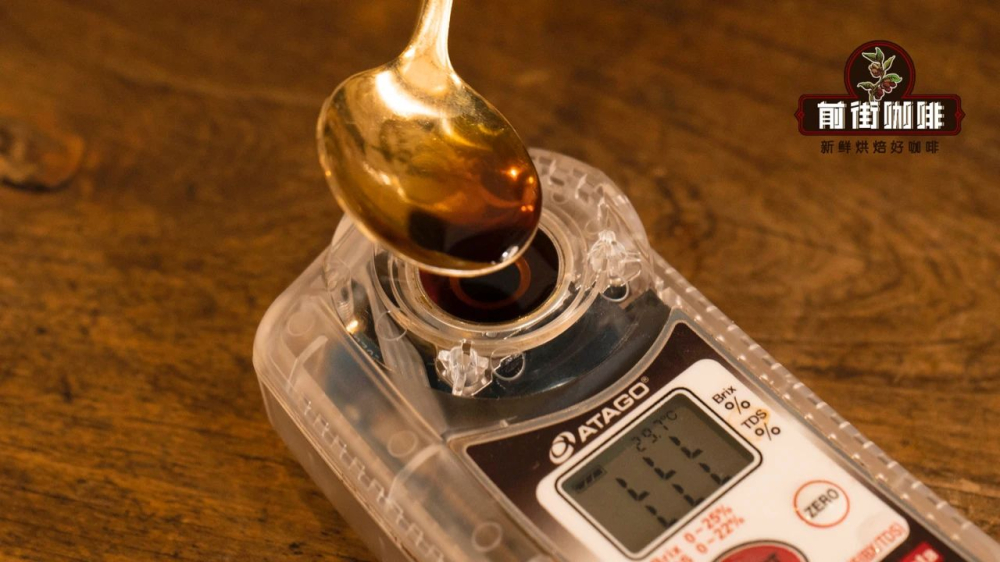
1.2% to 1.45% is only a statistically meaningful range that matches most people's taste preferences. If the actual value deviates from this range, it is completely fine as long as it tastes the way you want. However, as shown in the figure below, when Front Street Coffee (FrontStreet Coffee) brewed Butterfly Coffee with a 1:10 coffee-to-water ratio, the reading from the TDS tester far exceeded the standard range, almost more than double, and over-extraction could be clearly felt on the palate.
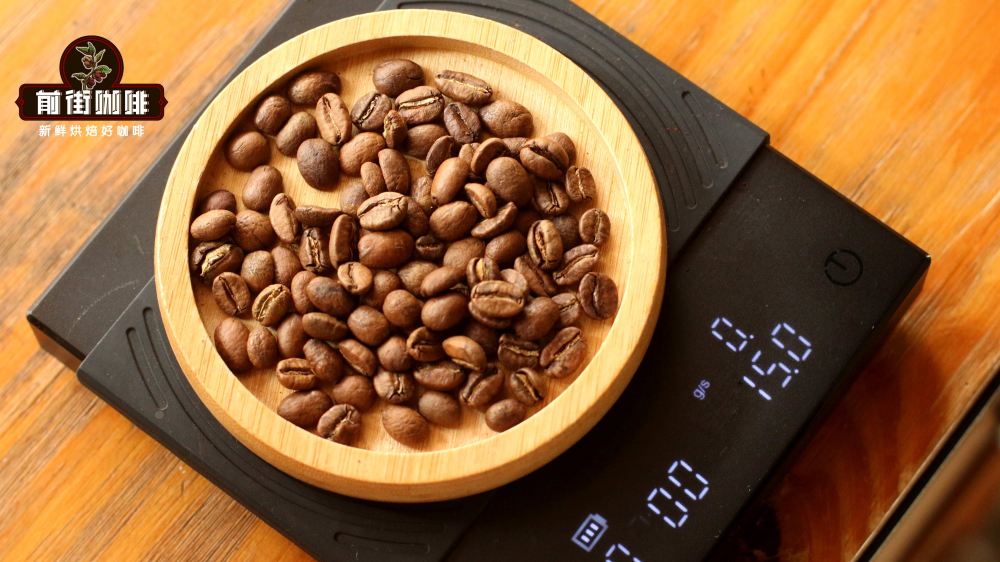
Coffee Dose Once the coffee-to-water ratio is determined, the next step is to decide how much coffee grounds to use—this is also a question Front Street Coffee (FrontStreet Coffee) is often asked. Front Street Coffee (FrontStreet Coffee)'s single-serving setting is 15 grams of grounds, and this value is determined by the size of the dripper used. If only 10 grams of grounds are used, the surface of the coffee bed will be lower, and during brewing the drop of the water column increases, so the force with which the water strikes the coffee bed also strengthens. Front Street Coffee (FrontStreet Coffee) also tested a dose of 20 grams and found that the time for water to pass through the coffee bed became longer, the extraction time was prolonged, and it was instead more prone to over-extraction.
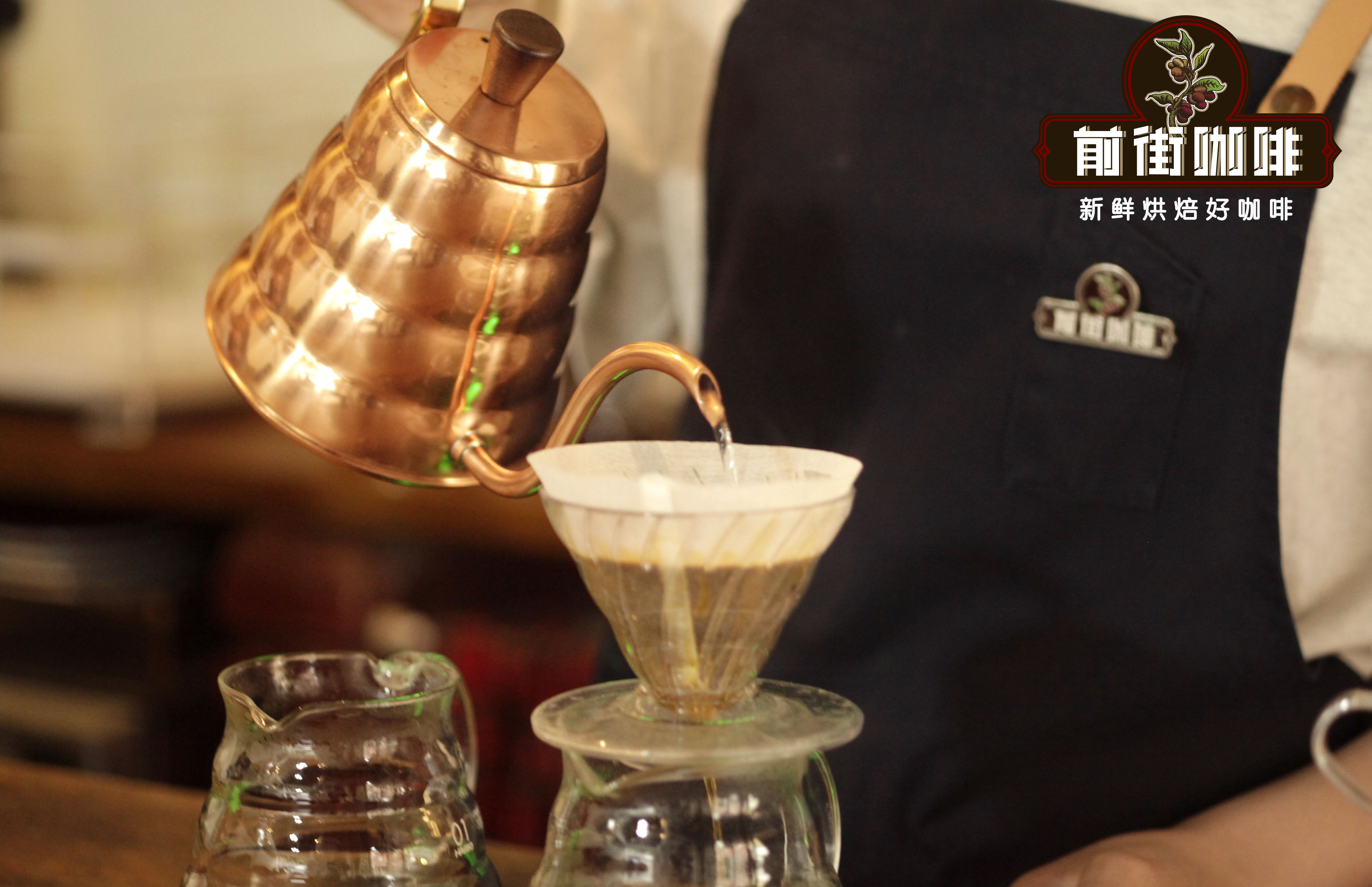
Grind Size The grind size for pour-over coffee should be moderate. Too coarse will make the water flow too fast, resulting in under-extraction and a thin aroma; too fine will obstruct the water flow, causing over-extraction and making the coffee bitter.
Front Street Coffee (FrontStreet Coffee) refers to the SCAA standard and sets the passing rate of a No. 20 sieve at between 70% and 80%. Front Street Coffee (FrontStreet Coffee) recommends a passing rate of 80% for light-roasted coffee beans and 70% for dark-roasted coffee beans. The reason is that the soluble substances in dark-roasted beans are released more easily, so when dealing with dark-roasted beans, Front Street Coffee (FrontStreet Coffee) chooses a slightly coarser grind; conversely, the lighter the roast level, the finer the grind should be.
Brewing Water Temperature Generally speaking, the higher the water temperature, the faster the extraction speed. Dark-roasted coffee beans have a loose structure and many pores, with a very high dissolution rate, so using a lower water temperature can slow the extraction pace and prevent bitter substances from being released in large amounts. In comparison, light-roasted beans are more resistant to extraction and can withstand higher water temperatures.
According to SCA brewing recommendations, light-roasted beans are suitable for 90 to 91°C, while medium-dark roasted beans are suitable for 85 to 87°C. A customer once questioned this temperature, so Front Street Coffee (FrontStreet Coffee) brewed Golden Mandheling (dark roast) with 90°C water, and the resulting cup was almost as intense as espresso.
Brewing Time During extraction, the aroma and flavors released in the early stage are the most concentrated and also higher in strength, while the further along it goes, the lighter the flavor and aroma become. At the same time, the amount of water poured also affects the overall extraction duration. If the poured amount is large, the water will quickly rush down, and the extraction time will naturally be compressed. Front Street Coffee (FrontStreet Coffee), under the conditions of 15 grams of grounds and a 1:15 coffee-to-water ratio, usually controls the brewing time between 2 minutes and 2 and a half minutes, which avoids over-extraction while also preventing under-extraction.
Having covered these basic elements, Front Street will now talk about pouring techniques. Although there are many schools of pour-over, the goal is the same: to enjoy the fun of experimentation while getting a uniquely good cup of coffee. Front Street takes [Front Street Coffee (FrontStreet Coffee) Yirgacheffe Kochere] as an example and demonstrates it using the one-pour, three-stage, and stirring methods respectively, to see what differences there will be in flavor.
One-Pour Method The one-pour method is named because after blooming ends, only one uninterrupted pour is made. Pouring continuously after blooming allows the coffee grounds to remain immersed in water, and the retained liquid fully brings out the aromatic substances in the coffee grounds. During pouring, the flow rate gradually speeds up, and before the water is about to overflow the dripper, the flow is appropriately slowed again.
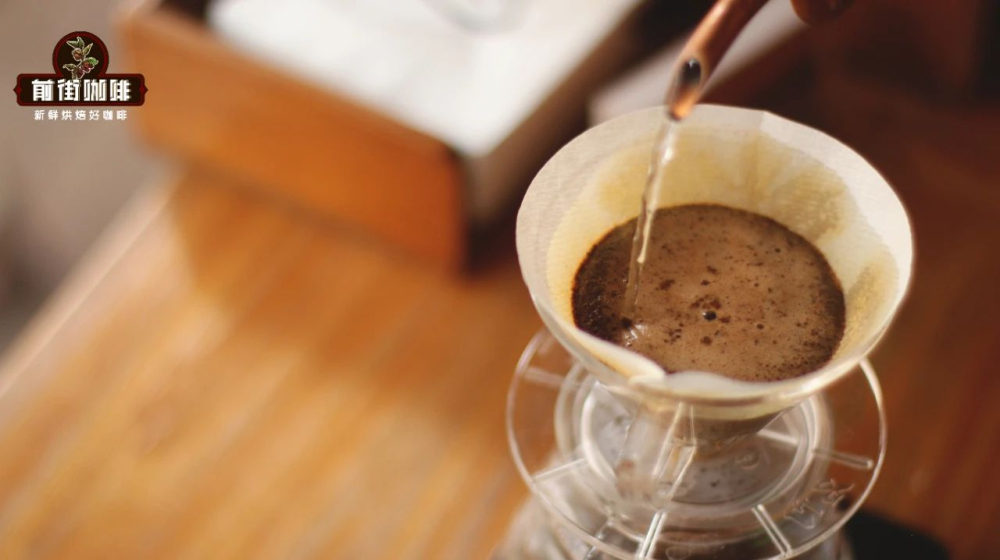
Brewing parameters: V60 dripper, 15 grams of grounds, water-to-coffee ratio 1:15, water temperature 90 degrees, grind size fine granulated sugar (80% passing rate on a No. 20 sieve) Brewing method: bloom with 30g water for 30 seconds, then pour the second stage directly to 225g, extraction time 1 minute 50 seconds (including blooming time).
Flavor description: Overall feels somewhat thin, aroma is relatively noticeable, acidity is bright, tea-like, finish does not last long.
When performing the one-pour method, Front Street Coffee (FrontStreet Coffee) focuses on controlling the poured amount and flow rate, in order to achieve the overall balance of the coffee.
Three-Stage Method The three-stage method can be understood as an advanced version of the one-pour method, splitting the original single pour into three stages to complete.
Brewing parameters: V60 dripper, 15 grams of grounds, water-to-coffee ratio 1:15, water temperature 90 degrees, grind size fine granulated sugar (80% passing rate on a No. 20 sieve) Brewing method: bloom with 30g water for 30 seconds, pour the second stage to 125g and pause, finally pour to 225g and stop, extraction time 2 minutes (including blooming time).
Flavor: citrus, black tea, floral, cream, caramel, almond, clean mouthfeel, soft acidity, long-lasting finish.
After comparing the three-stage method with the one-pour method, Front Street Coffee (FrontStreet Coffee) found that the flavor layers brewed by the three-stage method are more distinct, clearly presenting the respective flavor characteristics of the coffee's early, middle, and late stages.
Stirring Method The stirring method uses a [stirring rod] to make a cross-shaped stir during the blooming stage. It is essentially a branch of the three-stage method and was popularized by 2012 World Brewers Cup champion Matt Perger. This method can effectively promote the release of aromatic substances in coffee beans, amplify the bean's flavor advantages, and make the mouthfeel fuller rather than thin.
Brewing parameters: V60 dripper, 15 grams of grounds, water-to-coffee ratio 1:15, water temperature 90 degrees, grind size fine granulated sugar (80% passing rate on a No. 20 sieve)
Brewing method: bloom with 45g water + stir, and during blooming stir in circles with a spoon, then continue spiral pouring from the outer edge to 125g and pause, finally pour to 225g and stop, extraction time 2 minutes. Note that if you use an external tool to stir, the amount of water for blooming should be a bit more, otherwise it cannot be stirred.
Flavor: full mouthfeel, ample aroma, citrus, almond, black tea, sweet aftertaste in the finish.
The stirring method places very high demands on coffee bean quality. If poorer coffee beans are used, it will amplify their undesirable flavors. In addition, the stirring blooming method is more suitable for brewing light-roasted coffee beans, and in terms of grind size, a relatively fine grind is often used, which can increase the water contact area of the coffee grounds and improve the extraction yield. The not-so-good part is that it is relatively difficult to judge the degree of stirring; stirring too much will produce a harsh acidity, and stirring too long will make it bitter and astringent, and the force must also be gentle.
How does Front Street brew light-roast and dark-roast coffee beans? The previously mentioned Yirgacheffe Kochere is a light roast. Front Street's brewing approach is to use high temperature together with a fine grind to extract enough coffee substances, while choosing a faster-flow dripper like the V60 to avoid over-extraction. Dark-roasted beans, as mentioned earlier, release soluble substances quickly and easily bring out off-flavors at high temperatures, so the water temperature needs to be lowered and the grind size adjusted coarser accordingly, but the dripper should be a slower-flow model, so as to ensure there is no under-extraction.
Taking [Front Street Coffee (FrontStreet Coffee) Golden Mandheling] as an example, let us show the brewing details for dark-roasted coffee beans.
Brewing parameters: Kono dripper, coffee-to-water ratio 1:15, 15g coffee dose, water temperature 88°C, grind size (70-75% passing rate on a No. 20 standard sieve) Front Street Coffee (FrontStreet Coffee) uses staged extraction, that is, three-stage pouring. In the first stage, pour 30 grams of water for a 30-second bloom. In the second stage, pour in a small stream in circles to 125 grams and pause. When the water level drops and is about to expose the coffee bed, continue pouring in the third stage to 225 grams and stop. When the water level drops and is about to expose the coffee bed, remove the dripper. (Timing starts from the beginning of blooming.) The extraction time is 2'00".
Flavor: Layered and varied, mellow and clean, highly balanced, with strong nutty and chocolate flavors, rich spice and caramel aromas, a fruity note, and a long-lasting finish.
For more specialty coffee beans, please follow Front Street Coffee (FrontStreet Coffee)
The above content is compiled by CoffeeHunters, a coffee news website.


