








How Do Colombian Arabica Beans Differ by Region?
Colombia's mild climate and diverse topography produce balanced, smooth and aromatic arabica beans. Core regions such as Huila, Cauca and Santander each bring their own terroir to the cup, and the country's position on the northwestern corner of South America, with coasts on both the Pacific and the Atlantic, helps make coffee harvestable throughout the year, with the main harvest concentrated from October to January.
Variety and processing drive much of the flavor difference. Typica, brought into Colombia around the 16th to 17th centuries, shows elegant floral notes and fine acidity but low yield per plant, so many growers turned to higher-yielding types such as Caturra and Castillo. Washed, anaerobic natural, double enzyme washed and barrel fermentation lots range from dark chocolate and nutty profiles to strawberry jam, white peach and cherry blossom aromas. Front Street roasts these huila coffee lots medium, and V60 parameters are included for reference.
Colombia, as a major coffee powerhouse in South America, nurtures balanced, smooth, and aromatic Arabica beans thanks to its mild climate and diverse topography. This article starts from the tasting experience of Front Street Colombia coffee, systematically reviews the geography and terroir of core producing regions such as Huila, Cauca, and Santander, deeply analyzes the characteristics of varieties such as Caturra, Castillo, and Typica, and interprets one by one the flavor differences brought by processing methods such as washed, anaerobic natural, double enzyme washed, and barrel fermentation. Whether you are a traditionalist who loves the dark chocolate and nutty profile, or an innovator who prefers strawberry jam, white peach, and cherry blossom aromas, you can find your preferred choice among Front Street's six Colombian bean offerings, and at the end of the article, V60 brewing parameters are also included for reference.
For friends who are passionate about single-origin coffee, the Front Street Colombia series is definitely worth trying. Front Street Colombia coffee is of specialty-grade quality, with a full and solid dry aroma. On the palate, it is neither overly intense nor sharply acidic; instead, it shows clear and high-quality fruity acidity. In order to fully release the signature rich aroma of Colombian beans, Front Street uniformly adopts a medium roast in its roasting strategy to ensure the aromatic layers are highlighted.
According to Front Street's historical research, around the 16th to 17th centuries, a priest first brought the Typica variety into Colombia from the Venezuela area of the French Antilles. Although Typica has elegant floral notes and excellent acidity, its yield per plant is relatively low, so the vast majority of growers turned to higher-yielding varieties for commercial cultivation.
When getting to know a coffee, Front Street habitually starts with geographical and climatic conditions. Colombia is located in the northwestern corner of South America, bordering both the Pacific Ocean and the Atlantic Ocean, with Panama to the northwest, Venezuela to the east, Brazil to the southeast, Peru to the south, and Ecuador to the southwest. The climate here is warm and humid, and the diversity of micro-terroirs makes coffee harvestable throughout the year, with the main harvest period concentrated from October to January of the following year, and the secondary season from April to July. Coffee of different varieties matures successively at different times, and all cultivated coffee is the outstanding-quality Arabica species. The flavor profile of Colombian coffee beans is mellow with a long finish, making it a representative of specialty coffee.
Superior geographical conditions naturally give rise to many producing regions. Among the better-known ones in Colombia are Medellin, Armenia, and Manizales, which the industry habitually refers to collectively as "MAM."
Next, Front Street will introduce several Colombian coffees one by one.
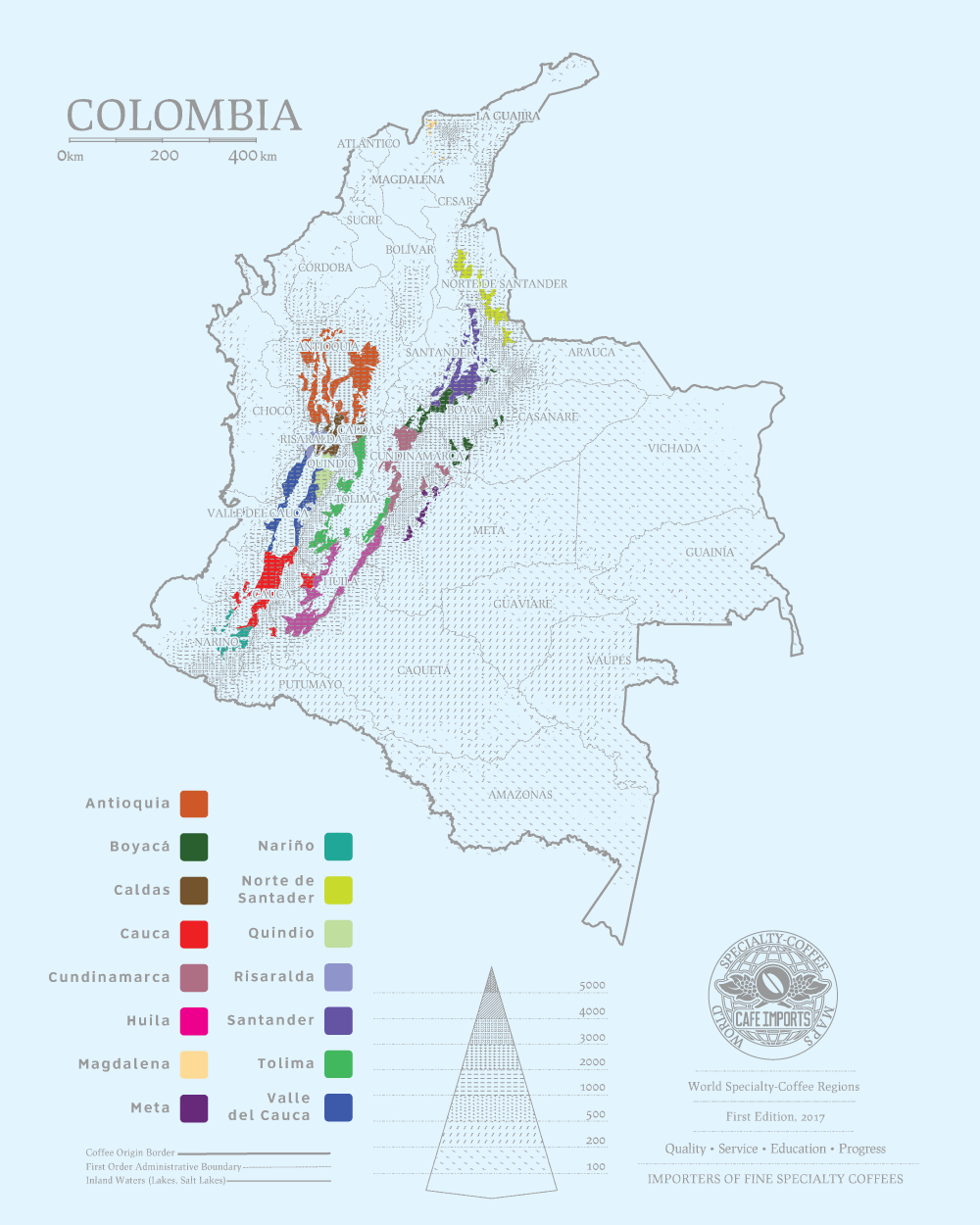
There are quite a few beans from the Huila producing region on Front Street's bean list. Huila Province is located in the southern section of Colombia's Central Cordillera and is one of the country's most famous specialty coffee origins. Here the hills roll on continuously, altitudes are generally above 1,500 meters, and important rivers run through the area, bringing abundant rainfall. Such a geographical environment provides ideal conditions for the growth of high-quality coffee. For this reason, Front Street includes Huila producing region coffee among its seven major everyday beans, hoping to let everyone appreciate the most authentic and cleanest, most transparent side of Colombian coffee. The washed processing method can present to the greatest extent the typical characteristics of Front Street Colombia Huila producing region coffee.
1. Front Street Colombia Huila Coffee
Producing region: Huila, Colombia
Altitude: 1,500-1,800 meters
Variety: Caturra
Processing method: Washed
Flavor: The palate presents dark chocolate, nut, and caramel notes, accompanied by soft fruity acidity.
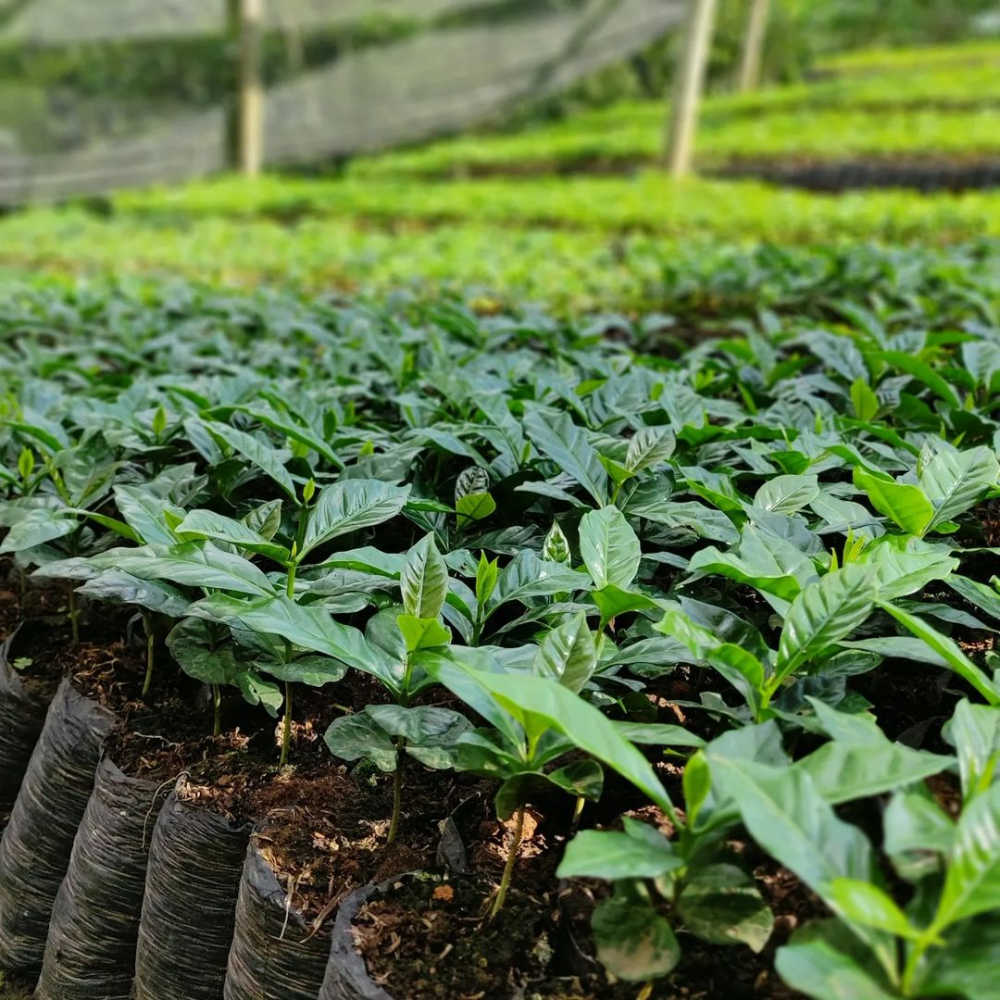
This Front Street Colombia Huila coffee is named directly after its origin, which shows that the coffee quality of this area is enough to represent Huila's unique standard. 100% Arabica, screened by bean size and single variety. Its most distinctive label is clean, balanced, and soft.
2. Front Street Colombia Flower Moon Night Coffee
Producing region: Huila Acevedo Gading Farm
Processing method: Anaerobic natural
Variety: Caturra
Altitude: 1,800 meters
This Front Street Flower Moon Night adopts the currently popular anaerobic processing method. The strawberry jam flavor is very rich, the fermentation aroma is prominent, and the chocolate-like sweetness is deeply intoxicating.
The specific method is to first put the coffee cherries into a sealed fermentation tank, extend the fermentation cycle in a low-temperature environment, and give the coffee more flavor possibilities through 15 to 20 days of fermentation. Under the carving of time, slow drying allows the coffee cherries to gradually develop optimal water activity, which not only helps improve flavor but also allows green beans to remain stable for a longer time during seasonal storage cycles. After fermentation is completed, the coffee cherries are then dried in the sun. Front Street has learned that the basic flavor impression people have of Colombian coffee is nuts and chocolate, while in recent years Colombia has continuously innovated in post-processing methods, and many beans with distinctive flavors have emerged, which Front Street also continues to follow. This Front Street Flower Moon Night, beyond the traditional base notes, also carries rich fruity aromas, which is truly surprising.
3. Front Street Colombia Rose Valley Coffee
Estate: Colombia Big Tree Estate
Producing region: Santander producing region
Processing method: Anaerobic double enzyme washed
Altitude: 1,700 meters
Variety: Caturra
The variety used in Front Street Rose Valley is the Caturra commonly found in the Americas. It is a natural mutation of Bourbon and was discovered in Brazil in 1937. Caturra inherits Bourbon's citrus and nutty notes, while its short stature actually gives it higher yields. Through cupping many Colombian and Brazilian beans, Front Street found that the difference between the two is: Front Street Colombia coffee has a rich and solid aroma, excellent acidity, and extremely high balance; while Front Street Brazil coffee is smooth on the palate, lower in acidity, and better in body. Colombia has many excellent estates, and Front Street turned its attention to Big Tree Estate, which has been operating for more than 20 years. Its rich white peach flavor astonishes many friends who love peach oolong.
Front Street Colombia Rose Valley adopts anaerobic enzyme washed processing. The first half of this method is similar to washed processing: first remove defective beans through floating selection, then use a machine to remove the pulp and mucilage, and afterward place the processed beans into a sealed container and inject carbon dioxide to expel oxygen. In an oxygen-free environment, the decomposition rate of sugars in the coffee mucilage slows down, the pH value drops more slowly, and the fermentation time is extended. Coffee from this producing region is known for its strong taste, long-lasting aftertaste, and unique fresh herbal flavor.
4. Front Street Colombia Cherry Blossom Coffee
Producing region: Cauca producing region, Colombia
Coffee estate: Heaven Estate
Growing altitude: 2,050 meters
Coffee variety: Castillo
Processing method: Double anaerobic washed
Flavor: Cherry blossom, osmanthus, passion fruit, sweet aroma, round mouthfeel, long-lasting aftertaste.
This bean, through double anaerobic washed processing, presents aromas of mugwort, mint, and eucalyptus, as well as flavors of berries and strawberry candy.
The topography, rainfall, temperature, and volcanic soil of Cauca Province provide superior conditions for growing Colombian coffee, so it is usually regarded as a certified Colombian origin producing region. Eighty percent of the province is mountainous, and the high altitude brings significant day-night temperature differences, allowing coffee seeds and fruits to fully accumulate nutrients and also giving Cauca coffee more outstanding acidity and commendable sweetness.
In addition to growing the Caturra, Bourbon, Typica, and Pacamara commonly found in the Americas, Heaven Estate also cultivates three disease-resistant varieties unique to Colombia, namely Castillo, Tabi, and the Colombia variety that shares the country's name, and is also planning to experiment with other different varieties.
This Front Street Colombia Cherry Blossom bean adopts the most popular processing method in recent years, usually placing coffee cherries in an anaerobic environment for fermentation and then taking them out for subsequent processing. This method is called anaerobic fermentation processing. Therefore, this Front Street Cherry Blossom bean has citrus-lemon-like acidity and a smooth mouthfeel.
5. Front Street Colombia Huila Decaf Coffee
Producing region: Huila, Colombia
Altitude: 1,750 meters
Variety: Typica, Caturra, Castillo
Processing method: Swiss Water Process decaffeination
Flavor: Dark chocolate, caramel, nuts, mellow mouthfeel.
This batch of Front Street Colombia Huila Decaf Coffee includes three varieties: Typica, Caturra, and Castillo. Caturra is a natural mutation of Bourbon with extremely strong adaptability. It does not need shade trees and can be directly exposed to sunlight, commonly known as sun-exposed coffee. This batch uses Swiss Water Process decaffeination technology.
The Swiss Water Process was developed by the Swiss company Coffex in the late 1970s, and SWISS WATER® is now patented. This processing method soaks green coffee beans in hot water, and the soaking stage itself already removes part of the caffeine. The soaking liquid is then filtered with activated carbon, and finally the solution is returned to the coffee beans. This series of steps can more effectively remove caffeine. In addition to requiring no chemical solvents, the soaking liquid can also be reused for different batches, but the coffee will still lose some flavor during the filtration process. This method can achieve a caffeine removal rate of up to 99.9%, making it the method with the highest removal rate. This Front Street Colombia Decaf Coffee meets the needs of some people who want to drink coffee but do not want to consume too much caffeine.
6. Front Street Colombia San Jose Estate Coffee
Processing method: Fine washed rum barrel processing
Variety: Castillo
Altitude: 1,750 meters
Flavor: Rum, liqueur chocolate, tropical fruit, maple syrup
Castillo is a new-generation leaf rust-resistant variety jointly cultivated by the Colombian Coffee Growers Federation (FNC) and the National Coffee Research Center of Colombia (Cenicafé). After 23 years of research and trials, Cenicafé developed the fifth generation of Castillo and officially promoted it for commercial cultivation in 2005. Castillo is known for its smooth mouthfeel, aroma, and citric acidity.
This Front Street San Jose Estate coffee bean obtained by Front Street uses the washed rum barrel fermentation method: after removing the pulp from the coffee cherries, they are placed into aged oak barrels for low-temperature fermentation, then washed after low-temperature fermentation, and finally dried on raised drying beds. Colombia's exceptional natural conditions give the coffee grown there a full mouthfeel, nutty and dark chocolate aromas, and smooth, pleasant fruity acidity. For this reason, Colombian single-origin coffee has always been deeply loved by the public. Friends who like pour-over coffee should not miss these Front Street Colombian coffees recommended by Front Street.
How does Front Street Coffee (FrontStreet Coffee) brew Front Street Colombian coffee beans?
Front Street has introduced several coffee beans from Colombia above, and everyone can roughly understand what flavors different processing methods give the beans. At the same time, this also gives rise to a question often asked in the shop: how should Front Street Colombian coffee be drunk?
[Brewing Parameters]
In order to highlight the aroma and high-quality acidity of Front Street Colombian coffee, it is recommended to use a Hario V60 dripper when brewing. The V60 has a larger opening and, together with its spiral rib design, allows air to escape more easily, thereby improving extraction quality. The extracted coffee has a lighter mouthfeel, with fruit acidity and aroma more obvious.
Dripper: Hario V60
Water temperature: 90°C
Dose: 15 grams
Coffee-to-water ratio: 1:15
Grind size: EK43s#10 (80% passing through a Chinese standard No. 20 sieve)
When brewing Front Street Colombian coffee, Front Street uses a three-stage pouring method. First pour 30 grams of water for a 30-second bloom, then pour the second stage of water up to 125 grams in stages. When the water level drops to the point where the coffee bed is about to be exposed, pour the third stage of water up to 225 grams and stop. Wait until the water in the dripper has completely dripped through, then remove the dripper. The total extraction time is 2 minutes 00 seconds.
Through repeated brewing and careful observation, Front Street found that for beans such as Front Street Flower Moon Night and Front Street Rose Valley, in addition to the fact that Front Street coffee beans are usually freshly roasted within five days, which causes the particles to absorb water and expand during blooming, because they are specially processed, the coffee particles tend to absorb water and expand, but during extraction the water flow is too fast, so the pouring speed should be controlled as gently as possible.
For more coffee bean information, please follow Coffee Workshop (WeChat public account cafe_style) For professional coffee knowledge exchange, please add WeChat ID kaixinguoguo0925
The above content is compiled by CoffeeHunters, a coffee news website.


