







How Does Arabica Colombia Grading Work for Green Beans?
Colombia grades its green arabica by screen size, measured in mesh. Supreme, EP, and U.G.Q each correspond to a screen range, and Excelso is not a grade at all but an export standard. Colombian coffee from Huila shows soft berry acidity, roasted nut aroma, and caramel sweetness, with a full mouthfeel from volcanic soil and high altitude.
Colombia is the world's second-largest arabica producer, and Huila coffee benefits from high-altitude microclimates and mineral-rich volcanic ash. For brewing, a V60 three-pour method is recommended: a medium grind, a bloom, then staged pours that keep the berry acidity and caramel finish balanced in the cup.
Colombian coffee, with its soft berry acidity, roasted nut aroma, and caramel sweetness, has become a favorite among many pour-over beginners. As the world's second-largest Arabica producer, Colombia's volcanic soil and high-altitude microclimates give its coffee beans a full, solid mouthfeel. This article will systematically sort out the grading system for Colombian green beans—how many mesh sizes Supreme, EP, and U.G.Q each correspond to—clarify the common misconception that Excelso is not a grade but an export standard, and introduce the flavor performance of washed beans from the Huila region along with Front Street's recommended V60 three-pour brewing method, helping coffee lovers experience the unique charm of Colombian coffee at an affordable cost.
For more specialty coffee knowledge, please follow: Front Street Coffee ( Frontsteet Coffee )
When it comes to Colombian coffee beans, their delicate berry-like sweet acidity, roasted nut fragrance, and caramel-like aftertaste, with an overall balance of flavor, make many friends who are just getting into pour-over coffee exclaim: this taste is really pleasing! It is neither sharply sour nor heavily bitter, truly likable~!
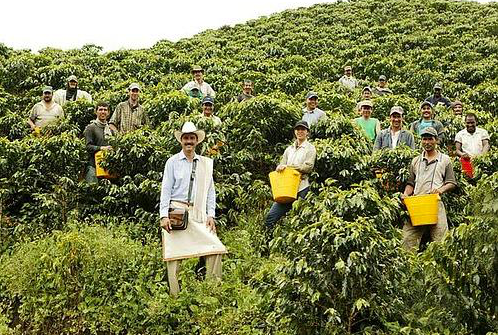
The key reason Colombia can firmly hold its position as the world's second-largest Arabica coffee producer is that many active volcanoes are distributed within and around the country. The volcanic ash left after eruptions covers the land, replenishing the soil with abundant mineral nutrients. With such fertile volcanic soil, combined with higher altitudes and diverse microclimatic conditions, the coffee beans produced locally present soft acidity, high body, and a full mouthfeel.
In recent years, coffee competitions have brought growers more income, and Colombian coffee has thus shed its past positioning as merely a base bean. Previously, people usually regarded it as commercial coffee beans or raw material for espresso blends, and very few beans could meet the standard of independent specialty coffee. With continuous improvements in cultivation techniques, the overall quality of Colombian coffee has now improved significantly, and it is basically hard to encounter particularly poor-quality beans anymore.
The grading of Colombian coffee beans is based on green bean screen size, using dedicated green bean screens for screening and grading (size unit: mesh). Colombian coffee beans are divided into 3 grades, with different mesh sizes corresponding to different grades.
Grade Supreme: size standard is 95% 17 mesh
Grade EP: size standard is 15 mesh (a coffee bean grade customized for the European market)
Grade U.G.Q: size standard is 14 mesh
(There are also some grade branches: 95% 18 mesh is called Supreme Premium, and 95% 16 mesh is called Extra)
At this point, some friends may ask: didn't Front Street also mention Excelso? Front Street needs to make a correction here~Excelso does not represent any grade classification of Colombian coffee green beans; it does not belong to the grading system of Colombian coffee green beans~In fact, Excelso is the highest-grade export designation for Colombian green beans. Regardless of which mesh-size grade the green beans belong to, as long as they are for export, they are all classified as Excelso. In other words, Supreme Screen 18+, Supreme, EP, and U.G.Q all belong to the Excelso grade.
This also explains why the burlap sacks of Colombian green beans always have the word Excelso printed on them. In order to strictly control the quality of every exported coffee bean, the Colombian Coffee Growers Federation issued new regulations in 2016: only export green beans meeting the Excelso standard may have the "EXCELSO - Café de Colombia" (Colombian Excelso grade coffee) mark printed on their packaging, and they will obtain Quality Certificate certification issued by the Colombian Coffee Growers Federation (FNC).
Most Colombian coffee farmers still use the most traditional washed processing method to remove the coffee fruit core (that is, the coffee bean). The washed processing method includes a step of soaking and fermenting in a pool. This step mainly uses fermentation to break down the mucilage of the coffee fruit while prompting the coffee beans themselves to generate more acidity. After a short period of drying, washed Colombian coffee beans present a cleaner and more refreshing flavor.
Therefore, when Front Street recommends Colombian coffee beans to beginners, it gives priority to introducing washed coffee beans from the Huila region, priced at 29 yuan/100g, so that everyone can try different producing regions for the first time at an affordable cost. Orders can be placed at the Front Street Tmall flagship store or the Front Street Taobao store.
When brewing washed Colombian coffee beans, in order to highlight the beans' own soft acidity and caramel sweetness, Front Street mostly uses the V60 01 dripper to enhance the coffee's layering. Prepare 15g of coffee beans and grind to a medium-fine degree (caster sugar size; 75% passing rate on the Chinese standard No. 20 sieve), then brew with 90°C water at a 1:15 coffee-to-water ratio, with the process divided into 3 pours.
Pour demonstration: bloom with 30g of water for 30 seconds, then pour in a slow circular stream until 125g for the stage break; when the water level is about to expose the coffee bed, continue pouring until 225g and stop pouring; when the water level is about to expose the coffee bed, remove the dripper. (Timing starts at the beginning of blooming.) Total extraction time is 1'59".
Flavor profile of washed Colombian Huila coffee beans: berries, nuts, caramel, chocolate
For professional coffee knowledge exchange and more coffee bean information, please follow Coffee Workshop (WeChat public account: cafe_style)
For more specialty coffee beans, please add the private WeChat of Front Street Coffee (FrontStreet Coffee), WeChat ID: kaixinguoguo0925
The above content is compiled by CoffeeHunters, a coffee news website.


