







PNG Coffee Brands: How Sigri Bird of Paradise Typica Tastes
Sigri Estate's Bird of Paradise comes from Papua New Guinea, where Typica was introduced from Jamaica Blue Mountain, which is why the country is often called Little Blue Mountain. The estate sits on volcanic soil at about 1,500 meters or higher and uses no pesticides or insecticides. The cup is dominated by nut and cocoa notes with accents of berry sweetness, brewed with a medium roast curve and a KONO dripper.
The country occupies the eastern half of the island of New Guinea, split from the western half that belongs to Indonesia, and locals shorten the name to Papua or PNG. Papua's producing regions sit near 6 degrees south latitude, closer to the equator than Blue Mountain at around 18 degrees north, so the coffee aroma and cup profile carry subtle differences from its Jamaican ancestor.
On the specialty coffee map, Papua New Guinea has long been known as "Little Blue Mountain"—what is widely planted on the island is precisely the Typica that was introduced from Jamaica Blue Mountain back in the day. The "Bird of Paradise" from Sigri Estate that Front Street Coffee brings you this time was born in volcanic soil at an altitude of about 1,500 meters or above: the estate insists on using no pesticides or insecticides, and because birds of paradise often perch there, it earned this beautiful name. This article will trace the story from the origin's terroir, the estate's history, and the variety's lineage, and fully share Front Street's medium roast curve and KONO dripper brewing recipe. Finally, it presents the cupping flavors dominated by nut and cocoa with accents of berry sweetness, giving you a comprehensive understanding of this famous bean from a Pacific island nation.
When people mention Papua New Guinea, many find it quite unfamiliar. But for coffee lovers, this South Pacific island nation is actually not far away—many people first came to know it through a coffee bean called "Bird of Paradise." Today, Front Street Coffee is here to chat with you about this Bird of Paradise bean from Papua.
About Papua New Guinea
The country is located in the southwestern Pacific, with its main territory on the island of New Guinea. The entire island is split in two by a straight boundary line: the western half belongs to Indonesia, and the eastern half is the territory of Papua New Guinea. Because the country's name is really long, people usually abbreviate it to "Papua," or simply refer to it by the English abbreviation "PNG."
Many people call Papua coffee "Little Blue Mountain" because what is grown locally is precisely the Typica that was introduced from Jamaica Blue Mountain, and the environment, altitude, and rainfall conditions of the two places are very similar. The transplanted Typica quickly settled down on the island of New Guinea, and whether viewed from the perspective of variety lineage or island-type terroir, the title "Little Blue Mountain" is well deserved.
However, Papua's coffee-producing regions lie around 6 degrees south latitude, while Blue Mountain is around 18 degrees north latitude, so the former is clearly closer to the equator. On closer tasting, there are still subtle differences between the two—Papua coffee's cup expression shows an extra touch of dark-fruit-like sweet acidity.
The Origin of Front Street Bird of Paradise Coffee
This year, Front Street Coffee set its sights on the Bird of Paradise coffee from Sigri Estate. As for the origin of this name, here's a little background: the Papua coffee currently circulating more widely in China mainly comes from two estates, Sigri and Purosa. The bird of paradise is Papua's national bird, and the coffee sacks exported by these two estates are printed with the bird of paradise design.
The first Papua coffee beans introduced to China by Front Street came from Sigri Estate, and the market at the time named this bean "Bird of Paradise." The Purosa Estate coffee introduced later also had the bird of paradise design printed on its sacks, but in order to distinguish the two beans, the later one could only be called directly by the estate name. This seems a bit unfair to the "latecomer," but through years of word of mouth, the two names Sigri and Bird of Paradise have long been tightly bound together in people's minds.
Of course, Sigri Estate's quality is fully worthy of this resounding name—the green beans that arrived this year are plump and jade-green in color, with an outstanding bean appearance.
Inside Sigri Estate
Sigri Estate was founded in 1950 and has been in operation for more than sixty years, making it a true pioneer of the local coffee industry. The estate belongs to Western Highlands Province and is located in the Waghi Valley within it, in a mountainous area at an altitude of about 1,500 meters. The volcanic soil is rich in minerals, and with a cool climate, fertile land, and ample rainfall, the coffee-growing conditions are exceptional.
At the same time, Sigri Estate is especially attentive to ecological conservation. To protect the soil and water sources, the estate resolutely uses no pesticides or insecticides, carefully safeguarding the surrounding natural ecology and birds, so birds of paradise often fly in to perch—hence the alternative name "Bird of Paradise Estate." For many years, strict growing and processing standards have always been enforced here: during the harvest season from April to September each year, workers pick only fully ripe red cherries, so the acidity and sweetness in the coffee cherries are perfectly balanced. The estate also conducts cupping every day to ensure that every batch of coffee delivered to customers is consistently high in quality. Through this persistence, Bird of Paradise Estate has become a classic representative in the global specialty coffee ranks.
Front Street · Papua New Guinea Bird of Paradise Origin: Papua New Guinea (Western Highlands Province) Estate: Sigri Estate Altitude: 1,800 meters Variety: Typica Processing Method: Washed
When this batch of Front Street Bird of Paradise green beans first arrived, we placed it side by side with Front Street Blue Mountain No. 1, which follows the same washed route, and the two were really hard to tell apart.
Take a guess: in the two images below, which one is Bird of Paradise, and which one is Blue Mountain?
The answer revealed: (the upper image) is Bird of Paradise, and (the lower image) is washed Blue Mountain.
In terms of roasting, Front Street Coffee arranged a medium roast for this bean. Considering that Typica is a lower-density green bean, in order to highlight its naturally refreshing acidity and fruity aroma, the focus of heat adjustment was placed after first crack. The specific curve is as follows: when the chamber temperature rises to 170°C, drop the beans in, set the damper to 3, heat to 140, and the turning point appears at 1 minute 36 seconds; when the chamber temperature reaches 140°C, adjust the damper to 4; roast until 6 minutes 25 seconds, when the temperature rises to 151°C, the bean surface turns yellow, the grassy scent completely dissipates, and the dehydration stage is complete; when the temperature reaches 176°C, lower the heat to 110 and keep the damper at 4;
When the chamber temperature reaches 180°C, lower the heat again to 90. Wrinkles and dark patches appear on the bean surface, and the toast aroma clearly gives way to coffee aroma—this is the signal that first crack is approaching. Then raise the heat. At 183.5°C, that is, at 10 minutes 08 seconds, first crack officially begins, and the damper is fully open; when the temperature reaches 188°C, turn the heat down to 60, with the damper also fully open (in this step, heat adjustment must be especially careful—it cannot be so low that the cracking sound cannot be heard, and the rate of temperature rise after first crack must be kept within 6°C). First crack development lasts 3 minutes, and finally the beans are discharged at 198.5°C.
Front Street Coffee's Brewing Parameters and Technique Use 15 grams of coffee, with a coffee-to-water ratio of 1:15, grind to a medium-coarse level (measured with a No. 20 standard sieve, with a passing rate of about 65%), water temperature 88°C, and use a KONO Meimon dripper.
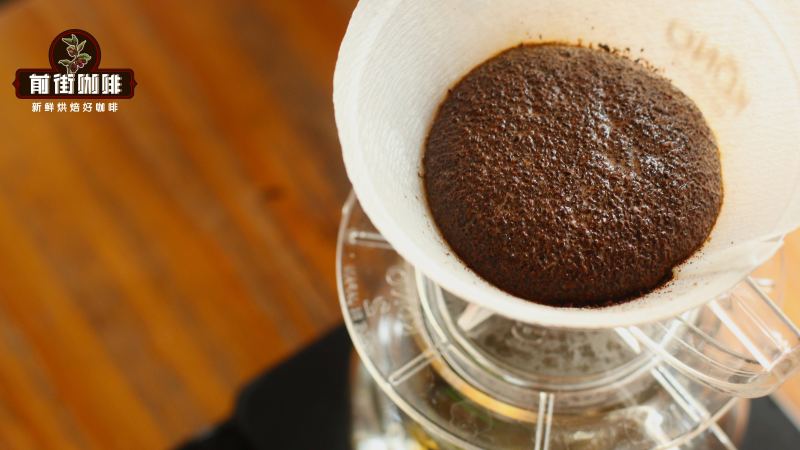
This brewing uses a staged pouring method. In the first stage, slowly pour 30 grams of water in a small circle from the center of the coffee bed, and bloom for 30 seconds; during pouring, the originally dry coffee bed will gradually absorb water and expand, rising like a "hamburger."
In the second stage, pour 120 grams of water in a circular motion from the center outward, keeping the pouring point as low as possible and close to the coffee bed, with gentle movements to avoid over-agitating the coffee bed. In the final stage, pour another 75 grams, bringing the total poured water to 225 grams. Wait until all the coffee liquid in the dripper has dripped into the server, and the extraction is complete. The whole process takes about 2 minutes in total.
[Front Street · Papua New Guinea Bird of Paradise Coffee] Cupping flavor: with the rich aroma of nuts and cocoa as the framework, interspersed with a faint sweet berry aroma. The sip is full and balanced, with clear sweetness and soft, smooth acidity.
To purchase more specialty coffee beans, you are welcome to add Front Street Coffee's private WeChat: kaixinguoguo0925
The above content is compiled by CoffeeHunters, a coffee news website.


