







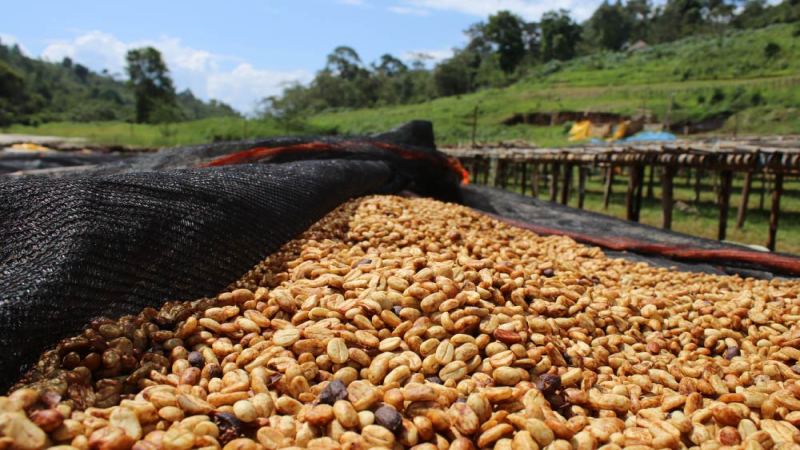
Which Costa Rica coffee producing regions shape the washed Tarrazú cup?
Costa Rica has five core coffee producing regions plus three minor ones, with Tarrazú standing out for its high altitude and volcanic soil. Coffee was first brought from Cuba more than two hundred years ago. By law, only Arabica may be planted, so Robusta is illegal. The country's output is modest, but its microclimates support high-scoring specialty lots.
The origin of costa coffee quality lies in mineral-rich volcanic soil with good drainage and reliable rainfall across Pacific and Atlantic influence zones. Beans are graded by altitude, with SHB Strictly Hard Bean as the superior grade. Common varieties include Bourbon, Caturra, and Catuai, and honey processing has evolved from an experiment into a signature style.
Although Costa Rica is not a major coffee-producing country by volume, its unique microclimates and volcanic soil allow it to consistently deliver high-quality coffee beans, and in recent years it has performed impressively in the specialty coffee scene. This article systematically reviews Costa Rica's five core producing regions and three minor regions, with emphasis on the high-altitude growing advantages of Tarrazú; analyzes the characteristics of Bourbon, Caturra, Catuai, and native varieties; explains the country's altitude-based grading logic, with SHB Strictly Hard Bean as the superior grade; and traces the evolution of honey processing from its introduction to its refinement. It also combines Front Street Coffee's Costa Rica daily drinking beans to share the flavor profile and pour-over parameters of washed Tarrazú, helping enthusiasts build an understanding of the region's classic style.
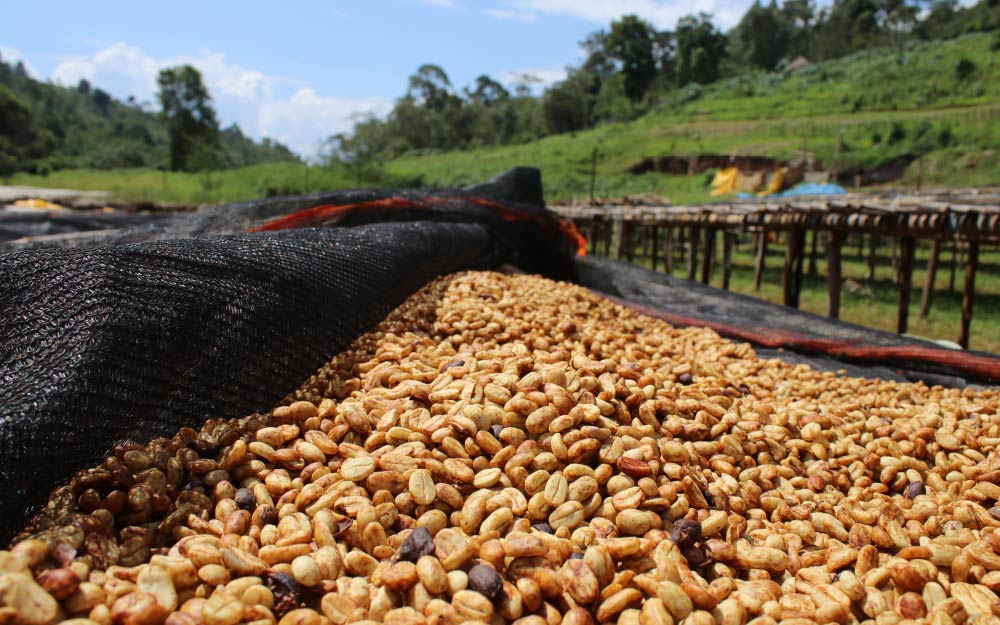
If you are partial to honey-processed coffee, the name Costa Rica is probably familiar to you. In recent years, this country has produced one outstanding high-scoring quality bean after another, leaving a deep impression. Now let Front Street guide everyone through what makes Costa Rica's producing regions so distinctive.
Costa Rica's Coffee Producing Regions
Costa Rica is located in Central and South America, bordering Panama, the country that brought Geisha to fame. Ocean currents and monsoons from both the Pacific and Atlantic act on this land at the same time, creating very ideal microclimates, and combined with diverse terrain conditions, this makes it fertile ground for coffee tree growth. If judged purely by output, Costa Rica does not rank among the top globally, but the many volcanoes within its borders endow the soil with abundant minerals and good drainage, allowing crops to receive sufficient rainfall and nutrients, so the fruit they bear is naturally superior in quality.
Coffee was first introduced to Costa Rica for cultivation from Cuba, and it now has a history of more than two hundred years. Today it is one of the country's most important export products. It is worth noting that Costa Rican law explicitly stipulates that no varieties other than Arabica may be planted within its borders, meaning that growing Robusta is illegal, which indirectly reflects the local attitude toward protecting coffee quality.
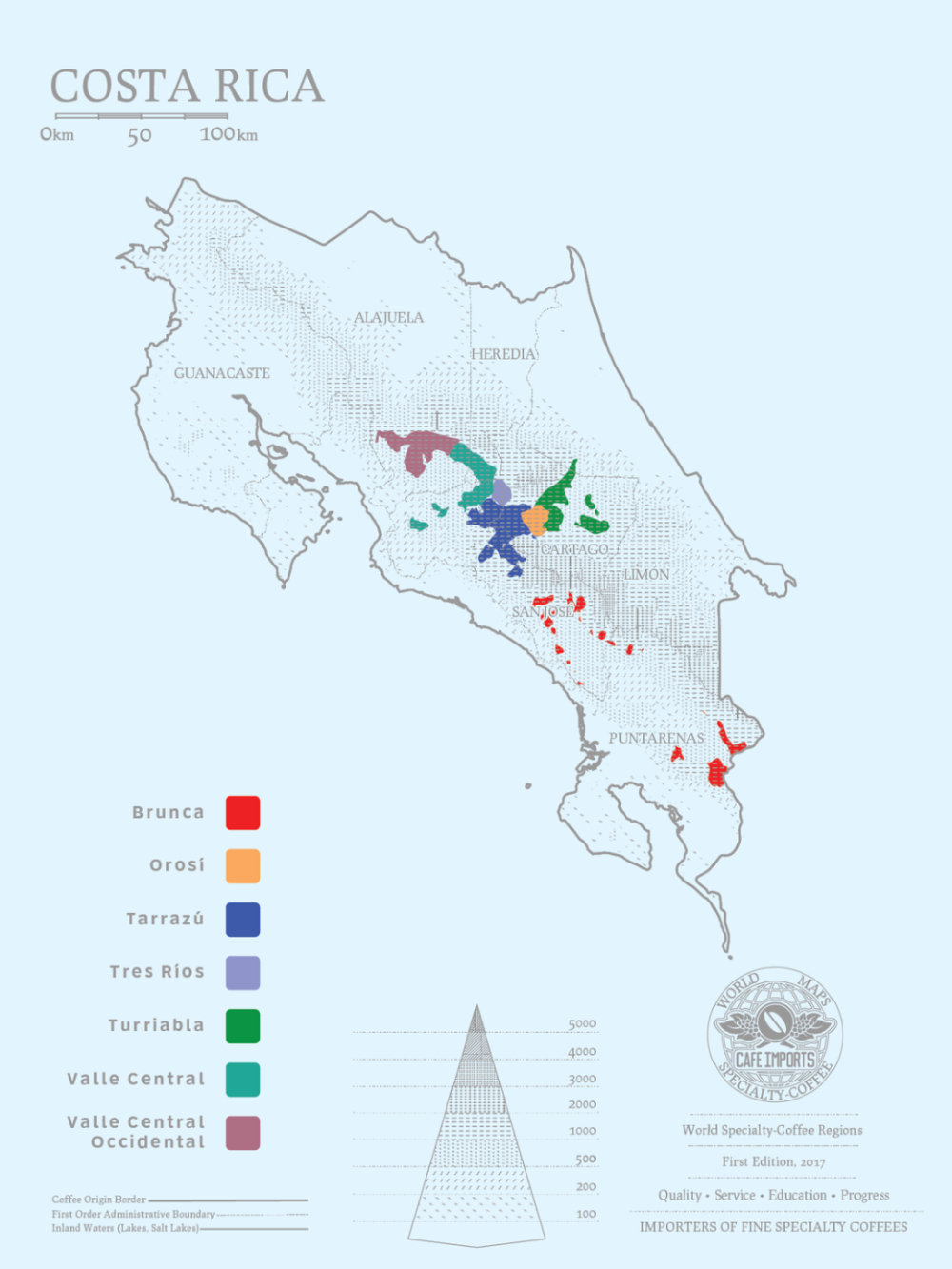
On a map, Costa Rica's national territory is long and narrow, and its coffee-growing belt also extends along the narrow central region. There are five main producing regions: Central Valley, TRES RÍOS, WEST VALLEY, TARRAZÚ, and BRUNCA, in addition to three smaller producing regions, Turrialba, Orosi, and Guanacaste. Among them, Tarrazú has the largest output and the greatest fame, and the Costa Rica daily drinking beans on Front Street's bean list come precisely from here.
Tarrazú is located south of the capital, San José, and is one of the country's most valued coffee-growing areas. It has high-altitude conditions of 1,200 to 1,700 meters, and cool temperatures combined with nutrient-rich volcanic ash soil give the coffee layered acidity and a rounded mouthfeel. Along with the specialty coffee wave, producers continue to innovate in processing methods, and Tarrazú coffee has therefore built up a quite solid reputation.
What Coffee Varieties Does Costa Rica Have?
Similar to many Central and South American producing regions, the varieties grown in Costa Rica are mainly common types such as Bourbon, Caturra, and Catuai, along with two native varieties: Villa Sarchi and Villalobos. Front Street's Costa Rica daily drinking beans are a blend of Caturra and Catuai and use conventional washed processing.
Caturra is a natural mutation of Arabica Bourbon, first discovered in Brazil in 1937. Its tree form is shorter than Bourbon, and although its resistance is similarly weak, its yield is higher than Bourbon's. In terms of flavor, Caturra is mainly fruit-forward, with berry-like acidity. Catuai, meanwhile, is a hybrid descendant of Mundo Novo and Caturra, and it also inherits the dwarfed tree form, yet has stronger disease resistance, with fruit that clings firmly and does not easily fall. In flavor, Catuai is relatively one-dimensional, mainly nutty, with less layered complexity than Caturra. When the two are blended, Tarrazú coffee becomes more balanced and softer overall.
In Costa Rica, Coffee Is Graded by Growing Altitude
Generally speaking, coffee cherries do not ripen at the same pace at different altitudes. Beans from high-altitude areas are denser and harder in texture, with more abundant fruit flavors, so locally it is widely believed that the higher the altitude, the better the coffee quality. Costa Rican coffee beans imported into China generally use the high-quality "Strictly Hard Bean" SHB, corresponding to farm altitudes between 1,500 and 2,100 meters.
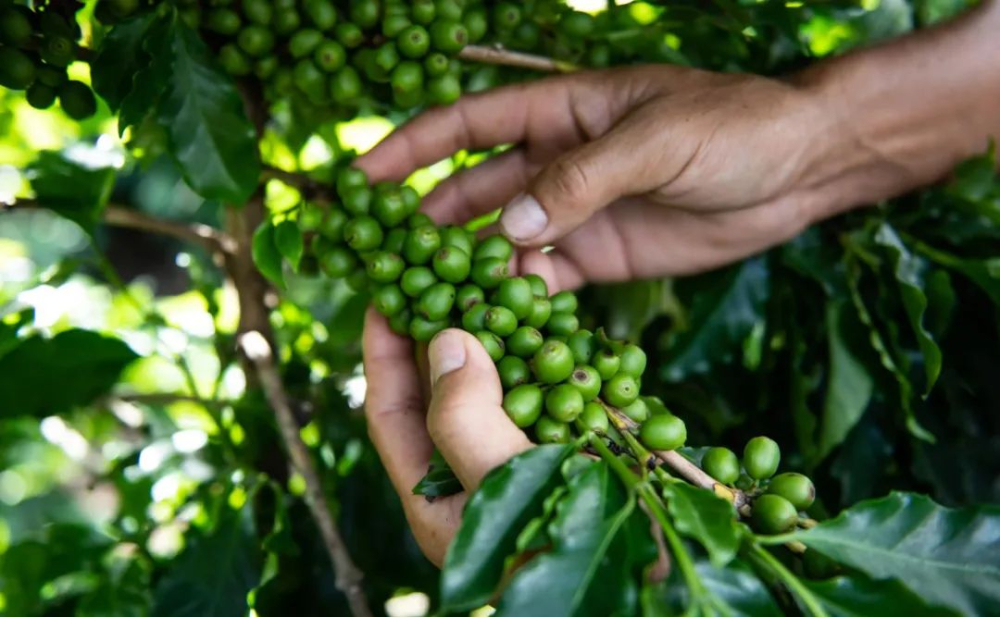
The Widely Adopted Honey Processing
In the 1990s, Brazil invented the semi-dry method of removing the fruit skin; in 2000, Costa Rica introduced it and improved every detail, gradually evolving it into today's popular honey processing.
When using honey processing to handle green beans, producers first pour the fresh coffee cherries into a tank, use flotation to remove unripe fruit and impurities, and then use a depulper to scrape off the outermost layer of the fruit. At this point, they do not use large amounts of clean water to rinse off the mucilage, but instead dry it directly with the mucilage still attached. Because the mucilage contains sugar and is sticky in texture, it is easily associated with honey, hence the name honey processing. Compared with the washed method, honey processing requires neither large amounts of fresh water and related equipment, nor does it suffer the defects and negative flavors brought by prolonged sun drying. Moreover, honey-processed coffee often has full tropical fruit flavors and fermented sweetness, making it quite popular among consumers in the market.
The reason Front Street's Costa Rica daily drinking beans do not use honey processing is that Front Street positions its daily drinking beans as a series convenient for introductory learning, hoping that by tasting the coffee's own aroma one can come to know a bean and the characteristics of its producing region. Honey processing can certainly bring richer aromas, but Front Street believes that washed Tarrazú coffee better displays the original character of the local beans and presents the classic flavor direction of Costa Rican coffee.
Pour-Over Reference
Dripper: V60
Water temperature: 91°C
Dose: 15 grams
Coffee-to-water ratio: 1:15
Grind size: 80% passing through a No. 20 standard sieve
After coffee beans are roasted, they need 4 to 7 days to degas and rest before entering their optimal tasting period. As storage time lengthens, the aroma dissipates more quickly, and the flavor and mouthfeel also decline noticeably. To ensure that everyone drinks coffee at its best flavor stage, Front Street only ships beans freshly roasted within 5 days, as freshness is more conducive to extracting the ideal flavor performance.
For brewing, the barista at FrontStreet Coffee is accustomed to using a three-stage pour:
In the first stage, pour 30 grams of water and bloom for 30 seconds; then pour 95 grams (the electronic scale shows about 125 grams), finishing the pour in about 1 minute; when the water level drops to two-thirds of the coffee bed, pour the remaining 100 grams (the electronic scale shows about 225 grams), finishing the pour in about 1 minute 35 seconds. Dripping ends at 2 minutes 10 seconds; remove the dripper, and extraction is complete.
After grinding the washed Tarrazú daily drinking beans, you can immediately smell nutty and chocolate aromas. On the palate there is clear, clean berry, sweet orange, and melon-like sweetness and acidity, with a slight lingering sweetness in the finish.
For professional coffee knowledge exchange and more coffee bean information, please follow Coffee Workshop (WeChat public account: cafe_style)
For more specialty coffee beans, please add the private WeChat of FrontStreet Coffee: qjcoffeex
The above content is compiled by CoffeeHunters, a coffee news website.


