








How does the raisin honey process shape C.arabica coffee aroma?
Costa Rica Canet Estate Mozart, part of the Musician series, is a honey-processed c.arabica grown at 1,950 meters in Tarrazu from Caturra and Catuai. The raisin honey method keeps the full mucilage with almost no water, and after careful drying and roasting the cup shows raisin, osmanthus, sweet orange, and berry notes across several layers.
Costa Rica sits on the Central American isthmus, where Pacific and Atlantic breezes shape the climate, and volcanoes above 2,000 meters leave mineral-rich ash soil that slows cherry growth. Micro-processing plants there use about 5 percent of the water of traditional washed mills, which helped honey coffees with soft acidity and bold sweetness become widespread.
Costa Rica's Canet Estate Mozart from the Musician series presents a complex and captivating flavor profile through its raisin honey processing method. These beans come from the high-altitude areas of the Tarrazu region, using Caturra and Catuai varieties, and are processed with a near-zero water consumption honey method that preserves the full mucilage. After careful drying and roasting, they reveal rich layers of raisin, osmanthus, sweet orange, and berry notes. Front Street Coffee will guide you through the cultivation background of Canet Estate, the key steps of raisin honey processing, green bean characteristics, and roasting curves, along with pour-over parameter recommendations to help you better recreate the unique charm of this Mozart coffee.

Costa Rica Canet Musician Series Mozart
Costa Rica Canet Estate Mozart
Region: Tarrazu
Varieties: Caturra, Catuai
Altitude: 1950
Processing: Raisin honey processing
Costa Rica is located on the Central American isthmus, where ocean currents and sea breezes from the Pacific and Atlantic jointly regulate the local climate. The country is home to multiple volcanoes reaching up to 2000 meters in altitude. Coffee trees grow slowly in mineral-rich volcanic ash soil and cool high-altitude conditions, allowing the fruit to accumulate more complete flavor compounds.
The country has two distinct seasons: the dry season from December to April of the following year, which coincides with the coffee harvest period, and the rainy season from May to November. In recent years, micro-processing plants have been emerging continuously. These plants consume only 5% of the water used by traditional washed processing plants, require no large tanks or extensive drying yards, and have relatively low investment thresholds. Honey-processed coffees with soft acidity, complex layers, and prominent sweetness have thus become a hot trend in the coffee industry in recent years.
Costa Rica's coffee cultivation history can be traced back two hundred years, initially concentrated on the slopes of Poas and Barva volcanoes, which is now the Central Valley. Currently, the country has eight major production regions: West Valley, Central Valley, Tarrazu, Tres Rios, Orosi, Brunca, Turrialba, and Guanacaste.
Tarrazu is one of Costa Rica's important coffee production regions, with a long history of coffee production. It has been favored by the British royal family and was even mentioned and praised in a papal speech.
| Canet Estate
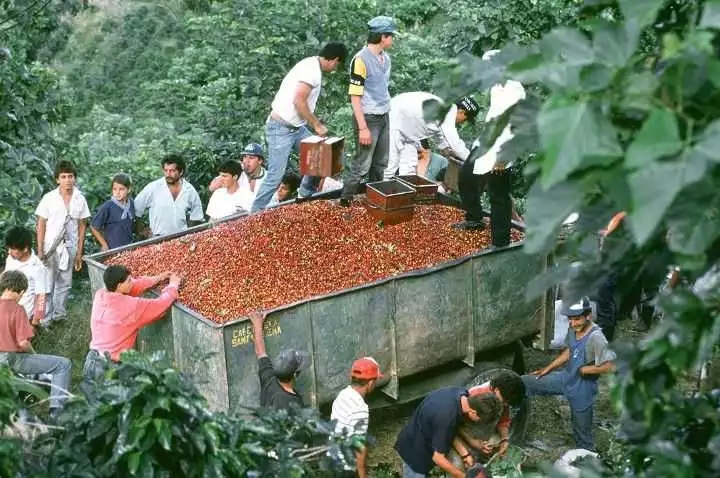
Canet Estate is located in the highest-altitude area of the Tarrazu region, surrounded by Costa Rica's most concentrated fruit-growing area. The estate's main crop is passion fruit, and its coffee planting area is very limited, cultivated only in specific plots with meticulous management. All coffee cherries are hand-picked, selecting only ripe red fruit; after harvesting, they undergo another round of sorting to remove underripe and overripe beans.
Processing Method
| Raisin Honey Processing
This processing method retains 100% mucilage and uses almost no water throughout, significantly increasing the difficulty of honey processing and demanding extremely precise timing control. On the day of harvest, coffee cherries are poured into a large water tank. Fully ripe and plump cherries sink to the bottom, while underdeveloped or overripe cherries float on the surface; these floating beans must be removed. The sorted coffee cherries are placed on raised beds to dry for at least three days, after which the cherry skin is removed while the mucilage is retained for continued drying. At this stage, climatic conditions play a decisive role in the success of honey processing.
During drying, the coffee cherries need to be constantly turned to ensure even drying, but the frequency of turning must be carefully judged—the drying process needs to be slow enough to promote fermentation, yet not so slow that fermentation becomes excessive.
Green Bean Analysis
| Caturra, Catuai
Caturra and Catuai are relatively common varieties among American coffees, especially widely cultivated in Central America.
Caturra

Caturra is a Bourbon mutation discovered in Brazil in 1937. Its productivity and disease resistance are both superior to Bourbon. Its short tree shape facilitates harvesting, and it has strong adaptability, requiring no shade trees and thriving even when directly exposed to sunlight, hence the name "sun-grown coffee." Caturra is suitable for cultivation at altitudes between 700 and 1700 meters, with a wide altitude adaptation range, but the higher the altitude, the better the flavor, with correspondingly reduced yield—a common rule for specialty beans.
Catuai
Catuai is also an Arabica hybrid variety, crossed from Mundo Novo and Caturra. It has strong resistance to natural disasters, especially wind and rain. It inherits Caturra's advantage of a short tree body, improving upon Mundo Novo's shortcomings; another advantage is that its fruit holds firmly and is not easily knocked off by strong winds, compensating for Arabica fruit's tendency to drop easily.

The green beans are yellow-green in color, a typical appearance for honey-processed coffee beans, with a fresh orange acidity and a faint fermented fruity aroma when smelled.
Roasting Analysis
Roasting machine: Yangjia 800N semi-direct fire (batch size 300g)
Preheat the drum to 200°C and charge. Adjust the gas to 160, open the damper to 3. The turning point is at 1'36"; maintain the gas. At 140°C, adjust the gas to 160 and open the damper to 4. At 5'20", the beans turn yellow, the grassy smell disappears, and the dehydration phase begins. At 166°C, lower the gas to 130 and keep the damper at 4. At 176°C, adjust the gas to 100 and keep the damper unchanged.
At 8'05", dehydration is complete. The bean surface shows wrinkles and dark patches, and the toasted bread aroma transitions to coffee aroma—a prelude to first crack. At this point, listen carefully for the sound of first crack. At 8'55", first crack begins. Open the damper fully to 5 and keep the gas unchanged. Post-first-crack development time is 1'30", and the beans are dropped at 193.2°C.

Cupping: raisin, osmanthus, sweet orange, berry, pineapple, caramel, toffee
Brewing Recommendations
Recommended brewing method: Pour-over
Parameters: V60/1:15/90°C/grind size EK43s setting 10 (80% passing through Chinese standard No. 20 sieve)/brew time 2 minutes
Technique: Bloom with 30g of water for 30 seconds, then slowly pour in a circular motion at the center to 120g in stages. When the water level drops and is about to expose the coffee bed, pour with a slightly stronger stream until reaching 225g to finish brewing.
Flavor: The entry presents complex floral notes and fermented savory aromas, with raisin and dried fruit-like sweetness, star fruit and berry acidity, and a sugarcane aftertaste.
The above content is compiled by CoffeeHunters, a coffee news website.


