







How do grind size and ratio change coffee extraction?
Coffee beans are roughly 70% woody fiber and 30% soluble material, and only about 18% to 22% of that material tastes pleasant. Over-extraction pulls out bitter compounds that mask sweetness and acidity, while under-extraction leaves a thin, watery cup. Grind size, water temperature, and pouring technique are the main variables that decide which way a brew goes.
Grind setting matters because finer particles pack tighter and slow the water, which lengthens contact time; coarser particles do the opposite. Matching grind to roast level keeps results repeatable, and the same logic explains how long to grind coffee beans for a given brewer. Dial in grind first, then adjust temperature and ratio to land inside the 18% to 22% range.
The key to a delicious cup of coffee lies in precisely controlling the extraction yield. About 30% of the soluble flavor compounds in coffee beans are extractable, but only 18% to 22% are truly pleasant. Over-extraction allows bitterness to mask the sweet and sour notes, while under-extraction results in a thin body and a noticeably watery taste. The core variables affecting extraction include grind size, water temperature, and pouring technique. This article will systematically analyze the causes and manifestations of over-extraction and under-extraction, and, drawing on Front Street Coffee's roasting and brewing experience, provide grind size and water temperature recommendations for coffee beans of different roast levels, helping coffee enthusiasts consistently reproduce their ideal flavor.
For professional coffee knowledge exchange and more coffee bean information, please follow the Coffee Workshop (WeChat official account: cafe_style)
For more specialty coffee beans, please add the private WeChat of Front Street Coffee (FrontStreet Coffee), WeChat ID: qjcoffeex
Extraction, literally understood, means squeezing out a substance and obtaining its essence. In chemistry, extraction refers to separating valuable components—that is, flavor—from raw materials such as coffee beans. In coffee brewing, the most common method is to use hot water to dissolve and draw out the flavor compounds from the coffee grounds.
In the composition of coffee beans, woody fiber accounts for 70%, and the remaining 30% is flavor compounds. Of this 30% of flavor compounds, the positive components that bring pleasant sweet and sour sensations make up about 20%, while the remaining 10% are negative substances that cause unpleasant bitterness.
For this reason, brewing coffee is not about extracting all 30% of these substances. Coffee beans can contribute at most 30% of solubles, but to get a delicious cup of coffee, you only need to control the extraction yield within the range of 18% to 22%.
What is over-extraction?
Over-extraction refers to the coffee grounds being in contact with hot water for too long, causing a large amount of negative flavor compounds to be released, with bitterness overpowering the original sweet and sour notes. This is usually caused by two reasons: grinding too fine, or water temperature being too high.
Coffee beans of different roast levels also change in internal structure. The longer the roasting time, the looser the bean body, and the faster the flavor compounds are released. Therefore, beans of different roast levels need to be matched with corresponding grind sizes and water temperatures for brewing.
According to Front Street Coffee's roasting and brewing experience, light-to-medium and medium roast coffee beans have a relatively tight structure and require a fine grind paired with a higher water temperature for extraction. A medium-fine grind is recommended, with particle size close to fine granulated sugar (75-80% passing rate through the Chinese No. 20 standard sieve), and water temperature controlled between 90 and 91°C.
Medium-dark to dark roast coffee beans have a looser structure and should use a coarse grind and a slightly lower water temperature. A medium-coarse grind is recommended, with particle size close to coarse granulated sugar (65-70% passing rate through the Chinese No. 20 standard sieve), and water temperature controlled between 88 and 89°C.
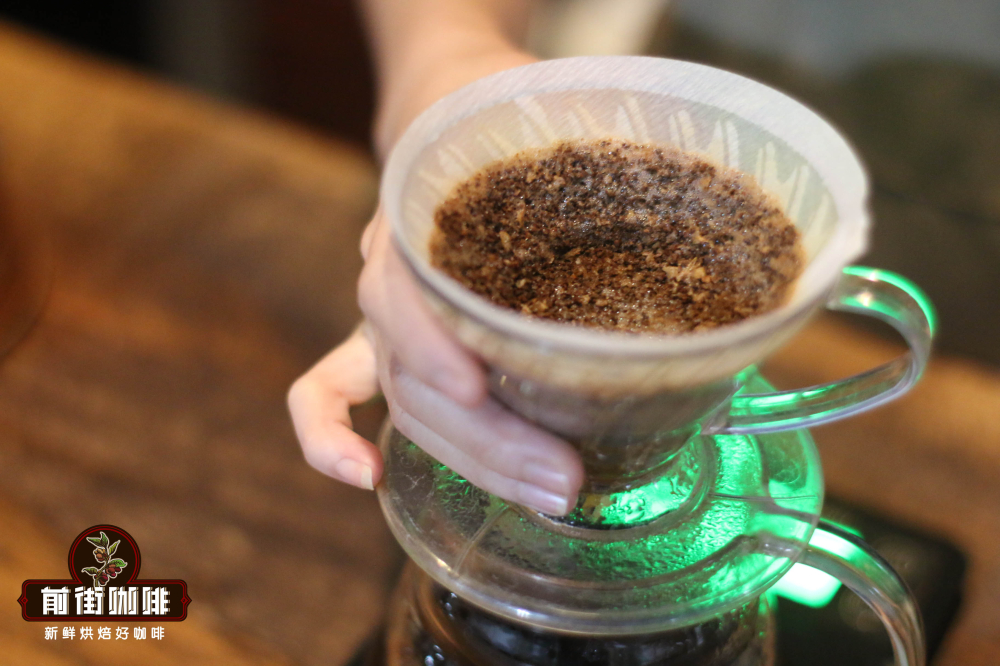
There is another situation that causes over-extraction, provided that the grind size and water temperature are reasonable: the pouring stream is too small, which lengthens the time water takes to pass through the coffee bed, and this can also easily cause over-extraction.
What is under-extraction?
Under-extraction refers to the coffee grounds being in contact with hot water for too short a time, failing to fully extract the flavor they should have. The coffee brewed this way tastes thin, with bitterness and an overall lack of balance. The causes of under-extraction are exactly the opposite of over-extraction: grinding too coarse, or water temperature being too low.
If the grind size and water temperature are both fine, yet the coffee still tastes thin and noticeably watery, it is most likely because the pouring stream is too large, and the water level in the dripper exceeds the coffee bed, causing water to flow directly down the wall of the dripper and dilute the already extracted coffee liquid.
The above content is compiled by CoffeeHunters, a coffee news website.


