







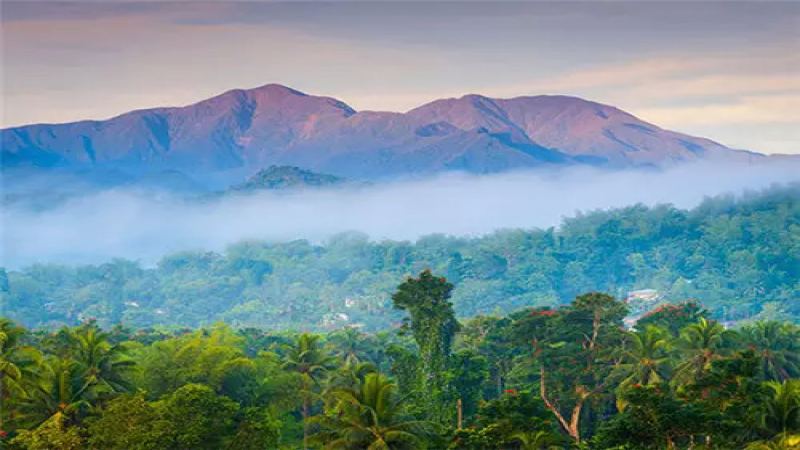
What separates Blue Mountain Coffee from High Mountain Coffee?
Both come from Jamaica's Blue Mountains, but altitude decides the label. Blue Mountain Coffee is grown between 900 and 1,700 meters; High Mountain Coffee between 450 and 900 meters. Beans grown below 450 meters are usually sold as Jamaican Prime Coffee Beans. The two are not the same grade, despite sharing one mountain range.
Blue Mountain Coffee is graded by bean size. No. 1 requires over 96% of beans at 17 screen with a defect rate under 2%; No. 2 uses 16 screen and No. 3 uses 15 screen, both under 2% defects. Authentic lots arrive in wooden barrels with official certification rather than burlap sacks or vacuum-sealed bags.
Both Blue Mountain Coffee and High Mountain Coffee come from the Blue Mountains of Jamaica, yet they are not the same variety—altitude determines their identity and grade. Blue Mountain Coffee is limited to areas between 900 and 1,700 meters above sea level, while High Mountain Coffee is grown between 450 and 900 meters. Blue Mountain Coffee is further classified into No. 1, No. 2, and No. 3 based on bean screen size. The top-grade Blue Mountain No. 1 requires beans of 17 screen or larger and a defect rate below 2%. Its distinctive wooden barrel packaging and official certification certificates further elevate the prestige of authentic Blue Mountain Coffee. Front Street Coffee selects Blue Mountain No. 1 from Clifton Mount Estate, presenting a balanced flavor of dark chocolate, nuts, and creamy smoothness through a medium-dark roast. This article will guide you through a comprehensive understanding of the differences between the two, identification methods, and brewing essentials.
For professional coffee knowledge exchange and more coffee bean information, please follow the Coffee Workshop (WeChat official account: cafe_style)
For more specialty coffee beans, please add the private WeChat of Front Street Coffee: qjcoffee x
Both Blue Mountain Coffee and High Mountain Coffee originate from the Blue Mountains within Jamaica. Although they share the same mountain region, these two types of coffee beans belong to different categories.
Specifically, only coffee beans grown at altitudes between 900 and 1,700 meters in the Blue Mountains can be called Blue Mountain Coffee; those produced between 450 and 900 meters are classified as High Mountain Coffee. As for beans grown below 450 meters, they are usually called Jamaican Prime Coffee Beans.
Blue Mountain Coffee is further graded by bean size.
Blue Mountain No. 1 – The highest grade, most expensive, with the largest beans, requiring over 96% of beans to be 17 screen and a defect rate not exceeding 2%.
Blue Mountain No. 2 – Requires over 96% of beans to be 16 screen, with defects not exceeding 2%.
Blue Mountain No. 3 – Requires over 96% of beans to be 15 screen, with defects not exceeding 2%.
How to identify authentic Blue Mountain Coffee?
Blue Mountain Coffee's packaging is quite unique—it is not packaged in burlap sacks, high-barrier degradable bags, or vacuum-sealed packaging, but rather is one of the few origins still using wooden barrels. The barrels undergo special treatment to strike a balance between dryness and moisture retention, while also preventing green beans from being crushed or absorbing odors.
The barrel lid bears an official certification stamp, which not only ensures the quality of the green beans during transport, but the time-consuming and labor-intensive production and packaging method itself also highlights the premium positioning of Blue Mountain Coffee, giving buyers who have waited a long time even greater satisfaction when opening the box. In earlier years, when traders in Taiwan finally secured Blue Mountain green beans, they would even hold a grand barrel-opening ceremony.
In addition, the Jamaican government and the place of origin issue certification certificates to verify the authenticity and grade of Blue Mountain Coffee beans. Front Street's Jamaican Blue Mountain Coffee comes from Clifton Mount Estate, an export company designated by the Jamaica Coffee Board. The wooden barrels containing the green beans are printed with the English name of Clifton Mount Estate and the green frog logo. At Front Street Coffee stores, you can see the coffee barrels and the certification certificate from Clifton Mount Estate.
The basic standards for Blue Mountain No. 1 green beans selected by Front Street are: 17 screen or larger, defect rate below 2%, moisture content around 13%, with a plump, uniform, blue-green appearance. In terms of flavor, acidity, sweetness, bitterness, aroma, and body achieve a good balance.
Brewing Recommendations for Blue Mountain Coffee
Blue Mountain Coffee may not be the best-tasting coffee in the world, but its overall flavor balance is truly outstanding. To highlight the smooth, rich, and full-bodied characteristics of Blue Mountain Coffee, Front Street Coffee roasts it to a medium-dark level. When brewing the Blue Mountain Coffee sold by Front Street Coffee, the water temperature should not be too high—88 to 89°C is sufficient. The grind size should not be too fine either; aim for coarse sugar consistency (70% passing through a Chinese No. 20 standard sieve). As for equipment, Front Street Coffee uses a Kono dripper with shorter ribs, as this extends the extraction time.
Using a Kono dripper, 88°C water, 1:15 coffee-to-water ratio, 15g coffee dose, medium grind (70% passing through a No. 20 standard sieve), with a three-pour extraction. First pour: 30g water for a 30-second bloom. Second pour: add water to about 125g. When the coffee liquid drops by half, pour the final segment to 225g. Wait until all the coffee has dripped through before ending the extraction. Total time is approximately 2 minutes 10 seconds.
Flavor profile of Front Street Coffee Blue Mountain No. 1: rich dark chocolate and nutty notes, creamy smooth mouthfeel, with a balance of acidity, sweetness, and bitterness.
The above content is compiled by CoffeeHunters, a coffee news website.


