








What makes Yirgacheffe coffee taste like white flowers and citrus?
Yirgacheffe is a specialty coffee region in Ethiopia whose washed beans are typically brewed as pour-over and produce clear white florals, green tea notes, and citrus acidity. The town sits at 1,700 to 2,100 meters, and farmers usually plant coffee trees mixed with other crops around their homes, which shapes the region's flavor profile.
The region was originally part of Sidamo and became independent once its coffee showed a distinctive cup. Light-medium roasting preserves the delicate floral and tea-like character, and a medium-fine grind with staged pouring releases that terroir. The coffee process behind washed Yirgacheffe removes the fruit quickly, so the cup stays clean and bright rather than heavy.
Yirgacheffe is one of Ethiopia's most iconic specialty coffee regions. With its white florals, citrus notes, and a clear, green-tea-like mouthfeel, it has been described as "coffee on the entry, a hundred flowers in bloom." This article walks through the region's history, the washed processing method, the logic behind light-medium roasting, and Front Street Coffee's in-store pour-over parameters, systematically unpacking the sources of Yirgacheffe's flavor and the key points of extraction. Whether you are a newcomer just starting out or an advanced enthusiast, you will come to understand why this bean has become a landmark of the fruity-acid coffee era, and how to fully release its terroir through proper brewing technique.
When we brew Yirgacheffe by pour-over, the cup often reveals clear white florals, green tea notes, and citrus tones, altogether like a refreshing cup of fruit tea. People once used the phrase "coffee on the entry, a hundred flowers in bloom" to describe this unique sensory experience.
Introduction to the Yirgacheffe Coffee Region
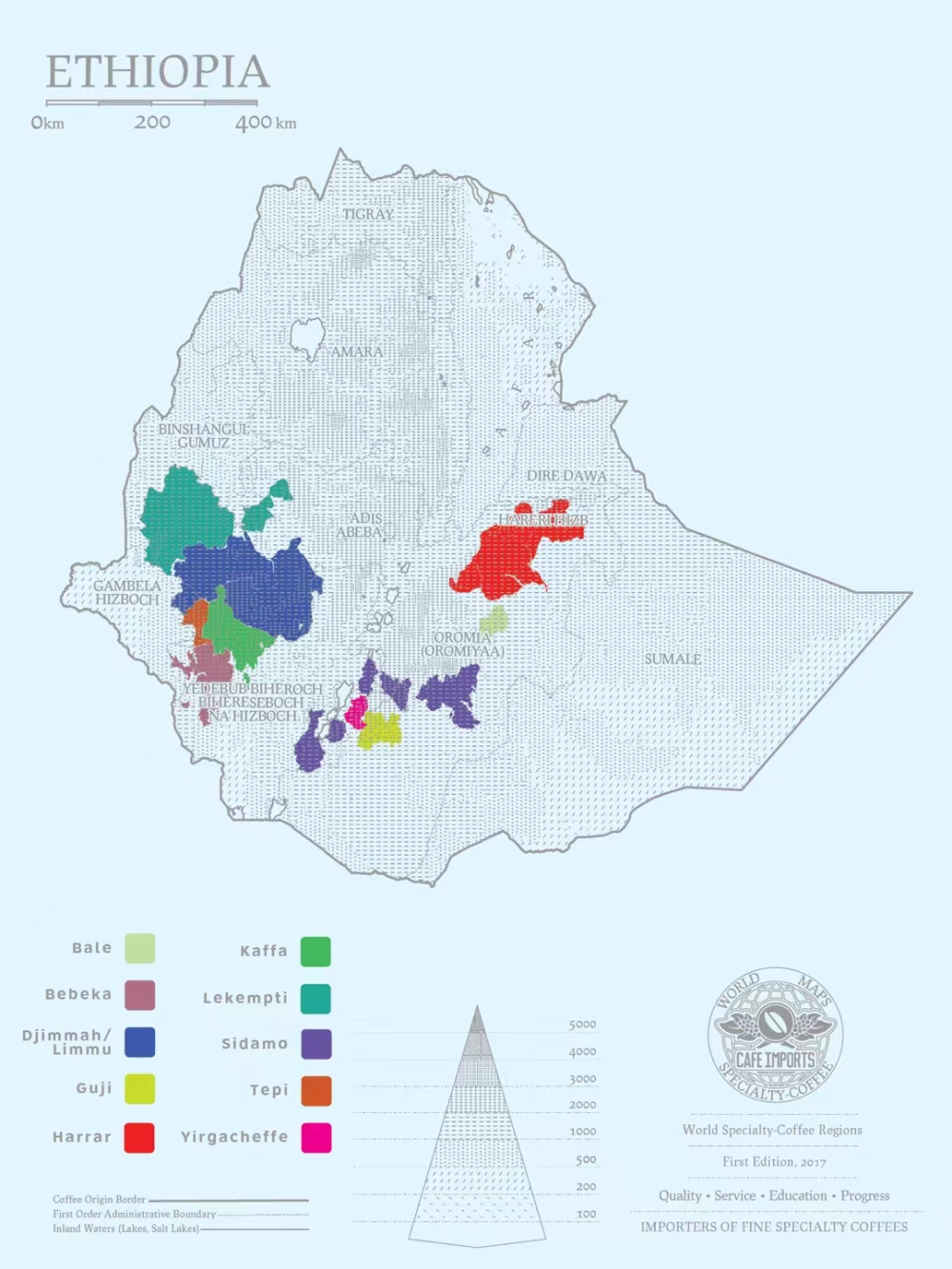
Quite a few countries on the African continent grow coffee, and Ethiopia, as the birthplace of the world's coffee, holds a deep coffee culture, a long cultivation history, and rich varietal resources—it can truly be called a vast coffee gene bank. Ethiopia contains broad stretches of high altitude, with ample rainfall and fertile soil, providing exceptional natural conditions for coffee growing. Sidama (SIDAMA), Yirgacheffe (YIRGACHEFFE), Guji (GUJI), and Harrar (HARRAR) are all region names deeply familiar to coffee lovers.
The name Yirgacheffe comes from the town of Yirgacheffe, which sits at an altitude of 1,700 to 2,100 meters, where clouds and mist swirl during the day and the climate stays mild as spring all year round. Local coffee farmers usually plant coffee trees mixed with other crops in their own yards or in the fields in front of their homes. Strictly speaking, Yirgacheffe was originally a sub-region under Ethiopia's Sidamo Province, located to the northwest of Sidamo. Later, because the coffee produced there showed a distinctive flavor profile and gained worldwide fame, it was separated from Sidamo and became an independent region.
With the rise of the third wave of coffee, consumers have become increasingly willing to pay higher prices for coffees with specific regional flavors. For example, Sidamo coffee carries sweetness and florals, Yirgacheffe coffee has a medium body along with sweetness and sweet aromatics, and Harar coffee presents exotic aromas and rich berry flavors. For protection purposes, the Ethiopian government registered three of the country's well-known coffee regions as commercial trademarks in 2004, among them Yirgacheffe®. Therefore, what we call Yirgacheffe today refers more to a coffee flavor trademark.
If you have just stepped into the world of coffee, Front Street recommends a washed Yirgacheffe everyday-drinking bean, made from locally selected Ethiopian heirloom coffee beans and roasted to a light-medium level. Front Street's everyday-drinking bean series lets friends new to coffee experience a region's basic flavors at an approachable price, and the small-package design also avoids the problem of waste when you can't finish a large bag. If you want to experience Yirgacheffe's classic aromatics, Front Street believes pour-over black coffee is the most suitable choice.
The Characteristics of Washed Yirgacheffe
Beyond its innate terroir, Yirgacheffe's ability to form such a distinct style owes a great deal to the washed processing method. Ethiopia overall is at high altitude with ample sunshine, which is actually very suitable for sun-drying coffee cherries. But traditional natural processing was rather rough—any coffee farmer could do it in their own small yard, spreading the cherries directly on the roof or ground to dry. Crude methods easily bring unpleasant flavors and also lead to uneven coffee quality.
In 1972, the Ethiopian government introduced more advanced washed-processing technology and supporting equipment from Central and South America. Farms using the washed method must build washing channels and ensure a continuous supply of running water, which makes production costs higher. During processing, the fermented beans are pushed back and forth in the channels, and the friction between the beans plus the force of the water current washes the coffee beans until they are smooth and clean. Every step removes impurities and defective beans, so the green beans are more uniform in quality, and the final trading price is also higher than that of coffee processed by natural drying. Washing not only greatly reduces the defect rate of the coffee but also gives Yirgacheffe its fresh citrus tones and elegant white florals, with an overall flavor that is bright, delicate, and clean.
Why Are Yirgacheffe Coffee Beans Roasted to a Light-Medium Level?
In the past, most of the coffee we drank was dominated by burnt bitterness. The reason coffee was so strong and bitter was mainly that roasters roasted the beans very dark; the caramelization reaction consumed a large amount of the lighter flavor compounds, so the main profile leaned toward nuts, dark chocolate, and caramel.
With the emergence of the specialty coffee concept, producers, to cater to public taste, successively released various light-medium roasted coffee beans with floral and fruity notes. In order to retain more acidity, roasters roast Yirgacheffe only to an appropriate light level. Light-roasted Yirgacheffe shows a pleasant fruity sweet-and-sour quality and white florals, and it can be said to have opened "a new era of fruity-acid coffee." Liking sweetness and fearing bitterness is exactly the public's taste tendency, and this is one of the reasons Yirgacheffe is so popular around the world. Front Street hopes everyone can taste the distinctive terroir of the region, so many of the Ethiopian coffee beans on its menu use a lighter roast level, presenting the classic orange-blossom-honey charm.
Pour-Over Recommendations
Many friends consult Front Street about brewing suggestions after buying coffee beans. In fact, Front Street puts brewing references on the label of every bag of coffee beans. Here, Front Street takes the washed Gotiti Cooperative as an example and explains Front Street's extraction approach according to in-store production standards.
Because Yirgacheffe coffee beans grow in high-altitude areas and are relatively hard in texture, Front Street uses hot water at 92°C to 93°C for extraction in order to bring out more florals and fruit flavors in the coffee. As for grind size, Front Street recommends a medium-fine grind (78% passing through a Chinese standard No. 20 sieve). Too coarse and it cannot extract the full-bodied substances, making the brewed coffee seem thin. Too fine and it is easy to over-extract at high water temperature, making the brewed coffee prone to bitterness.
During cupping, Front Street noticed that this bean shows different flavors at different temperatures, so the brewing method uses three-stage extraction, allowing different flavor compounds to present their best selves as the coffee bed rises in temperature in stages. To highlight the fresh, captivating aromatics of washed Yirgacheffe, Front Street uses a V60 dripper for brewing. The dripper's spiral rib design allows the coffee grounds to degas better, maximizing the release and dissolution of aromatic acid compounds.
Dripper: V60 Water temperature: 92-93°C Dose: 15g Coffee-to-water ratio: 1:15 Grind size: caster sugar size (78% passing through a No. 20 sieve)
Three-stage pouring: Wet the coffee bed with twice the coffee's weight in water, forming a dome, and let it bloom for 30s. Then pour in a small stream in circles from the inside out until it reaches 125g, pause, and when the coffee bed drops to half the height of the dripper, continue pouring the third stage with the same fine stream until 225g, until all the coffee liquid has filtered through, then remove the dripper; the time is about 2 minutes. After the coffee in the dripper flows into the server, remove the dripper, then swirl the server to mix the coffee liquid evenly, and you can begin tasting Yirgacheffe's flavors starting from the high temperature.
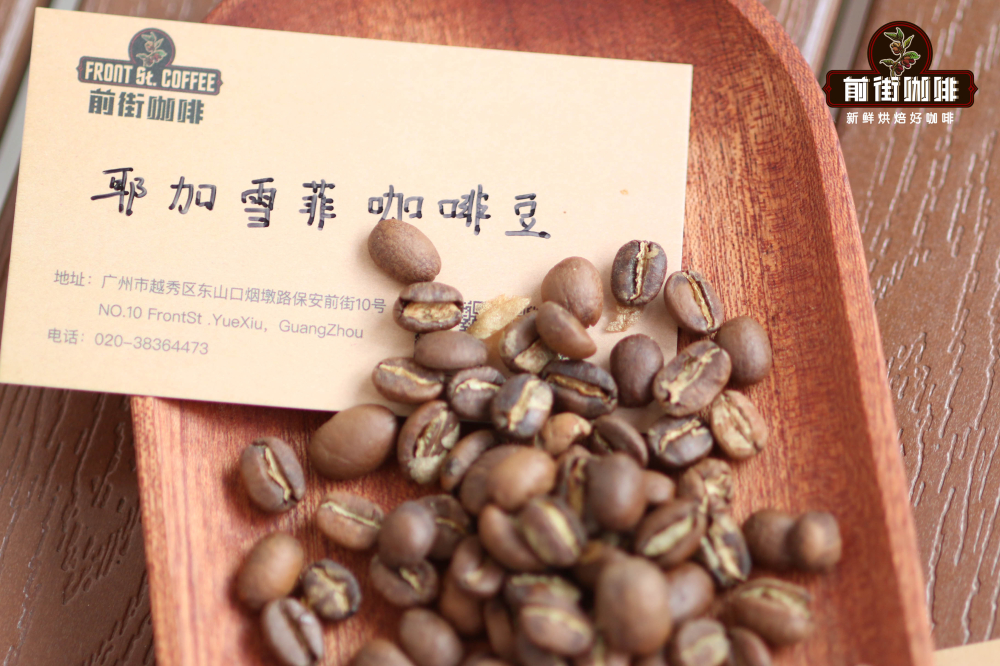
Flavor Description of Pour-Over Washed Yirgacheffe
After washed Yirgacheffe coffee beans are ground into powder, you can smell the fresh fragrance of honey and jasmine. When Front Street pours in hot water, it begins to release traces of berry flavor. The pour-over black coffee enters the mouth with bright lemon, citrus, and green tea, and as the temperature changes there are lingering notes of berries, cream, and sugarcane, with obvious sweet aftertaste and a clean, sweet mouthfeel.
For professional coffee knowledge exchange and more coffee bean information, please follow Coffee Workshop (WeChat public account: cafe_style)
For more specialty coffee beans, please add the private WeChat of Front Street Coffee (FrontStreet Coffee), WeChat ID: qjcoffeex
The above content is compiled by CoffeeHunters, a coffee news website.


