







How does Arabica variety shape Costa Rica honey coffee?
Costa Rica is the only country where growing anything other than Arabica is illegal, and a 1989 law pushed farmers toward higher quality. The Mirazu Estate Geisha blend from Tarrazu uses raisin honey processing, giving the parchment a golden color and the cup thick sweetness with floral and fruity Geisha notes. A medium roast, higher water temperature, and faster-flow dripper bring out the aroma.
The arabica variety is harder to cultivate than others and needs altitude, soil, and climate to line up. Costa Rica has distinct dry and rainy seasons, an average temperature of 17 to 28 degrees Celsius, humidity, and 2,000 to 3,000 millimeters of annual rainfall. More than 80 percent of coffee grows between 800 and 1,700 meters, where volcanic soil feeds the trees.
Costa Rica is renowned for its honey-processed coffee beans, which have a golden color in parchment and a thick, intensely sweet cup. As the only country in the world where it is illegal to grow anything other than Arabica varieties, Costa Rica's pursuit of quality is evident. This article begins with the terroir differences among Costa Rica's seven major coffee-producing regions, focusing on the Strawberry Candy, a Geisha blend from the Mirazu Estate in the Tarrazu region. This bean uses raisin honey processing and combines the floral and fruity notes of Geisha with a strong sweetness. The roaster at Front Street Coffee uses a medium roast, higher water temperature, and a faster-flow dripper to bring out its aroma and sweetness. The article includes complete pour-over parameters and staged pouring steps, making it suitable for coffee enthusiasts to reference and practice.
Coffee beans produced in Costa Rica are often described as precious as gold—not because of a high price, but because the country is known for its honey processing. After honey processing, the parchment beans take on a color close to gold, and honey-processed coffee is rich and full of sweetness on the palate, making it a favorite among those who prefer sweet-tasting flavors.
Most people familiar with specialty coffee know that to be classified as specialty coffee, it must first be an Arabica variety. Interestingly, Costa Rica is the only country in the world where growing varieties other than Arabica is illegal, which shows how much it values high-quality coffee beans. In 1989, the country also passed a law prohibiting the cultivation of low-quality coffee, encouraging farmers to pursue truly outstanding coffee quality.
Arabica itself is harder to cultivate than other varieties. To grow high-quality Arabica beans, strict requirements must be met for altitude, soil, and climate conditions.
Costa Rica has a clear distinction between dry and rainy seasons, with an average annual temperature between 17 and 28 degrees Celsius, an annual temperature range of about 10 degrees Celsius, relatively high air humidity, and annual rainfall between 2,000 and 3,000 millimeters. More than 80% of coffee is grown at altitudes between 800 and 1,700 meters, and the fertile volcanic soil provides ample nutrients for the coffee trees.
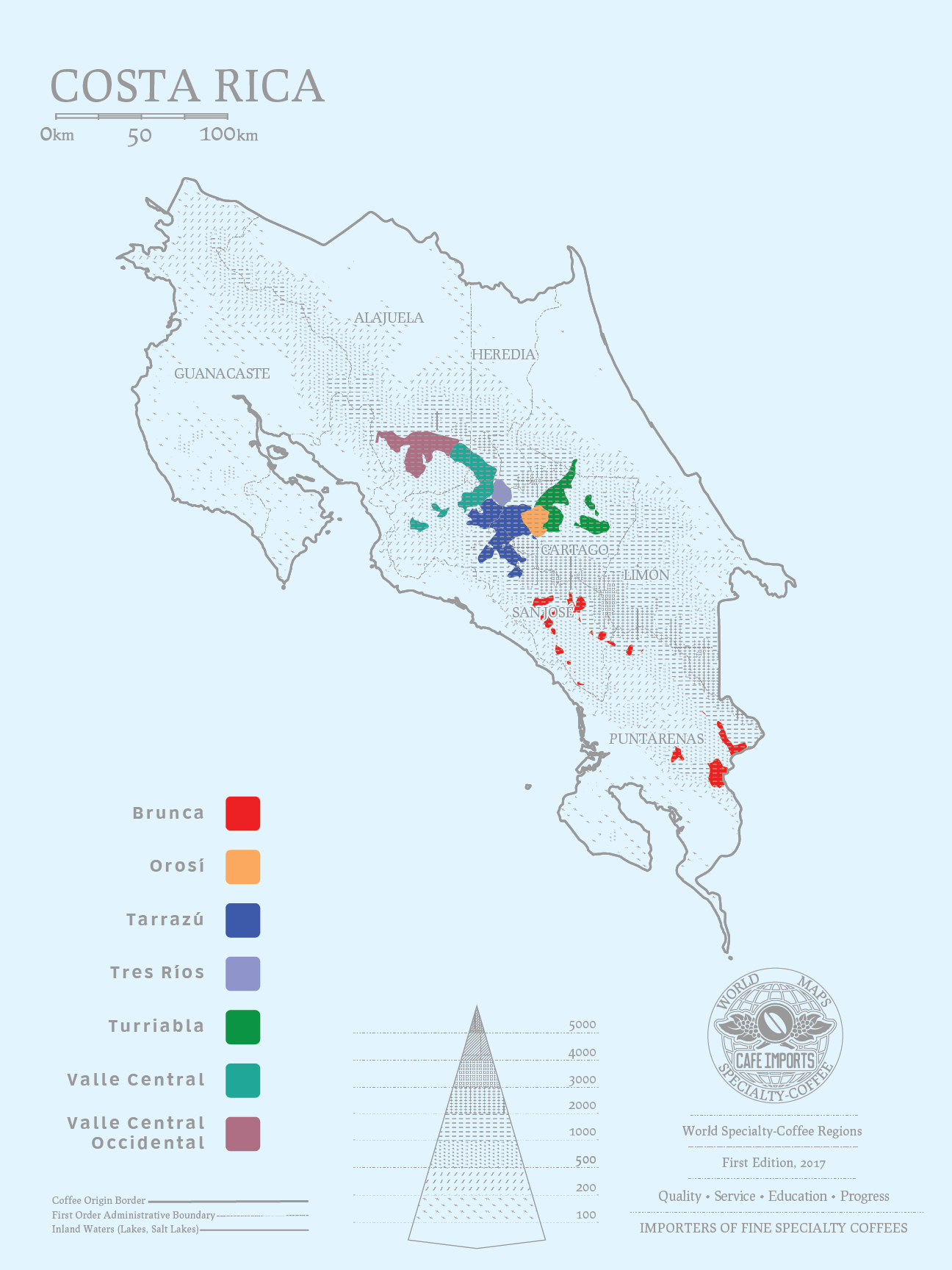
Costa Rica's central, mountainous, and high-altitude areas are divided into seven officially recognized coffee-producing regions. Because the growing altitude mostly falls between 800 and 1,700 meters, most of the country's coffee beans can be classified as SHG-grade strictly hard beans. Below is a look at the subtle differences among the regions.
[Central Valley]
Coffee production in the Central Valley accounts for about 15% of the national total. The region lies at an altitude of 1,000 to 1,200 meters, and the soil is mainly volcanic. The unique local microclimate gives the coffee beans rich fruit and chocolate notes, along with a pleasant hint of honey aroma.
[Tres Rios]
This region is located on the slopes of Irazu Volcano, just a few miles from the capital, San Jose, and is one of Costa Rica's well-known producing regions. It is also the smallest of all the regions, with coffee grown at altitudes of up to 1,650 meters. The coffee produced here is bright and clear, with honey-like sweetness and rich fruit flavors.
[Brunca]
Located at the southernmost tip of Costa Rica, the Brunca region contributes nearly 20% of the country's coffee production. The area spans a wide range of altitudes, from 800 to 1,700 meters. Overall, Brunca's coffee beans are milder than those from other regions and carry layered citrus fruit aromas.
[Turrialba]
Named after the local volcano, this region receives the most rainfall among the eight coffee-producing regions. Most coffee trees grow above 1,400 meters. Turrialba's coffee beans are characterized by a light, soft body, delicate aroma, and moderate acidity.
[Tarrazu]
Tarrazu is regarded as one of Costa Rica's highest-altitude coffee-producing regions, and its beans are also considered among the finest representatives in the country. The region's flavor expression is outstanding, and because of the very high altitude, it is rich in SHB-grade strictly hard beans.
[Orosi]
Orosi is one of Costa Rica's oldest coffee-growing areas, with a history dating back nearly a century. The region receives more rainfall than other regions, and most coffee is grown on the slopes of the Orosi Mountains at altitudes of 1,000 to 1,400 meters. Thanks to the favorable climate conditions, the coffee produced here has a smooth and balanced taste.
[Western Valley]
This region is located at the westernmost end of Costa Rica, adjacent to Tarrazu, and accounts for about 25% of the country's total coffee production. The growing altitude is between 1,200 and 1,700 meters, and the coffee cherries ripen more slowly than in the Tarrazu region.
As early as the nineteenth century, the Costa Rican government strongly promoted coffee cultivation. Today, the country has produced many coffee estates with international reputations, and Mirazu Estate is one of them. On Front Street Coffee's bean list, there is a honey-processed coffee bean from Mirazu Estate.
Front Street Coffee: Costa Rica · Mirazu Estate Strawberry Candy Coffee Beans
Region: Tarrazu, Costa Rica
Estate: Mirazu Estate
Altitude: 1,700 meters
Varieties: Geisha, ET47, SL28, Maico
Processing method: Raisin honey processing
Mirazu Estate owner Esteban Sanches originally worked at La Candelilla Estate and has considerable knowledge of coffee equipment and post-harvest green bean processing. Later, relying on his own unique understanding of coffee, he left La Candelilla Estate and established a coffee estate on his own, naming it Mirazu. In the local language, Mirazu means "overlooking Tarrazu." Esteban Sanches firmly believes that the quality of coffee is already determined on the tree.
This Costa Rican Tarrazu coffee bean is a Geisha blend, with Geisha making up 50%, and the other 50% composed of ET47, SL28, and Maico.
Front Street has mentioned in several articles about Geisha that the Geisha variety originated in the Geisha forest of Ethiopia and was sent to the Kenyan Coffee Research Institute in the 1930s for study, where it received little attention at the time due to its unremarkable flavor performance. After passing through several hands, Geisha arrived in Costa Rica in 1953 at the Tropical Agricultural Research and Higher Education Center (CATIE) in Central America and was cataloged as T2722. In the 1960s, it was distributed to Panama for cultivation, and because of its low yield, coffee farmers used it only as a windbreak tree. It was not until 2004, when Hacienda La Esmeralda sent Geisha to compete in the BOP competition and won first place, that the Geisha variety gradually became famous.
After receiving this Geisha blend, the barista at Front Street Coffee chose a medium roast level to highlight the intense floral and fruity aroma of the Geisha variety and the strong sweetness brought by honey processing.
Once the roasted beans arrived, the barista at Front Street Coffee decided to brew with a higher water temperature (93 degrees Celsius), a finer grind (80% passing through a Chinese standard No. 20 sieve), and a faster-flow dripper (Hario V60) to bring out the coffee's aroma and sweetness.
Pour-over parameter sharing
Dripper: Hario V60
Water temperature: 93 degrees Celsius
Dose: 15 grams
Coffee-to-water ratio: 1:15
Grind size: 80% passing through a Chinese standard No. 20 sieve
First pour 30 grams of water for a 30-second bloom, then slowly pour the second stage in a gentle circular motion with a small stream until reaching 125 grams to complete the stage; then gently and slowly pour the third stage of hot water in a circular motion until reaching 225 grams, with a total extraction time of about 2 minutes.
For more coffee bean information, please follow Coffee Workshop (WeChat public account: cafe_style) For professional coffee knowledge exchange, please add WeChat ID: kaixinguoguo0925
The above content is compiled by CoffeeHunters, a coffee news website.


