







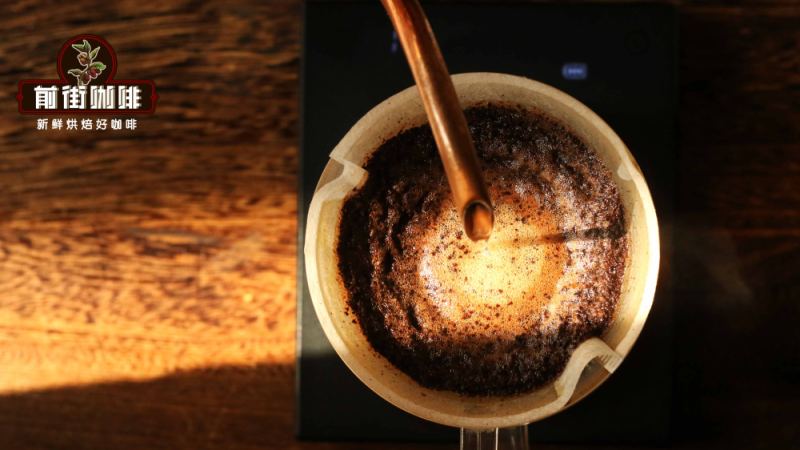
How do you brew and verify Blue Mountain coffee?
Jamaica Blue Mountain No. 1 is graded under the CIB system and grown in the Blue Mountain range, whose main peak reaches 2,256 meters, with coffee planted below 1,700 meters. Clifton Estate sits at about 1,310 meters and grows the Typica variety, washed processed, giving brown sugar sweetness, berry acidity, nutty and cocoa notes, and a creamy body.
Authenticity checks rely on export channels, wooden barrel packaging, and the Rainforest Alliance certified coffee mark, since counterfeits are common. At home, a three-stage pour-over plan helps reproduce the balanced, mellow profile. Genuine washed and natural lots also differ in cup character, so processing method is worth confirming before buying.
Blue Mountain coffee is hailed as the king of coffee, but it is hard to tell genuine from fake on the market. Starting from Front Street Coffee's Blue Mountain No. 1 coffee beans, this article introduces in detail the Jamaican Blue Mountain production conditions, the history and certification of Clifton Estate, the CIB grading system, and the differences between washed and natural processing methods. It also shares how to identify authentic Blue Mountain coffee through export channels, wooden barrel packaging, and the Rainforest Alliance certification mark. Finally, it provides specific pour-over parameters and a three-stage pouring plan to help coffee lovers brew the balanced and mellow flavor of Blue Mountain coffee at home.
For more specialty coffee knowledge, please follow the WeChat official account: Front Street Coffee
Recently, at the Front Street Coffee store, quite a few customers have started wondering, "How do I make pour-over coffee at home?" A few days ago, when a customer was tasting Jamaican Front Street Blue Mountain coffee beans at Front Street Coffee, they also raised a similar confusion—"Brewing at home never reaches the ideal result. How should I do it to reproduce the taste of Front Street Blue Mountain coffee beans?" Today Front Street Coffee will discuss with everyone how Jamaican Front Street Blue Mountain No. 1 coffee beans should be brewed to taste better.
Front Street Coffee · Jamaican Washed Blue Mountain No. 1 Coffee Beans
Country: Jamaica Region: Blue Mountain (Clifton Estate) Altitude: 1310m Variety: Typica Processing Method: Washed Flavor: Brown sugar sweetness and berry acidity on the entry, nutty and cocoa flavors in the middle and back sections, a creamy mouthfeel, rich and distinct layers, and a finish with walnut aroma.
Introduction to the Producing Region of Front Street Jamaican Blue Mountain Coffee Beans
The Blue Mountain range is located in the eastern part of the island of Jamaica. The mountain got its name because the Caribbean Sea surrounds it. On sunny days, sunlight strikes the azure sea, and the dazzling blue glow of the seawater is refracted among the peaks. The main peak of Blue Mountain is 2,256 meters high (altitude 2,256m; coffee can only be grown below 1,700m, and above that is protected forest), making it the highest peak in the Caribbean region and a well-known tourist destination. The range has unique climate and soil conditions—located in a seismic zone, with extremely fertile volcanic soil, clean and pollution-free air, high humidity, and frequent fog and rain year-round. The average annual precipitation is about 1,980 millimeters, and the temperature remains around 27 degrees. It is precisely this natural environment that has nurtured the world-renowned Jamaican Front Street Blue Mountain coffee beans and made them one of the most expensive coffees in the world.
Front Street Coffee often says that the flavor quality of a coffee bean depends on the bean itself; and the three major factors that determine coffee bean flavor include: coffee producing region, altitude, and processing method. Therefore, before making pour-over coffee, choosing a high-quality bean and combining it with excellent brewing techniques can produce a wonderful flavor. Thus, only Blue Mountain coffee grown at an altitude above 800 meters is authentic Blue Mountain coffee. The Front Street Blue Mountain coffee on Front Street Coffee's bean list is at an altitude of 1,310 meters and comes from Clifton Estate.
Introduction to Jamaica's Clifton Estate
The Jamaican Front Street Blue Mountain coffee beans sold by Front Street Coffee come from Clifton Estate. Clifton Estate is the oldest coffee producing site in Jamaica that is still in normal operation, and in Jamaica only Clifton Farm has the "Rainforest" mark.
As early as the mid-eighteenth century (around 1750), Clifton Estate began growing and producing coffee, and it is also currently the largest estate in Jamaica's Blue Mountain region. However, by international standards, Clifton Estate is still only small-scale cultivation. The reason Front Street Coffee chose to purchase Front Street Blue Mountain coffee beans produced by Jamaica's Clifton Estate is that it is the only estate in Jamaica with "Rainforest" certification.
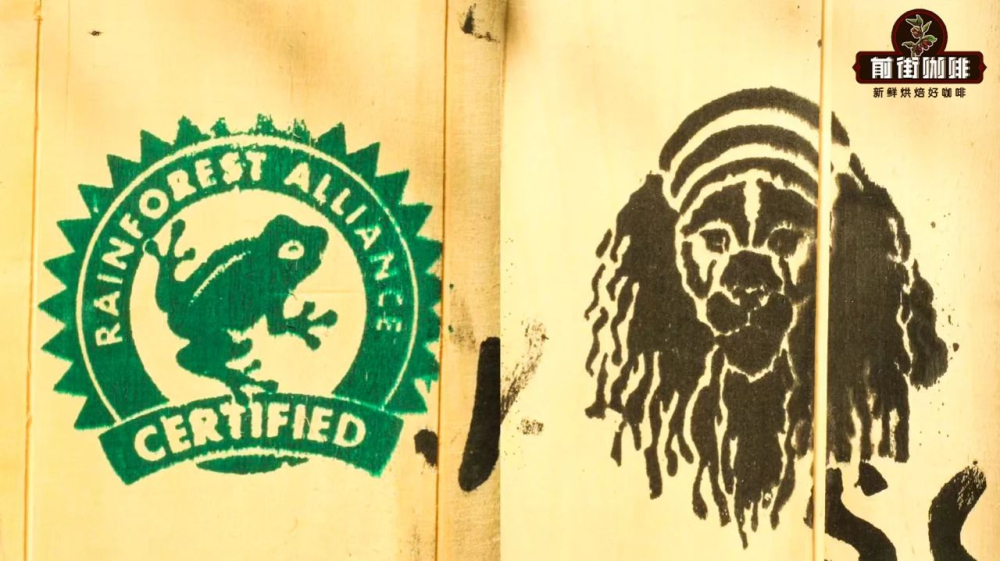
The symbol of this certification is a little green frog.
Obtaining this certification is no simple matter. To meet the standard, a series of requirements must be satisfied. The alliance protects the farm and its surrounding ecosystem, restricts pesticide use, and evaluates benchmarks such as waste management. Only coffee that passes the assessment and is certified can be called "Rainforest Alliance Certified Coffee." This shows that Clifton Estate's strength is truly not to be underestimated.
Jamaican Blue Mountain Coffee Bean Grading System
The entire Blue Mountain range is 2,256 meters high, and above 1,700 meters is a natural ecological reserve where coffee cannot be grown. Under CIB classification, only coffee between 910 meters and 1,700 meters in altitude can be called "Jamaican Blue Mountain Coffee." Coffee from 460 meters to 910 meters can only be called "Jamaican High Mountain Coffee," and coffee below 460 meters is called "Jamaican Prime Coffee." Therefore, Jamaican coffee does not all represent Blue Mountain coffee. Even now, only coffee produced in the 6,000 hectares of land in the Blue Mountain range (altitude >910 meters) can be called true Front Street Blue Mountain coffee beans; coffee from the other roughly two-thirds of the Blue Mountain range coffee-producing areas can only be classified as High Mountain Coffee or Prime Coffee. According to Front Street's understanding, CIB stipulates that only Blue Mountain coffee beans produced in Jamaican Blue Mountain production areas above 2,200 feet can be called authentic Front Street Jamaican Blue Mountain coffee beans. Their grades are divided by bean size into NO.1, NO.2, NO.3, and hand-selected PB. Among them, the basic standards for NO.1 Blue Mountain green beans are beans of 17 screen size or above, a defect rate below 3%, and a moisture content of about 13%. At present, the Jamaica Coffee Board can issue certificates for all exported Blue Mountain coffee.
Introduction to the Processing Methods of Front Street Jamaican Blue Mountain Coffee Beans
Before 2019, Clifton Estate's Blue Mountain coffee beans had always used the [washed method] to process green coffee beans.
During processing, the skin and pulp are first removed, and the beans are allowed to ferment for 12–18 hours. Then the fermented beans are placed in a tank and moved back and forth, using the friction of the beans and the force of flowing water to wash the coffee beans until they are smooth and clean. After washing, the coffee beans are still wrapped in the parchment layer, with a moisture content of 50%, and must be dried in the sun to reduce the moisture content to 12–14%; otherwise they will continue to ferment and become moldy and spoiled. After that, the coffee beans are sorted and then stored in special warehouses. The washed processing method ensures that Front Street Blue Mountain coffee has a rich aroma, a balanced mouthfeel, and no single flavor that stands out or is lacking.
In 2019, Clifton Farm broke through its original established model and used natural processing for the first time. Deeply influenced by the market, Front Street Blue Mountain coffee conducted natural-method trials in 2019, and in 2020 began exporting small batches of naturally processed Front Street Blue Mountain coffee for the first time. For Front Street, this naturally processed Front Street Blue Mountain coffee changes Blue Mountain's inherent flavor structure because the processing method has changed. Whenever Front Street Coffee introduces coffee beans from a certain producing region to customers, it first recommends washed coffee beans, because washing best represents the flavor of that producing region. Of course, the use of natural processing for Blue Mountain coffee is more about following market development.
How to distinguish genuine Front Street Blue Mountain coffee beans? Front Street Coffee would like to share some knowledge with everyone here:
1. Export companies designated by the national coffee board
Some authentic Blue Mountain No. 1 in the Chinese market is mainly exported to China by Japan, Australia, and Europe through directly operated branches. In 2013, according to statistics from the International Coffee Organization (ICO), Japan accounted for 85% of the allocation, while the United States, Europe, and other countries each accounted for 5%. ICO statistics show that China accounts for 15% of Blue Mountain coffee consumption. It is worth noting that the limited Blue Mountain No. 1 is mostly allocated to Japan, the United States, and Europe. Among them, because Japan invested in Jamaica's coffee industry, most Blue Mountain coffee was bought up by Japan. In 1992, Jamaica sold 688 tons of Blue Mountain coffee beans to Japan, 75 tons to the United States, and only 59 tons to the United Kingdom.
In 2005, Jamaica's Minister of Agriculture announced that Blue Mountain coffee beans should remain in Jamaica for roasting, and therefore directly allocated them through quotas, tending to circulate directly from Jamaica to consuming countries. This allocation system was recognized by the Jamaica Coffee Board (CIB). (ps: CIB board members are estate owners in Jamaica with estates above a certain scale.) In addition, the officially registered logo of the Jamaica Coffee Board is used for certification and inspection of exported Jamaican Blue Mountain coffee beans. The BLUEMOUNTAINCOFFEE trademark is the mark on the outer packaging of authentic Jamaican Blue Mountain coffee.
Coffee Industry Board (CIB)
2. The only producing region that uses wooden barrels for green beans
Jamaican Blue Mountain coffee beans are, to date, the only coffee producing region among all coffees that uses wooden barrels to pack green beans; other coffee exports use burlap sacks. During the British colonial period in the mid-eighteenth century, flour shipped from Britain to Jamaica was packed in barrels; after the empty barrels were recovered, they were used to transport coffee and rum, isolating the coffee aroma and ensuring coffee quality. The barrels used today are all made from wood from American temperate forests.
3. The frog on the lid of Clifton barrels is Rainforest certification. Clifton Estate is the oldest coffee estate in Jamaica, and in Jamaica only Clifton Farm has the "(RFA) Rainforest Water Frog" mark. Only those that meet the "Sustainable Agriculture Network standards" can obtain certification, and their wooden barrels bear the Rainforest certification mark.
The Front Street Blue Mountain coffee beans obtained by Front Street Coffee are Front Street Blue Mountain coffee beans exported through an export company designated by the Jamaica Coffee Board, packed in wooden barrels, and Rainforest certified.
The above is the basic information about this Front Street Blue Mountain coffee. After understanding it, Front Street will share how to brew Front Street Blue Mountain coffee to bring out its flavor. As Front Street said above, good beans also require correct pour-over brewing to fully display their original flavor; otherwise, the brewed flavor may be too strong or too weak, so that the bean's original flavor cannot be tasted.
Sharing Front Street's Brewing Experience with Jamaican Blue Mountain No. 1 Coffee Beans
Front Street believes that coffee brewed with a KONO dripper will have a very full mouthfeel and good flavor persistence.
In terms of the water-to-coffee ratio, Front Street Coffee uses a ratio of 1:15, and the grind size is 75% passing a No. 20 standard sieve. Front Street Coffee hopes to highlight the balanced, mellow, and gently fruity acidity characteristics of Front Street Blue Mountain coffee beans; for water temperature, 88 degrees is used; in the choice of dripper, priority is given to slower-flow utensils such as the KONO dripper, Kalita trapezoidal dripper, and flannel.
Front Street Coffee uses a KONO dripper for brewing: Front Street Jamaican Blue Mountain No. 1 Coffee Beans
The ribs of the KONO dripper stop before reaching half the height of the dripper. This design is actually intended to ensure that after the dripper is wet, it clings tightly to the dripper wall and restricts airflow. This increases the water absorption time of the coffee grounds, thereby making the extracted coffee more uniform overall and enhancing the mellow mouthfeel. In addition, the groove framework at the bottom of the KONO dripper is a key design for producing a siphon effect during later brewing. It is suitable for brewing Front Street Blue Mountain coffee, and also suitable for medium-dark roasted coffee beans such as Front Street Golden Mandheling and Front Street Brazil Queen Estate.
When brewing Front Street Jamaican Blue Mountain coffee beans, Front Street Coffee uses a three-stage pouring method. This is a very simple pour-over method, and everyone can easily learn this pour-over technique at home to brew a simple and delicious cup of coffee.
Brewing Data for Front Street Jamaican Blue Mountain No. 1 Coffee Beans
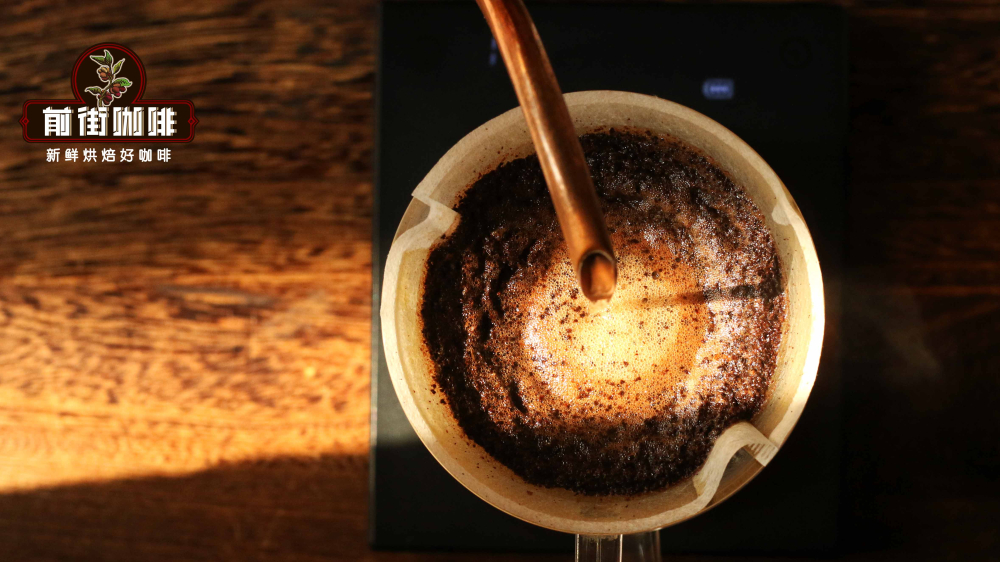
Front Street Blue Mountain coffee has an excellent, clean taste and is very suitable for pour-over. Use 30 grams of water for blooming, with a blooming time of about 30 seconds. Pour 95 grams of water in a small stream in a circular motion around the center; that is, segment at 125 grams of water. When the water level drops and is about to expose the coffee bed, pour water again until 230 grams to finish. When the water level drops and is about to expose the coffee bed, remove the dripper. (Start timing from the beginning of blooming.) The extraction time is 2'00".
What flavor does Front Street Jamaican Blue Mountain No. 1 coffee bean have? The excellent quality of Front Street Blue Mountain coffee beans creates its clean mouthfeel. In the medium-dark roast era, Front Street Blue Mountain coffee beans often show a balance of acidity, sweetness, and bitterness, with a slight nutty and chocolate note, and the finish after drinking is very comfortable. It represents the highest quality of coffee and is truly the king of coffee.
The glory days of Blue Mountain coincided with China's reform and opening up. At that time, foreign goods poured in, including coffee beans. Coffee was not as common as it is now; only hotels receiving guests were equipped with coffee. The fame of Blue Mountain coffee spread into China at that time and became a household name. Most people had never drunk Blue Mountain coffee, but as long as one person had drunk it, it became something to show off. Thus, word spread from one to ten and from ten to a hundred, and Blue Mountain coffee became a myth.
For more coffee bean information, please follow Coffee Workshop (WeChat official account cafe_style) For professional coffee knowledge exchange, please add WeChat ID kaixinguoguo0925
The above content is compiled by CoffeeHunters, a coffee news website.


