







What defines the cup of Yirgacheffe green coffee beans?
Yirgacheffe is Ethiopia's most recognized specialty coffee region, known for floral and lemon-citrus notes. It sits on the eastern side of the East African Rift Valley in Sidamo Province, at 1,700 to 2,100 meters, among the highest coffee-growing areas anywhere. Nearby Wenago, Kochere, and Gelena Abaya share enough flavor commonality to be included in the region.
Processing shapes the final cup. A brewing comparison of Kochere washed green coffee beans against Red Cherry natural lots shows clear differences: the washed version tends toward cleaner florals and acidity, while the natural leans fruitier and sweeter. Ethiopia also drinks about 40 percent of its own production, and the name Yirgacheffe itself traces to early inhabitants settling on high ground.
Yirgacheffe is Ethiopia's most iconic specialty coffee region, renowned worldwide for its floral and citrus-lemon notes. This article begins with the region's geography, grading system, and the washed and natural processing methods, systematically analyzing the flavor formation of Yirgacheffe. Through a brewing comparison between Front Street Coffee's Kochere washed beans and Red Cherry natural beans, it presents the specific differences between the two processing methods in the cup. It also includes Front Street's brewing recommendations and a Yirgacheffe cold brew recipe, helping coffee enthusiasts gain a more comprehensive understanding of this region's charm.
When it comes to coffee, Ethiopia is a country that cannot be overlooked—it is both the birthplace of coffee and the native home of the Arabica species, boasting the world's longest coffee-drinking tradition. Unlike other African producing countries that export nearly all their coffee, Ethiopia consumes about forty percent of its coffee production domestically.
Ethiopia is home to numerous famous producing regions, among which the most talked-about is undoubtedly Yirgacheffe, which is virtually a household name in specialty coffee circles. Front Street Coffee's specialty bean list includes several Yirgacheffe offerings, and customer feedback has always been positive. The name Yirgacheffe originates from the historical account of early inhabitants choosing high ground to avoid water, and it is said that the French were the first to discover the outstanding flavors of coffee from this area. Today, Yirgacheffe is a must-stock item for specialty bean merchants, celebrated worldwide for its floral and delicate lemon-citrus notes.
Yirgacheffe
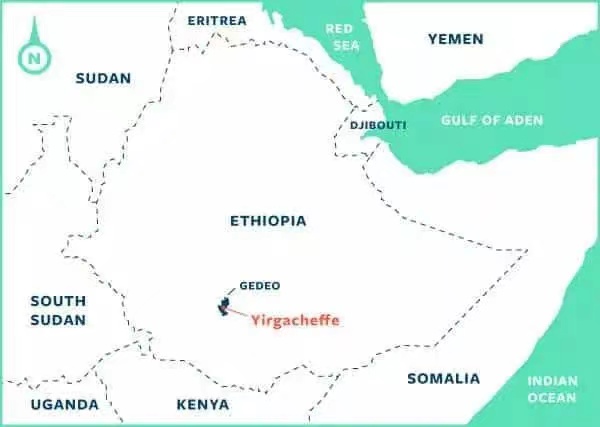
Yirgacheffe is located on the eastern side of the East African Rift Valley, administratively belonging to a small town in Ethiopia's Sidamo Province. Because its coffee has a unique flavor profile, it was designated as a separate producing region. The three nearby sub-regions of Wenago, Kochere, and Gelena Abaya are also included within the Yirgacheffe region due to their coffee flavors sharing significant commonalities with Yirgacheffe. The region sits at an altitude between 1,700 and 2,100 meters, making it one of the highest coffee-producing regions in the world and synonymous with Ethiopian specialty coffee.
Coffee trees in the Yirga area are mostly planted in farmers' own backyards or intercropped with other crops in their fields, with limited output per household—a typical garden coffee model. Mountain villages are shrouded in mist year-round, with spring-like weather in all four seasons, cool breezes in summer, cool but not hot, humid but not damp, and no threat of cold damage in winter. Perhaps it is precisely these geographical and climatic conditions that give rise to the region's distinctive citrus and floral terroir flavors.
Yirgacheffe Coffee Beans Grading
According to differences in green bean processing methods, Yirgacheffe can be divided into two major categories:
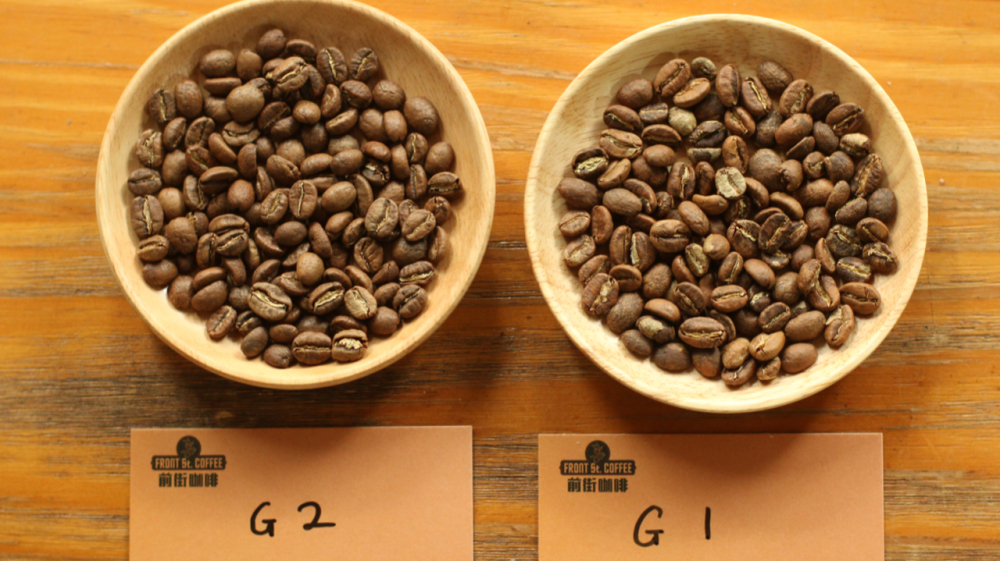
Category A is the washed processing method, with grading standards set by the Specialty Coffee Association of America (SCAA), divided into Gr-1 and Gr-2. The smaller the Arabic numeral, the higher the grade. G1 Yirgacheffe has a distinct style with intense citrus and floral notes. Category B is sun-dried (natural) green coffee beans, graded as Gr-1, Gr-3, Gr-4, and Gr-5. Similarly, the highest grade G1 natural Yirgacheffe has rich fruity flavors. Among these, washed Grade 1 means 0–3 defective beans per 300 grams of green beans; Grade 2 means 4–12 defective beans per 300 grams.
Washed Processing Method
Traditionally, Yirgacheffe coffee used the oldest natural (sun-dried) processing method, but early natural beans were mostly spread flat on the ground to dry, inevitably picking up earthy and dusty off-flavors. Combined with inadequate sorting, natural bean quality was generally mediocre. In 1972, Ethiopia introduced washed processing technology from Central and South America to improve coffee quality, making Yirgacheffe's jasmine and citrus-lemon aromas clearer and more transparent, propelling it into the ranks of the world's representative specialty coffees.
The washed method makes it easier to control coffee bean quality compared to the natural method. The key lies in slowing down the "fermentation" process by washing the coffee. Because it requires large amounts of water, countries with scarce water resources generally use the washed processing method less. Front Street believes that in the same producing region, the washed method presents the coffee bean's base flavors, while natural and honey processing add aroma and some sweetness on top of that foundation. The washed method highlights the primary flavors, while the natural method and honey processing weaken the primary flavors while adding aroma and sweetness.
Front Street Coffee (FrontStreet Coffee) recognizes that washed processing better demonstrates coffee's clean mouthfeel and pure flavor presentation, so when analyzing the specific flavors of a coffee-producing region, it uses that region's washed beans as a reference.
The Washed Processing Method Workflow
Bean selection: Harvested cherries are placed into large water tanks. Ripe cherries sink to the bottom, while underripe or overripe cherries float on the surface.
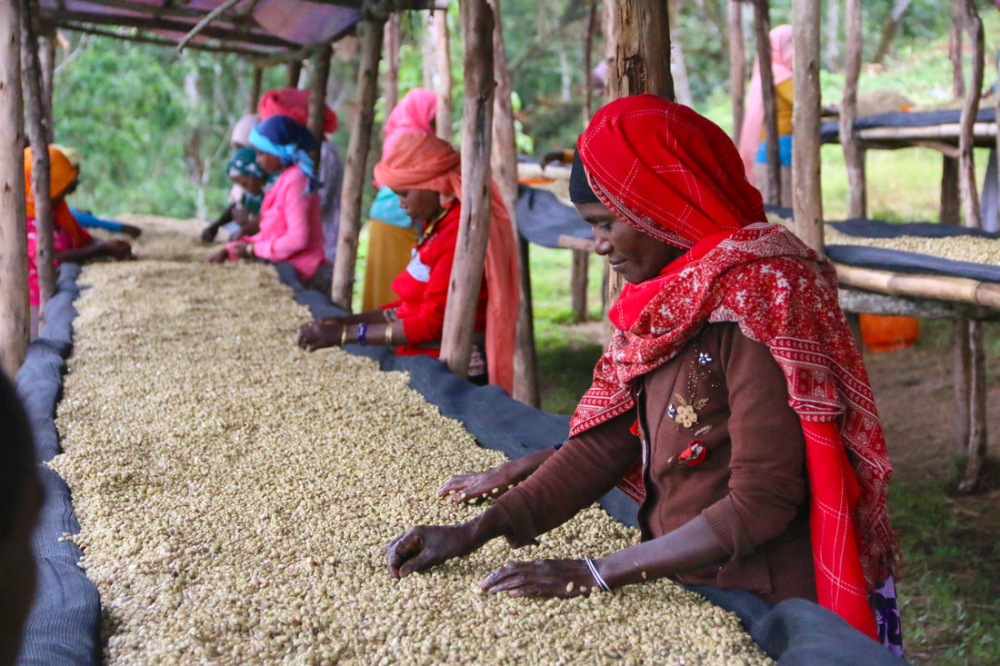
Pulp removal: Machines remove the skin and pulp, leaving only the coffee beans coated in mucilage. The washing process is about rinsing off this layer of mucilage. Fermentation: The mucilage has strong adhesion and is not easy to remove. It must be placed in tanks for about 18–36 hours, using microbial fermentation to break down the mucilage. Washing: The fermented beans are placed in water tanks and rinsed back and forth, using the friction between the beans and the water flow to wash the coffee beans clean. Drying: After washing, the coffee beans have a moisture content of 50% and must be dried to bring the moisture content down to 12%, otherwise excessive moisture will cause mold and spoilage. The best method is sun drying—though it takes 1–3 weeks, the flavor is superior. Some places use machine drying, which greatly shortens processing time, but the flavor is relatively inferior to sun-dried coffee beans.
Hulling: After drying, the coffee beans are stored in warehouses for one week (to stabilize moisture content), then sent to the factory for hulling to remove the parchment layer.
Sorting and grading: Defective beans are removed and better quality is ensured, then the beans are sold to exporters who distribute them around the world.
Natural (Sun-Dried) Processing Method
Natural processing is one of the oldest and most traditional processing methods. After coffee cherries are harvested, they are immediately dried in the sun. It is more common in areas with abundant sunlight or scarce water resources—for example, nearly seventy percent of coffee cherries in all Ethiopian producing regions undergo natural processing. Front Street believes that compared to washed coffee, natural coffee has lower acidity, higher sweetness, a clearer body, but slightly lower cleanliness. In terms of flavor, it produces more berry-like notes and is more complex.
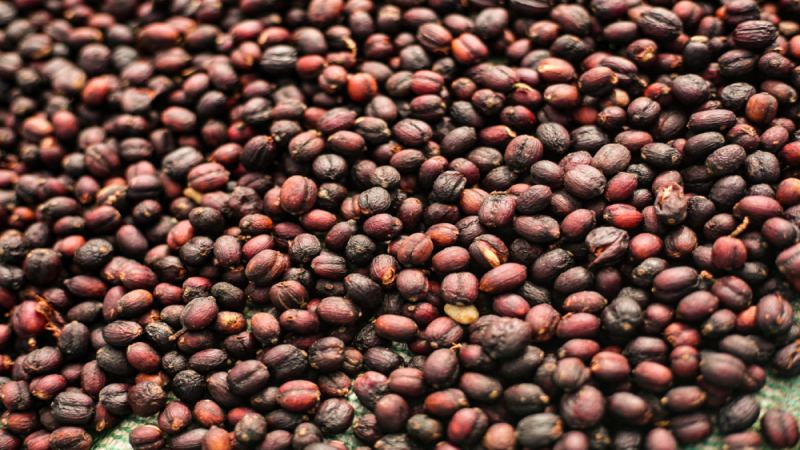
Yirgacheffe natural processing involves selecting usable coffee cherries, then placing the whole cherries with flesh and skin intact on raised drying beds for sun-drying. It is precisely this labor-intensive raised-bed drying method that isolates the cherries from contact with the ground, preventing earthy off-flavors during sun-drying, resulting in exceptionally clean fruity flavors. After more than two weeks of sun-drying, the dark brown coffee cherries are professionally stored, waiting for the full flavor to mature. Only before shipment are the coffee beans removed from the cherries—the sweetness can be imagined.
Yirgacheffe Coffee Bean Characteristics and Taste
Yirgacheffe Coffee Flavor : Light roast has a unique lemon, floral, and honey-like sweet aroma, with soft fruit acidity and citrus notes, and a fresh, bright mouthfeel. Some have used the phrase "coffee enters the mouth, a hundred flowers bloom" to describe Yirgacheffe's coffee flavor characteristics—like flowers stimulating the taste buds and nasal olfactory cells with a pleasant sensation. Beyond the floral aroma, the delicate body is like silk massaging the mouth, a wondrous tactile experience. Yirgacheffe's floral and citrus or citric acid notes are very pronounced; washed beans have a fresh, fragrant taste with bright fruit acidity and a noticeable tea-like quality; natural beans are rich in tropical fruits with fermented aromas, a full body, and sweet taste.
Natural vs. Washed Brewing Recommendations and Flavor Comparison
Front Street Coffee (FrontStreet Coffee) starts with Yirgacheffe washed and natural green coffee beans, comparing them through brewing to see the differences between Front Street Coffee (FrontStreet Coffee)'s Yirgacheffe washed Kochere coffee beans and natural Red Cherry coffee beans.
Front Street Yirgacheffe Kochere
Region: Yirgacheffe Kochere
Variety: Local heirloom
Growing altitude: 1,800m–2,200m
Processing method: Washed
Front Street Yirgacheffe Red Cherry
Region: Yirgacheffe
Variety: Local heirloom
Growing altitude: 1,700m–2,200m
Processing method: Natural
Front Street Brewing Recommendations
Dripper: V60 #01 Water temperature: 90–91°C Dose: 15g Coffee-to-water ratio: 1:15 Grind size: Medium-fine (80% passing through No. 20 standard sieve)
Front Street brewing method: First, rinse the filter paper with hot water while preheating the dripper and coffee pot. For the first pour, add 30g of water and let it bloom for 30 seconds. Then pour 95g (electronic scale reads about 125g), finishing the pour in about 1 minute. When the water level drops to two-thirds of the coffee bed, pour the remaining 100g (electronic scale reads about 225g), finishing in about 1 minute 35 seconds. At 2'05", dripping is complete. Remove the dripper and extraction is finished.
Through Brewing Comparison
Washed Kochere brewing flavor: Lemon, floral, orange blossom, fruity sweetness. Overall clean and refreshing, with a sweet finish featuring honey and oolong tea aftertaste.
Natural Red Cherry brewing flavor: Lemon, licorice, citrus, berries, sweet orange. Overall higher sweetness, with a caramel and cream finish, and a black tea aroma in the aftertaste.
Yirgacheffe Cold Brew Recipe
To accommodate more friends who love iced coffee, Front Street shares another coffee-making method here: Yirgacheffe cold brew. First, for coffee beans, Front Street tends to use medium-light roasted coffee beans. For the container, all you need is a clean, sealable container. Prepare 40g of coffee grounds, grind to a fine grind (85% passing through No. 20 sieve), pour into the container, then pour in 480ml of cold water. Stir evenly with a wooden stick and cover with a lid.
After stirring evenly, seal with plastic wrap and refrigerate for 12 hours. Remove and strain out the coffee grounds. After filtering out the grounds, you get a clear coffee liquid that can be enjoyed immediately, or you can pour the filtered coffee liquid into a bottle and continue refrigerating for 4 hours for even better flavor and mouthfeel.
After long steeping, Yirgacheffe cold brew has an icy, refreshing mouthfeel with a light aroma and the acidity of yellow lemon and sugar mandarin—very refreshing.
Generally speaking, for considerations of flavor experience and health safety, whether it's ice drip or cold brew, Front Street recommends drinking any low-temperature extraction method within 5 days (counting from the production date).
The above content is compiled by CoffeeHunters, a coffee news website.


