







Why do Kenyan coffee grades and the K72 washed process matter?
Kenya's coffee reputation rests on industry management built during British colonial rule. Scott Laboratories selected and bred SL28 and SL34, the Nairobi Coffee Exchange set up an auction system, and a grading system sorts beans by both size and cupping results. The K72 washed process adds bright, full-bodied acidity, giving Kenyan coffee a distinct profile next to Ethiopia.
Front Street Coffee's Little Tomato beans from the Asali processing station in Thika show how light-roasted Kenyan coffee performs in the cup. Tasting notes often lean toward blackcurrant and citrus. Comparing them with other African origins, such as what uganda coffee beans taste like, helps tasters see how processing, variety, and grade shape the names for coffee beans on a menu.
Among African specialty coffees, Kenya and Ethiopia are often mentioned together; although both are known for their acidity, their flavor profiles are quite different. The rise of Kenyan coffee is inseparable from the refined industry management established during the British colonial period—from the Scott Laboratories' selection and breeding of SL28 and SL34, to the auction system of the Nairobi Coffee Exchange, and then to the grading system that classifies by both bean size and cupping results, Kenya gradually built up its competitive advantage in specialty coffee. The K72 washing process further gives it a bright and full-bodied acidity. In this article, Front Street Coffee will start with the historical context, grade classification, and processing methods, and combine them with the "Little Tomato" coffee beans from the Asali processing station in the Thika region to share the brewing key points and flavor performance of light-roasted Kenyan coffee.

For more specialty coffee knowledge, please follow: Front Street Coffee (Frontsteet Coffee)
Among African coffee beans, when it comes to specialty representatives famous for their acidity, Ethiopia and Kenya are often the first to be mentioned. Today, Front Street Coffee will talk about Kenyan coffee. Kenya is adjacent to Ethiopia, and both are known for their prominent acidity, but the two places show obvious differences in the presentation of acidity and flavor. Front Street Coffee believes that Kenya's coffee achievements today are inseparable from the history of British colonial rule. Although the colonial period brought harsh living conditions to local farmers, it also introduced a refined management model for the coffee industry, pointing the way for the later development of Kenyan coffee.
Kenyan Coffee Kenya is located in eastern Africa, bordering Ethiopia, the birthplace of coffee. Kenya did not introduce coffee until close to the 20th century; coffee had almost traveled all the way around the world before returning to Africa. But Front Street Coffee believes that although Kenyan coffee started late, it developed quickly. Under British colonial rule, both the establishment of a breeding mechanism and the determination of a grading system pushed Kenyan coffee beans into the specialty coffee market. Kenyan specialty coffee is now world-renowned, and Front Street Coffee summarizes the following reasons:
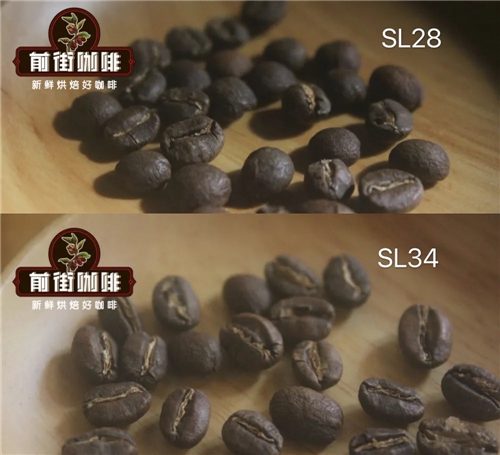
1. Establishment of a breeding mechanism. In 1883, the British brought coffee from Réunion to Kenya. In 1922, Kenya established the Scott Agricultural Laboratories (Scott Labs, from which SL28 and SL34 got their names) to engage in coffee planting research. During the more than 10 years after its establishment, the laboratory selected SL28 and SL34, suitable for cultivation in the production areas, from 42 types of coffee, providing a good start for the development of the coffee industry.
2. Government emphasis. In 1931, the Kenya Planters' Co-operative Union and the Kenya National Coffee Board were established to guide the development of the coffee industry from both the civilian and national levels. In 1937, the Nairobi Coffee Exchange was established, beginning Kenya's coffee auction system, where good coffee gets a good price, setting the tone for coffee prices. In particular, this year Kenya's Ministry of Agriculture launched a 1.5 billion shilling coffee revitalization plan.
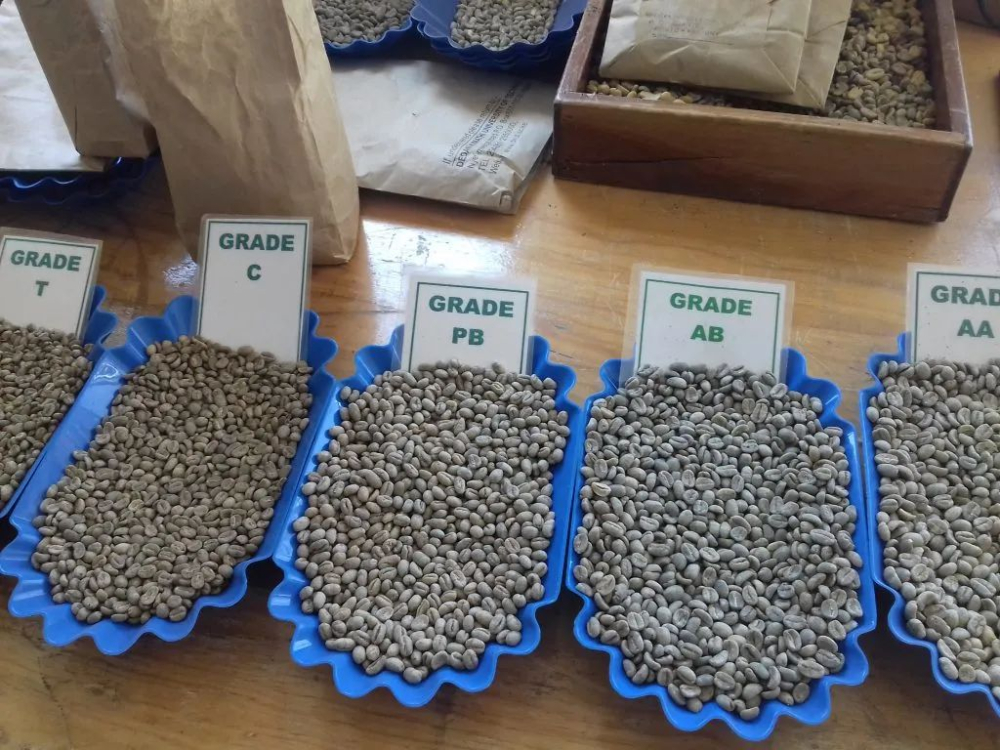
3. Determination of the grading system. Kenya classifies grades by coffee bean size and cupping results. According to the size, shape, and hardness of the coffee beans, from high to low they are AA or AA+, AB, PB, C, E, TT, and T. For green coffee beans of the AA and AB grades, an additional special classification based on cupping results was added (not officially recognized by the Kenyan government, but set by exporters), from high to low as TOP, PLUS (+), and FAQ.
AA Plus (AA+) AA grade with especially excellent cup quality (flavor, mouthfeel). AA screen size: 17-18 mesh. AB screen size: 15-16 mesh, accounting for most of the production. C screen size: smaller than AB. TT from AA and AB grade beans: lighter-weight beans blown out by an airflow sorter. T from C grade beans: lighter-weight beans blown out by an airflow sorter. E Elephant Bean: a large mutant bean formed by two beans merged into one, also called elephant ear. PB Peaberry: classified by appearance, unrelated to flavor or weight. For green coffee beans of the AA and AB grades, an additional special classification based on cupping results was added (not officially recognized by the Kenyan government, but set by exporters), from high to low as TOP, PLUS (+), and FAQ. The Kenyan Asalia on Front Street Coffee's bean list reaches the TOP level in flavor grade. However, as mentioned earlier, this is not an officially recognized grading system, and not every Kenyan coffee bean from the several production areas that Front Street Coffee purchases carries a flavor grade, so there is no need to dwell too much on this. Generally, once beans reach the AA and AB grades, their flavor is already by default considered very high quality.
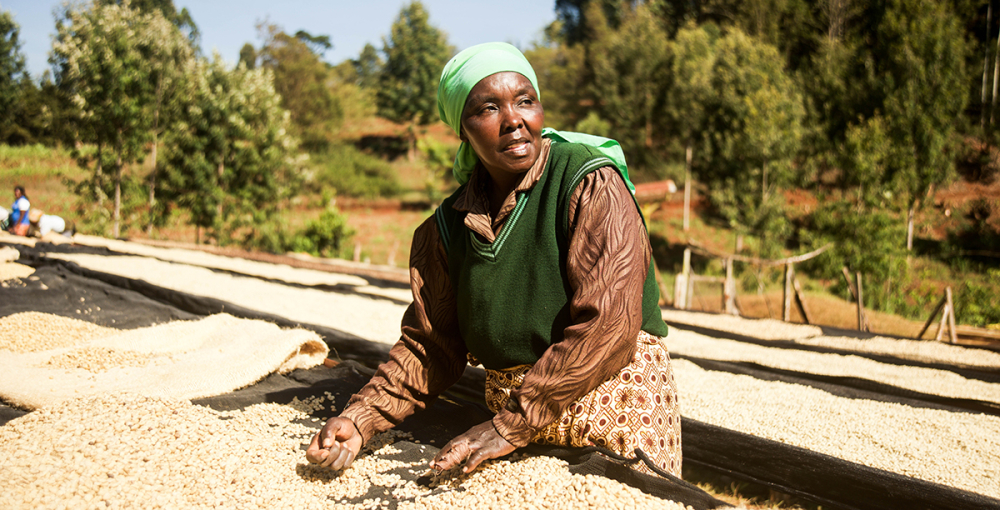
4. K72 processing method. The unique acidity of Kenyan specialty coffee is closely related to its excellent processing method. In the general washed processing method, fully ripe coffee cherries are selected, the skin and pulp are removed, and then they are soaked in a fermentation tank to remove the pectin. This process rarely exceeds 36 hours, but Kenya's fermentation time is as long as 72 hours. After that, they are dried until the moisture content reaches 12%. Front Street believes that Kenya's unique washed processing method can better allow Kenyan coffee beans to show bright acidity and a full-bodied juicy mouthfeel.
The Kenyan coffee beans launched by Front Street come from the Asali processing station in the Thika production area. They have very bright dark plum acidity, a solid mouthfeel, and a sweet-and-sour fruitiness like little tomatoes and cherry tomatoes, so they are named "Little Tomato."
Front Street Coffee: Kenya · Little Tomato Coffee Beans
Region: Asali Processing Station, Thika Region, Kenya
Altitude: 1,550 meters—1,750 meters
Variety: SL28, SL34
Processing method: K72 washed processing
Flavor description: dark plum, cherry tomato, snow pear, yellow sugar, plum
Kenya's acidity is bright, vivid, and impressively full-bodied, making it hard for anyone who has tried it to forget. The beautiful flavors of Kenyan beans cover almost 29 tastes in the "SCA Flavor Wheel." Its acidity includes blackcurrant, the dark plum we are familiar with, lime, grapefruit or pineapple, green apple, passion fruit, and many berry flavors; its sweetness includes honey, dark brown sugar, and sweet fresh orange juice.
For brewing light-roasted coffee such as Kenya · Little Tomato, Front Street believes there are three details to note:
1. Give priority to a dripper with a fast flow rate. Because coffee beans with a lighter roast degree expand less and the beans are relatively hard in texture, it is easy to release very fine powder during grinding. At the pouring stage, these fines also tend to sink first and cause clogging in the final stage, so the brewed coffee often has a flat aroma and a muddy mouthfeel. Therefore, it is best to pair it with a dripper with a fast flow rate, such as the V60 most commonly used by Front Street. Its spiral rib design allows the coffee grounds to degas better, while maximizing the activation of the volatilization and dissolution of aromatic and acidic substances. The large filter hole at the bottom further speeds up the flow of water downward.
2. The water temperature should not exceed 93°C, or be lower than 90°C. According to Front Street's brewing experience, if you want the coffee's acidity to be bright and uplifting and the aftertaste to show a tea-like quality, you can brew at 90°C-91°C; if you want the coffee's fruit acidity to be full and solid and to enhance its body, you can use a water temperature of 92°C-93°C.
3. Since the grinding degree parameter affects changes in the total time, under normal circumstances Front Street judges whether the grinding setting is correct by combining extraction time and the taste of the coffee. It is actually quite simple: if you brew 15 grams of coffee grounds using a three-pour method and the time is less than 1 minute 40 seconds, with a sharp, thin taste, it means the particles are too coarse and the coffee is under-extracted; if the time exceeds 2 minutes 20 seconds and the coffee is bitter and astringent, heavy and flat, then it may be ground too fine and over-extracted.
As for the coffee-to-water ratio, Front Street believes 1:15 to 1:16 are both acceptable. If you want the coffee to be richer, like oolong tea or berries, use 1:15; if you want to more clearly perceive white floral notes and citrus acidity, use 1:16 to spread the flavors out more.

For the first pour, add 30 g of water and bloom for 30 seconds. Start timing as you pour. Use a small stream at the center point and begin spiraling outward, making sure to wet the entire coffee bed. After 30 seconds, begin pouring the second stage with a slightly larger but steady stream, adding 95 g of water, with the aim of raising the entire coffee bed. The stream should be poured vertically and evenly. At this point the scale shows 125 g, and the pour is finished at about 55 seconds.
When the liquid level drops to halfway, begin using a small stream in a small spiral to pour the third stage of 100 grams, trying to control the stream so the spiral is not too large, as it is easy to disturb the coffee bed and cause under-extraction. The final total water amount is 225 grams, and the drip finishes at about 2 minutes.
For the first pour, add 30 grams of water and bloom for 30 seconds, then pour the second stage up to 125 grams. When the water level drops to the point where the coffee bed is about to be exposed, pour the third stage until reaching 225 grams and stop pouring. Wait for the water in the dripper to completely drip into the server, then remove the dripper. The total extraction time is 2'00".
The above content is compiled by CoffeeHunters, a coffee news website.


