







How the Arabica Variety and Anaerobic Natural Processing Shape Huila Coffee
Huila Province in Colombia is known for refined acidity and berry sweetness, and the Flower Moonlight micro-lot pushes that further through anaerobic natural processing. The Caturra arabica variety is fermented slowly at low temperature, then dried with the fruit still on the bean, producing strawberry jam, liqueur chocolate, and creamy fermented notes in the cup.
Colombia sits between 3 and 8 degrees north latitude, and its varied topography creates many microclimates within a single department. Coffee culture there runs deep, with cafes serving freshly brewed cups from morning to night. For this lot, a V60 staged pour and a recorded roast curve on the Yangjia Feima 800N help repeat the coffee aroma and cup profile.
Huila Province in Colombia is renowned for its refined acidity and berry sweetness, and the Flower Moonlight micro-lot beans present a complex profile of strawberry jam, liqueur chocolate, and creamy fermentation through anaerobic natural processing. In this article, Front Street Coffee starts from Colombian coffee culture, sorts out the terroir of the Huila growing region, the characteristics of the Caturra variety, and the low-temperature slow fermentation processing at Gatine farm, and also discloses the roasting curve of the Yangjia Feima 800N, cupping results, and V60 staged brewing parameters, providing coffee lovers with a complete tasting and practical reference.
For more specialty coffee knowledge, please follow the WeChat public account: Front Street Coffee (FrontStreet Coffee)
Front Street Colombia Coffee has always enjoyed extremely high popularity in the specialty coffee community. Colombia and Costa Rica are both very open-minded about innovations in coffee cultivation methods and post-processing techniques. At present, the flavor expression of Colombian coffee is becoming increasingly rich. Front Street Coffee (FrontStreet Coffee) will now introduce everyone to Front Street Colombia Coffee.
Colombia's coffee culture Colombia's coffee culture is quite distinctive, and coffee is regarded by locals as a source of pride. Aside from football, which once ranked among the world's top, the topic Colombians love to chat about most in daily life is their proud coffee. Drinking coffee in Colombia can be called an enjoyment. It is not only indispensable three times a day, but cafes can be seen everywhere in the streets and alleys, full of guests from early morning to late night. Instant products absolutely cannot be found in cafes; everything is freshly brewed and sold on the spot. Waiters serve it in exquisite porcelain bowls and respectfully bring it to guests, with sugar added freely according to one's own preference. The room is filled with lingering aroma, the bowl is sweet and smooth, and the aftertaste is long when savored carefully. No wonder locals are so obsessed with it.
Colombian coffee cultivation Colombia is located in the northwest of the South American continent, adjacent to Panama in Central America. It lies between 3 and 8 degrees north latitude and has a tropical climate, but because of topographical differences the climate varies from place to place. Volcanic soil resources are abundant, annual rainfall is 2000 to 3000 mm, the climate is mild, and the air is humid. Diverse climatic conditions allow Colombia to harvest coffee throughout the year. The southern part of the eastern plains and the Pacific coast have a tropical rainforest climate, the mountainous areas at elevations of 1000-2000 meters have a subtropical climate, and the northwest has a tropical savanna climate. The average annual temperature is 15.8-20.5 degrees Celsius, and the average temperature in coffee-producing regions fluctuates between 18°C and 22.5°C. Front Street believes that low latitude, high altitude, and volcanic soil will make Front Street Colombian coffee beans present a balanced flavor, intense acidity, and unique flavor characteristics, with a relatively full body, sometimes revealing a hint of red wine charm and admirable fruit notes.
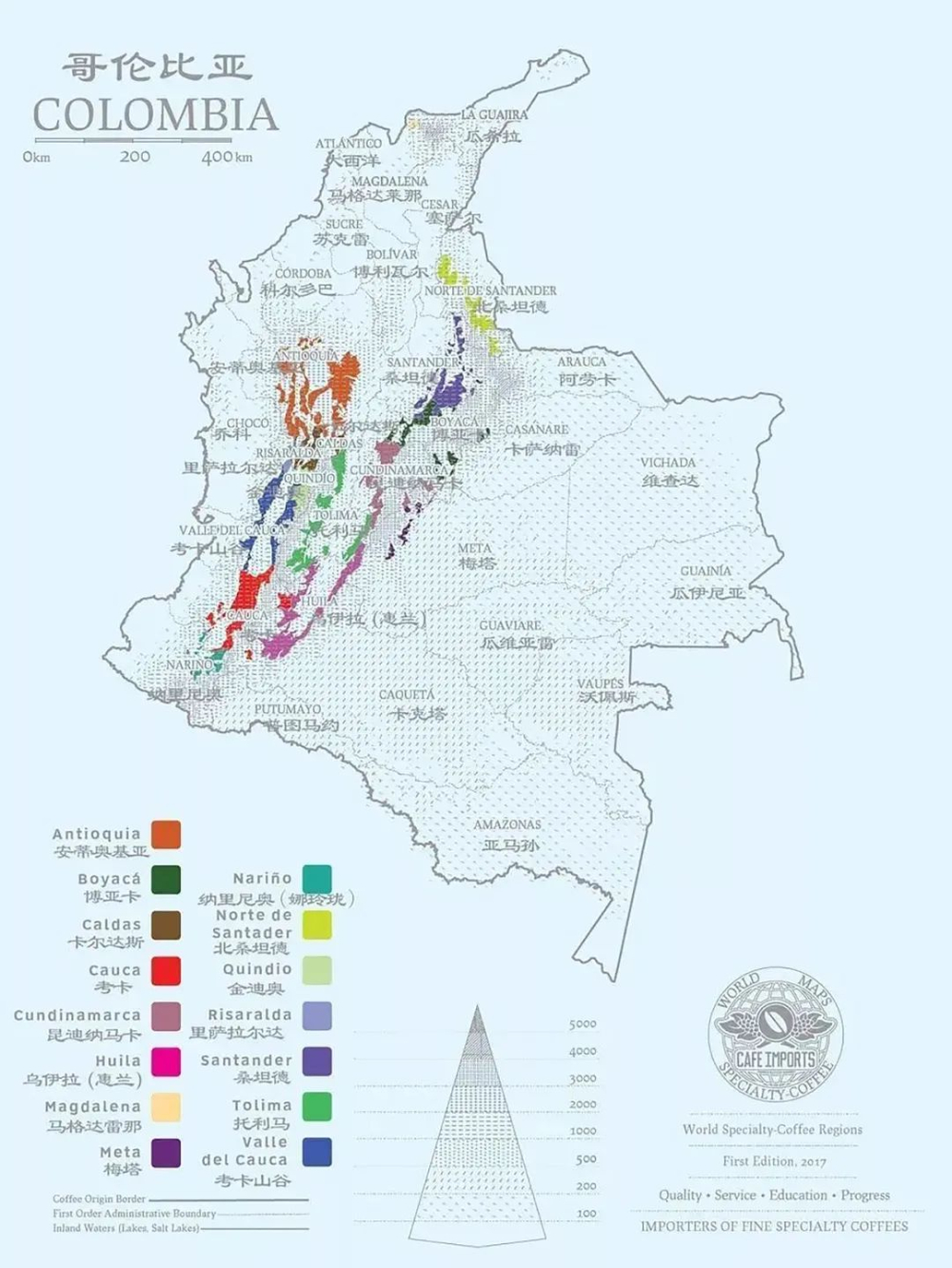
Colombia's specialty coffee bean producing areas are mainly concentrated in the south, at elevations above 1500 m, mainly distributed in Huila, Cauca, Narino, and Tolima. These producing areas all have refined acidity and berry sweetness, with abundant sweetness.
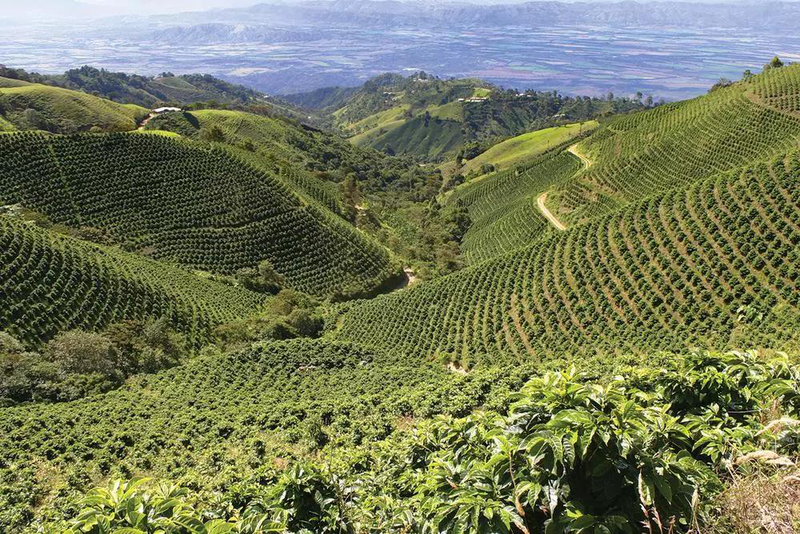
Huila Province is located in the southern section of Colombia's Central Cordillera in the south of the country and is the country's most famous specialty coffee producing region. It has a hilly terrain surrounded by mountains, with cultivation elevations above 1500 meters. Colombia's most important rivers converge here, bringing quite abundant water resources and moisture.
Unlike the general public impression of Colombian coffee as balanced, mellow, and smooth, many Colombian specialty coffees produced in smallholder micro-lots actually have quite distinctive regional flavor characteristics. In recent years, as the international market has attached greater importance to coffee quality and raised its requirements for specialty coffee, the original system of grading by bean size has gradually been abandoned, shifting instead mainly to micro-regional selections provided by smallholder coffee producers. Dozens of smallholders aggregate their individual harvests into a micro-lot for sale, and therefore there is a greater opportunity to directly select many outstanding specific smallholder coffees through lot-by-lot cupping.

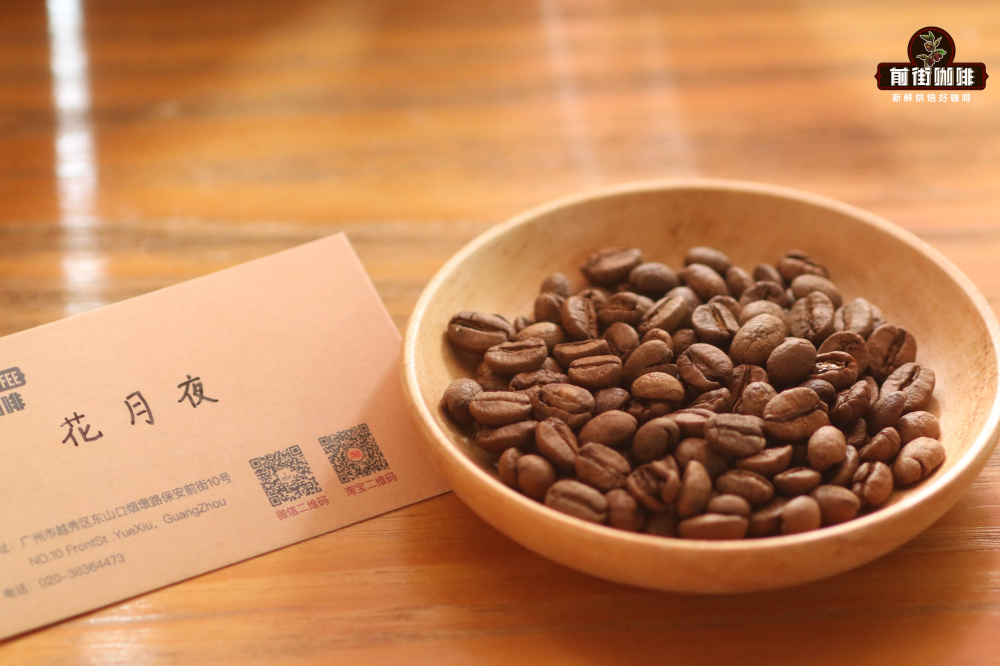
Front Street Coffee (FrontStreet Coffee) · Colombia Flower Moonlight
Country: Colombia
Region: Huila Acevedo Gatine Farm
Processing method: Anaerobic natural
Variety: Caturra
Altitude: 1800m
Coffee variety Caturra is a natural mutation of the Arabica variety Bourbon, discovered in Brazil in 1937. Its tree is not as tall as Bourbon and is shorter. Because it inherits Bourbon's lineage, its disease resistance is relatively weak, but its yield is higher than Bourbon's. Although discovered in Brazil, Caturra is not suitable for growing in Brazil, so it was not planted on a large scale there. Instead, it became widely popular in Central and South America. For example, Colombia, Costa Rica, and Nicaragua all have large areas planted with Caturra.
Anaerobic processing method The former owner of Gatine Farm launched a special processing plan three years ago and guided Ramirez on how to advance the special processing project. With a passion for coffee cultivation, Ramirez changed the original fermentation process that had failed to achieve the desired effect.
The coffee cherries are placed into sealed fermentation tanks, and low-temperature fermentation is used to lengthen the entire fermentation time. With 15-20 days of fermentation, the coffee's flavor gains more possibilities. Nurtured by time, slow drying allows the coffee cherries to develop optimal water activity during this process. First, the flavor develops well; second, the green beans can also be stored longer in the seasonal cycle. After fermentation is completed, these coffee fruits are then dried in the sun.
Front Street Coffee (FrontStreet Coffee) roasting analysis The roaster is the Taiwan-made Yangjia Feima 800N, with a charge of 500 grams. Considering that Front Street Colombia Flower Moonlight uses anaerobic natural processing, in order to preserve the fruit notes of Front Street Flower Moonlight while also showing a full body and sweetness on the palate, a medium roast profile is adopted.
Bean charging temperature is 180°C, initial heat is 130, and airflow is 3; at 140°C the heat remains unchanged and airflow is opened to 4. At this stage the beans slowly change from green to yellow, the original grassy smell of the green beans gradually disappears, and they enter the dehydration state. 6'25" is the turning point when the beans turn yellow. At this time the beans give off a sweet aroma similar to toasted bread. At 180°C, lower the heat to 100, and keep airflow at 4 unchanged.
At 9'38", ugly wrinkles and dark streaks appear on the bean surface, and the toasted bread smell clearly turns into coffee aroma. This can be defined as the prelude to first crack, and at this time one should listen clearly for the sound of the first crack point. At 10'20" first crack begins, airflow is opened to 4, development after first crack is 1'50, and the beans are dropped at 196°C. Because Front Street Colombia Flower Moonlight uses anaerobic natural processing, the dehydration time should be extended as much as possible to around 9 minutes to 9 minutes 30 seconds, so that the beans are roasted through and conditions such as underdevelopment are avoided. After first crack, develop to 1'50'' and discharge at 196°C.
Front Street cupping After receiving the first batch of green beans, Front Street began setting the roasting curve, made adjustments across 3 profiles, and conducted cupping. During cupping, the roasting production curve was determined and the coffee flavor was confirmed.
Dry aroma: violet, strawberry jam Wet aroma: strawberry jam aroma, fermented wine aroma Sipping: strawberry jam, liqueur chocolate
Front Street Coffee (FrontStreet Coffee) brewing recommendation Because of the special processing, this light-roasted Front Street Flower Moonlight coffee absorbs water and expands relatively easily. In terms of grind size, choose a slightly coarser setting, and control the pouring stream to be as small as possible. Coffee grounds: 15g Coffee-to-water ratio: 1:15 Grind size: medium-fine grind (78% passing through No. 20 standard sieve) Water temperature: 91°C Dripper: V60
Use Front Street staged extraction. Use 30 grams of water for a 30-second bloom, pour in a small stream in a circular motion until 125 grams and then pause for a stage, and when the water level drops and is about to expose the coffee bed, continue pouring until 225 grams and stop pouring. When the water level drops and is about to expose the coffee bed, remove the dripper. The extraction time is 1'48" (timed from the start of the bloom).
Flavor description In terms of processing method, Front Street Colombia Flower Moonlight uses anaerobic natural processing, making the overall cup richer and more balanced. Front Street Colombia Flower Moonlight is more balanced, with floral and strawberry jam notes accompanied by a finish of liqueur chocolate, cream, and fermentation.
The above content is compiled by CoffeeHunters, a coffee news website.


