








How Does the Natural Coffee Process Shape Flavor?
The natural process is one of the oldest ways to strip coffee beans from the fruit: whole cherries dry first, then the pulp is removed. On Sidamo beans from Ethiopia it tends to produce full body and bright berry notes, a profile that has gained ground in specialty coffee as drying moved from ground spreads to raised beds.
Washed coffee processing is the more stable benchmark, which is why Front Street cups washed batches first when screening Central and South American origins. For natural Sidamo, pour-over parameters and approach matter, since the processing method plays a decisive role in the final taste of the cup.
The flavor profile of coffee is closely tied to how the green beans are processed. As one of the oldest coffee processing methods, the natural process has undergone a long evolution in quality—from the crude ground-drying of early days to today's meticulous raised-bed management. Natural-processed beans from the Sidamo region of Ethiopia, with their full body and bright berry notes, have gradually won the favor of the specialty coffee world. From the perspective of Front Street Coffee, this article traces the evolution of the natural process, compares the flavor differences between washed and natural processing, and uses the new-crop Huakui as an example to offer specific pour-over parameters and extraction approaches—helping coffee lovers more clearly understand the logic of selecting and brewing natural-processed coffee beans.
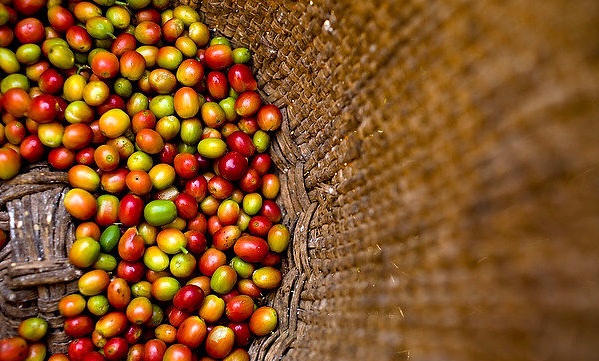
The processing method plays a decisive role in the final taste of a cup of coffee, so its influence should never be underestimated. Today, Front Street is here to talk about the topic of coffee processing methods.
In the view of FrontStreet Coffee, the washed process is arguably the most favored processing method. The reason is that washed beans offer sufficiently stable quality, and it also serves as a "touchstone" for testing the strength of a producing region. When FrontStreet Coffee screens beans from various coffee-producing countries in Central and South America, it usually prioritizes cupping washed batches first, selecting the beans that best represent the region's flavor.
What exactly is the natural process?
When introducing processing methods, FrontStreet Coffee often points out that the so-called natural process is essentially the process of stripping coffee beans out of the coffee fruit. The natural method can be said to be one of the earliest and most traditional processing methods used by humans.
Compared with the washed process, the natural process is more intuitive to understand. The crudest form of natural processing is common among smallholder farmers: after harvesting, farmers spread the coffee fruit directly on the ground to dry, and once the fruit's moisture content drops to a certain level, they peel away the pulp to extract the coffee beans inside.
However, this rough approach easily leads to a significant decline in green bean quality, and the flavor is naturally less than ideal. A typical example is Ethiopia's past green bean grading system—in an era when coffee flavor was not yet valued, the country mainly classified green bean grades by defect rate, specifically by the number of defective beans contained in every 300 grams of green beans: Grade G1 required no more than 3 defective beans, G2 allowed 4 to 12, and so on.
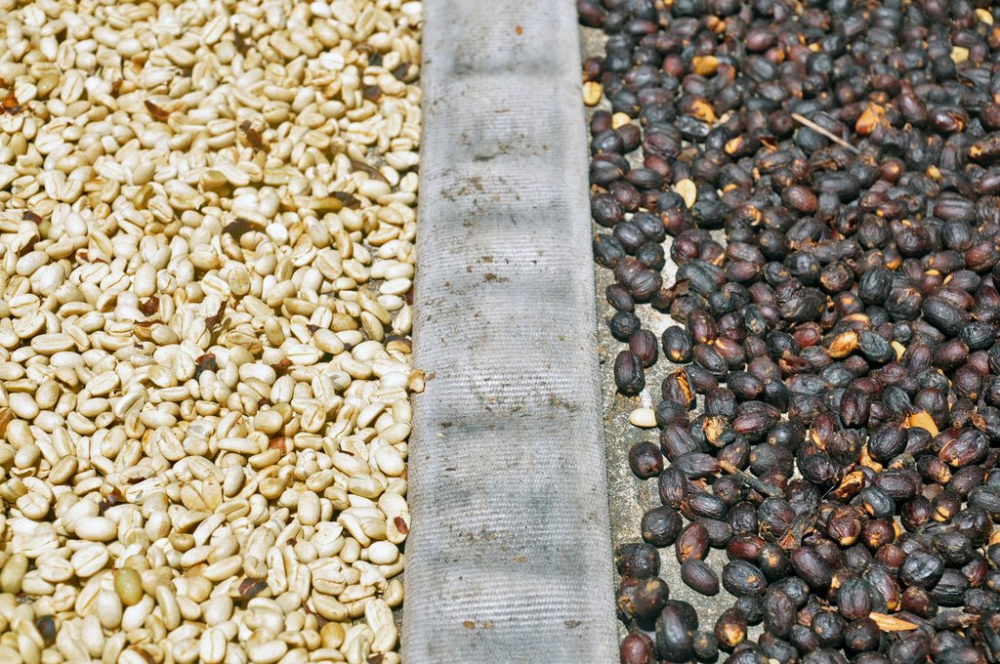
The washed coffee beans that can be exported to the stores we commonly see mostly belong to grades G1 and G2. But at that time, the highest grade for natural coffee beans only reached G3, meaning every 300 grams of natural green beans contained at least 13 defective beans.
Fortunately, as natural processing techniques have continuously improved and matured, Ethiopian natural coffee beans can now also reach G1 grade. Huakui is the most representative example—this natural bean from the Guji Hambela region presents a distinct dark berry flavor profile, with rich and full layers that leave an unforgettable impression. Natural processing gives it a full body and a pleasant fermented aroma.
The appeal of the natural process
Although FrontStreet Coffee has a particular fondness for the washed process, it also holds great affection for natural beans. Not just us—many estates and renowned producing regions also favor natural processing. FrontStreet Coffee still remembers that when the Blue Mountain region began experimenting with producing natural-processed Typica twenty years ago, the industry was quite shaken. In the past, when we described the flavor of Blue Mountain, we always relied on words like balanced, stable, high-quality, and consistent—thanks to the local commitment to producing only washed Typica. That dedication also built Blue Mountain coffee's status. Yet times change, and as the concept of specialty coffee spread, Blue Mountain coffee faced new competitive pressure. So starting in 2019, the Blue Mountain region began experimenting with natural processing, brought in renowned estates to provide technical guidance, and ultimately in 2020 launched natural-processed Typica Blue Mountain coffee.
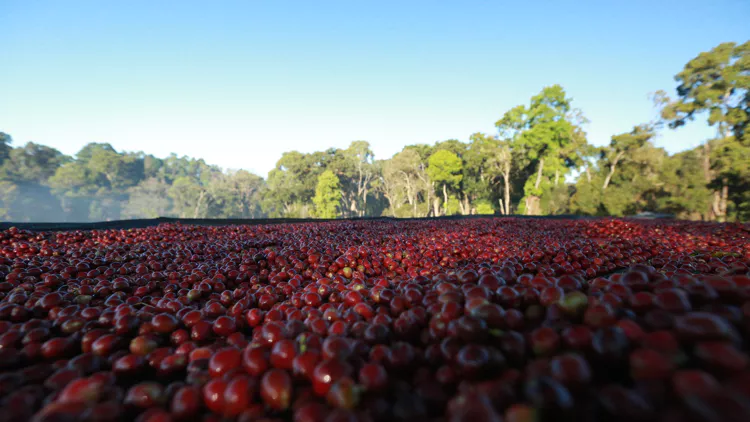
This shows that even Blue Mountain has compromised with the market's enthusiasm for natural coffee. Although natural processing is riskier and highly dependent on weather conditions, carefully managed natural coffee often brings generous rewards—a complex, full body and refined berry notes. The source of this flavor lies in retaining the pulp and skin during processing and drying them together; the sugars in the pulp are absorbed by the coffee beans, thus cultivating such alluring flavors.
The refined natural process
When refining green beans using the natural method, farmers pick fully ripe coffee cherries from native forests, ensuring each fruit is intact, retaining the pulp and skin, and then placing them on raised beds to dry. On one hand, this thoroughly avoids contact with soil that could introduce off-flavors; on the other hand, it also improves the drying efficiency of the coffee cherries, thereby more completely showcasing the coffee's own fruity flavors.
Front Street's new-crop natural Huakui coffee beans
Country: Ethiopia Region: Sidamo · Guji Altitude: 2250–2350 meters Variety: Local heirloom varieties Processing method: Natural process
Flavor: Floral, jackfruit, dried fruit, apricot, juicy
FrontStreet Coffee brewing recommendations: Dripper: Hario V60 #01 Water temperature: 90–91°C Dose: 15 grams Coffee-to-water ratio: 1:15 Grind size: 80% passing a Chinese standard No. 20 sieve

To fully extract the fruity acidity of Yirgacheffe and Sidamo, Front Street uses a relatively high water temperature and a finer grind. But to avoid over-extraction caused by high temperatures, a faster-flow dripper is chosen, such as the V60. The V60 has a 60-degree cone shape, and this angle allows the coffee grounds to gather together. When pouring, the water flow also automatically converges toward the center of the dripper, ensuring enough contact time between water and coffee grounds to extract an ideal cup. In addition, the ribs on the inner wall of the V60 form a clockwise spiral extending from the bottom all the way to the top, leaving ample space between the filter paper and the dripper for better flow; combined with the large hole at the bottom, the overall flow rate is faster than many drippers.
Front Street brewing method: For the first pour, add 30 grams of water and let it bloom for 30 seconds. Then pour in 95 grams (the scale will read around 125 grams), finishing the pour in about 1 minute. When the water level drops to two-thirds of the coffee bed, pour in the remaining 100 grams (the scale will read around 225 grams), finishing the pour in about 1 minute 40 seconds to 1 minute 45 seconds. The drip finishes at 2:00–2:10. Remove the dripper and extraction is complete.
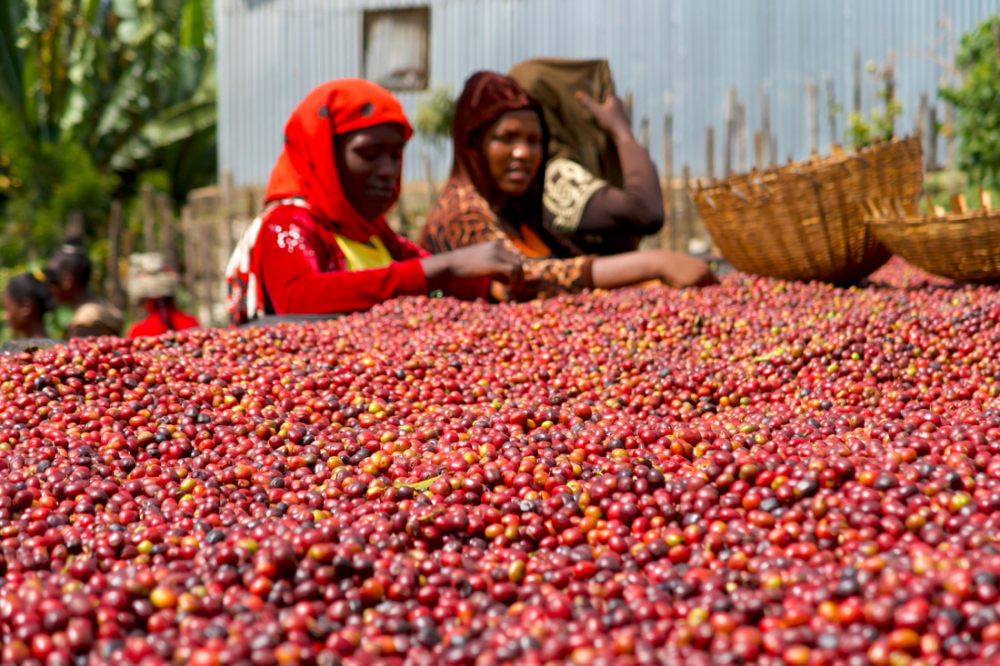
Compared with washed coffee, natural coffee has a more abundant fruity aroma and a fuller body.
The above content is compiled by CoffeeHunters, a coffee news website.


