







How Is Mamba Blend Coffee Built and Brewed?
Mamba is a classic blend coffee pairing Indonesian Mandheling with Brazilian coffee. The version here uses Lintong Mandheling and Brazil Red Bourbon, both medium-dark roasted, blended at a 1:1 ratio. The result is a high-body cup with a pronounced bitter note, combining dark chocolate and herbal flavors, suited to drinkers who prefer a rich, full-bodied pour-over.
Lintong Mandheling comes from North Sumatra around Lake Toba, where beans fall under the Mandheling category and are processed with Sumatra's wet-hulling method. Brazil Red Bourbon is semi-washed. For brewing, use 88°C water, a Kono dripper, a 1:15 water-to-coffee ratio, and staged pouring. Indonesia exported 300,000 tons of coffee last year, about 75,000 tons of it arabica.
Mamba coffee is a classic blend combining Indonesian Mandheling and Brazilian coffee. In this article, Front Street Coffee selects Lintong Mandheling and Brazilian Red Bourbon, two medium-dark roasted beans, blended at a 1:1 ratio, to take you through the charm of this legendary recipe. The article will introduce the production regions of Mandheling and its unique wet-hulling method, the characteristics of Brazil's semi-washed processing, and provide a complete pour-over recipe: 88°C water temperature, Kono dripper, 1:15 water-to-coffee ratio, and staged pouring. The resulting coffee has a high body, a pronounced bitter note, and combines dark chocolate and herbal flavors, making it ideal for those who love a rich, full-bodied cup.
【Introduction】 When it comes to blend combinations in the pour-over world, there is one legendary recipe that is always unavoidable: Mamba coffee. As the name suggests, this blend is made up of Indonesian Mandheling and Brazilian coffee beans.
To find out what kind of taste the Mamba blend actually presents, and why it has stood the test of time to become a classic, Front Street Coffee decided to conduct a hands-on test using 【Lintong Mandheling】 paired with 【Brazilian Red Bourbon】!
【Lintong Mandheling】
Coffee trees were brought to Indonesia by the Dutch in the mid-17th century. Last year, Indonesia exported a total of 300,000 tons of coffee, making it the world's fourth-largest coffee producer, of which Arabica beans accounted for about 75,000 tons. Ninety percent of these Arabica beans come from smallholder farmers, most of whom cultivate no more than one hectare.
Indonesia's coffee-producing regions are mainly distributed across the three major islands of Sumatra, Java, and Sulawesi, with the most famous being "Mandheling" from Sumatra. Coffee produced around Lake Tawar at the northern tip of the island can be called Aceh coffee or Lake Tawar coffee, while beans from Lintong and around Lake Toba fall under the Mandheling category. Indonesia's coffee-producing regions span eight provinces, but only Aceh and North Sumatra have truly large-scale coffee cultivation. The most representative producing region in Aceh is the Gayo mountain range surrounding Lake Tawar, where coffee is grown by the local Gayo indigenous people; coffee in North Sumatra grows by Lake Toba—an extremely vast lake that is the largest volcanic lake in the world. Mandheling from Lake Tawar and Lake Toba are collectively known as the famous 【Two Lakes, Two Mandhelings】, and the Lintong producing region is located to the south of Lake Toba.
【Growing Environment】
Lintong Mandheling is grown on highland plateaus at an altitude of 1,000-1,500 meters. The region is dotted with volcanoes and volcanic lakes, with the most renowned growing belt located around Lake Lawar, a freshwater lake. The soil here originates from volcanic mud, an original brown podzolic soil rich in organic matter. Combined with the nourishment of a tropical rainforest climate and abundant year-round rainfall, this creates nearly ideal geographical and climatic conditions for coffee trees.
【Wet-Hulling Method】
The reason Mandheling can display a rich, intense, and highly recognizable flavor lies in a green bean processing method unique to Indonesia—【wet-hulling】. Local air humidity remains at 70%-90% year-round, with frequent typhoons and abundant rainfall. Conventional drying often takes 2-3 weeks. In such a humid environment, drying beans becomes a major challenge. In addition, farmers want to shorten the cycle and pursue higher economic returns, so wet-hulling came into being. It differs markedly from washed processing: the skin and pulp are removed first, then the beans are placed in a water tank to ferment with parchment and mucilage still attached. After that, the mucilage is washed off, and the beans are dried together with the parchment for 2-3 days. When the moisture content drops to 20%-24%, the parchment is hulled off, and the final drying stage begins. In this way, sunlight can directly hit the surface of the green beans, making drying 2-3 times faster than the washed method. However, the beans are also more prone to being squeezed and developing small indentations, commonly known as horse-hoof beans or goat-hoof beans. The frequent appearance of hoof beans in Mandheling is not a defect, but a mark left by this processing method.
【Flavor】 Sweet herbal aroma, spice notes such as cinnamon, and orange-grapefruit peel notes, accompanied by a rich, full sweetness and creamy walnut chocolate flavors. The fruit acidity is restrained and mild, and the aroma is filled with a strong melon note; as the temperature drops, the herbal aroma is slowly released, with faint spice interwoven with a substantial herbal character, while the sweetness remains rich throughout.
【Brazilian Red Bourbon】
The Red Bourbon selected by Front Street Coffee comes from Brazil's oldest coffee-producing region—South Minas, grown in hilly terrain at an altitude of 700-1,200 meters.
Brazil's coffee farms are broadly distributed across two types of terrain: one is plateau areas above 500 meters in altitude, and the other is plains below 200 meters. Bourbon family varieties (including Yellow Bourbon, Red Bourbon, and flat-bean Santos) are the most widely planted and most recognized variety group locally. In terms of flavor, Brazilian beans have relatively low acidity, are dominated by nutty notes, and are overall balanced with a moderate body. Although they are not particularly dazzling in the specialty coffee world, they frequently appear in espresso blends; and because of their excellent balance, many merchants also use them to create Blue Mountain-style beans.
【Processing Method】
This bean is processed using the semi-washed method.
After the coffee cherries are harvested, they are first sorted in a water tank to remove unripe fruit and impurities, then the outer skin and part of the pulp are removed, and the surface mucilage is removed with a demucilager. Removing the mucilage not only shortens the time required for sun drying, but also reduces the risk of fermentation and spoilage. When climatic conditions are less than ideal, this processing method is especially useful—under conditions of high air humidity, muggy weather, or rainfall, the drying stage is very prone to mold and spoilage. For this reason, most Brazilian washed beans used for commercial trade are processed by the semi-washed method.
【Flavor】 Prominent sweetness, a clean and smooth mouthfeel, relatively low acidity, with nutty aromas.
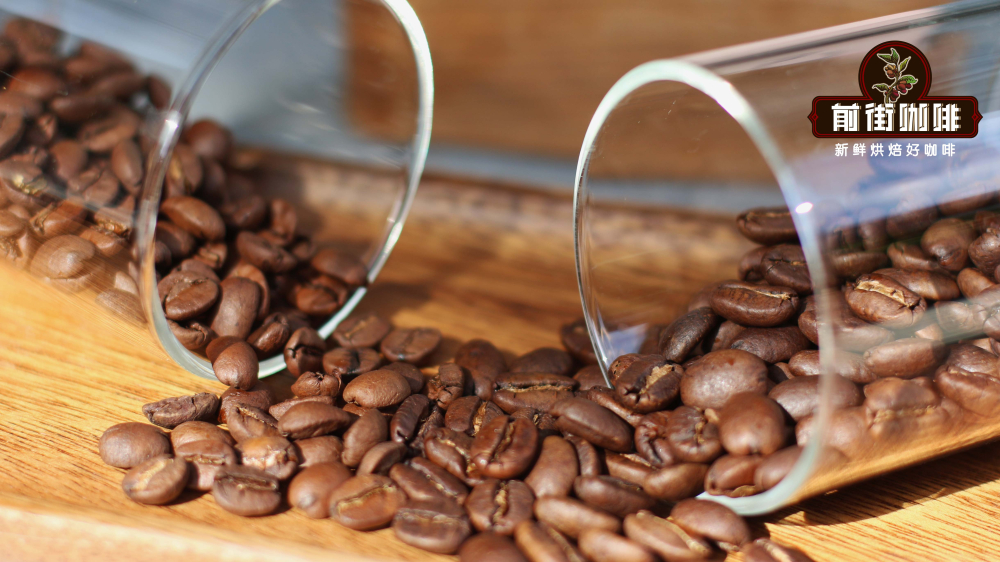
The two beans—【Lintong Mandheling】 and 【Brazilian Red Bourbon】—are both roasted to a medium-dark level, and Front Street Coffee blends them in an equal 1:1 ratio to create this Mamba blend.
【Brewing Recommendation】 Recommended method: pour-over Grind size: similar to medium granulated sugar Water temperature: 88°C Coffee dose: 15 grams Use a Kono dripper, with a water-to-coffee ratio of about 1:15 First pour 30 grams of water for blooming, with a blooming time of 30s Staged pouring: pour to 120ml in the first stage, then pause, then slowly continue pouring to 240ml, that is, 30-120-230, with the entire extraction taking about 1 minute and 50 seconds
Flavor: When dry, spice and herbal plant notes can be detected, while in the wet state, chocolate-like aromas are released. On the palate, the front section presents mild fruit acidity, the middle section has a very prominent dark chocolate flavor, and the finish carries the signature Mandheling herbal character, with a long, lingering caramel sweetness.
Overall, 【Mamba Blend Coffee】 belongs to the type with a prominent body and a relatively strong bitterness. Friends who usually prefer a rich, substantial mouthfeel should definitely give it a try!
The above content is compiled by CoffeeHunters, a coffee news website.


