







Why does Jamaican coffee from Blue Mountain cost so much?
Authentic Jamaican Blue Mountain coffee comes only from Typica plants grown between 910 and 1,700 meters in the Blue Mountains and certified by the Coffee Industry Board of Jamaica. The certified growing area covers about 6,000 hectares, roughly one-third of the region, which keeps supply limited and prices high. A verified Blue Mountain No. 1 lot such as Front Street sells at a premium tied to that scarcity and grading.
The price reflects both terroir and handling. The Blue Mountains, the highest range in the Caribbean, receive 1,800 to 2,000 millimeters of rain a year, and the steep slopes drain well while mist provides natural shade. Farmers interplant coffee trees with banana and avocado. Beans are washed and packed in barrels, and buyers check the CIB mark before treating them as genuine.
Blue Mountain coffee long held the throne of top-tier coffee, and even today, authentic Jamaican Blue Mountain still commands a high price. But what exactly qualifies as true Blue Mountain? Why does it sell for so much? This article starts with Front Street Jamaican Blue Mountain coffee and works through the terroir of the Blue Mountain region, the CIB certification and grading system, the washed processing flow, and the barrel packaging details, and also provides the specific price of Front Street Blue Mountain No. 1 along with a pour-over brewing recipe. Whether you want to understand how Blue Mountain coffee's price is composed or want to know how to brew Blue Mountain to taste even better, this piece will give you a clear reference.
Before the Geisha variety was discovered by the general public, Jamaican Blue Mountain coffee was practically the ceiling of specialty coffee. With inherently limited output, Blue Mountain was once pushed to a price of over a hundred yuan per cup thanks to its enormous fame — back then, ordinary office workers could hardly afford it casually. So why does Front Street Jamaican Blue Mountain coffee command a relatively high price? To answer that question, we first need to clarify what authentic Blue Mountain really means.
The Definition of Authentic Jamaican Blue Mountain Coffee
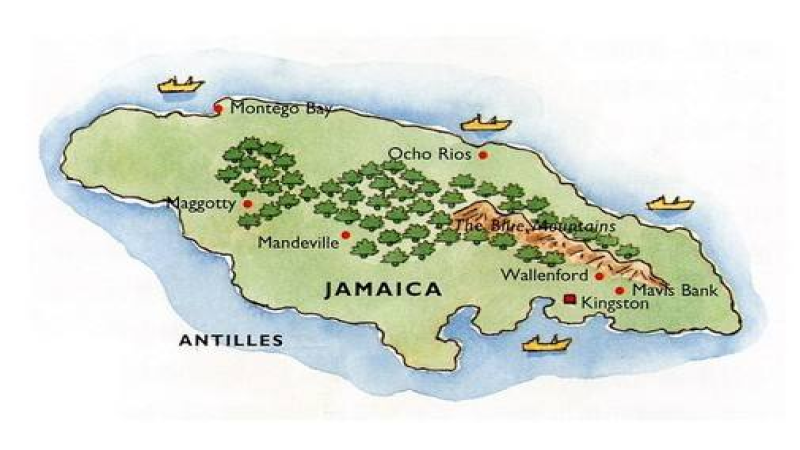
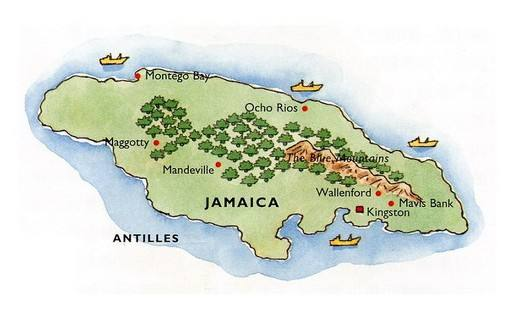
The Blue Mountains are the highest mountain range in the Caribbean region, with steep slopes and deep valleys, a tropical rainforest climate, and annual rainfall reaching 1,800 to 2,000 millimeters. The steep slopes drain exceptionally well, so the vegetation is fully nourished, and local coffee farmers traditionally interplant coffee trees with banana and avocado trees. The Blue Mountain area has fresh air and pleasant scenery, and its volcanic soil is fertile, giving the coffee fruit a fuller flavor. The high-altitude zones are shrouded in mist and clouds year-round, providing natural shade for the coffee trees.
To distinguish Blue Mountain coffee from ordinary Jamaican coffee, the Jamaican government established a dedicated grading system. Only Typica variety grown at altitudes between 910 and 1,700 meters in the Blue Mountains, certified by the Coffee Industry Board of Jamaica (CIB), is eligible to bear the name Jamaican Blue Mountain coffee. The certified growing area is only 6,000 hectares, about one-third of the entire Blue Mountain region, and only about 15% of Jamaica's national coffee output can carry the Blue Mountain coffee label. The higher the altitude, the harder the harvest and the greater the labor management costs. Each harvest season, local women familiar with the terrain are sent up the mountain to pick only fruit at the perfect stage of ripeness, ensuring the quality of the beans.
To make flavor and quality more consistent, Blue Mountain coffee estates generally use washed processing, removing defective beans across multiple stages, which gives Front Street Blue Mountain coffee a clearer aroma. The Front Street Blue Mountain coffee on our bean list is indeed washed, sourced from Clifton Mount Estate. The estate puts freshly picked coffee cherries into a flotation tank, removes the skin and pulp before fermentation, and after a night of fermentation produces a large amount of acidic substances that separate the mucilage layer from the bean surface. The parchment beans are then dried in the sun, and once the moisture content reaches standard, they are packed into warehouses and sent for quality inspection. The washing process makes Front Street Blue Mountain coffee beans' flavor cleaner and more transparent, and their quality more consistent.
Once dried, Blue Mountain green beans are graded against multiple evaluation criteria, including bean size, color, moisture content, and cupping performance after roasting. Jamaican Blue Mountain coffee is classified by different characteristics into NO.1, NO.2, NO.3, and Peaberry, with NO.1 being the highest grade, commonly known as Blue Mountain No. 1 coffee. The green beans must reach a screen size of 17 to 18, with a defect rate below 3%, uniform particles and plump beans, and a flavor presenting balanced body, aroma, sweetness, and acidity. To reach such a top standard, more manpower must be invested to hand-sort out inferior beans, which is also why high-quality Blue Mountain coffee is so precious.
What Are the Characteristics of Authentic Blue Mountain No. 1 Coffee?
Blue Mountain coffee green beans are packaged in wooden barrels, setting them apart from the moment you get your hands on them. Compared with the coarse burlap sacks common in other regions, oak barrels can absorb and release internal and external moisture while blocking coffee aroma from escaping, keeping the beans at a more stable moisture content and making the roasting process more controllable. Jamaican coffee barrels come in three sizes: 70 kg, 30 kg, and 15 kg.
Front Street can glean quite a bit of Blue Mountain information just by examining the barrel. The top of the lid bears the CIB certification mark, and each shipment's barrel is marked with the shipping marks of the registered exporter and the official importer — for example, this Front Street batch comes from Clifton Mount Estate, and the barrel also bears the Rainforest Water Frog logo. In addition, this Front Street Blue Mountain No. 1 coffee comes with a quality certificate issued by the Jamaica Coffee Board, an authorized sales certificate issued by the Blue Mountain coffee producer, and a Jamaican Blue Mountain coffee certificate of origin.
When Front Street received the Blue Mountain No. 1 green beans, the particles were uniform and plump, consistent in size, and overall a translucent blue-green. After roasting, Front Street conducted a cupping: the dry aroma had nuts, melon, and chocolate, and after adding water we could smell oolong tea, caramel, honey, and dark chocolate. On the palate there is rich dark chocolate, roasted hazelnut, cream, and black sugar; the flavor is clean and clear, the body is smooth and full, and the aroma is long-lasting.
For such a top-tier Blue Mountain No. 1 coffee, Front Street lists it at 158 yuan per 100 grams. If you want to drink it directly as pour-over black coffee, you can visit the Front Street Dongshankou store and order it; pour-over Front Street Blue Mountain No. 1 coffee is priced at 60 yuan per cup.
How to Brew Front Street Blue Mountain No. 1 Coffee So It Tastes Good
Front Street has always believed that a good cup of coffee depends on an excellent variety, refined processing methods, an appropriate roast level, bean freshness, and matching extraction parameters. Top-tier Blue Mountain No. 1 coffee beans have already helped us select an excellent batch; what remains is how to brew them. Front Street recommends using freshly roasted coffee beans — if stored for more than a month and a half, the aroma has likely already faded, making it hard to present a full flavor. The coffee beans Front Street ships are all freshly roasted within 5 days, so by the time you receive them they are usually right in their optimal tasting window.
Front Street Jamaican Blue Mountain coffee is on the darker side of roasting, with a relatively loose bean structure and strong water absorption, making over-extraction easy. We therefore recommend a coarser grind (75% passing a No. 20 standard sieve) and a lower water temperature (88°C) for extraction. In addition, since Front Street wants a fuller body, you can choose a slower-flow dripper, such as the KONO dripper.
Front Street Jamaican Blue Mountain pour-over steps: 15 g coffee grounds, 1:15 coffee-to-water ratio, three-stage extraction.
Pour the ground coffee into a preheated dripper. For the first stage, pour 30 grams of water to bloom and start the timer, pouring in a small stream in circles from the center outward. After 30 seconds, move to the second stage, pouring up to 125 grams, raising the coffee bed as much as possible and keeping the stream steady throughout. When the liquid level drops to halfway, pour the final stage for a total water volume of 225 grams. Once all the coffee has dripped through, remove the dripper; the total time is about two minutes. Swirl the coffee in the server to mix it evenly, and you can enjoy a richly aromatic cup of Front Street Blue Mountain coffee.
During brewing, Front Street Blue Mountain coffee already gives off a rich aroma of roasted nuts and caramel. On the palate you can taste dark chocolate and the sweet nuttiness; the various flavors interweave and blend, the body is smooth and full, and the finish is transparent and clear.
For professional coffee knowledge exchange and more coffee bean information, please follow Coffee Workshop (WeChat public account: cafe_style)
For more specialty coffee beans, please add the private WeChat of Front Street Coffee (FrontStreet Coffee), WeChat ID: qjcoffeex
The above content is compiled by CoffeeHunters, a coffee news website.


