







What is arabica coffee from Ethiopia's Guji region?
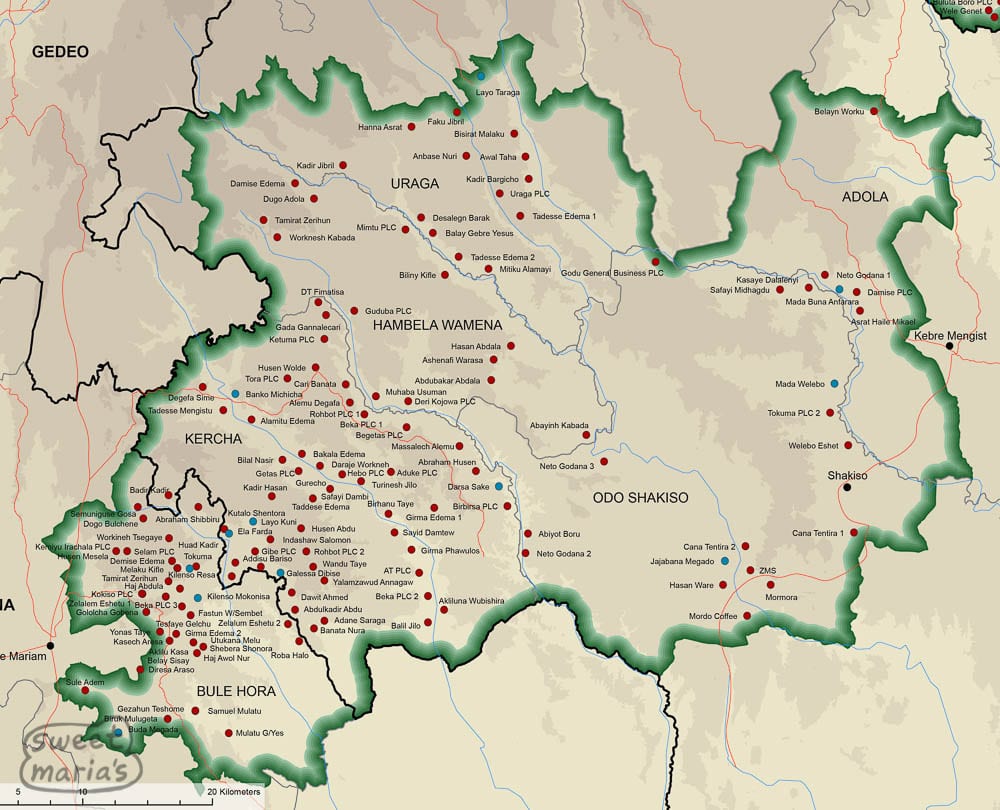
Guji is a specialty coffee region in Ethiopia that became an independent zone in 2010 with approval from the Ethiopia Commodity Exchange, after previously falling under Sidama. It sits southeast of Yirgacheffe, next to Sidama and Gedeo, with mountains, plateaus, valleys, and plains across the landscape.
Soils are mainly fertile black Vertisol nearly two meters deep, and average altitude sits above 1,800 meters, with wide day-night temperature swings. Natural-processed Guji, such as Huakui, shows floral and fruity dry aroma, citrus and berry in the wet aroma, and a juicy body with prominent sweetness. This is what is arabica coffee looks like at its most expressive.
Guji is a specialty coffee region in Ethiopia that has performed impressively in recent years, cultivating full-flavored coffee thanks to fertile black soil, high altitude, and significant day-night temperature differences. This article starts from the tasting experience of Front Street Coffee's natural Guji coffee, systematically sorting out Guji's historical development from its independence from Sidama to its own zone, terrain and soil conditions, natural processing flow, and local heirloom characteristics, and appends Front Street Coffee's roasting curve and V60 three-stage brewing suggestions. Whether you want to understand the terroir of the region or are looking for a natural bean with rich fruity aroma and prominent sweetness, this article can provide valuable reference.
Among the many specialty coffee regions in Ethiopia, Guji has always been an object of continuous tracking and research by Front Street Coffee. It enjoys exceptionally favorable natural conditions, with abundant soil fertility, and the green coffee beans produced are quite outstanding in quality. Let's take this natural Guji purchased by Front Street Coffee as an example: after grinding, the dry grounds already reveal layered floral and fruity notes, with both the honeyed sweetness of dried peaches and the crispness of lemon peel; when water is poured for brewing, the wet aroma leans toward the sweet direction of citrus and berries. In the mouth, the texture is like juice, full and rich, with outstanding sweetness, while berry-like acidity blends in softly, making one want to drink it all in one go. Next, let's follow Front Street Coffee into the story of natural Guji.
Guji GUJI
The Guji region has been attracting increasing attention in recent years, delivering impressive results in both flavor presentation and quality consistency. It was originally under the jurisdiction of the Sidama region, and in 2010, with approval from the Ethiopia Commodity Exchange (ECX), it officially became an independent region. Guji is located southeast of Yirgacheffe, adjacent to Sidama and Gedeo, with towering mountains, interlaced highlands, plateaus, valleys, and plains, and quite complex terrain changes. The geology of the area is mainly fertile black soil (Vertisol), with a soil layer nearly two meters thick and an average altitude of over 1,800 meters. The obvious day-night temperature difference brought by the special geographical environment provides an ideal terroir foundation for producing high-quality specialty coffee. The region's greatest advantage lies in maintaining soil vitality through natural organic matter cycles—fallen branches and leaves from surrounding trees, as well as residual plant roots, all become natural sources of fertilizer.
Natural NATURAL
The natural method can be considered a time-honored way of processing green coffee, and this batch of beans from the Guji region at FrontStreet Coffee uses exactly natural processing.
1. Removing floating beans
The harvested coffee cherries are poured into a large water tank; fully developed cherries sink to the bottom, while unripe or overripe fruits float on the surface, and these floating beans need to be picked out and discarded.
2. Sun drying
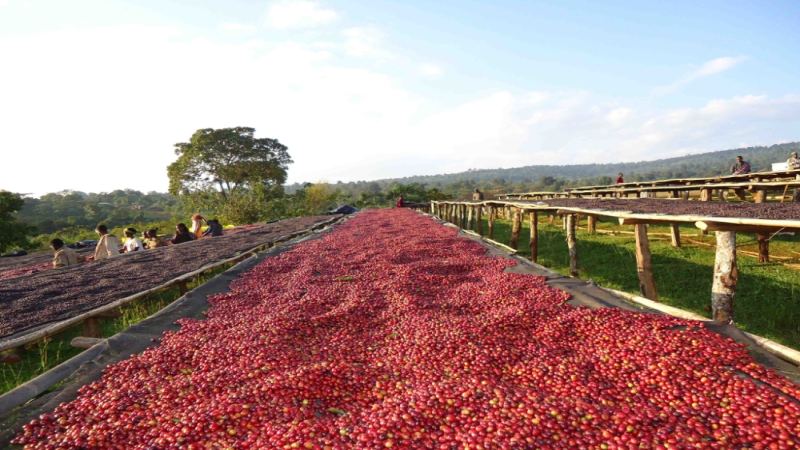
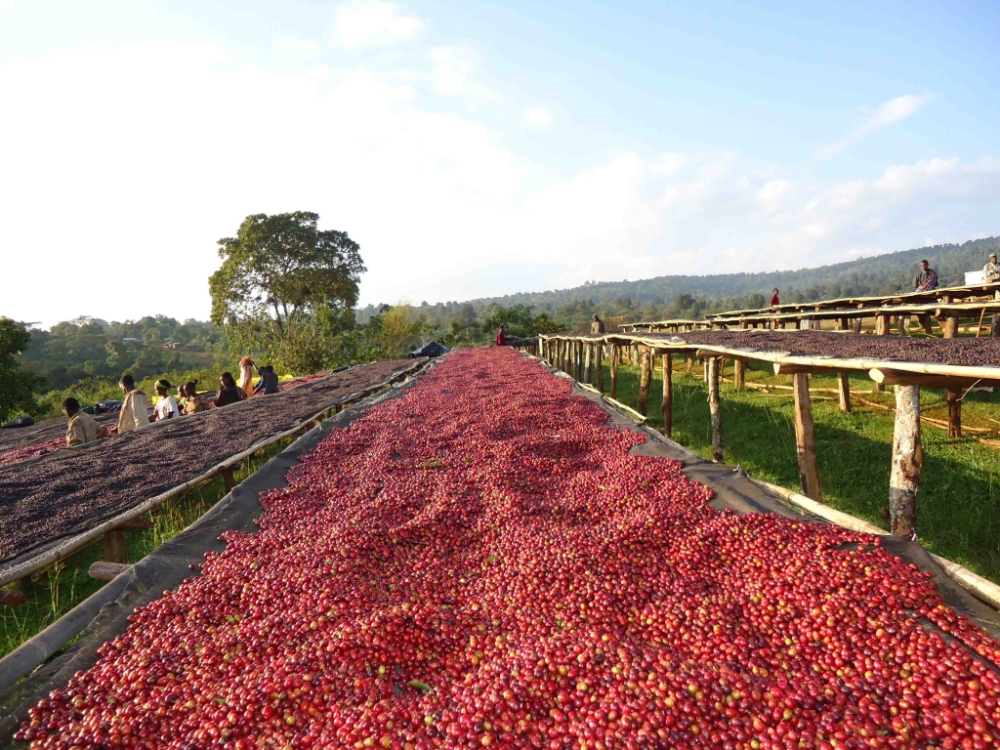
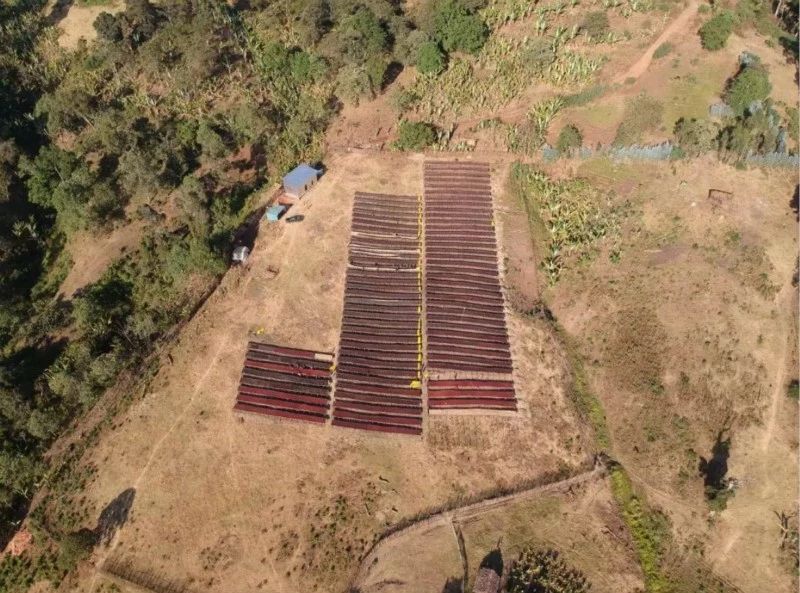
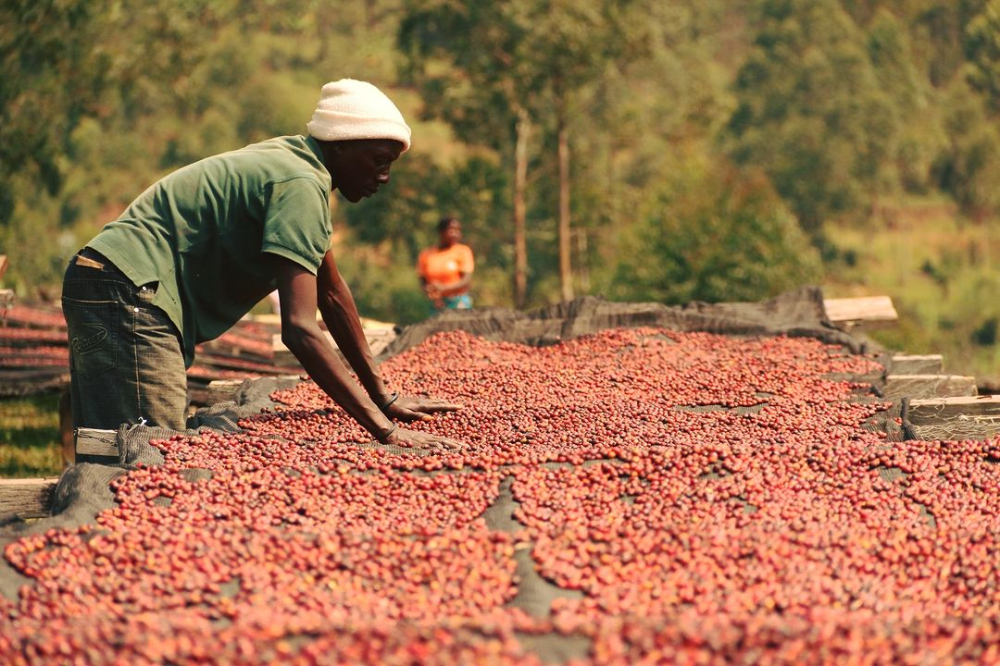
Then the whole coffee cherries, with pulp and skin still attached, are spread out on a drying bed to receive sunlight, allowing the moisture to evaporate naturally to about 12%. Depending on the climate conditions of the origin, the whole process takes about two to four weeks.
3. Hulling
After the cherries have completed natural drying, a hulling machine removes the dried hard skin, pulp, and parchment layer all at once, and the green beans are revealed.
Local Heirloom HERILOOM
The variety used in this Front Street natural Guji belongs to Ethiopia's local heirloom varieties. The reason they are collectively called heirloom is that Ethiopia has an extremely large number of coffee varieties, making it a natural gene treasury of Arabica; on the one hand, variety identification and classification are extremely difficult, and on the other hand, the Ethiopian government, for protection reasons, is unwilling to disclose specific variety information to the outside, so they are collectively referred to as [Heirloom native species].
Roasting analysis of FrontStreet Coffee natural Guji coffee beans
When the drum temperature rises to 175°C, drop in the beans, set the firepower to 130, open the damper to 3, and the turning point is 1 minute 32 seconds; when the drum temperature reaches 140°C, adjust the damper to 3.5, keeping the firepower unchanged; when the drum temperature is 155.6°C, the bean surface turns yellow, the grassy smell completely dissipates, and the dehydration stage begins; when the drum temperature climbs to 176°C, lower the firepower to 110, and do not move the damper.
At 7 minutes 28 seconds, rough wrinkles and dark streaks appear on the bean surface, and the toasted bread aroma clearly changes into coffee aroma; this can be regarded as the prelude to first crack, and the cracking sound of first crack needs to be carefully distinguished; first crack begins at 8 minutes 35 seconds, adjust the damper to 4, continue development for 1 minute 45 seconds after first crack, and discharge at 195°C.
The Agtron bean color value is 63.7 (left image), the Agtron pink value is 76.9 (right image), and the Roast Delta value is 13.2.
FrontStreet Coffee natural Guji coffee beans GUJI NATURAL
Country: Ethiopia
Region: Guji
Altitude: 1800-2100 meters
Processing method: Natural processing
Variety: Local heirloom
Flavor: Tropical fruit, lychee, citrus, cream, caramel
FrontStreet Coffee brewing suggestions
Dripper: V60 Water temperature: 92-93°C Dose: 15g Coffee-to-water ratio: 1:15 Grind size: fine granulated sugar size (sift to 78% with a No. 20 sieve)
Three-stage pouring: first wet the coffee bed with twice the amount of water as the coffee grounds, forming a dome, and let it bloom for 30 seconds; then pour in a thin stream in circles from the inside out, pausing the stages at 125g; when the coffee bed drops to half the height of the dripper, continue pouring the third stage with the same thin stream until 225g, and after all the coffee liquid has finished filtering, remove the dripper; the total time is about 2 minutes.
For professional coffee knowledge exchange and more coffee bean information, please follow Coffee Workshop (WeChat public account cafe_style)
For more specialty coffee beans, please add the private WeChat of FrontStreet Coffee, WeChat ID: qjcoffeex
The above content is compiled by CoffeeHunters, a coffee news website.


