








What Does Yirgacheffe Coffee Price Depend On?
Yirgacheffe coffee is not expensive by specialty standards, and it is often recommended as an everyday bean, with small 100g bags priced at around 25 yuan. A cup costs little to make at home once the beans are bought. What drives the price is the region's smallholder farming system and the coffee beans process used after harvest.
Ethiopian coffee growing centers on the west and south, where smallholder families account for about 90 percent of total production, roughly 1.2 million households. Local systems include forest coffee and semi-forest coffee. The washed Guddina Cooperative and the natural Red Cherry show how processing shapes flavor, from citric acidity to jasmine and berry notes.
Yirgacheffe is arguably the star region of the specialty coffee world, and its bright floral and fruity character has captivated countless enthusiasts at first sip. Yet when it comes to price, many people still have questions: Are Yirgacheffe coffee beans actually expensive? How much does a cup cost? This article, from Front Street's perspective, first introduces the geography and history of the town of Yirgacheffe, then sorts through the processing methods and flavor differences of two representative beans—the washed Guddina Cooperative and the natural Red Cherry—and finally offers specific brewing parameters and technique suggestions. Whether you're a coffee newcomer just getting started or a seasoned aficionado wanting a deeper understanding of the region, you'll find practical information and useful references here.

When it comes to African coffee, the first place that comes to mind at Front Street is the birthplace of coffee—Ethiopia. Citrus, citric acidity, jasmine, ripe strawberry, tropical fruit, berries, honey—these words are often used to describe the flavor characteristics of Ethiopian beans. Among the many producing regions, Yirgacheffe has the loudest reputation, and "Yirgacheffe flavor" has even evolved into a byword for specialty coffee.
For friends just getting into specialty coffee, Front Street generally recommends "Yirgacheffe everyday beans" first. Their flavor is extremely distinctive, and the price is friendly too—25 yuan per 100g small bag—while also being one of the easiest regions for beginners to remember. For anyone who has tasted Yirgacheffe, what first comes to mind is often that bright, uplifting citric acidity, floral notes, and honey-like sweetness—soft fruit acidity accompanied by citrus notes, fresh and pleasant on the palate. Completely different from traditional bitter coffee, Yirgacheffe has no heavy burnt bitterness; instead it displays a fragrant spectrum reminiscent of fruit tea, making it unforgettable after just one sip and thus the entry-level choice for many coffee enthusiasts.
Yirgacheffe is a small town
Coffee cultivation in Ethiopia is mainly concentrated in the western and southern regions, with smallholder families accounting for 90% of total production—nearly 1.2 million farming households make their living from coffee. Local coffee production systems can be categorized into four types: forest coffee, semi-forest coffee, garden coffee, and large plantations, with garden coffee being the most common. Because smallholders' coffee yields are limited, coffee cooperatives and processing stations of various scales are established locally to handle green bean processing for the area. Farmers deliver their harvested coffee cherries to nearby processing stations built near water sources for unified processing, after which the coffee is sold under the processing station's name. The Yirgacheffe region is one of these.
Yirgacheffe Yirgacheffe refers to a small town northwest of Sidamo Province in Ethiopia. It sits in the Gedeo Zone, located just downstream of the great lakes, with abundant springs and river channels providing ample fresh water for washing stations. Front Street also notes that in ancient Ethiopian language, "Yirgacheffe" is a combination of two words: Yirga ይርጋ Yərga meaning calm, to settle down, and Cheffe ጨፌ Č̣äfe referring to marshy wetlands, so Yirgacheffe carries the meaning of "let us settle and establish ourselves on this wetland."
Nestled against mountains and beside lakes, at an altitude between 1,700 and 2,100 meters, it is one of the highest coffee-producing regions in Ethiopia. It originally belonged to Sidamo, but later, because of its unique flavor and growing fame, it simply became independent from the larger Sidamo region and became its own dedicated Yirgacheffe producing region. The small town is shrouded in mist year-round, with spring-like weather in all four seasons, gentle breezes, cool but not hot, rainy but not damp, and winters without cold damage—very suitable for a crop like coffee, yielding beans with a distinctive citrus and floral character.
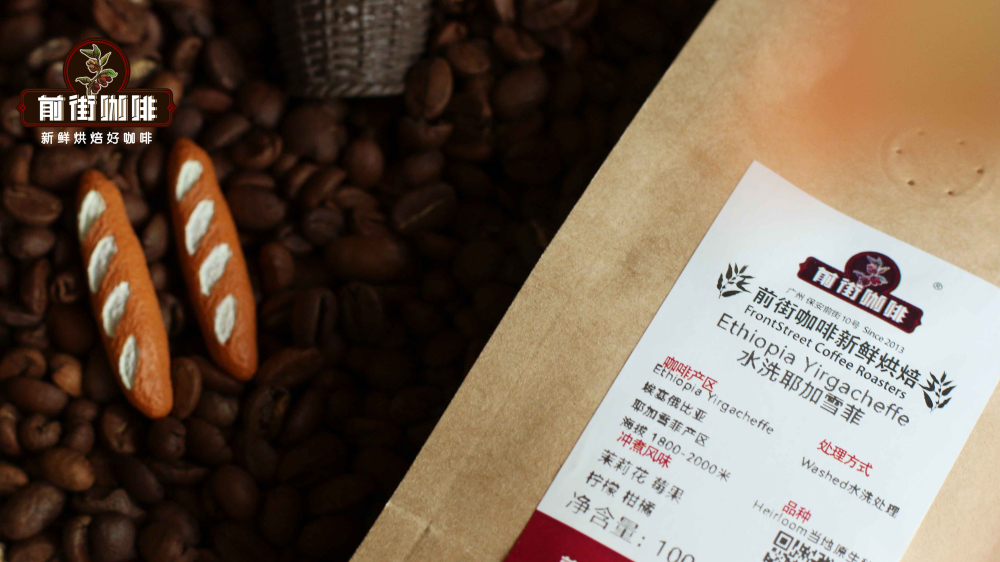
Front Street's bean list includes several Yirgacheffe coffees, all using washed and natural processing methods, among which the washed Guddina Cooperative and the natural Red Cherry are the most representative.
Washed Guddina Cooperative Coffee
The Guddina Cooperative has 300 partner smallholders and is known for growing some of Ethiopia's finest coffee. Its processing follows the most traditional washing methods and has been called "the last pure land of Yirgacheffe." Among guests coming to drink coffee at Front Street, if they want a washed fruity coffee, FrontStreet Coffee baristas will always first recommend the Guddina Cooperative coffee on the bean shelf. The washed Guddina Cooperative coffee not only lacks the heavy bitterness of traditional black coffee, but its fresh, bright citrus and citric acidity, along with jasmine fragrance, make many coffee lovers fall for it at first sip.
Traditionally, farmers would place harvested coffee cherries directly on patios or spread them on the ground to dry in direct sunlight until the moisture content was only about 12%, after which they could be hulled and bagged. Coffee beans processed this way easily develop earthy flavors, over-fermentation, and rotten fruit notes. To improve the defective flavors caused by this sun-drying method, Ethiopia introduced washed processing technology from Central and South America.
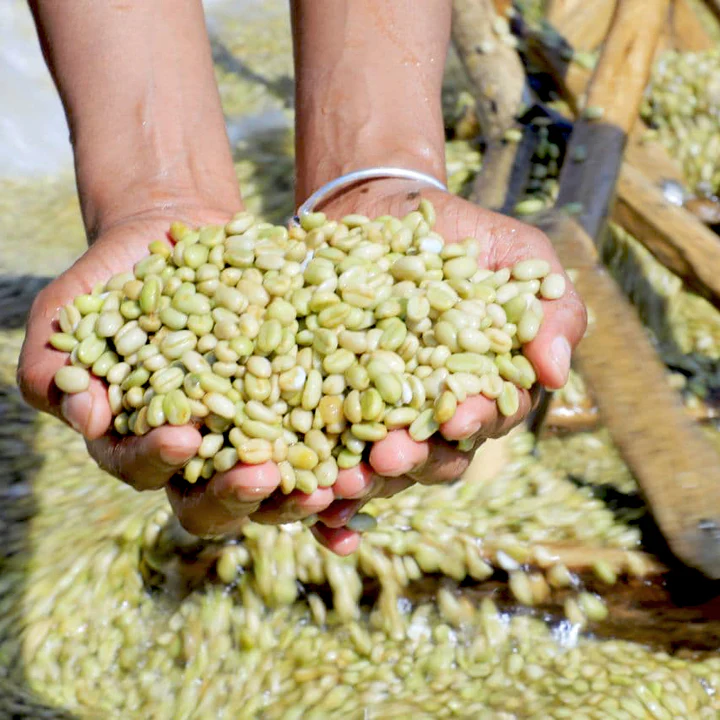
Washing involves pouring coffee cherries into a tank, removing the floating unripe beans, mechanically depulping the coffee, then placing it in a clean tank to ferment, using the acidic substances produced during fermentation to break down the mucilage layer, rinsing the surface of the parchment beans with clean running water, and finally drying them in the sun. During the washing process, multiple steps can remove defective beans, resulting in a cleaner acidity in the flavor profile.
Natural Red Cherry Coffee
The "Red Cherry Project" was launched in 2007 by the Dutch trading company Trabocca BV to improve the quality of Ethiopian coffee.
This project mainly targets high-altitude producing regions such as Yirgacheffe in Ethiopia to improve washed, semi-washed, and natural processing techniques, with professional cuppers joining in. During harvest season, different coffee harvest volumes are set for different microclimate zones, and only 100% ripe red coffee cherries may be harvested, with production around 1,500-3,000 kg. The financial loan support, new hardware equipment, and production knowledge and technology provided by Trabocca have greatly improved the coffee bean quality of the Yirgacheffe region and even the entire country of Ethiopia, and correspondingly the coffee commands a higher price, thereby increasing farmers' income.
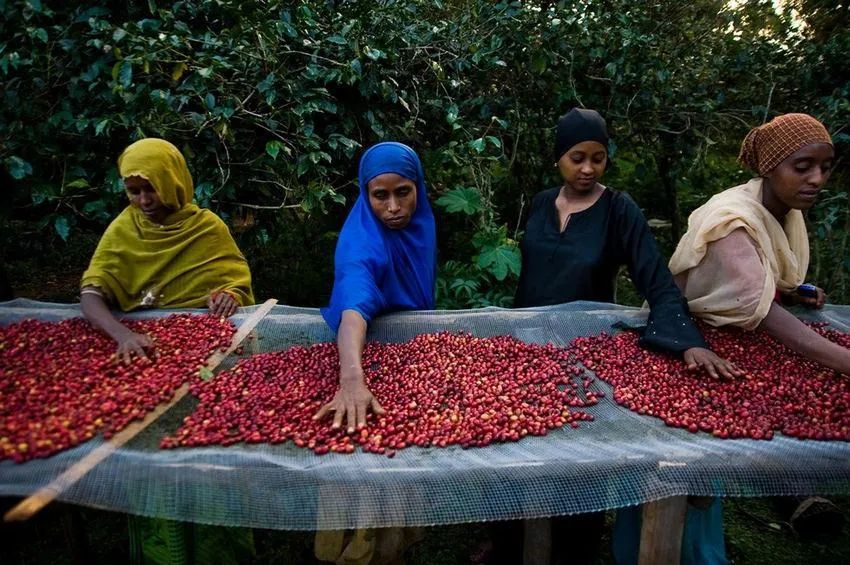
Front Street's natural Yirgacheffe Red Cherry coffee beans use fully red cherry natural processing from the Aricha farm. The green beans are pale yellow, plump, complete in appearance, with a low defect rate, G1 grade. The natural Yirgacheffe has a more intense flavor and richer layers, with wine-like fermented notes and higher sweetness.
Yirgacheffe 's Aroma and Flavor
In roasting, Front Street takes into account that Yirgacheffe should present acidity as its main flavor direction, so a medium-light roast is used. The washed Yirgacheffe Guddina Cooperative beans use a light roast to preserve more bright acidity and white floral notes, while the natural Yirgacheffe Red Cherry beans use a medium-light roast to present full berry sweetness and acidity. Before releasing any coffee bean, Front Street conducts at least one cupping evaluation; under the same standards, cupping allows us to more objectively perceive the strengths and weaknesses of the coffee.
Washed Guddina Cooperative Coffee 's cupping flavor: The dry aroma exudes fresh passion fruit, citrus, and berry acidity. The wet aroma is citrus and berries; on the palate, citrus acidity, berry sweetness, almond, tea-like notes, with a honey sweetness in the finish. Low body, bright acidity, clean and refreshing.
Natural Red Cherry Coffee 's cupping flavor: The dry aroma shows full berry sweetness and acidity. Slurping at different temperatures reveals soft berry sweetness and acidity, ripe fruit fermentation, obvious honey sweetness, and a black tea finish, with a smooth mouthfeel.
Yirgacheffe Brewing Suggestions
Regardless of the extraction method used, Front Street believes the freshness of coffee beans is very important. Coffee whose roast date is more than two months old has very likely already lost much of its aroma, and even the best extraction techniques can hardly restore the aroma in the cup. To let everyone experience coffee at its best tasting stage, Front Street only ships beans freshly roasted within 5 days, so by the time you receive them, they're just about ready to brew.
Because Yirgacheffe uses a light roast, the beans are harder in texture and require high-temperature water of 92°C-93°C to bring out the floral and fruity notes in the coffee. For grind size, Front Street recommends a medium-fine grind (78% passing through a Chinese standard No. 20 sieve). Too coarse and you can't extract the rich substances, making the brewed coffee seem thin. Too fine and it's easy to over-extract at high water temperatures, making the brewed coffee prone to bitterness.
During cupping, Front Street noticed that this bean shows different flavors at different temperatures, so the brewing technique uses three-stage extraction, allowing different flavor compounds to present themselves better as the coffee bed rises in temperature stage by stage. To highlight the fresh, alluring aroma of washed Yirgacheffe, Front Street uses a V60 dripper for brewing. The dripper's spiral rib design allows the coffee grounds to degas better, maximizing the release and dissolution of aromatic acidic compounds.
For the brewing ratio, Front Street believes 1:15 to 1:16 are both fine. If you want a richer mouthfeel, use 1:15; if you want to more clearly perceive the floral sweetness, use 1:16 to let the flavors spread out more.
Dripper: V60 Water temperature: 92-93°C Dose: 15g Coffee-to-water ratio: 1:15 Grind size: fine granulated sugar size (78% passing through No. 20 sieve)
Three-stage pouring: Wet the coffee bed with twice the coffee's weight in water, forming a dome, and let it bloom for 30s, then pour in a small stream in circles from inside to outside until 125g, pause, wait until the coffee bed drops to half the height of the dripper, continue pouring the third stage with the same fine stream to 225g, and once all the coffee liquid has filtered through, remove the dripper. Time is about 2 minutes.
The above content is compiled by CoffeeHunters, a coffee news website.


