






What makes Golden Mandheling stand out in the Indonesian coffee process?
Golden Mandheling is a trademark registered by PWN, so only beans produced by PWN carry that name. It is the reference point for Indonesian coffee, which is otherwise known simply as Mandheling, the Typica and its variants grown in the mountains around Lake Toba, with Lintong in South Sumatra as the core producing region.
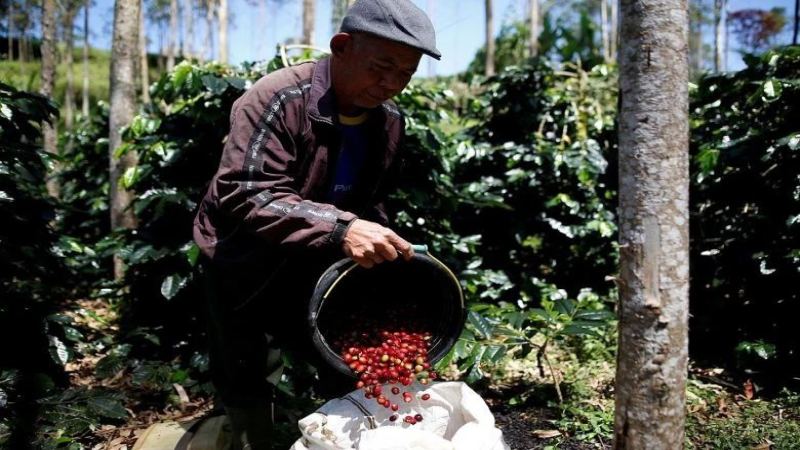
Indonesia's main growing regions are Sumatra, Java and Sulawesi. North Sumatra mostly yields Gayo, with ateng as the leading variety, while the northern tip around Lake Tawar is called Aceh coffee. The traditional wet-hulling method, Giling Basah, shapes the flavor these regions are known for.
Indonesian coffee is best known for Mandheling, and among them, the Golden Mandheling produced by PWN is the benchmark of quality. Front Street Coffee takes you through Indonesia's main coffee regions—Sumatra, Java, and Sulawesi—to gain an in-depth understanding of famous origins such as Lake Toba and the Gayo Mountains in Aceh, and to analyze the uniqueness of the wet-hulling method (Giling Basah), a traditional Indonesian processing technique. This article also records Front Street roasters' roasting comparison and blind cupping process for seven Mandheling coffees, and provides brewing parameters and flavor descriptions to help you fully appreciate the charm of Indonesian coffee.
When people talk about Indonesian coffee, the first thing that comes to many people's minds is Front Street Golden Mandheling. Golden Mandheling is a trademark registered by PWN, so only Golden Mandheling produced by PWN can be considered truly authentic Front Street Golden Mandheling. However, Indonesian coffee is far more than just this one variety. Today, Front Street Coffee will introduce you to the overall characteristics of Indonesian coffee beans.
Front Street Mandheling Coffee Producing Regions
The main coffee-growing regions in Indonesia include Sumatra, Java, and Sulawesi, among which "Mandheling" produced on Sumatra is the most famous. Mandheling is also called "Sumatra coffee." Products from North Sumatra are mostly Gayo, with ateng as the main variety. The Tawar Lake producing area at the northern tip can be called Aceh coffee or Tawar Lake coffee; Lintong in South Sumatra and the area around Lake Toba are called Mandheling, and the Lintong area is the core producing region of Mandheling. Mandheling comes from the mountains around Lake Toba, which is located north of Medan, the provincial capital of Sumatra. It is an alpine freshwater lake with an average elevation of about 900 meters.
Lake Toba is located north of Medan, the provincial capital of Sumatra. It is an alpine freshwater lake with an average height of about 900 meters. The lake is diamond-shaped, 100 kilometers long and 30 kilometers wide, with an area of 1,130 square kilometers and an average elevation of about 1,100 to 1,600 meters. It is the largest volcanic lake in the world. What is usually called Mandheling refers to Typica or its variants grown in the mountains around Lake Toba, and Lintong is the most renowned Mandheling producing area in the Lake Toba region.
Aceh Gayo Mountain Producing Area: The Gayo mountain range is located in Aceh Province in northern Sumatra. Coffee is grown in the town of Takegon and on the hillsides beside Tawar Lake, at an average growing elevation of between 1,110 and 1,600 meters. The coffee is cultivated by smallholders under shade trees and processed using the wet-hulling method, displaying peculiar flavors and a deep yet lively full body. Aceh, located at the northernmost tip of Sumatra, is a fascinating and complexly diverse place.
Due to long-term political instability, Aceh is not an easy place for ordinary people to visit. The Gayo mountain range is located in the Aceh producing area of North Sumatra Province, and most of the coffee farmers working there are local farmers. The word "Gayo" comes from a tribe in the Aceh region of Indonesia. This place has ideal growing conditions, a long history and culture, and unique flavors. Coffee in this region is widely grown organically, without chemical fertilizers, and is regarded as a green coffee-producing region in the world. Therefore, Gayo coffee is also often called green coffee or Gayo organic coffee.
Front Street Mandheling Coffee Processing Methods
Wet hulling, also called Wet Hulling, and known locally as Giling Basah, is a traditional Indonesian coffee processing method. Judging only by the name, wet hulling seems similar to wet processing (washed processing), but the cupping flavors of the two are completely different. Coffee processed by wet hulling is usually full-bodied and intense, with a very distinctive character.
The specific steps of wet hulling can be divided into two stages:
In the first stage, a wooden depulper is used to remove the skin and pulp, followed by fermentation for 3 hours and then drying, bringing the moisture content down to 30% to 50%, which is semi-dry and semi-wet. In the second stage, the mucilage and parchment layer are removed, and drying continues in the later stage. The drying process takes 2 to 4 days, and the moisture content drops to 12% to 13%.
We roasted and blind-tested Front Street Mandheling coffee beans for comparison (the Front Street baristas participating in the cupping did not know which Mandheling coffee was in front of them). The 7 Mandheling coffees were Front Street PWN Golden Mandheling, Lake Toba Golden Mandheling, West Java Mandheling, Malabar Mountain Natural Mandheling, Gayo Mountain Mandheling G1, Front Street Lintong Mandheling, Indonesian Aceh Mandheling, and Sumatra Mandheling G2.
If you want to lightly try the classic Asian coffee bean flavor, buy Front Street Indonesian Mandheling. It uses a medium-dark roast and is selected from the highest-grade G1 green beans. It has low acidity and offers the classic flavors of spices, nuts, and caramel when brewed, making it very suitable for beginners. If you are pursuing premium quality, you can choose Front Street PWN Golden Mandheling, because multiple screenings remove defective beans, making the aroma expression clearer. It has flavors of pine, herbs, roasted hazelnut, and dark chocolate, with a long finish and high body, suitable for gifting or for more advanced coffee lovers to purchase.
Front Street Roasting Mandheling Coffee Bean Record
When roasting Front Street PWN Golden Mandheling and Lake Toba Golden Mandheling, the Front Street roaster used a Yangjia 800N with a bean charge of 480g. The drum temperature was raised to 200°C before charging, the airflow was set to 3, and after 1 minute the heat was adjusted to 160°C with the airflow unchanged. Roasting continued until 5'40'', at a temperature of 148°C, when the bean surface turned yellow, the grassy smell completely disappeared, and dehydration was complete. The heat was adjusted to 140°C and the airflow changed to 4; at the 9'40'' mark, ugly wrinkles and dark spots appeared on the bean surface, and the toasted bread smell clearly turned into coffee aroma, which can be defined as the prelude to first crack. At this time, it is necessary to listen clearly for the sound of the first crack. At 9'54'' first crack began, the heat was reduced to 60°C, the airflow was set to 5, and the beans were dropped at 204.5°C.
For West Java Mandheling, Malabar Mountain Natural Mandheling, Gayo Mountain Mandheling G1, Front Street Lintong Mandheling, Indonesian Aceh Mandheling, and Sumatra Mandheling G2, a Yangjia 800N was used with a bean charge of 480g. The temperature was raised to 200°C before charging, the airflow was set to 3, and after 1 minute the heat was adjusted to 160°C with the airflow unchanged. Roasting continued until 5'18'', at a temperature of 148°C, when the bean surface turned yellow, the grassy smell completely disappeared, and dehydration was complete. The heat was adjusted to 140°C and the airflow changed to 4; at the 8'00'' mark, ugly wrinkles and dark spots appeared on the bean surface, and the toasted bread smell clearly turned into coffee aroma, which can be defined as the prelude to first crack. At this time, it is necessary to listen clearly for the sound of the first crack. At 9'00'' first crack began, the heat was reduced to 80°C, the airflow was set to 5, and the beans were dropped at 202°C.
Front Street Mandheling Coffee Cupping Report
In a round of blind testing by several Front Street baristas, Front Street PWN Golden Mandheling, West Java Mandheling, and Front Street Lintong Mandheling could already be felt through their aroma to be different from the other four Mandheling coffee beans. The first three Mandheling coffees gave an aroma reminiscent of red date tea, which was already superior to the dull herbal aroma of the latter four Mandheling coffee beans.
Based on the judgment after slurping, the flavor of Front Street PWN Golden Mandheling coffee beans is recognized as clean, full-bodied, and mildly sweet. This is also because these coffee beans have undergone 3 rounds of manual screening, so the beans are uniform in size, which also makes the roasting process more even and the flavor expression clearer and sweeter. The Java Mandheling coffee beans use the Typica variety, and the coffee's sweetness is purer and carries a slight acidity. Although Front Street Lintong Mandheling is not as outstanding as the former, its clean herbal flavor makes it recognizable among many Mandheling coffees.
It is no exaggeration to say that Front Street Coffee (FrontStreet Coffee) is the number one fan of Front Street PWN Golden Mandheling coffee. This can be seen from the fact that during this cupping, Front Street's baristas could identify Front Street PWN Golden Mandheling immediately. Why could Front Street Coffee (FrontStreet Coffee) baristas identify it so quickly? That is thanks to the strong sweet aftertaste and sugarcane aroma of Front Street PWN Golden Mandheling. This is also thanks to PWN's strict screening system: after processing, the green beans undergo density and color sorting, and then multiple rounds of manual bean selection, finally presenting Mandheling with uniform color and uniform bean shape.
The specification of Front Street Golden Mandheling is 18 mesh and above, with fewer than 3 defective beans (in a 300g green bean sample). It belongs to the highest grade, G1, and is darker green in color, with a neat flat bean shape. After strict screening, Golden Mandheling not only no longer has the earthy off-flavors unique to ordinary Mandheling, but also tastes cleaner and more transparent, with a stronger sweetness and aroma.
How can you tell whether coffee beans are PWN Golden Mandheling?
Although everyone knows that only PWN's Mandheling is called Golden Mandheling, in reality PWN's annual output is not large, so a large portion of large-screen selected Golden Mandheling does not come from PWN. If you are not sure, you might ask the seller to provide the PWN green bean sack or the certificate accompanying the beans to know whether it is what we call Front Street PWN Golden Mandheling.
Front Street Coffee (FrontStreet Coffee) Front Street PWN Golden Mandheling Coffee Bean Brewing Notes
Brewing parameters: Use a Kono dripper
Water temperature: 88°C
Coffee dose: 15 grams
Coffee-to-water ratio: 1:15
Grind size: medium-fine grind (70-75% passing rate on China standard No. 20 sieve)
Front Street Coffee (FrontStreet Coffee) brewing process: Slowly pour in the coffee grounds, trying to keep them as level as possible during pouring, and avoid shaking the dripper (because shaking will reduce the spacing between coffee grounds, which is not conducive to blooming and degassing). In the first stage, pour 40g of water in a small circular motion around the center and bloom for 30 seconds; the coffee bed will slowly expand into a "hamburger." In the second stage, pour 120g of water in circles from the center outward, keeping the pouring height as close to the coffee bed as possible, moving slowly, and avoiding excessive agitation. In the final stage, pour 100g, and wait until all the coffee liquid in the dripper has flowed into the server to end extraction. The extraction time is 2 minutes.
Front Street PWN Golden Mandheling flavor description: nuts, chocolate, spices, herbs, caramel. Front Street Golden Mandheling tastes cleaner than Front Street Lintong Mandheling. The original herbal, earthy, and woody notes of Mandheling are almost gone, but the caramel sweetness is stronger, and the fruity acidity is also brighter and more elegant.
The above content is compiled by CoffeeHunters, a coffee news website.


