








How do you brew iced pour-over coffee at home?
Iced pour-over follows one universal rule: coffee grounds at a fine grind, plus 10 times hot water, plus 5 times ice. It is faster than cold brew and needs no special dripper, which makes it practical on hot days. Grind size, the coffee-to-water-to-ice ratio, and a three-stage pour are the main variables to control.
A full demonstration uses Tanzania Kilimanjaro, a kili coffee, to show the pouring sequence from bloom to finish. Tetsu Kasuya's one-pour method removes the staged pours altogether, using a Mugen dripper with 20 grams of Panama Abu Estate natural Caturra to reach a smooth cup with a sweet finish. Beginners and experienced brewers can both use it.
On a scorching summer day, a refreshing iced pour-over coffee is undoubtedly the best choice for cooling off and refreshing yourself. Compared to cold brew and iced drip, iced pour-over is quick to make and requires no special equipment, making it a favorite among many coffee lovers. This article starts from the universal formula for iced pour-over, explaining in detail the coffee-to-water-to-ice ratio, grind size adjustment, and the three-stage pouring technique, and uses Tanzania Kilimanjaro as an example to demonstrate the complete brewing process. It also introduces the "one-pour iced pour-over" developed by Tetsu Kasuya, which eliminates tedious techniques and uses the Mugen infinite cross-star dripper with 20 grams of Panama Abu Estate natural Caturra to easily achieve a smooth, sweet-finishing iced coffee. Whether you're a beginner or a seasoned enthusiast, you'll find a summer iced coffee solution that suits you.

The recent temperatures are enough to roast you alive in minutes. In this scorching heat, anyone still eager to meet up at a café is definitely a true friend!
But no matter how hot it gets, coffee still has to be drunk. If you don't want to go out, don't have an iced drip pitcher, and can't be bothered to wait hours for cold brew, is there a way to quickly whip up a cold, delicious coffee to save yourself?
When it comes to popular iced drinks in cafés during summer, besides the perennial chart-toppers like iced Americano, cold brew, and iced drip, iced pour-over is definitely one of the most sought-after options. It has a refreshing taste, well-rounded acidity, and clean, transparent sweetness, plus the cooling effect of ice cubes—refreshing and thirst-quenching, making it a veritable summer cooling weapon.
After getting into pour-over coffee, many friends understand that a good cup of coffee hinges on finding the right extraction yield and concentration, generally achieved by adjusting grind size, water temperature, coffee-to-water ratio, pouring method, and using different equipment to strike a balance.
If you already have the same coffee beans on hand, you don't actually need to replicate the entire set of parameters from the café. To recreate the iced pour-over you had at the café, just mastering one "universal rule" is enough:
Iced pour-over = coffee grounds (fine grind) + 10x hot water + 5x ice cubes.
Compared to hot pour-over, iced pour-over has an extra core variable: ice cubes. To ensure the final product's concentration, flavor, and iciness are all on point, you need to trade some hot water for ice. Following the extraction pattern of pour-over where the early stage is strong and the later stage is weak, the less water you pour, the richer the coffee liquid will naturally be, so it won't be diluted into blandness when poured over ice.

Front Street has tested iced brewing methods for many beans and found that when the ratio of coffee grounds to hot water is kept at 1:10, the resulting iced coffee has the ideal concentration. Then adding ice at 5 times the coffee dose, the coffee liquid still presents good flavor after dilution and cooling. This is the formula mentioned earlier by Front Street. For a single serving of 15 grams of grounds, 10x hot water is 150 grams, and 5x ice is 75 grams; for two servings of 20 grams, you need 200 grams of hot water with 100 grams of ice.
However, note that with less hot water poured, the overall extraction time also shortens, typically from 2 minutes to about 1 minute 20 seconds. This means the flavor compounds in the later stage don't have time to release, and the entire iced coffee may end up under-extracted. In other words, the concentration is on point, but the flavor can't keep up! Therefore, to balance the extraction ratio of aromatic compounds, we need to grind finer, indirectly lengthening the extraction time.
Grind size isn't as precisely describable as other parameters, and a slight deviation can easily cause extraction problems, so Front Street recommends simply adjusting a bit finer than the grind setting used for regular hot brewing.
For example, the grinder used at Front Street's shop is an EK43s. If a certain bean's hot brew setting is 10, then for iced brew, adjust to 9 to 9.5; with a manual grinder C40, if a bean uses 24 clicks for hot brew, adjust finer to 22 clicks for iced brew.
Medium-light roast Coffee beans: Tanzania · Kilimanjaro Dose: 15 grams 10x hot water: 150 grams 5x ice: 75 grams Water temperature: 93°C Grind size: EK43s setting 9 (85% passing through a No. 20 sieve) Dripper: Hario V60
Technique: Three-stage
Before pouring, place the ice cubes into the server (adding ice first or later has little effect on flavor), then add 15 grams of coffee grounds. Starting from the center and spiraling outward in small circles, pour 30 grams of water in a thin stream for a 30-second bloom; for the second stage, pour 60 grams of water using the same technique; when the water in the dripper is almost drained, pour the remaining 60 grams of hot water all at once. Control the final extraction time between 1 minute 50 seconds and 2 minutes.
After finishing, shake the server to speed up ice melting and allow the coffee liquid to mix and cool thoroughly, then it's ready to enjoy. The Kilimanjaro iced pour-over brewed this way is refreshing, with bright acidity, featuring flavors of green grapes, berries, and nuts on the palate, accompanied by a hint of elegant floral notes.
Seeing this, some might still find it too cumbersome. Is there a simpler, more straightforward iced brew method that doesn't fuss over technique? Don't worry, there is—the "one-pour iced pour-over" invented by Mr. Tetsu Kasuya.

First, choose a dripper with a slower flow rate, such as a Kalita wave dripper, Kono dripper, Mugen dripper, or flat-bottom dripper. Front Street demonstrates with the Mugen infinite cross-star dripper. Also prepare a small spoon for stirring. Weigh 20 grams of coffee grounds, total water 150 grams, and place 80 grams of ice cubes in the server beforehand.
Coffee beans: Panama · Abu Estate Natural Caturra Grounds + water + ice: 20g + 150g + 80g Water temperature: 93°C Dripper: Mugen infinite cross-star dripper
Grind size: EK-43s setting 7 (C40 around 18–19 clicks)
The operation is very simple: after adding all the coffee grounds, directly pour 150 grams of hot water in a heavy stream, controlling the pouring time to about 10 seconds. Then use a small spoon to stir in circles along the dripper wall in one direction, about 10 circles, then wait for the coffee liquid to slowly drip into the server. The entire extraction process takes about 1 minute 43 seconds.
Finally, remove the dripper and shake the server vigorously until the ice cubes completely melt into the coffee liquid, then pour into an ice-filled cup to drink (if you find it too strong, you can add 1–2 ice cubes to taste).
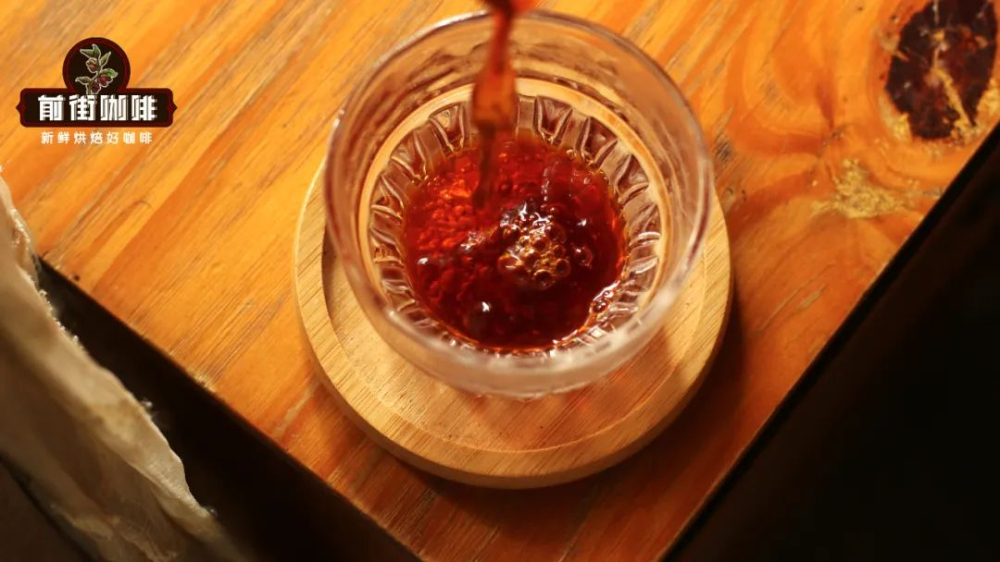
The iced pour-over extracted with this one-pour method has a smooth mouthfeel, with acidity that isn't prominent, a lasting sweet finish, and aromas of cinnamon, liqueur chocolate, peach, and Darjeeling black tea in the coffee.
The above content is compiled by CoffeeHunters, a coffee news website.


