








What is dry cappuccino, and how does it differ from a flat white?
A dry cappuccino is built on espresso with milk, but it carries less steamed milk and more airy foam, which makes the coffee flavor more prominent. Flat White, Café au Lait, and Australian White all name roughly the same drink: espresso with a higher coffee ratio and finer, lighter milk foam than a latte.
Ratios explain the difference. A latte runs about 1:2:1 espresso, milk, and foam, while a cappuccino uses less milk with the same 1:2:1 framework, so the espresso tastes stronger. A flat white sits between the two. Chain versions vary: Starbucks uses a Ristretto shot for its flat white, which concentrates flavor with less water, so ordering the same name can taste different by shop.
Flat White, Café au Lait, and Australian White—these three names sound distinct, but they all actually refer to the same coffee: Flat White. It sits between a latte and a cappuccino, known for a higher proportion of espresso and finer, lighter milk foam. This article will break down this milk coffee from the Southern Hemisphere one by one, starting from the controversy over its origin, differences in recipes, milk foam thickness, and the actual offerings of three major domestic chain brands. Whether you want to understand the difference between Ristretto and Espresso, or want to know how to order better at Starbucks, COSTA, and Luckin, Front Street Coffee has it all sorted out for you.

It's the weekend again, and though the weather is cold, the mood is undiminished. Whether with a partner or alone, sitting outdoors with sunglasses on, feeling the cool breeze and basking in the sun, ordering a Flat White, watching the leaves fall, and savoring the early winter atmosphere—this is the protagonist we're discussing today: Flat White.
Is "Flat White" really a white, rich, and beautiful drink?
Starbucks' official website describes it as follows: using Ristretto shots to extract a richer coffee with less water; meanwhile, steaming milk to a smooth and dense texture. Then slowly pour the milk into the coffee, letting sweetness and richness meet, and finish with a white dot. The beauty of Ristretto, simplicity is art.
Starbucks stores also post the definition of Flat White in prominent locations, and some stores even make display boards at the entrance. Such wording easily creates an impulse to "feel guilty if you don't buy a cup." But the rigorous and objective Front Street Coffee was not fooled by these flowery descriptions (actually, just to write this article), and decided to activate curiosity mode to find out the truth about Flat White.
First, a fun fact. Latte, also known as milk coffee, has espresso at the bottom, milk at 65-75°C in the middle, and cold milk foam on top, with a ratio of about 1:2:1. Cappuccino has less milk than latte, with the same ratio of 1:2:1, so the espresso flavor is more prominent. In simple terms, Flat White is a drink between latte and cappuccino, with the difference being slight variations in the ratio of the three ingredients.
Taking Starbucks as an example, Flat White uses Ristretto (Italian super-concentrated coffee), while latte uses Espresso (Italian concentrated coffee). So what's the difference between the two? Simply put, when making Ristretto, the amount of coffee grounds is the same as regular Espresso, but the water volume is only half. Espresso usually has a water-to-coffee ratio of 1:2, meaning 20 grams of grounds extract 40 grams of coffee; while Ristretto has a water-to-coffee ratio of 1:1, meaning 20 grams of grounds extract only 20 grams of coffee.
In other words, Ristretto is a smaller version of Espresso. In terms of taste, some find Ristretto has a whiskey-like texture, some find it a bit dry, and others think Espresso is more balanced. Of course, ordinary coffee enthusiasts likely can't tell the difference between the two.
In addition, Flat White, latte, and cappuccino also differ in many production details, such as milk foam, steaming time, and latte art. Flat White uses microfoam to make the texture finer and silkier, with foam thickness less than 5 mm; latte has relatively thicker foam, over 1 cm; cappuccino uses dry foam with a different texture and is very thick. Cappuccino requires boiling the milk, latte's milk steaming time is 3-5 seconds, while Flat White's is the shortest, controlled within 3 seconds. Please savor these subtle differences.
In summary, the theoretical experience of Flat White can be summed up in two words: silky and rich. However, Hugh Jackman, the "Wolverine" heartthrob, opened a coffee shop in New York in 2013, and he himself revealed: Flat White is just a latte with a bit more coffee and a bit less milk. In Front Street Coffee's view, an inappropriate analogy for Flat White is: a stronger latte, a thinner cappuccino.
The first time you hear the name "Flat White," it's easy to associate it with white coffee, or think it's a coffee with less coffee content and a whiter color. Starbucks' "Flat White" tastes very similar to a latte, but Flat White's bitterness is heavier than its milkiness, slightly bitterer than a latte, with an aftertaste; latte has a stronger milky taste and lighter bitterness. In our memory, latte is milky with a slight bitterness, while Flat White is bitter with a hint of milkiness.
The milk-based coffee that has gradually become popular globally and in the Chinese market in recent years is actually a variant of cappuccino—flat white, originating in Australia, a latte coffee with fine milk foam, which appeared as early as the 1980s.
Speaking of this, Front Street Coffee needs to explain the issue of Australian White.
The original text from Wikipedia roughly says:
Flat White is a coffee beverage originating in Australia, but some claim it actually originated in New Zealand. However, the latter claim appeared three years later than the former. Flat White is made by blending fine microfoam into a single espresso or double Ristretto. To some extent, it is similar to a traditional 5-ounce cup (150mL) cappuccino or latte, thus having a higher proportion of coffee, lighter and finer milk foam, a richer Espresso flavor, and the aroma of milk at the same time.
From the above, we can easily identify three issues:
1. The origin of Flat White is controversial;
2. Flat White has a higher proportion of espresso;
3. What exactly are the differences between Flat White, cappuccino, and latte.
Let's discuss these three issues first, and then compare it with Starbucks' Flat White.
Controversy over origin
A well-known foreign food website once published an article titled "Australia and New Zealand culinary war in new front over flat white inventor," with an interview video attached.
The video interviews a barista from New Zealand, Mclnnes. He said that the birth of Flat White came from a mistake while making a cappuccino for a customer, where the milk foam was not fully frothed, and he explained to the customer: "Sorry, this is a flat white." This happened in the winter of 1989.
Coincidentally, another barista from Sydney, Preston, said in the video: "I tell you, I was the first to name it flat white!" Preston claims he opened a café called MOORS ESPRESSO BAR in 1985 and wrote flat white on the menu at the opening, and attached a photo of his shop's menu card, which indeed had flat white. He also created a website specifically for his story, which interested parties can visit at http://www.flatwhitehistory.com.au.
In my view, no matter where flat white originated or who created it, it's no longer that important. Its emergence is actually an inevitability in the ever-changing world of coffee. It emphasizes the flavor of Espresso while not losing the aroma of milk, making it a highly favored drink among coffee enthusiasts.
Speaking of this, it's necessary to explain the issue of Flat White again. Flat White is a coffee beverage originating in Australia, but some claim it actually originated in New Zealand. New Zealanders like to use Double Ristretto, while their Australian counterparts use Single Espresso.
Flat White is made by blending fine microfoam into a single espresso or double Ristretto. To some extent, it is similar to a traditional 5-ounce cup (150mL) cappuccino or latte, thus having a higher proportion of coffee, lighter and finer milk foam, a richer Espresso flavor, and the aroma of milk at the same time.
Ristretto means "restricted," so it is actually an espresso with restricted flow rate, and the flow rate will be slower.
For example, if Espresso uses 18g of grounds and extracts 36g of espresso in about 25 seconds, then Ristretto uses 18g of grounds and extracts only 18g of espresso in about 25 seconds, so Ristretto is very concentrated (the grind size also differs from normal Espresso).
When making Flat White, Front Street Coffee usually blends double Ristretto with milk with thinner foam, served in a 180mL coffee cup, which makes the coffee aroma of flat white more intense. Flat white (a 200ml cup): the base is two shots of espresso, and some places also extract the Espresso longer on this basis, or use two Ristrettos.
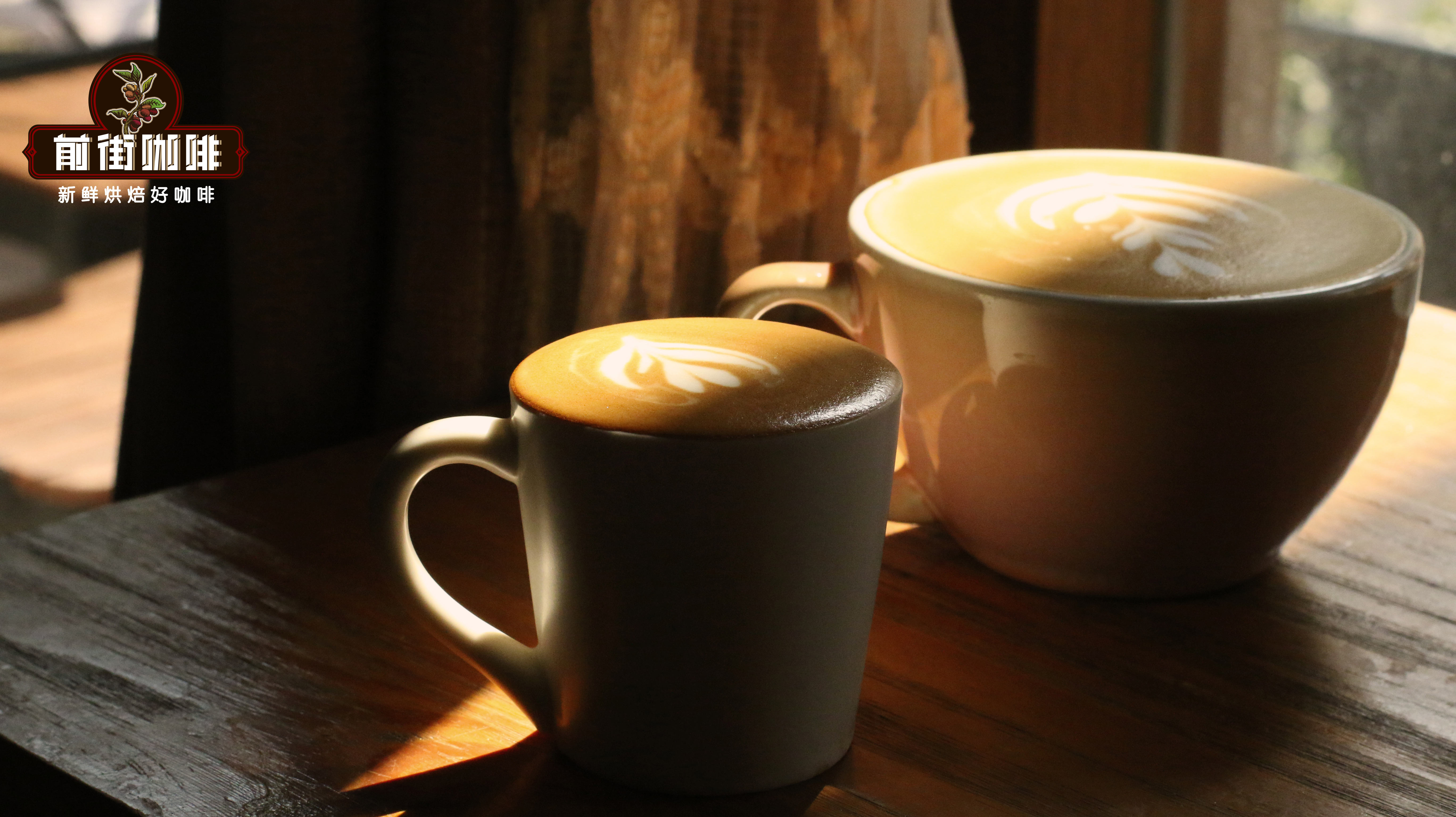
Differences between Flat White, cappuccino, and latte
When searching online for the differences between these three coffees, Front Street Coffee found that most explanations focus on milk foam thickness. Actually, that's not the case; foam thickness only affects the taste to some extent and does not determine the coffee's flavor. The main factor determining the difference between Flat White, cappuccino, and latte is the coffee ratio.
In fact, the difference between the three can be divided by the intensity of coffee aroma: Flat White > cappuccino > latte; and by milk foam thickness: cappuccino > latte > Flat White. Flat White's requirement for milk is to remove the looser foam on the surface, retaining only the finer part in the middle.
After basically understanding what kind of coffee flat white is, let's take a look at what Starbucks' new Flat White actually is.
For most consumers, the term Flat White came into view starting with a coffee launched by Starbucks in 2015. Since then, various coffee brands have launched flat white products and given this drink from the Southern Hemisphere various names: Starbucks calls it Flat White, Costa calls it Café au Lait, and the newly emerging chain brand Luckin Coffee calls it Australian White. So what are the differences between these different brands' flat whites?
Generally, coffee shops use semi-automatic dual-head espresso machines. When extracting Espresso, a standard 18-20 gram portafilter is used to extract 60mL of Espresso. Since a 180mL flat white contains 30mL of Ristretto, Ristretto accounts for 16.7% of the entire flat white, and the taste and flavor are very good. So, ignoring coffee bean quality factors and only calculating based on Ristretto at 16.7%, according to Starbucks' cup sizes tall (12 oz)/grande (16 oz)/venti (20 oz), the amounts of Ristretto to add would be 60ml, 80ml, and 100ml respectively.
Typically, extracting Ristretto stops 15 seconds after the first drop of coffee liquid flows into the cup, with an extraction amount of about 30mL. Based on the above speculation, Starbucks would need to extract 2, 3, and 4 times respectively for different cup sizes to achieve the theoretical concentration ratio. Starbucks' service speed is still astonishing, which must be credited to its fully automatic coffee machine Mastrena.
After basically understanding what kind of coffee flat white is, today the editor will present the flat white products of three domestic chain brands. Flat White: Starbucks calls it "Flat White," COSTA calls it "Café au Lait," and Luckin calls it "Australian White." The prices of the three coffees are 36 yuan, 33 yuan, and 27 yuan respectively.
First, the coffee. According to the staff, there's something special about this coffee. Unlike Espresso, Starbucks says Flat White uses Ristretto Shot. Compared to Espresso Shot, because the extraction time and amount are less, the coffee is richer, fuller, and slightly sweet. If you want to try a richer coffee, it's definitely a good choice.

『COSTA Café au Lait』
Café au Lait is made from espresso and milk, characterized by a silkier milk foam texture, with a heart-shaped latte art, priced at 31 yuan. Costa stores use Aoya Ranch pure milk, with fresh milk newly added.
Costa places great emphasis on latte art. From the appearance and foam presentation, Café au Lait is the best among the three brands, and the foam remains tight after opening the lid. However, the taste of Café au Lait upon entry is very unsatisfactory.
『Luckin Australian White』
Australian White chose a more standard Australian flat white recipe: Espresso + milk. The first impression after opening the lid is: the milk foam is relatively thin. Luckin Coffee also uses Aoya Ranch pure milk, and like Costa, Australian White has a heavier milky taste, with coffee and milk flavors relatively balanced.
The above content is compiled by CoffeeHunters, a coffee news website.


