








What Defines Coffee From the Sidamo Coffee Farm Region?
The Santa Vini processing station sits in Sidamo, southern Ethiopia, at about 2,050 meters, run under DWD Company. Cherries are picked fully ripe through the Red Cherry Project and fermented anaerobically for 96 hours before natural drying. The 74158 variety, graded G1, shows citrus, pineapple, guava, and a red wine finish.
Sidamo's highlands near Lake Awasa and the Kenyan border, with moderate rainfall and fertile soil, let coffee grow between 1,550 and 2,200 meters. Higher altitude slows cherry ripening, which builds a more complex aroma and pushes harvest later than in other parts of Ethiopia. On a coffee farm here, shade trees and native species are common.
Sidamo, as a high-altitude coffee-producing region in southern Ethiopia, nurtures richly layered coffee flavors thanks to its complex terrain and microclimates. This article focuses on the Santa Vini processing station under DWD Company, outlining its geographical background, the harvest standards of the Red Cherry Project, the 96-hour anaerobic natural processing method, and an in-depth interpretation of the origin and rise to fame of the 74158 variety. This full-red-cherry anaerobic natural bean recommended by Front Street Coffee presents a captivating combination of citrus, pineapple, guava, and a red wine finish, taking you to explore the unique charm of Sidamo coffee.
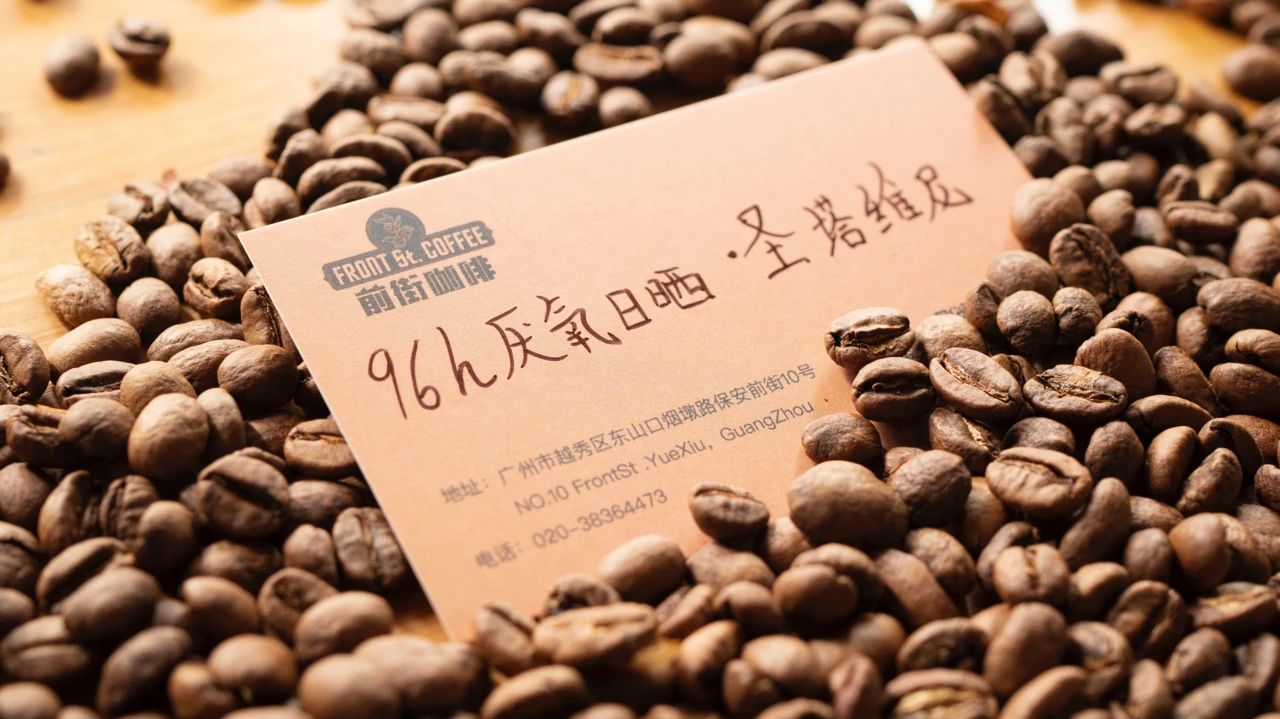
Front Street Coffee: Ethiopia Sidamo Santa Vini 74158 Coffee Beans
Country: Ethiopia
Grade: G1
Region: Sidamo
Processing Station: DWD Santa Vini Processing Station
Altitude: 2,050 meters
Processing Method: Full Red Cherry 96-Hour Anaerobic Natural
Variety: 74158
Flavor: Citrus, Pineapple, Guava, Red Wine Finish
Region Introduction
After consulting the materials, Front Street learned that Sidamo Province was established in 1942, and its name comes from the local Sidama people who have lived there for generations and once established the Sidama Kingdom. Regarding whether this land should be written as Sidamo or Sidama, academia and the industry have long held different views, but in the coffee field, the spelling Sidamo is more commonly used, so people are more inclined to continue using the name "Sidamo."
Geographically, the Sidamo producing region is located in the highlands of southern Ethiopia, close to Lake Awasa in the East African Rift Valley and bordering Kenya. The high altitude, moderate rainfall, fertile soil, and the presence of many native tree species provide ideal conditions for coffee cultivation. Coffee trees in this area are mostly distributed between 1,550 and 2,200 meters above sea level. The higher altitude slows the ripening of coffee cherries, making the aroma structure more complex and intense, and the harvest season also arrives later than in other parts of Ethiopia.
Historical changes have caused Sidamo and surrounding administrative divisions to intertwine, which also makes it one of the most complex and difficult-to-distinguish coffee origins in the world. Compared with other producing regions, the area covered by Sidamo is both vast and scattered. The Ethiopia Commodity Exchange (ECX), based on geographical indications, divides it into five regions: A, B, C, D, and E. Each region also contains several sub-regions, covering more than 50 cooperatives and more than 200 washing stations in total. Influenced by multiple factors such as altitude, humidity, soil, and microclimate, coffee produced by different villages also shows subtle differences in flavor.
The Santa Vini processing plant under DWD Company is about a 40-minute drive from the small town of Santa Vini and is one of the higher-altitude processing plants among the company's 17 processing plants. If there is a chance to visit the Santa Vini processing plant in person, one can see coffee farmers processing large quantities of freshly harvested full red coffee cherries, and this practice originates from the "Red Cherry Project" proposed in 2007.
In 2007, a Dutch green bean merchant launched the "Red Cherry Project" in order to obtain higher-quality Ethiopian coffee beans. The project required replacing mechanical operations with manual picking and harvesting only cherries that had reached the appropriate ripeness. Ripe coffee cherries are red, while unripe cherries are mostly green. Mechanical harvesting often mixes unripe cherries in as well, which brings undesirable flavors to the final brewed coffee.
Compared with the Gaus processing station, which also belongs to DWD Company, Santa Vini has a drier climate and a lower average temperature, which slows the growth rhythm of the coffee cherries and allows them to absorb sufficient nutrients over a longer period. After harvesting, the coffee cherries are first sorted. Qualified red cherries are loaded into fermentation tanks, then carbon dioxide is injected for anaerobic fermentation lasting up to 96 hours.
After fermentation is completed, the coffee cherries are spread on raised drying beds and turned regularly to ensure even drying. When the temperature is too high, shade coverings are added to avoid over-drying. After about 20 to 24 days of drying, once the moisture content drops to around 12%, they can be stored in the warehouse.
What does "74158" mean?
After 1970, Coffee Berry Disease (CBD) spread rapidly across major producing regions in Ethiopia. Coffee cherries infected with this disease gradually turn from green to gray-black and eventually die on the branches. Once a coffee tree is infected, the harvest may suffer losses of about 80%.
In 1972, growers began applying chemical fungicides to control CBD. Although certain results were achieved, relying solely on pesticides only treats the symptoms. The long-term solution is to find varieties with inherent high disease resistance.
In 1973, Ethiopia's JARC (Jimma Agricultural Research Center) selected 19 collection sites in the southwestern region. By 1975, researchers had collected a total of 639 seed samples. Through scientific identification and field trials, 13 coffee varieties were ultimately selected that were resistant to CBD and also drought-tolerant, high-yielding, and excellent in flavor.
The later numbering such as 74*** and 75*** was developed and bred from this group of mother trees. JARC recorded this category as "1974/1975 CBD-Rexistent Selections." Among them, "74" represents the year 1974, the year the variety was cataloged, and the last three digits are the test sample number. The 74 series we often hear about were all included during this period.
Therefore, the "74" here indicates that this bean variety was discovered in 1974, while "158" is the sample number of this bean, and its bean size is medium. As for why 74158 became famous, Front Street speculates that much of the credit goes to Ethiopia's Cup of Excellence (COE), and Front Street's Santa Vini with 96-hour anaerobic natural processing is precisely an outstanding example that placed in that competition.
The above content is compiled by CoffeeHunters, a coffee news website.


