







What Country Is Arabica Coffee From and Where Does Tarrazu Grow?
Costa Rica is a major specialty coffee origin, and all coffee grown there is Arabica. Its Tarrazu region sits above 1,500 meters, uses washed processing, and is graded SHB, giving a clean cup with fresh flavor and soft acidity. Tarrazu beans are typically Caturra and Catuai varieties.
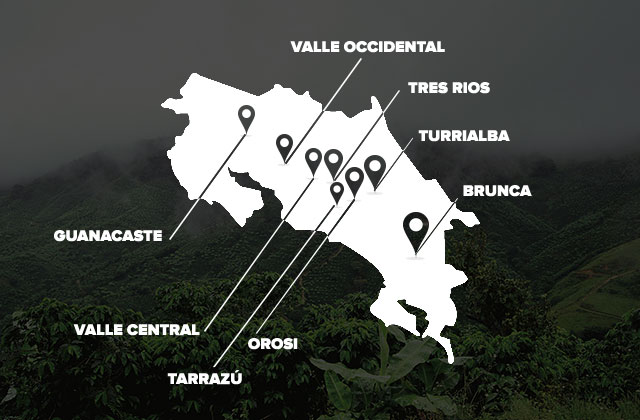
Costa Rica has eight coffee regions: Tarrazu, West Valley, Tres Rios, Guanacaste, Turrialba, Orosi, Brunca, and Central Valley. Estate owners there accept only ripe cherries and sign quality improvement agreements. Higher altitude brings lower precipitation, humidity, and temperature, which shapes acidity and aroma; where are arabica coffee beans grown depends on exactly these conditions.
Costa Rica is an important origin for specialty coffee, and its Tarrazu region is known for high altitude, washed processing, and SHB grade. From the perspective of Front Street Coffee, this article systematically reviews Costa Rica's eight major coffee regions, the growing environment and variety characteristics of Tarrazu, and compares the flavor differences between washed and anaerobic heavy honey processing. At the same time, Front Street shares standard pour-over parameters and brewing techniques to help you more clearly understand the classic flavor of Tarrazu everyday beans—clean, fresh, and with soft acidity—as well as the unique blueberry gummy and berry notes of Finca El Jardin Blueberry.
For more specialty coffee knowledge, welcome to follow our WeChat public account: Front Street Coffee (FrontStreet Coffee)
Let's get straight to the point! If you are a longtime reader of Front Street, you should already know which coffee regions Costa Rica has, right?
Those who know can skip this paragraph and continue reading. Those who are less familiar may as well review it with Front Street. According to ICAFE (Costa Rican Coffee Institute), Front Street has previously introduced that Costa Rica has eight coffee regions in total: Tarrazu, West Valley, Tres Rios, Guanacaste, Turrialba, Orosi, Brunca, and Central Valley. It is worth mentioning that all regions in Costa Rica have signed quality improvement agreements, and estate owners promise to produce the highest-quality coffee, accepting only ripe cherries and ensuring that only the best beans enter the revenue chain. So you will find an interesting phenomenon: in Costa Rica, all coffee grown is Arabica.
Among these eight regions, some are located in low-altitude areas, and some are in volcanic zones above 1,200 meters, where the coffee has higher acidity, a richer taste, and more abundant aroma. Every Costa Rican coffee selected by Front Street is grown at an altitude above 1,500 meters. Take the most affordable everyday bean—Costa Rica Tarrazu—as an example. The growing region for this coffee is at an altitude above 1,500 meters.
Front Street Coffee: Costa Rica · Tarrazu Coffee Beans
Variety: Caturra, Catuai
Altitude: 1,500 meters
Processing method: Washed
Grade: SHB
In Costa Rica, precipitation, relative humidity, and temperature tend to decrease as altitude increases, and this difference affects the bean size, hardness, and flavor profile of the coffee. According to information Front Street has reviewed, Tarrazu is sheltered by mountains on the Pacific slope and is a habitat for forests and rare birds. Its ecological environment is excellent and very suitable for coffee cultivation. These coffee beans are grown in small valleys and on slopes of the country's highest mountain range.
Tarrazu is located southeast of the capital, San Jose, and produces Arabica coffee with small beans, a bluish color, and a beautiful appearance. Local land production is about 650,000 quintals, from about 22,000 hectares of land, composed of small farms averaging 2.5 hectares in size. Of the coffee sold, 95% is graded Strictly Hard Bean (SHB). These coffees are produced under ideal growing conditions, and the soil is mainly sedimentary and acidic due to its composition. Most plantations are shaded, and different trees are planted in the region.
When choosing everyday beans, Front Street almost always selects washed processing. If you drink coffee often, you will know that washed coffee beans have a clearer flavor. Because after the washed processing step, most of the mucilage on the coffee beans has already been rinsed away by the end of fermentation, so the flavor of the terroir is highlighted and amplified. This is exactly Front Street's main goal: to let consumers drink the most classic flavor of the region at the highest cost-performance ratio.
Of course, many friends do not have a clear enough understanding of flavor, so they may not understand what "the flavor of the terroir" specifically refers to. Next, Front Street will use the anaerobic heavy honey processed Front Street Finca El Jardin Blueberry from Costa Rica to compare and analyze the flavor differences between honey-processed and washed coffee. As usual, Front Street will briefly describe the coffee region information for Finca El Jardin · Blueberry.
Finca El Jardin is located in Costa Rica's Brunca coffee region. Brunca sits in the southern part of Costa Rica and consists of the cantons of Coto Brus, Buenos Aires, and Perez Zeledon. In this area, coffee cultivation began in the late 19th century in Perez Zeledon, also because the first settlers came from the coffee-growing areas of the Central Valley, bringing with them a deeply rooted Costa Rican coffee culture.
The Coto Brus Valley is located on the slopes of the Talamanca Mountains, which divide Costa Rica into two slopes: Pacific and Atlantic. This makes the region's economy almost dependent on coffee cultivation. Up to now, there are records of 2,600 coffee producers here, involving 75 communities. It is understood that the Coto Brus area has a higher altitude and is more humid. The temperature range is between 18 and 26°C.
Generally speaking, Costa Rica's honey processing methods are standardly divided into several types, called white honey, yellow honey, red honey, and black honey. Next, Front Street will show you the different processing methods for each of these.
White honey: Remove 80-90% of the mucilage Beans are dried directly on raised beds Beans dry quickly at high temperatures, and the parchment turns white
Yellow honey: Remove 50% of the mucilage Beans are dried under low wind and moderate sunlight Beans are raked 3 to 4 times a day, and drying can take up to a week
Red honey: 80-90% of the mucilage remains on the beans Beans are dried on raised beds under cloudy or shaded conditions Beans are raked on the first morning, then only once or twice in the afternoon
Black honey: Keep the mucilage intact as much as possible Beans are dried on fully shaded raised beds Beans are left completely untouched on the first day, then raked once a day; drying may take up to three weeks.
But none of the above is the processing flow for anaerobic heavy honey. The anaerobic process is one of Costa Rica's most innovative processes, and it is a semi-industrial method between washed and natural. It involves placing coffee without pulp but with all the mucilage into sealed tanks to isolate oxygen and strengthen the controlled fermentation process. Then it is placed in a greenhouse for about 4 days, and then on drying beds for 18 days. The temperature is above 21 degrees Celsius.
Note: Drying time and temperature depend on different variables (region, temperature, altitude, humidity, season, shade, etc.). Whether drying beds or greenhouses are used depends on the producer's own processing concept.
Using the same brewing method, let's look at the different flavor presentations of these two coffees. Next, Front Street will provide Front Street's standard serving method:
Front Street brewing parameters:
V60 dripper
Water temperature 91℃
Water-to-coffee ratio 1:15
Coffee dose 15g
Grind size (80% passing through China standard No. 20 sieve)
Front Street brewing method: Use 30 grams of water for a 30-second bloom, then pour in a small stream in circles until 125 grams for a staged pour. When the water level is about to expose the coffee bed, continue pouring until 225 grams and stop. When the water level is about to expose the coffee bed again, remove the dripper. (Start timing at the beginning of the bloom.) The extraction time is 2'00".
Relatively speaking, the overall flavor presentation of Tarrazu everyday beans is clean and fresh, with rounded, soft acidity, and there will be a hint of dark chocolate in the cup. It is a primitive and classic Costa Rican-flavor coffee. Blueberry, on the other hand, is relatively special, with a very clear flavor direction of blueberry gummy, mint, and berry fruit notes, and the mouthfeel is very distinctive.
The above content is compiled by CoffeeHunters, a coffee news website.


