







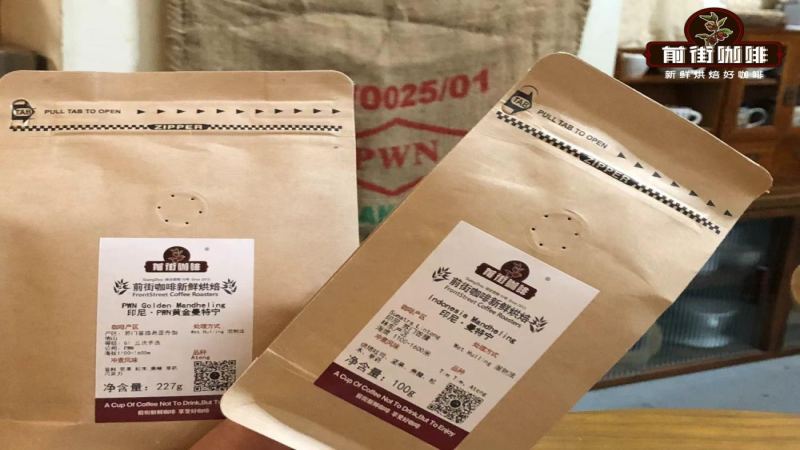
How does golden mandheling differ from regular Mandheling?
Mandheling is a Sumatra coffee known for full body and low acidity, with dark chocolate and caramel sweetness and a lasting finish. Golden Mandheling, the PWN single-origin version, is cleaner and clearer in the cup than the everyday Lintong Mandheling. The two share the same base profile, but the golden grade is the more refined expression.
The bitterness people notice in Mandheling comes partly from its heavy mouthfeel rather than roast alone. Lintong Mandheling works as a daily drinker, while Golden Mandheling is positioned as the superior selection within the same origin. Front Street shares roasting and brewing suggestions for both, covering varietal background and the wet-hulling process used in Sumatra.
Mandheling coffee has long been renowned for its full-bodied, low-acid taste, holding an important place in Asia's specialty coffee landscape. But many people ask: what exactly is the difference between Mandheling and Golden Mandheling? Is it really that bitter? This article systematically sorts out the ins and outs of Sumatra Mandheling—from origin background, varietal characteristics, and processing methods to brewing parameters—and compares the specific flavor differences between Lintong Mandheling and PWN Golden Mandheling. It also shares Front Street Coffee's practical suggestions on roasting and brewing, helping coffee lovers more clearly understand the positioning and charm of this classic Indonesian bean.
Professional coffee knowledge exchange. For more coffee bean information, please follow Coffee Workshop (WeChat public account: cafe_style).
When it comes to Asian coffee, Indonesian Mandheling is almost an unavoidable name. Even before Blue Mountain coffee rose to fame, Mandheling was already regarded by many seasoned coffee enthusiasts as the most prominent representative of body. Front Street holds the same view. Mandheling's body ranks among the top in specialty coffee; its heavy mouthfeel and low acidity are its hallmarks, while its dark chocolate and caramel-like smoothness and sweetness bring a lasting finish in the aftertaste, making the overall layers quite complex. Especially in the Asian market, Mandheling has always held a place.
Mandheling's flavor is indeed distinctive, and many people simply sum it up as "bitter." At Front Street, two preferences are often seen: one group likes the fresh floral and fruity notes of Ethiopia, while the other is devoted to Mandheling's full-bodied style. Some say Mandheling is very MAN—the more you drink it, the more flavor it has. Front Street believes Mandheling does carry a slight bitterness. If you don't accept that taste, you will naturally keep your distance; but if you like it, you will become more and more addicted the more you drink it, especially Golden Mandheling. Front Street currently has two Mandheling offerings: one is the daily-drinker Lintong Mandheling, and the other is the single-origin Golden Mandheling. If Mandheling is the specialty of Indonesian coffee, then Golden Mandheling is the superior choice among Mandheling. Golden Mandheling is cleaner and clearer than ordinary Mandheling, with richer layers, and naturally a higher price.
Sumatra Mandheling Coffee
Indonesia is located in Southeast Asia, and its coffee history can be traced back to 1696. At that time, Dutch coffee farm owners were searching everywhere for broader planting lands, and after extensive investigation, they finally set their sights on Indonesia's Java Island. Thirty years later, Indonesia had already built a sufficient foundation in the coffee market.
However, today the representative of Indonesian coffee has become Mandheling, which is actually not surprising. Because in the early Java coffee sold to Europe, a large portion came from the Sumatra region, and Mandheling is precisely a product of Sumatra. It can be said that Sumatra is an important coffee-producing region in Indonesia. At present, the best-quality beans from Sumatra come from the Gayo highlands, mostly grown from old tree varieties. The Gayo Mountains are located in the Aceh producing region of North Sumatra Province, at an altitude of 1,500 to 2,500 meters, and most local coffee farmers are indigenous people of the Gayo ethnic group.
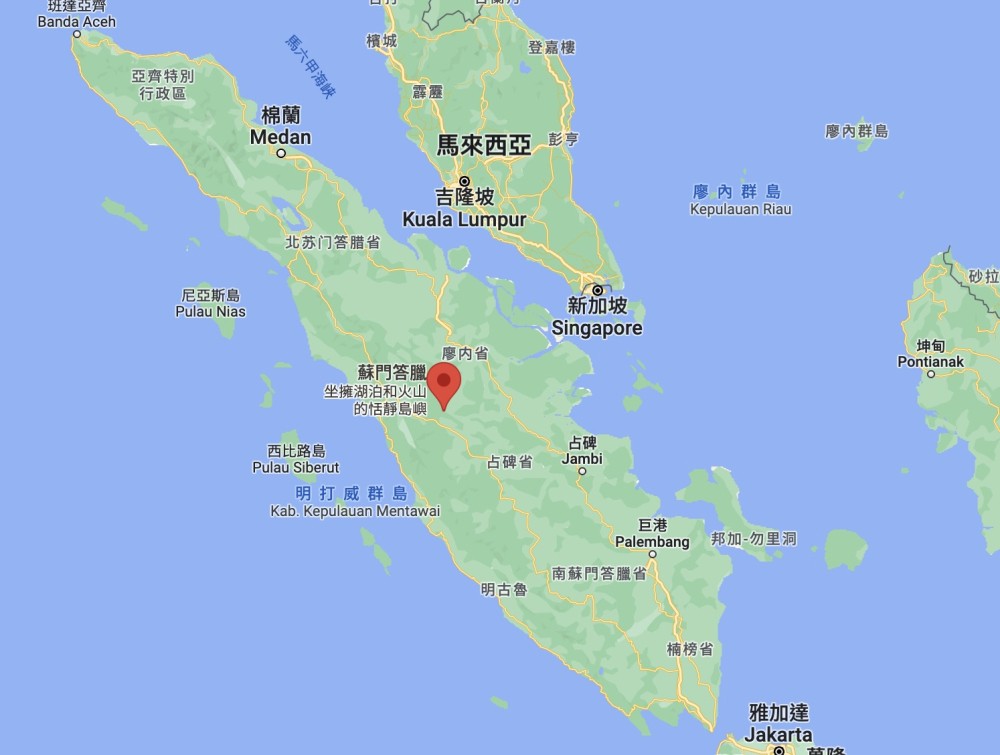
Sumatra is both Indonesia's largest island and the world's sixth-largest island. It is located in northwestern Indonesia, extending from northwest to southeast, with the equator passing through its center. The terrain is high in the northwest, with the Barisan Mountains running through it, mainly growing Arabica and serving as the main producing area of Mandheling; the southeast is low, mostly flatland or swampland, mainly growing Robusta varieties. The island has more than ninety volcanoes and numerous volcanic lakes, providing fertile soil for coffee growth. Influenced by its geographical location, Sumatra has the country's earliest harvest season—from November to March of the following year.
Mandheling:
Lintong Mandheling is produced in the Lintong mountain area of north-central Sumatra, near Lake Toba. Lintong Mandheling is the regular version of Sumatra Mandheling. Mandheling refers to the semi-washed or natural beans around Lake Toba in north-central Sumatra, with the most famous being those from the Lintong mountain area at 900 to 1,200 meters on the southwest shore. The Batak people are the main body of coffee farmers in this area. This place was once praised as the coffee bean producing area with the plumpest beans in the world. Mandheling is also a trademark used for Arabica coffee from North Sumatra, and its name comes from the Mandailing people who produced coffee in the Tapanuli region of northwestern Sumatra.
Golden Mandheling Coffee
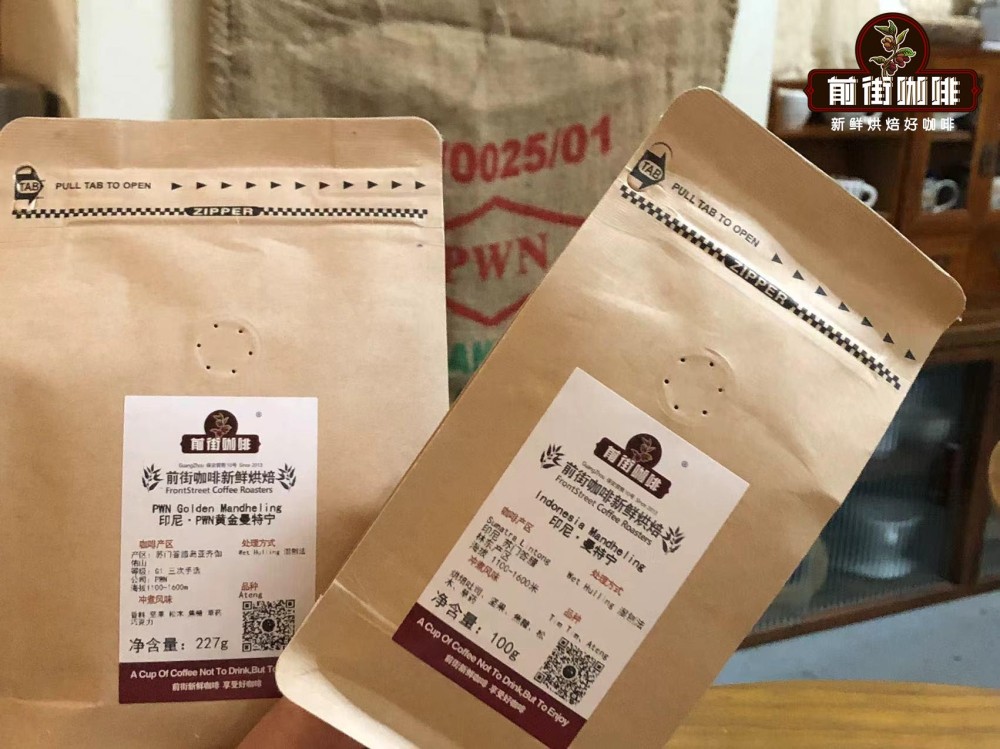
PWN applies extremely strict standards when producing Golden Mandheling coffee beans: first select green coffee beans of 18 screen size or above, with fewer than 3 defective beans (in a 300-gram green bean sample). After reaching the highest grade G1 standard, they are then hand-sorted three times. Therefore, Front Street PWN Golden Mandheling coffee beans present an appearance of uniform color and uniform bean shape. Under such high standards, the Front Street PWN Golden Mandheling coffee selected has a clean and transparent mouthfeel and a strong sweet aroma.
Front Street Coffee's Golden Mandheling coffee comes from PWN. Golden Mandheling is derived from Mandheling and can be understood as selected Mandheling, which is also the reason Front Street Coffee chose to offer it. Front Street Coffee cups 300 to 500 sets of beans each year, selecting one-fifth of them with the most regionally representative flavors, and Golden Mandheling is a representative work under this kind of selection. Front Street believes it represents the style of Sumatra very well. As for the difference between Mandheling and Golden Mandheling, for professional-level coffee tasters and coffee friends with sensitive palates, if they drink these two coffees at the same time, the contrast will be very obvious. Golden Mandheling's sweetness and cleanliness, body, and wild spice-series flavors are all slightly superior to G1, which is also one of the reasons Golden Mandheling is much more expensive than G1.
Mandheling Coffee Bean Varieties
Indonesia has a very long history of growing coffee beans. Arabica was planted early on, but later, due to leaf rust, currently 90% of the coffee beans exported by Indonesia are Robusta, and only 10% are Arabica. Front Street's Lintong Mandheling coffee variety is TimTim Ateng, and the variety of Golden Mandheling coffee is labeled Ateng. In fact, TimTim is Timor, an Arabica variety with Robusta blood, while Ateng is Catimor, a hybrid variety of Caturra and Catimor. These variety names are merely local terms.
Mandheling Coffee Bean Processing Method
Mandheling coffee beans use the wet-hulled processing method. Some customers think Mandheling coffee beans look a bit ugly because there are gaps at both ends, commonly known as sheep-hoof beans, but these are not defective beans. Indonesia is located near the equator and has a tropical rainforest climate, and most coffee beans produced in large quantities use rough wet-hulled processing. Wet-hulled processing greatly accelerates the entire process, but removing the parchment layer while it is still semi-dry requires greater friction, so green beans are easily crushed and squeezed, especially at both ends, forming small gaps.
Front Street Coffee's roaster uses a medium-dark roast level when roasting Mandheling coffee beans to highlight its full-bodied mouthfeel. When Front Street Coffee's barista brews this coffee bean, they use a KONO dripper to extend the contact time between hot water and coffee grounds, paired with 88°C hot water and a coarser grind, thereby avoiding burnt bitterness.
Front Street Brewing Mandheling Coffee Parameters:
In daily brewing, Front Street Coffee generally uses a KONO dripper for medium-dark roasted Mandheling. The KONO dripper makes the coffee mouthfeel rounder and fuller, with a more direct flavor expression. Compared with the V60, the KONO dripper has much fewer diversion ribs, and the upper part is a smooth curved surface, allowing the filter paper to fit more closely and restricting airflow upward. Hot water can only flow downward, forming a siphon-style extraction effect, allowing the aromatic substances of the coffee grounds to be released more fully, thereby improving the full-bodied mouthfeel.
Using Kono dripper: water temperature: 88°C; dose: 15 grams; coffee-to-water ratio: 1:15; grind size: medium-fine grind (75% passing through a Chinese standard No. 20 sieve).
Use three-stage extraction, blooming with twice the amount of water as the coffee grounds, that is, 30 grams of water for 30 seconds. Blooming allows the coffee grounds to release internal carbon dioxide, thereby making the later-stage extraction more stable. Pour in a small stream in circles until 125 grams, then pause, continue pouring until 225 grams and stop. After the water in the dripper has dripped through, remove the dripper. Start timing from the beginning of pouring; the extraction time is 2 minutes 00 seconds. Next, pick up the whole cup of coffee and swirl it evenly, then pour it into a cup to taste.
[Front Street Lintong Mandheling Coffee Flavor Characteristics] Rich nutty notes, with a hint of melon aroma in the aftertaste. After the temperature drops, herbal plant flavors emerge. The mouthfeel is full-bodied, with rich layers.
[Front Street PWN Golden Mandheling Coffee Flavor Characteristics] Rich nutty flavor. As the temperature drops slightly, melon, herbal, and spice flavors begin to emerge. The finish is dark chocolate, with obvious caramel sweetness and a clean, soft mouthfeel.
Front Street Coffee Brewing Suggestions:
Regarding coffee brewing, Front Street has always believed that the freshness of coffee beans greatly affects the flavor, so all coffee beans shipped by Front Street Coffee are within 5 days of the roasting date. Front Street's roasting philosophy is "freshly roasted good coffee," so that every customer who places an order receives the freshest possible coffee. The resting period for coffee is about 4 to 7 days, so when customers receive it, it is exactly at its best flavor.
For friends who need ground coffee, Front Street warmly reminds: after coffee beans are ground in advance, there is no need for further resting, because during transportation the pressure generated by carbon dioxide inside the package can also make the coffee flavor rounder, so you can immediately brew a cup upon receiving the coffee grounds. However, coffee grounds need to be brewed promptly, because after contact with air they oxidize relatively quickly, the flavor dissipates faster, and the overall performance of the coffee is not as good. Therefore, Front Street recommends buying whole beans and grinding fresh before brewing, so that you can better taste the coffee's flavor.
For more specialty coffee beans, please add the private WeChat of Front Street Coffee. WeChat ID: qjcoffeex.
The above content is compiled by CoffeeHunters, a coffee news website.


