








What defines Australian white coffee and how is it brewed?
Australian white coffee is the drink more widely known as flat white: an espresso base topped with a thin layer of steamed milk and microfoam, served in a smaller cup than a latte. It spread from Australia and New Zealand and gained global reach after Starbucks launched its own flat white in 2015. The name covers flat white, flat white coffee, and Aussie white.
Preparation matters more than the label. A flat white uses a ristretto-style shot with less water and a small volume of velvety milk, so the coffee flavor stays forward. A dry cappuccino, by contrast, relies on stiff foam and little liquid milk. The two drinks differ in milk texture and ratio, not in the espresso itself.
Australian White, Flat White, Artisan White, Aussie White coffee—behind these various names is actually the same drink: Flat White. It originated in Australia and New Zealand, and became popular worldwide thanks to Starbucks' promotion. This article will start from the controversy over its origin, sort out the historical context of Australian White, compare the differences between the Australian and New Zealand preparation methods, and share Front Street Coffee's extraction parameters and milk frothing key points. In addition, the article will also analyze the difference between espresso and ristretto, and what exactly distinguishes Flat White, latte, and cappuccino, to help you understand this coffee more comprehensively.

To get more specialty coffee knowledge, welcome to follow: Front Street Coffee
In recent years, after Starbucks made flat white popular, many friends who previously preferred lattes or cappuccinos have switched to the flat white camp. At Front Street stores, we often encounter situations like this: someone comes in first asking for Flat White, later calls it Australian White, then later calls it Aussie White coffee, and finally simply says flat white. But have you ever thought about why there are so many names for what is essentially the same coffee?
This coffee, originally named Flat White, first spread from Australia. In 2000, Starbucks tried to enter the Australian market, but was defeated by the local brand Gloria Jean's and withdrew from Australia in 2008. By 2014, Gloria Jean's Coffee entered the Chinese market, and Starbucks had to make its own Flat White popular before its rival could build momentum for Flat White.
Thus, in 2015 Starbucks launched "Flat White" and invested substantial resources in promoting it.
Origin History
After reviewing the materials, Front Street found that the earliest use of flat white to describe coffee can be traced back to a 1962 British film "Danger by My Side." In that film, flat white was used to describe coffee of poor quality, completely different from what we understand as flat white today.
At present, regarding the birthplace of flat white, Australia and New Zealand each have their own claims.
[Australia]
The earliest written record of flat white can be traced back to the mid-1980s.
In May 1983, in a magazine called Sydney cafe, Miller's Treat cafe mentioned flat white coffee on its menu.
In April 1984, a local Sydney newspaper published an article satirizing the popularity of latte, saying: "Caffea latte translated means flat white."
In 1985, Alan Preston of Moors Espresso Bar in Sydney added this drink to the permanent menu and claimed that the idea was brought to Sydney from his hometown of Queensland. In the 1960s and 1970s, cafes in Queensland often served "White Coffee & flat."
In January 1985, the cafeteria of Parliament House in Canberra posted a notice saying "flat white only," because seasonal issues made it impossible for milk foam to form.

[New Zealand]
Those who believe Flat White originated in New Zealand are Derek Townsend and Darrell Ahlers of DKD Cafe in Auckland, who said this coffee could replace the latte. There is also another saying that Australian-style white coffee Flat White originated from a failed cappuccino at Bodega bar on Willis Street in Wellington, New Zealand in 1989—at that time, barista Fraser Mclnnes tried to make a cappuccino with low-fat milk that was difficult to froth. Because there was not enough milk foam, it could not be called a cappuccino, so he named this coffee Flat White.
How to make Australian White coffee Flat White?
Front Street mentioned earlier that the origin of Australian-style white coffee Flat White is controversial, and the preparation methods of the two disputed countries of origin are also different.
Australians tend to use a single shot of espresso when making Australian-style white coffee; New Zealanders use a double shot of ristretto when making it.
[Front Street Coffee's method for making Australian-style white coffee]
This time we chose Front Street Classic Espresso Blend, a recipe composed of beans from three origins: Brazil, Indonesia, and Vietnam. It uses a deep roast, which can maximize the coffee's rich aroma and also allow everyone to easily extract abundant and dense crema. It is suitable whether making an Americano diluted with water or a latte paired with milk.
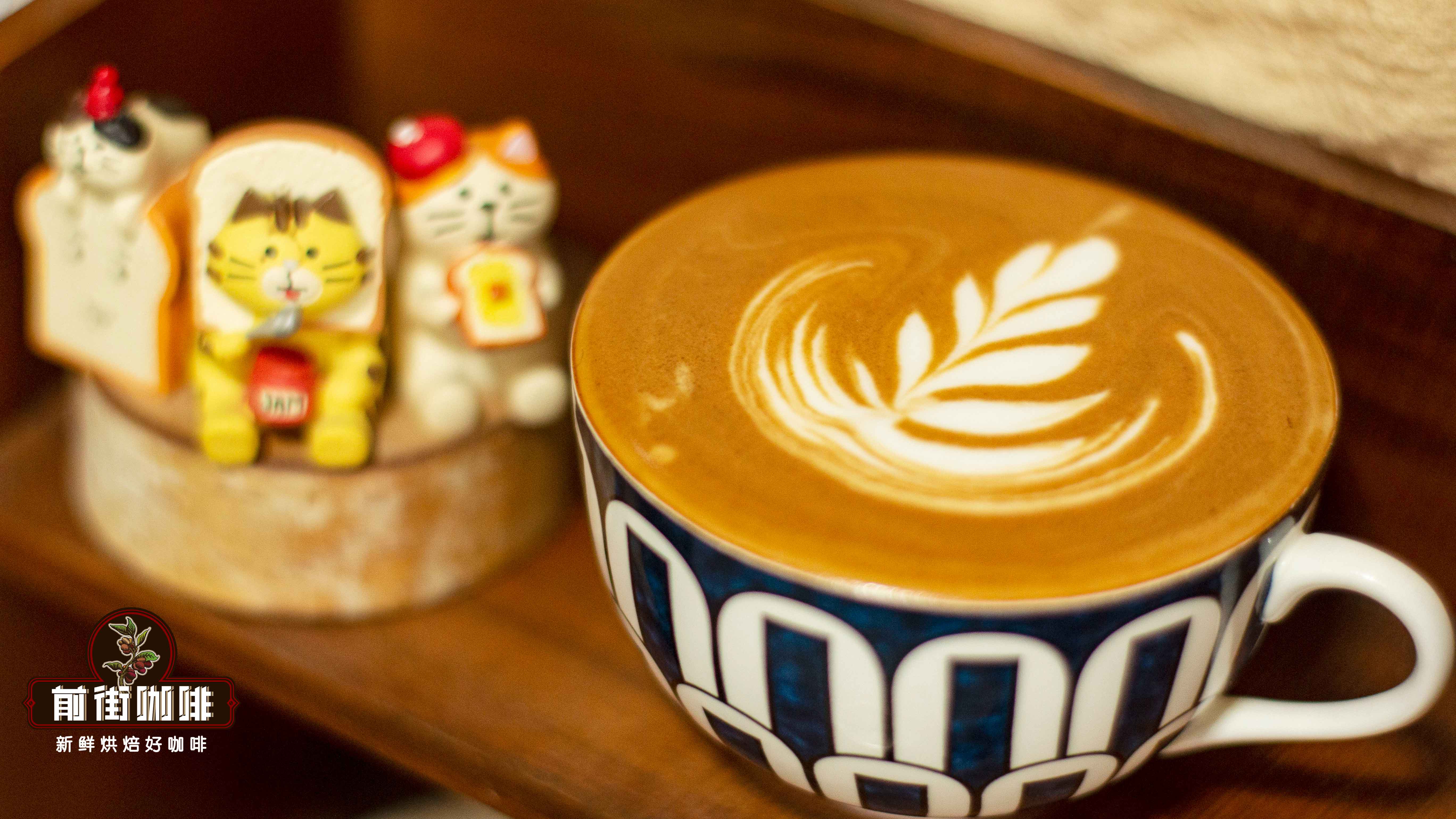
Front Street Coffee's extraction parameters for making espresso are as follows:
Pressure: 9bar Temperature: 90.5~96°C Time: 20~30 sec Coffee-to-water ratio: 1:1.7~1:2 Dose: 12g (single espresso) 20g (double espresso) Extracted espresso yield: 20ml (single) 40ml (double)
Front Street Coffee uses whole milk fresh milk for milk selection, and controls the milk frothing temperature between 50 and 60°C (if the temperature is too low, the lactose in the milk cannot be brought out; if the temperature is too high, the protein in the milk is destroyed and the mouthfeel will be gritty). The milk foam thickness is 3 millimeters.
What is ristretto?
The original name of ristretto is ristretto. The word ristretto comes from restrict and narrow, literally meaning to restrict flow rate, which means that ristretto is slower in flow rate than ordinary espresso.
Espresso is made by forcing high-pressure and extremely hot water through finely ground dry coffee powder, with an extraction time of 25 to 30 seconds, to produce a highly intense and rich coffee drink.
The production process of espresso and ristretto is almost the same. The dose, water temperature, and pressure used are exactly the same, but the yield and time are different.
Front Street Coffee's extraction parameters for making espresso: 20 grams of coffee powder, extract 35 grams of coffee liquid, taking 27 seconds.
Front Street Coffee's extraction parameters for making ristretto: 20 grams of coffee powder, extract 27 grams of coffee liquid, taking 20 seconds.
Through many experiments by Front Street Coffee, it is known that no matter which extraction method is used, the first substances extracted from coffee are light-molecular-weight acidic substances, followed by sweetness, and finally heavier-molecular-weight bitter substances. Therefore, compared with espresso, ristretto has more obvious acidity and sweetness and lighter bitterness.
The flavor extracted by Front Street Coffee's ristretto is mainly dark chocolate and roasted hazelnut, with creamy smoothness, low acidity, balanced mouthfeel, and lasting aroma. Espresso can extract heavy-molecular-weight flavors, showing overall lingering notes of dark chocolate, caramel, and maple syrup, with a mellow and solid mouthfeel and full flavor.
What is the difference between Australian White coffee, latte, and cappuccino?
Front Street has learned that when searching online for the differences among the three, much of the content only discusses the thickness of the milk foam. However, this is not the case. The thickness of the milk foam only affects the coffee's mouthfeel to a certain extent, but does not affect the coffee's taste. The key to determining the different tastes of the three is the ratio of coffee to milk.
In fact, the difference among the three can be divided by the intensity of coffee aroma: Flat White > cappuccino > latte; and by the thickness of milk foam: cappuccino > latte > Flat White. Flat White's requirement for milk is to remove the looser foam on the surface and retain only the finer part in the middle.
Flat White is called "Flat White" by Starbucks, "Artisan White" by COSTA, and "Australian White" by Luckin. The name can change, but the essence is still Flat White. For friends who want to taste coffee flavor but do not want the coffee flavor to be too strong, Front Street Coffee recommends trying Flat White.

For more specialty coffee beans, please add private WeChat Front Street Coffee, WeChat ID: kaixinguoguo0925
The above content is compiled by CoffeeHunters, a coffee news website.


