







How do coffee particles, brew ratio, and grind size shape espresso extraction?
Espresso forces hot water at pressure through a compacted puck of fine coffee particles, producing a small, dense, intensely flavored liquid topped with crema. Dose, yield, time, and grind size all interact, so a small change in any one of them shifts the balance of the cup.
Commercial machines typically supply more than nine atmospheres of pressure and water above 90 degrees Celsius, which is why grind must match the equipment. Before espresso existed, coffee was brewed by slow immersion with very fine grounds; the shift toward pressure, and the semi-automatic and automatic machines that followed, made fast extraction possible.
Espresso, with its golden crema and rich, full-bodied taste, has become a favorite among many coffee lovers. Unlike pour-over, it relies on steam pressure to force hot water quickly through a puck of coffee grounds, extracting a concentrated coffee liquid in a short time. Behind this seemingly simple operation, parameters such as dose, yield, time, and grind size all influence one another, and even a slight change can affect the performance in the cup. This article will systematically sort out the extraction principles of espresso, analyze the relationship between brew ratio, extraction time, and grind coarseness, and, using examples from Front Street Coffee's Sunflower Warm Sun Blend and Classic Espresso Blend, explain how to adjust parameters based on flavor feedback, helping you consistently make a delicious espresso at home.
For more specialty coffee knowledge, please follow our WeChat official account: Front Street Coffee (FrontStreet Coffee).
Front Street Coffee has noticed that more and more friends are attracted by that golden layer of crema on espresso and want to make a cup at home themselves. Compared with pour-over, the method for espresso is to let high-temperature hot water pass through coffee grounds driven by steam pressure, resulting in a small, thick, intensely flavored coffee liquid. The process may not seem complicated, but once the parameter details change, the quality of the final cup fluctuates with them, so every step is worth taking seriously, and every value needs repeated consideration.
Before espresso was born, people mainly brewed coffee by immersion, which required grinding the beans very fine and going through a slow extraction process with a fairly long wait. To improve efficiency, Italians tried using steam pressure to force high-temperature, high-pressure water quickly through a puck of coffee grounds, thereby speeding up what had originally been a drip-style extraction. Only after continuous improvement and iteration did the semi-automatic and fully automatic espresso machines we are familiar with today gradually take shape.
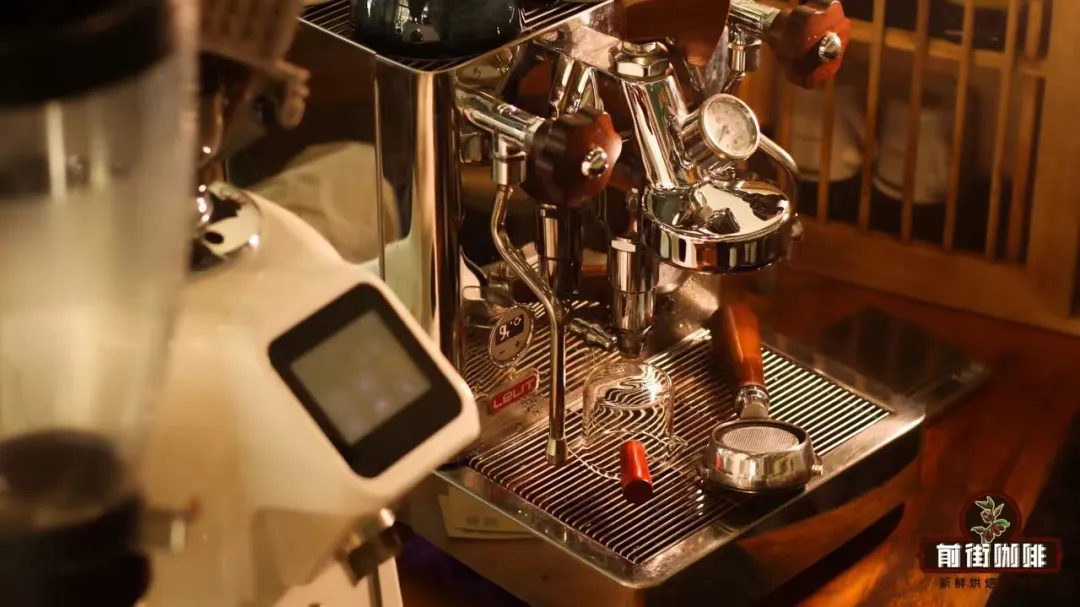
Commercial espresso machines on the market can usually provide stable pressure of more than nine atmospheres and hot water above 90 degrees Celsius. The high pressure pushes hot water quickly through finely ground coffee, extracting a coffee liquid rich in crema, with intense aroma and a full body. To obtain an ideal espresso, the barista needs to control the parameters that affect flavor and thereby adjust extraction into the optimal range.
From a coffee bean to a cup of coffee liquid, many variables affect flavor, including grind size, boiler pressure, water temperature, distribution and tamping force, dose, extraction time, extraction yield, and other details. Generally speaking, the machine's pressure and water temperature are set in advance and are not changed at will; distribution and tamping force vary according to the barista's habits. In daily extraction adjustments, the four most commonly used factors are dose, time, yield, and grind size.
The coarseness and uniformity of the grind are key factors affecting the flow rate variation of each espresso. Even if the dose differs by only 1 gram, the time required to extract the same yield may differ by several seconds. When coffee particles are uneven in size, areas with higher density after tamping create greater resistance to water flow, and the extraction distribution becomes uneven. Grind condition is directly reflected in changes in flow rate, time, and flavor.
The ratio of dose to extraction yield, commonly called the brew ratio, is a relatively intuitive extraction parameter. The dose depends on the capacity of the basket in the portafilter, divided into double and single types. For example, the coffee machine at Front Street Coffee's shop uses a 20-gram double dose and makes fine adjustments on that basis (accurate to 0.1 grams). Since the brew ratio is not fixed, the final yield must ultimately be determined by the coffee's flavor performance.
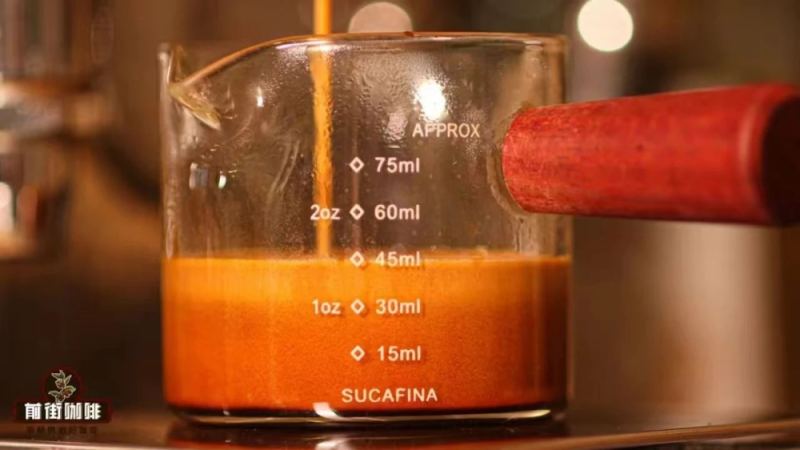
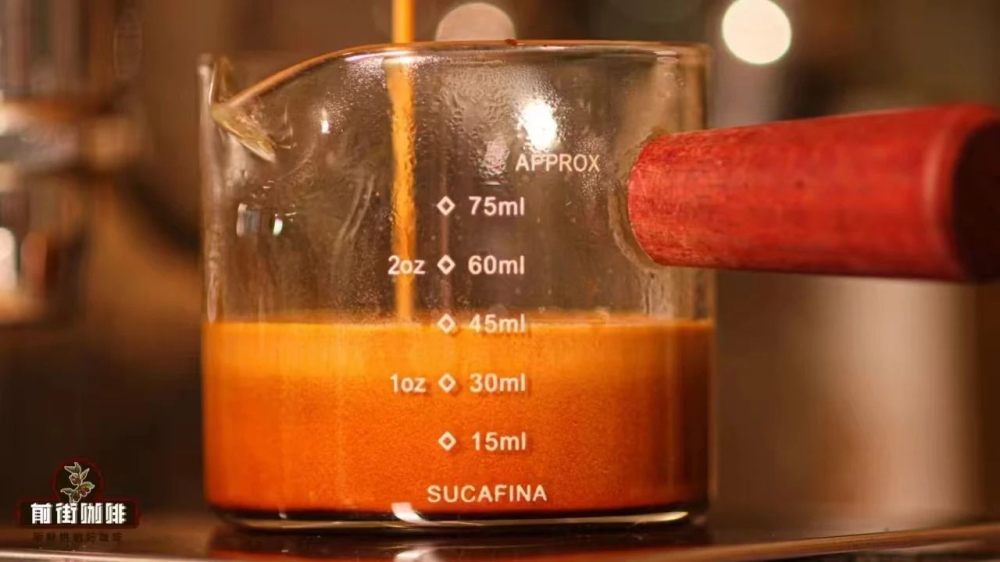
In earlier years, baristas did not have the conditions for precise weighing and would directly observe changes in the color of the crema to judge the yield: at the beginning it was dark brown and rich, then gradually turned golden yellow over time, and then became light yellow. Usually, when the crema began to turn pale, it meant extraction should end. Today's espresso extraction standards are more rigorous, with more stable data summarized, and the brew ratio also tends toward a fixed reference value of 1:2. For example, Front Street Coffee's shop uses 20 grams of coffee grounds to extract 40 grams of coffee liquid.
Extraction time is affected by the interaction of the key factors above, and espresso extraction time generally falls between 25 and 30 seconds. Under the premise that the brew ratio is determined, the shorter the extraction time, the fewer coffee substances are dissolved; the longer the extraction time, the more substances are dissolved. Under the same brew ratio, if you want to change the extraction time, you can only do so by adjusting grind size and dose.
Once we have clarified the relationships among the various influencing factors, we can make adjustments based on the condition of the coffee liquid and the tasting experience. The flavor performance of the coffee depends on the espresso beans used. Here, the house-roasted "Front Street Coffee Sunflower Warm Sun Blend" is used, made by combining sun-dried Yirgacheffe Red Cherry coffee beans with Honduran coffee beans. Under ideal conditions, the espresso presents whiskey-like aroma, vanilla, cream, and berry acidity.
For friends who prefer coffee with a rich, mellow aroma, Front Street Coffee's Classic Espresso Blend is recommended. This is a recipe combining three origins: Brazil, Indonesia, and Vietnam. It uses a dark roast, which can highlight the coffee's mellow aroma to the greatest extent. The extracted espresso not only has rich, dense golden crema, but on the palate you can also feel the aromas of dark chocolate, caramel, butter, and roasted almonds, with very rich layers. It can be purchased at Front Street Coffee's Taobao store or Front Street Coffee's Tmall flagship store.
For example, the extraction parameters for Front Street Coffee's first espresso were: 19.8 grams of coffee grounds, 40 grams of coffee liquid yield, and 26 seconds, with a relatively fast flow rate. If, after tasting, the flavor is thin, the whiskey aroma and fruit aroma are not obvious, and astringency remains in the finish, it may be under-extraction plus excessive extraction in the later stage. Front Street Coffee will increase the dose and reduce the yield to make the coffee flavor more concentrated. When the coffee no longer has astringency and the whiskey aroma becomes stronger, it means the direction of adjustment is correct.
If the flow rate is still fast and the aroma is not enough, it may be insufficient extraction. In this case, the grind size needs to be made finer to extend the extraction time. Conversely, if the flow rate is slow and the taste is strongly bitter or sharply sour, it is very likely over-extraction, and the extraction rate needs to be reduced. This can be done by decreasing the dose and making the grind coarser, so that the yield is greater within the same extraction time.
Front Street Coffee believes that as long as the relationships among extraction parameters are clarified, adjusting a delicious espresso is not difficult. But it should also be clear that most home espresso machines are less stable than commercial machines and produce fewer cups, which instead tests our grasp of the parameters even more. Front Street Coffee suggests recording the parameters and flavor performance of daily extractions that taste good, and comparing and summarizing more, which helps improve adjustment efficiency.
The above content is compiled by CoffeeHunters, a coffee news website.


