







A Reliable Way to Brew Mandheling Coffee in a French Press
The French press brews by full immersion, so its metal filter leaves the coffee's oils and aroma in the cup. That suits medium-dark single-origin beans. Light roasts are less suitable because the short, gentle contact does not develop their acidity well. The result is a rich, sweet, smooth cup.
The device is simple: add water and grounds, press the plunger down, and decant. PWN Golden Mandheling serves as the example, showing grinding, coffee-to-water ratio, steep time, and serving steps. Because no paper filter absorbs the oils, the method resembles cupping and yields a delicious coffee with layered body.
The French press, with its simple operation and excellent flavor extraction, has become the daily first choice for many coffee lovers. It extracts through immersion, fully preserving the coffee's oils and aroma, and is especially suitable for medium-to-dark roasted single-origin beans. This article covers the French press's extraction principle, suitable bean types, grinding and coffee-to-water ratio recommendations, and Front Street Coffee's specific brewing steps, and explains why light-roasted beans are not suitable for the French press. The article also uses PWN Golden Mandheling as an example to demonstrate the complete process from grinding to serving, helping readers master a cup of rich and sweet French press coffee.
Among city coffee drinkers, some prefer the ritual of pour-over, some are fond of the experimental feel of the siphon, and naturally some appreciate the convenience and directness of the French press. Yet the finer points of each brewing device go far beyond appearance and technique. Making coffee is actually much like a science—different devices each have their own extraction characteristics, and through repeated trials and adjustments we discover the most suitable parameters and the best flavor expression.
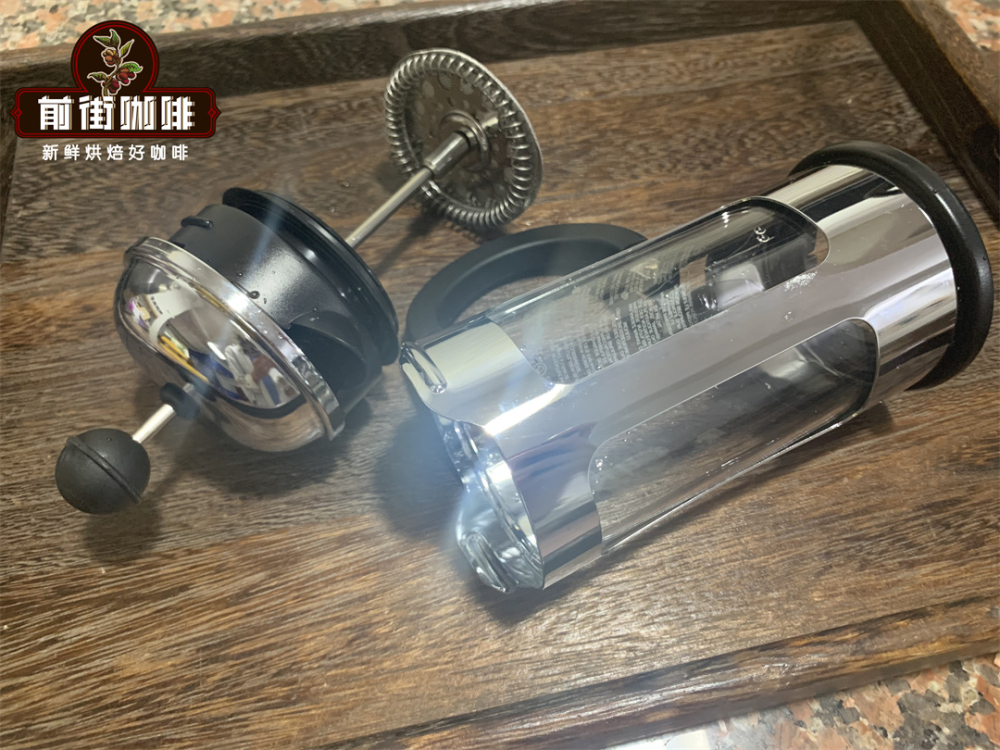
The French press's structure is not complicated: put water and coffee grounds into the pot, then use the plunger to push the grounds to the bottom, and filtration is complete. The metal filter can also be washed and reused. The principle is simple, yet it is highly efficient, and it doesn't consume paper filters, making it both eco-friendly and money-saving. The French press can quickly extract coffee's most authentic taste; because there is no paper filter absorbing them, the coffee's precious natural oils are retained, allowing it to display an original, rich, and varied layering.
The French press is like a "lazy person's device"—effortless to operate, yet it doesn't sacrifice the complete flavor a good cup of coffee should have.
In fact, the French press's extraction method is closest to the resulting state of a cupping, fully releasing the coffee's oils, aroma, and flavor compounds, with a smooth, sweet, and rich mouthfeel—perfect as a breakfast coffee.
For beans used in the French press, single-origin beans or beans with more prominent fruity acidity are more suitable, and medium to dark roasts both work. Front Street recommends choosing coffee beans with better balance. For example, among Front Street's bean list are Front Street Brazil Coffee Beans, Front Street Colombia Huila Coffee Beans, Front Street Mandheling Coffee Beans, and Front Street Costa Rica Tarrazu Coffee Beans. The beans Front Street mentions have balanced flavors with dark chocolate and fruity notes. Since the French press is an immersion-style extraction, it can fully present the coffee's oils, aroma, and richness, and dark-roasted beans more easily express aroma and body, so these medium-to-dark roasted beans from Front Street are very suitable for making French press coffee. Coffee brewed with a French press will have more prominent aroma and a heavier mouthfeel when dark-roasted.
As for light-roasted coffee beans, Front Street does not recommend them for the French press, because the acidity easily becomes too high.
Let's see how Front Street makes an excellent cup of coffee with the French press. Front Street Brazil Queen, Front Street PWN Golden Mandheling, and Front Street Colombia Huila all have flavor profiles suitable for the French press. Here we'll use the popular Front Street PWN Golden Mandheling coffee beans to demonstrate the brewing.
For Front Street's own-roasted coffee beans, use well-rested Front Street PWN Golden Mandheling, ground to a coarseness suitable for the French press, that is, medium-coarse, coarser than pour-over coffee grounds. Front Street recommends a standard sieve pass rate of 70%–75%. If the powder is too fine, the coffee grounds will leak through the filter mesh and the coffee will become cloudy.
You can start by trying a 1:10 coffee-to-water ratio. For two servings, that's 20g of coffee beans with about 200g of water, and the final ratio depends on personal taste. Like Front Street's drip bags, each small packet contains 10 grams of powder—for example, the seasonal Brazil drip bag and Mandheling drip bag; using these pre-ground drip bags to make French press coffee is also very convenient. Front Street recommends a coffee-to-water ratio of 1:16, 15 grams of coffee powder with 240 grams of water.
Front Street recommends preparing an electronic scale. Even though the French press itself has markings and a measuring spoon, an electronic scale is still recommended, because coffee beans change density depending on factors such as growing altitude and roasting method, and different beans vary in mass and weight. Also, if you make a cup of coffee that is very delicious and want to replicate that taste, you must record the ratio; conversely, if you make an unsatisfactory cup, the data can tell you how to adjust.
At Front Street, use fresh, clean soft water such as C'estbon mineral water; do not extract with water that is too hard, and do not use unfiltered water. If the water quality itself is poor, it is difficult to make delicious coffee.
Front Street Coffee brewing steps:
Grind the coffee beans, then pour them into the French press. At this point you can ignore what many people say about grind size—don't grind too coarse; a medium grind is fine.
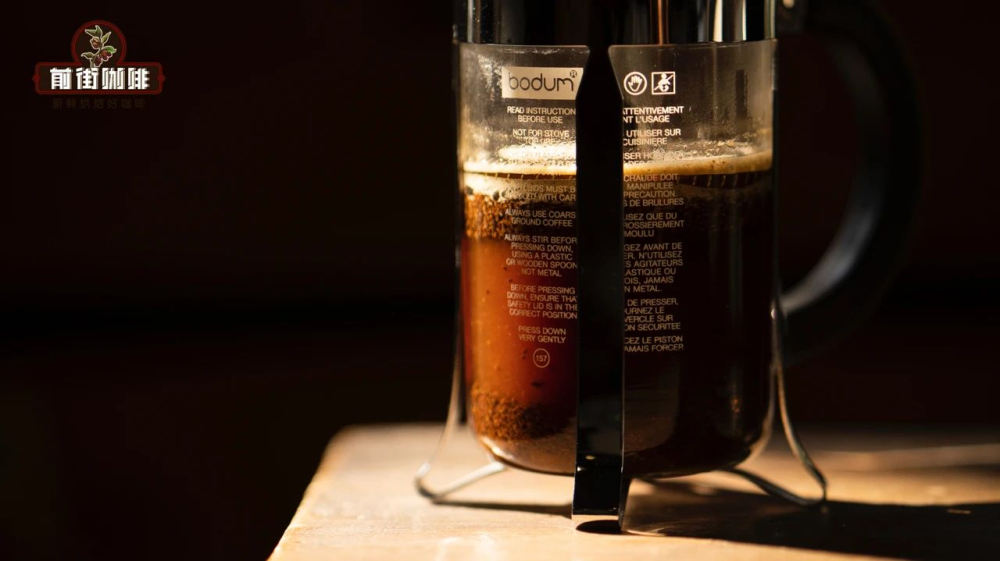
Bring the water to a boil; the recommended water temperature is 93°C, then pour in the appropriate amount of water. We used 15g of coffee powder and poured in 240g of hot water, stirring with a spoon so the coffee powder and water fully blend.
Put the lid on the French press with the filter resting at the highest position, then let it sit for 4 minutes.
Before pressing down the filter, you can open the lid and use a spoon to scoop out the foam and small fragments floating on top, then press the filter all the way down.
Once brewing is complete, immediately pour it out into another insulated container! Don't delay, because the coffee grounds are still steeping in it. Then pour it into a cup and enjoy it slowly.
The French press is the simplest, most convenient, and most eco-friendly brewing method. The coffee it produces is stronger, more flavorful, and more layered than a fully automatic drip coffee machine, and it requires no electricity, no heating, no paper filters, is easy to clean, and lets you drink the coffee oils along with it—making it most suitable for office workers who are busy but want to steal a moment of leisure. Come and try it yourself.
The above content is compiled by CoffeeHunters, a coffee news website.


