








What Does the Meaning of Mocha Cover in Coffee Today?
Mocha carries three linked meanings. Historically it named Yemeni coffee shipped from Mocha Port, the main export harbor for Yemeni beans from around 600 AD until it silted up. Later it became a general nickname for coffee, much like Java. Today it usually describes beans with a chocolate-like aftertaste, or a drink mixing hot chocolate and coffee.
The word also drifted onto hardware. The moka pot was invented and popularized by the Italian company Bialetti, which used mocha as a trademark, a choice with little connection to Yemeni mocha beans. Yemeni coffee itself still has no unified naming standard or official grading system, so growers rely on internal codes and local names to separate lots and varieties.
When many people mention mocha, their first thought is coffee with milk and chocolate. But in fact, the most authentic mocha coffee is far more than that. From the export history of Yemen's Mocha port, to mocha beans with a chocolate-like aftertaste, to the moka pot and flavored mocha drinks, this name carries a rich coffee culture behind it. This article will help you clarify the multiple meanings of mocha, understand the naming rules of Yemeni coffee, and share Front Street Coffee's roasting suggestions and brewing parameters for Yemeni mocha, so you can truly understand what a genuine cup of mocha is.

The difference between pour-over mocha and espresso mocha, and the flavor and characteristics of mocha coffee
Everyone must be familiar with the name mocha coffee, but most people think of "mocha" as coffee plus milk plus chocolate. In fact, the most authentic mocha coffee is not made this way ^^
What exactly does Mocha refer to?
The word "mocha" contains several meanings. Around 600 AD, Ethiopian coffee beans in Yemen opened the prelude to the global coffee trade. At that time, the main export port for Yemeni coffee was Mocha Port (now silted up and abandoned), so coffee beans produced in Yemen were called "mocha" beans. Over time, some people began to use "mocha" as another name for coffee, somewhat similar to saying "Java" today.
Later, because mocha coffee has a chocolate-like aftertaste, beans with this characteristic were also collectively called mocha beans, such as Yemeni mocha beans, Harar mocha beans, Tanzanian mocha beans, and so on... So although they are all called "mocha," the meanings are very different, summarized as follows:
Mocha beans: currently generally refers to coffee beans with a chocolate-like aftertaste
Moka pot: invented and heavily promoted by the Italian company Bialetti, which made it popular. Using "mocha" as a trademark is actually quite arbitrary and has little connection with mocha beans.
Mocha coffee: in the early period it referred to black coffee with a chocolate-like aftertaste, and now it has expanded to mean a drink made by mixing hot chocolate and coffee.
| How Yemeni coffee is named
There is still no unified standard or official grading system for the naming of Yemeni coffee. Locals have their own classification system, with hundreds of coffee codes and names used for internal differentiation, but these are not applicable to the commercial export market. In the commercial market, Yemeni mocha usually adopts one of two naming methods: "place name" or "tree variety name."
Yemeni Mokha Mattari and Yemeni Mokha San'ani use the "place-name method," respectively indicating production from Bani Matar Province and the hillside area near the capital Sana'a; Yemeni Mokha Ismaili uses the "tree variety name method," and its production area is located in Hirazi, southwest of Bani Matar.
| Front Street Coffee roasting suggestions
A coffee expert once said: "The taste of Yemeni mocha is too rich. It is not only different across production areas, tree varieties, and batches; every sack, even every cup, has a different flavor." Precisely because of its complexity and variability, for roasters, how to roast out the best flavor of Yemeni mocha is a major challenge!
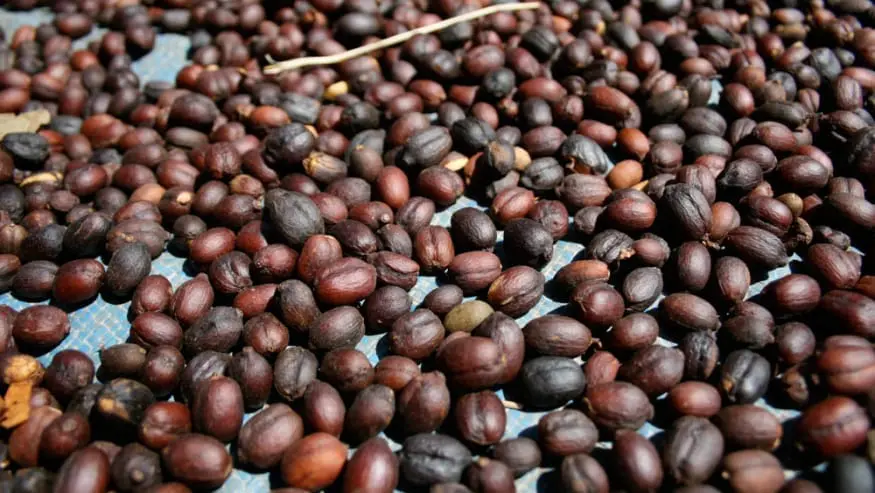
This Yemeni mocha bean has brighter fruit acidity at a light roast, with fruity sweetness, spices, and chocolate flavors; at a medium roast it presents red berries, vanilla, cream, caramel, and chocolate flavors; at a deep roast it has very obvious chocolate, nut, and spice flavors. We chose a medium roast for the roast level. Also, Yemeni mocha is a green bean with relatively low moisture, and the beans vary in size. For green beans with low moisture content, the drop temperature should not be too high. Early-stage dehydration should be accelerated to preserve moisture for flavor and mouthfeel development during first crack. Preheat for 30 seconds, open the air damper to 3, until the green bean color turns light green or white, open the air damper to 4, and after first crack open it to 5 (maximum).
The caramelization reaction produces the optimal roast level for flavors such as nuts, chocolate, and caramel, and also balances to a certain extent the tricky acidity of mocha coffee. But note that mocha is full of chocolate flavor, and if over-roasted it easily develops a rubbery taste.
Roasting curve:
Charge when the drum temperature reaches 170°C, set the air damper to 3, after 1 minute adjust the heat to 140°C, keep the air damper unchanged, roast until 5'00'', temperature 147.2°C, the bean surface turns yellow, the grassy smell completely disappears, dehydration is complete, adjust the heat to 110°C, change the air damper to 4;
At the 8:00 minute mark, ugly wrinkles and dark streaks appear on the bean surface, and the toast smell clearly turns into coffee aroma, which can be defined as the prelude to first crack. At this time, listen carefully for the sound of the first crack. At 8'23'' first crack begins, reduce the heat to 60°C, open the air damper fully (adjust the heat very carefully, not so low that there is no cracking sound), and drop at 197.9°C.
Dripper: V60 Water temperature: 92-93°C Dose: 15g Coffee-to-water ratio: 1:15 Grind size: caster sugar size (No. 20 sieve bowl sifts the grounds to 78%)
Pour 30 grams of water for the first stage and bloom for 30 seconds, then pour 95 grams (the electronic scale shows about 125 grams), completing the pour in about 1 minute. When the water level drops to 2/3 of the coffee bed, pour the remaining 100 grams (the electronic scale shows about 225 grams), completing the pour in about 1 minute 35 seconds. Dripping is completed at 2'10'', remove the dripper, and extraction is complete.
The above content is compiled by CoffeeHunters, a coffee news website.


