







Is Australian White Coffee Served Hot or Iced?
A flat white, also called Australian white coffee, is a milk coffee from New Zealand and Australia with a higher coffee concentration and thinner milk foam than a latte, giving a silky texture. Authentic versions are traditionally served hot, though some shops now offer an iced option to suit customer demand.
Two origin stories circulate. One credits a barista whose milk foam did not whip properly; the other points to customers wanting stronger coffee than a 1:6 latte ratio, leading to a small 3oz drink with roughly a 1:1 coffee-to-milk ratio. Many shops use ristretto for a denser, stronger base.
Flat White is called "Furui Bai" at Starbucks in China, and some also call it Flat White or Australian White coffee. It is a classic milk coffee originating from New Zealand and Australia. Its biggest difference from a latte is that it has a higher coffee concentration and thinner milk foam, with a silky-smooth texture. So, can Furui Bai be made iced? Why does it have two origin legends? What role does ristretto play in it? This article will sort out the characteristics of this cup of coffee one by one, from pronunciation, origin, espresso extraction parameters to specific preparation methods, while combining the production experience of Front Street Coffee to help you understand the details behind a authentic Australian White.
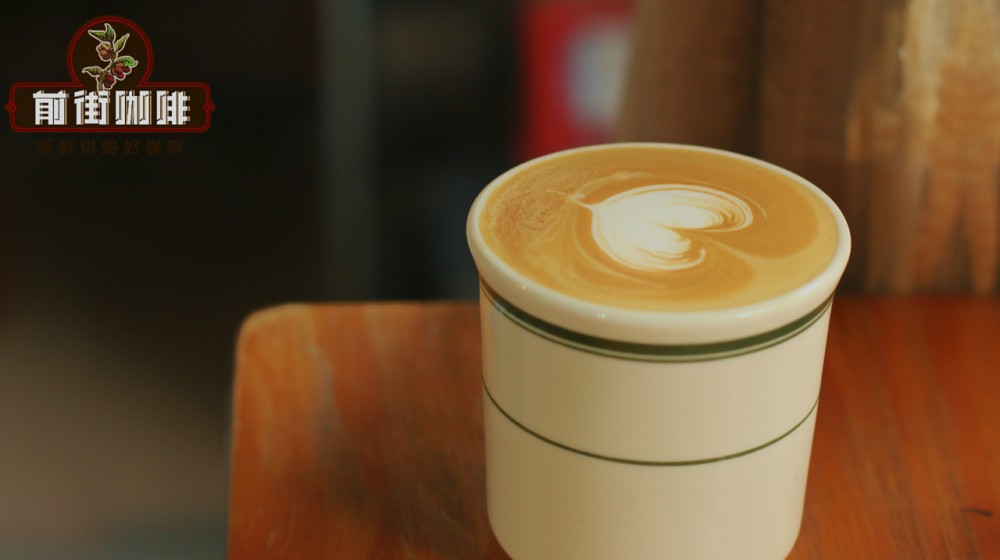
Flat White is often translated in China as Flat White or Australian White coffee, and some also call it "fresh milk espresso." Starbucks gives it the Chinese name "Furui Bai Coffee." It belongs to the category of flavored milk coffee originating from New Zealand and Australia. One theory is that during World War II, Italians immigrated to New Zealand and Australia, bringing coffee culture with them, and by the 1980s, Flat White gradually took shape locally.
The Origin of Furui Bai Coffee
Regarding the birth of Furui Bai coffee, two theories circulate. One is that a certain barista originally intended to make a cappuccino—with a stronger coffee flavor than a latte and thicker milk foam than a latte—but the milk foam was not whipped properly, resulting in a milk coffee with a stronger coffee flavor but thinner milk foam than a latte.
Another theory is that many customers wanted milk coffee with a stronger coffee flavor but were unwilling to accept a latte with a coffee-to-milk ratio of 1:6, so some coffee shops introduced a milk coffee with a very small serving size and a coffee-to-milk ratio of about 1:1, ultimately forming a fresh milk espresso with a capacity of only about 3oz.
Can Furui Bai Coffee Be Made Iced?
Regardless of which origin theory it comes from, one thing is clear: Furui Bai coffee has a higher coffee concentration than a latte. Some coffee shops also switch to ristretto (with a higher concentration than regular espresso), paired with thinner milk foam than a latte, to create a silky texture and rich coffee flavor.
For this reason, authentic Furui Bai coffee only comes in a hot version. However, to cater to different customer needs, Starbucks has also introduced a cold version. Compared with the hot version, the cold version of Furui Bai appears somewhat lighter; if you want to drink a rich Furui Bai, Front Street Coffee recommends choosing the hot one.
The Taste and Mouthfeel Characteristics of Ristretto
Ristretto is a type of espresso. Compared with what is commonly called espresso, under the same extraction parameters, it takes only less coffee liquid, so its concentration is higher than that of espresso. If the coffee beans used are inherently acidic, then the acidity of the ristretto will also be more prominent than that of espresso.
At present, all espresso coffee products produced by Front Street Coffee use a house blend called "Sunflower Warm Sun Blend Coffee Beans," made from 30% Ethiopian natural Yirgacheffe and 70% Honduras Sherry coffee beans. According to Front Street's cupping, the flavor profile of these beans includes whiskey aroma, soft berry acidity, and vanilla cream and nutty caramel.
In daily espresso extraction, Front Street uses 9-10bar of pressure to obtain a coffee liquid with a powder-to-liquid ratio of about 1:2. Usually, a single shot uses 9-11g of coffee powder to extract 15-25g of coffee liquid; a double shot uses 18-20g of coffee powder to extract 35-45g of coffee liquid. The less coffee liquid extracted, the higher the concentration naturally is.
Ristretto is essentially espresso with a smaller extraction ratio. Therefore, Front Street Coffee will use the same grind size and dose as espresso, take only less coffee liquid, and the extraction time will be correspondingly longer, with the powder-to-liquid ratio generally controlled at about 1:1.6.
How to Make Furui Bai Coffee
Front Street Coffee uses a 200ml cup, first adds a double shot of ristretto (35g), then pours steamed hot milk with thin milk foam from the center while dispersing the espresso, so that a gradual flavor can be presented. The first sip is the rich fermented wine aroma of the espresso, the second sip is the strawberry milkshake flavor that appears after the coffee and milk blend, and the third sip is the roasted nut flavor brought by a small amount of coffee combined with milk.
In order for the taster to finish it while the coffee is in its most ideal state, it should be neither too hot nor too thick, while also being sufficiently dense. If cappuccino and latte pursue an airy "fluffiness," then Australian White coffee emphasizes a silky "smoothness." Front Street hopes that guests will taste an Australian White that is both creamy and smooth without being too "watery," so it retains a 0.3cm milk foam layer to blend with the espresso, pour latte art, and controls the temperature at 50-55°C, making it more comfortable to drink.
The above content is compiled by CoffeeHunters, a coffee news website.


