







What Causes Off-Center Latte Art Patterns?
Off-center latte art usually comes from three faults: milk foam that is too thin and flows too fast, returning the cup too quickly, which raises impact force, and a pour point placed in the wrong spot. Centered composition suits most symmetrical designs, so fixing those three issues restores balance without changing the pattern type.
The milk coffee ratio and foam texture set the foundation, so steam milk to a fine, glossy microfoam before pouring. Espresso also needs a smooth, rich crema; blends that include a small amount of Robusta, such as classic and commercial blends, give a more stable base. Practice the pour point and cup return timing first.
In latte art, the beauty of a design depends not only on smooth lines but also on whether the composition is reasonable. Centered composition is the most common approach, as it highlights the stability of symmetrical patterns. However, many beginners find that their latte art patterns always drift off-center. Front Street Coffee points out that this is mainly caused by three reasons: milk foam that is too thin, leading to excessive fluidity; returning the cup too quickly, which increases impact force; and incorrect placement of the pour point. This article will analyze the causes and solutions for these issues one by one, while emphasizing the importance of choosing the right coffee beans, and recommending two products—Front Street Classic Blend and Front Street Commercial Blend—to help you create centered, beautiful latte art at home.
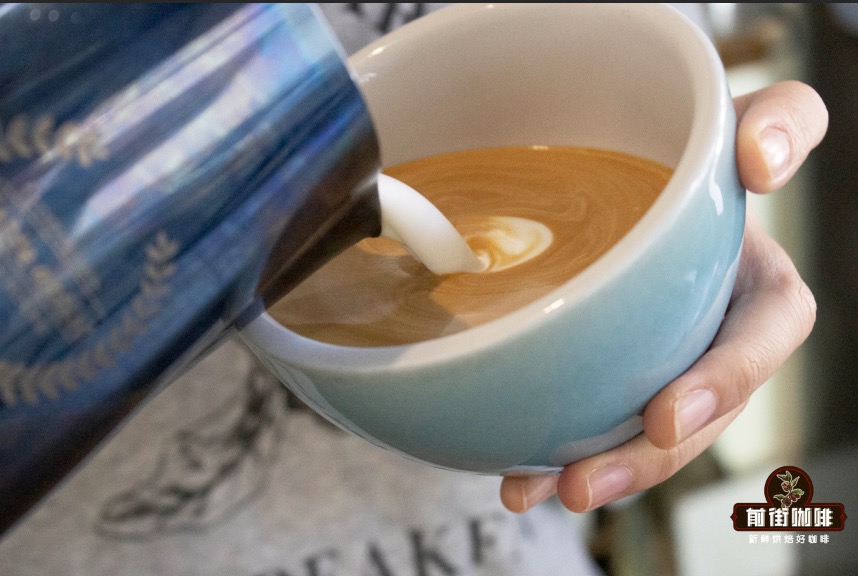
In the art of latte art, whether a pattern is pleasing to the eye depends not only on whether the milk foam is shaped beautifully, but also on the composition, which is equally crucial. A reasonable composition can guide the eye to focus on the pattern itself, thereby better showcasing its beauty. Therefore, when creating latte art, we must not only outline the details of the pattern but also place it in the appropriate position.
Among the many composition methods, centered composition is the most common—that is, placing the pattern in the exact center of the cup. Most patterns are inherently symmetrical, and centering them reinforces this symmetry, bringing a sense of stability and balance that is visually pleasing. Therefore, for simple and symmetrical designs, we usually deliberately place them at the center point of the cup.
But Front Street has noticed that many beginners often encounter a problem during latte art: the final pattern is always off-center. What exactly causes this? It can mainly be attributed to three situations.
It must be acknowledged that creating beautiful latte art requires a perfect espresso as a foundation, so the choice of coffee beans is crucial. Front Street believes that espresso with fine, smooth, and rich crema is the best standard, and you can use the two popular products: Front Street Classic Blend and Front Street Commercial Blend. The former blends the wild character of Brazil and Mandheling, while the latter is rich in various nutty aromas, and both include a small amount of Robusta beans to enhance the richness and golden luster of the crema.

1. Milk foam is too thin
Before learning latte art, one must master the skill of steaming milk foam, because the quality and thickness of the milk foam directly affect the difficulty of creating latte art—this is a point Front Street repeatedly emphasizes.
The quality goes without saying, but the key lies in the thickness of the milk foam, which determines its fluidity during latte art. The thicker the foam, the lower the fluidity; the thinner the foam, the higher the fluidity.
When the milk foam is too thin, its high fluidity makes the pattern more likely to deviate from the target position during creation. Because of the excessive fluidity, even a slightly larger flow can easily push the pattern outside the target area. This also explains why many cafés do not attempt latte art on flat whites—the milk foam in a flat white is too thin, and forcing latte art would greatly test the barista's skill.
This situation is also easy to identify: if you see the pattern being washed out or developing "jagged edges" during latte art, it is most likely due to milk foam that is too thin. The solution is simple—next time you steam milk, extend the aeration time appropriately.

2. Returning the cup too quickly
If you ask beginners which part of latte art is the hardest to master, Front Street would say it is none other than the cup-returning motion. The so-called cup-returning refers to continuously adjusting the tilt angle of the cup as the pattern progresses during latte art, with the cup gradually returning to upright from a tilted position, hence the term "returning the cup."
Its difficulty lies in the need to coordinate with the pouring simultaneously, and since it is hard for us to multitask, we must develop muscle memory through repeated practice. Many beginners are not yet accustomed to it in the early stages and tend to return the cup too quickly.
Returning the cup too quickly increases the impact force when the milk foam is poured, directly pushing the already-formed pattern out of its target position. If you notice the pattern continuously drifting off-center as you return the cup, Front Street suggests you focus on practicing the cup-returning motion.
3. Incorrect pour point position
The last reason for off-center patterns is an incorrect pour point position. Different patterns have different pour point positions because their creation steps differ, so the pour point positions vary. For example, the pour point for a heart-shaped latte art is slightly above the center of the cup, while the pour point for a leaf-shaped latte art is slightly below the center.

If you get the pour point position wrong during latte art, the final pattern will be off-center, appearing below or above the center, thereby affecting the overall aesthetics. Therefore, the pour point position in latte art is also an aspect that requires close attention.
The above content is compiled by CoffeeHunters, a coffee news website.


