







How do Colombia's coffee producing regions differ in flavor?
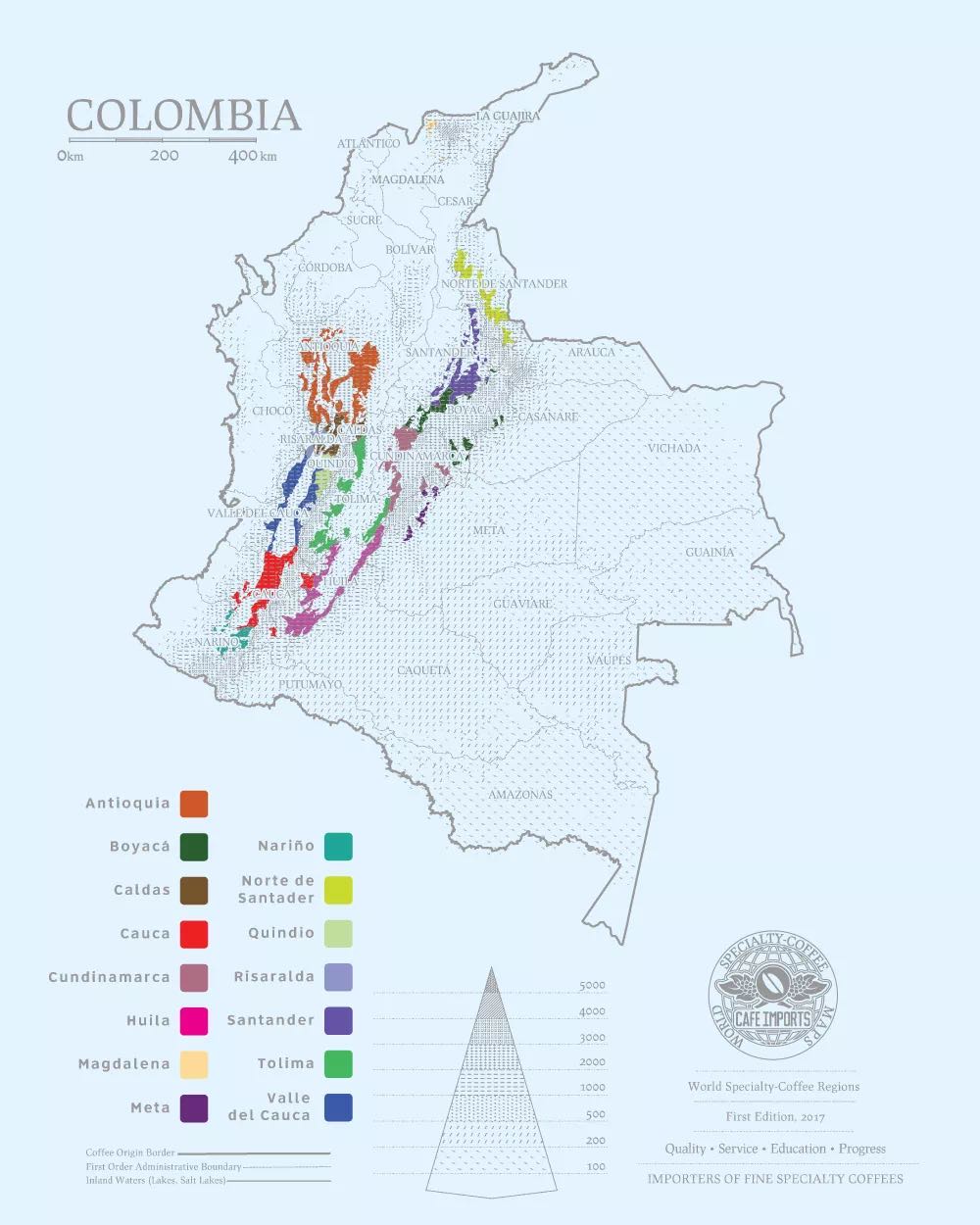
Colombia's main coffee producing regions run from Santander and Antioquia through Tolima, Huila, Cauca and Narino. Each area brings its own geography, climate and processing methods, which show up in the cup. Huila, in the southwest, accounts for roughly 12 percent of national production and is one of the country's main cultivation areas.
The Andes terroir and smallholder farming give Colombian beans their diverse flavors, and the country is one of the few origins that sells single-origin coffee under its national name. Huila coffee from Front Street shows the classic profile, and the article also covers the Sidra variety, Finca El Diviso's competition results, plus hand-brew parameters and roasting suggestions.
Colombia is one of the few single-origin coffee producing regions in the world named after a country. Thanks to the superior terroir of the Andes Mountains and the meticulous farming of smallholders, it has given rise to specialty coffees with diverse flavors. This article systematically reviews Colombia's main producing regions—Santander, Antioquia, Tolima, Huila, Cauca, and Narino—covering their geography, climate, processing methods, and the flavors of representative beans, with a focus on the origins of the Sidra variety and the competition-level performance of Finca El Diviso. It also includes hand-brew parameters and roasting suggestions for several Front Street Colombian beans, providing coffee lovers with a complete reference from understanding producing regions to brewing practice.
Among the many coffee-producing countries in the world, Colombia is one of the very few exceptions that sells single-origin coffee directly under its national name as a brand. The reputation this country has earned for coffee quality is virtually unmatched by any other origin. Rather than simply expanding export volume, Colombia focuses more on product development and industry upgrading. Combined with its exceptional natural conditions, this has created its outstanding coffee flavor and world-class reputation. In Front Street Coffee's (FrontStreet Coffee) everyday beans lineup, there is a Front Street Colombia Huila coffee bean that presents the most classic flavor profile of Colombia.
Since 1990, Colombian coffee has become a core sourcing target for Starbucks, and it subsequently rose rapidly in popularity around the world. Starbucks' iconic totem design also incorporates elements of Colombian culture. When Front Street Coffee (FrontStreet Coffee) was founded, its starting point was not simply selling coffee beans, but rather the hope of drinking coffee from every producing region in the world. In this process, Front Street Coffee (FrontStreet Coffee) has been committed to understanding the characteristics of each producing region, including the performance of different varieties within the same region and the differences between different processing methods for the same variety. Based on this, it has built a database and conducted horizontal comparisons between producing regions, allowing more coffee lovers to glimpse the full picture of the coffee world.
Colombia's Coffee Culture
Coffee occupies an extremely special place in the hearts of Colombians; it is a national pride. Aside from football, which once ranked among the world's best, the topic locals love to chat about most is the coffee that makes them proud. Drinking coffee in Colombia is truly a life enjoyment, and it is essential three times a day. Coffee shops line the streets and alleys, packed with a steady stream of customers from early morning until late at night. Coffee shops never use instant products; everything is brewed fresh to order. Waitstaff serve it respectfully in refined porcelain cups, and customers add sugar themselves. The room is filled with aroma, the cup is sweet and pleasant, and the lingering finish rewards careful savoring—no wonder locals are all devoted coffee addicts.
Colombian Coffee Is Renowned Worldwide
Colombia is located in the northwest of South America, with beautiful scenery and a deep history. In ancient times, Indigenous peoples flourished here. In 1531, it became a Spanish colony, gained independence in 1819, and adopted its current name in 1886 to commemorate Columbus, the discoverer of the American continent. In 1808, a priest set out from the French Antilles, passed through Venezuela, and brought coffee into what is now Colombia for the first time.
Colombia is said to have "four treasures": flowers, gold, emeralds, and coffee. This shows just how important coffee is in the country. Globally,using a national name as a coffee brand is extremely rare. Nestle, Blue Mountain, and others are not named after countries, and Colombia was the first country to use its national name as a coffee brand. Colombian coffee beans are world-famous for their quality, flavor, and high standard. Coffee production occupies an important position in the national economy, with annual exports of about US$1.5 billion, accounting for a considerable share of foreign trade. Just as only wine produced in the Champagne region of France can be called Champagne, only coffee grown in Colombia and picked entirely by hand is qualified to be called "Colombian coffee." Today, Colombia is the world's third-largest coffee producer and exporter, as well as the world's largest exporter of Arabica coffee beans and the largest exporter of washed coffee beans.
A Unique Geographical Environment Creates Colombian Coffee
Colombia has beautiful mountains and rivers, a mild and humid climate, springlike weather year-round, and fresh air. Its diverse climatic conditions allow coffee to be harvested throughout the year, with different varieties ripening successively at different times. The country mainly cultivates the outstanding-quality Arabica coffee bean. Coffee brewed from these beans is rich in flavor and long in finish, truly deserving to be called specialty coffee. Today, many people directly equate "Colombian coffee" with "high quality" and "great taste."
The world's coffee is broadly divided into two major categories: one is the "soft" coffee represented by Brazil, with a strong taste; the other is the "hard" coffee represented by Colombian coffee beans, with a delicate, elegant, and fragrant flavor. The difference between the two mainly comes from altitude and cultivation methods—Brazil grows coffee on hilly red soil with relatively extensive management, while Colombia carefully cultivates coffee on mountain black soil.
Colombian coffee is classified into more than 200 grades, which shows how strong its regional variation is. The country's coffee-producing regions are located in the Andes Mountains, with a mild climate and humid air. Three Cordillera mountain ranges run north-south and extend toward the Andes, and coffee farms are distributed along the highlands of these ranges. The terraced mountain terrain provides diverse climatic conditions, making it a harvest season all year round, with different types of coffee ripening successively at different times. Fortunately, unlike Brazil, Colombia does not need to worry about frost damage. There are about 700 million coffee trees nationwide, of which 66% are grown in plantations using modern methods, while the rest are distributed among traditionally managed small farms.
The pure flavor of Front Street Colombian coffee is not only due to the natural environment most suitable for coffee cultivation, but is also inseparable from the hard work of local growers. Colombia's coffee planting area reaches 1.07 million hectares, with about 302,000 coffee farms nationwide, and 30% to 40% of the rural population depends directly on coffee production for their livelihood. Although there are many farms, they are generally small, each only about 2 hectares. More than 80% of coffee farms have only about 5,000 coffee trees, with an average of just 3,000. This shows that Colombian coffee agriculture is smallholder-based. Locals plant tall trees or banana trees around the coffee trees, and during the seedling stage they build shade structures for the coffee trees to ensure the cool, humid environment needed for growth. In the coffee groves, humidity is high and temperature differences are small, so the coffee beans mature slowly, which helps the accumulation of caffeine and aromatic substances, resulting in excellent quality.
Colombia's Coffee Producing Regions
Colombia's best-known producing regions include Medellin, Armenia, and Manizales, conventionally grouped together as "MAM." Specialty bean producing regions are mainly in the south, at altitudes above 1,500 meters, including San Augustin, Huila; Popayan, Cauca; Narino Department; and Tolima Department. Coffee from these places generally has refined acidity and berry aromas, accompanied by caramel notes and plenty of sweetness.
From north to south, Colombia's producing regions are:
Santander/North of Santander Santander and Northern Santander
The Santander producing region is located in northern Colombia, bordered to the west by the Magdalena River, with a growing altitude of about 1,400-1,600 meters. Coffee beans from this region are known for their strong taste, long finish, and unique fresh herbal notes.
Representative coffee: Front Street Colombia Finca La Reserva Rose Valley Coffee Beans
Processing method: Anaerobic enzyme washed
Brewing equipment: Hario V60
Grind size: 80% passing a Chinese standard No. 20 sieve
Coffee-to-water ratio: 1:15
Suggested water temperature: 90-91°C
Brewing suggestion: Use 30 grams of water for a 30-second bloom, then pour in a small circular stream to 125 grams and pause in stages. When the water level is about to expose the coffee bed, continue pouring to 225 grams and stop. When the water level is about to expose the coffee bed again, remove the dripper. (Start timing from the beginning of the bloom.) Extraction time is 2'00".
Flavor description: Stunning peach character, accompanied by rose and rum chocolate aromas, fragrant and rich. On the palate it blends into a peach juice-like sensation. It has both the high-quality sweet-tartness of black grapes and the silky mouthfeel of cream toffee.
Antioquia Antioquia
Antioquia Department is located in north-central Colombia, with a coffee planting area of 126,000 hectares, accounting for 18% of Colombia's national output, second only to Huila Department. Most of the department consists of the high mountainous terrain of the Andes, but it is also brushed by warm sea breezes from the Caribbean. The departmental capital, Medellin, is Colombia's second-largest city and also an important Colombian coffee-producing region.
Representative coffee: Front Street Colombia Antioquia Finca La Herrera Coffee Beans
Processing method: Washed
Brewing equipment: Hario V60
Grind size: 80% passing a Chinese standard No. 20 sieve
Coffee-to-water ratio: 1:15
Suggested water temperature: 90-91°C
Brewing suggestion: Use 30 grams of water for a 30-second bloom, then pour in a small circular stream to 125 grams and pause in stages. When the water level is about to expose the coffee bed, continue pouring to 225 grams and stop. When the water level is about to expose the coffee bed again, remove the dripper. (Start timing from the beginning of the bloom.) Extraction time is 2'00".
Flavor description: Light floral notes, white grape juice, honey sweetness, cream, fruit gummies, sweet citrus notes, smooth and rich sweetness.
Tolima Tolima
Tolima is adjacent to Huila and Cauca. The north-south-running Andes (M. Andes) and Cordillera (M. Cordillera) run through the entire region, and between the two mountain systems flows the Magdalena River (R. Magdalena) from south to north.
The name Tolima comes from the Pijao people who first lived here. In their language (Pijao word), tolima means "snowed." Farms in Tolima are generally slightly larger than in other southern Colombian producing regions, at about 10-15 hectares. The cooperative model is also common here, with farmers sending small lots of coffee cherries to cooperative processing stations. Some farmers also choose to process coffee themselves, using their own small-scale facilities to process the cherries picked that day.
Representative coffee: Front Street Coffee (FrontStreet Coffee) · Colombia Geisha Esperanza Margarita Coffee Beans
Processing method: Natural
Brewing equipment: Hario V60
Grind size: 80% passing a Chinese standard No. 20 sieve
Coffee-to-water ratio: 1:15
Suggested water temperature: 90-91°C
Brewing suggestion: Use 30 grams of water for a 30-second bloom, then pour in a small circular stream to 125 grams and pause in stages. When the water level is about to expose the coffee bed, continue pouring to 225 grams and stop. When the water level is about to expose the coffee bed again, remove the dripper. (Start timing from the beginning of the bloom.) Extraction time is 2'00".
Flavor description: When hot, it enters with obvious sucrose and licorice sweetness, along with some lemon acidity and an oolong tea finish, somewhat like a cup of lemon tea. After it cools, citrus flavors become more obvious, and the sweetness of honey and sucrose lingers. Once cooled, it gives a honey green tea impression.
Roasting suggestion: Yangjia 800N roaster
Charge when the drum temperature reaches 180°C, set airflow to 3, and after 30 seconds adjust heat to 150 with airflow unchanged. The turning point is 1'36". When the drum temperature is 140°C, adjust heat to 130 and open airflow to 4. At this point the bean surface turns yellow, the grassy smell completely disappears, and the drying phase begins. When the drum temperature reaches 166°C, lower heat to 110 and keep airflow unchanged. At 7'50", ugly wrinkles and dark patches appear on the bean surface, and the toast aroma clearly turns into coffee aroma, which can be defined as the prelude to first crack. At this time, listen carefully for the sound of first crack. At 8'20", first crack begins. Lower heat to 50 and set airflow to 5 (adjust heat very carefully; do not lower it so much that there is no cracking sound). After first crack, develop for 1'30" and drop at 190°C.
Huila Huila
Huila Department is located in the southern part of Colombia's Central Cordillera and is the country's most famous specialty coffee producing region. This area is mountainous terrain surrounded by mountains, with a planting altitude above 1,500 meters. Colombia's most important rivers converge here, bringing abundant water resources and moisture.
In contrast to the common impression of mass-market Colombian coffee as balanced and mellow, many specialty Colombian coffees produced in smallholder micro-lots actually have strong regional flavor characteristics. In recent years, with the international market's growing emphasis on coffee quality and demand for specialty coffee, the previous system of grading by bean size has gradually been abandoned in favor of micro-regional selections provided by smallholder coffee producers. Dozens of smallholders contribute their individual harvests, which are consolidated into a micro-lot for sale. As a result, there are more opportunities to directly select many outstanding coffees from specific smallholders through lot-by-lot cupping.
Sidra coffee originally came from Pichincha Province, Ecuador, where the variety is locally called Sydra. According to available information, Sidra is a laboratory variety developed by crossing Typica and Red Bourbon. Later, based on genetic comparison, it was found that Sidra coffee shares similar genes with Ethiopian landraces, so some scholars also speculate that Sidra was a cross between an experimental research variety exported from Ethiopia and local Bourbon coffee in Ecuador. At present, the Sidra variety is mainly found in producing countries such as Ecuador and Colombia.
Finca El Diviso is located in Huila, one of Colombia's most famous coffee-producing regions; it sits at about 2,100 meters above sea level and covers 14 hectares. This is a family-run coffee estate founded by Jose Uribe Lasso in 1996 and has more than 25 years of coffee-growing experience.
It is currently mainly operated by Nestor Lasso. He is young and highly motivated. His grandfather led him into the magnificent world of coffee, and his father inherited the farm and had even greater ability in coffee cultivation. Influenced by this family, Nestor continuously strives for excellence in coffee cultivation and processing, growing twelve bean varieties including Caturra, Colombia, Sidra, Castillo, Geisha, and Bourbon.
In the 2022 World Barista Championship, champion barista Anthony Douglas used Sidra coffee beans from Finca El Diviso in the competition, which made Sidra coffee beans a major focus of attention.
Representative coffee: Front Street Colombia Finca El Diviso Sidra Coffee Beans
Processing method: Double fermentation natural
Brewing equipment: Hario V60
Grind size: 80% passing a Chinese standard No. 20 sieve
Coffee-to-water ratio: 1:15
Suggested water temperature: 90-91°C
Brewing suggestion: Use 30 grams of water for a 30-second bloom, then pour in a small circular stream to 125 grams and pause in stages. When the water level is about to expose the coffee bed, continue pouring to 225 grams and stop. When the water level is about to expose the coffee bed again, remove the dripper. (Start timing from the beginning of the bloom.) Extraction time is 2'00".
Flavor description: On the palate there are floral, tropical fruit, lychee, and passion fruit flavors, with a juice-like smooth mouthfeel.
Roasting suggestion: Yangjia 800N roaster
Charge when the drum temperature reaches 180°C, set airflow to 3, and set heat to 100; the turning point is 1'40". When the drum temperature is 140°C, keep heat unchanged and open airflow to 4. At this point the bean surface turns yellow, the grassy smell completely disappears, and the drying phase begins. At 151°C, lower heat to 80; at 166°C, lower heat to 65, keeping airflow unchanged. At 8'35", ugly wrinkles and dark patches appear on the bean surface, and the toast aroma clearly turns into coffee aroma, which can be defined as the prelude to first crack. At this time, listen carefully for the sound of first crack. At 9'58", first crack begins. Set airflow to 5 (adjust heat very carefully; do not lower it so much that there is no cracking sound). After first crack, develop for 1'28" and drop at 193°C.
At 8'35", ugly wrinkles and dark patches appear on the bean surface, and the toast aroma clearly turns into coffee aroma, which can be defined as the prelude to first crack. At this time, listen carefully for the sound of first crack. At 9'58", first crack begins. Set airflow to 5 (adjust heat very carefully; do not lower it so much that there is no cracking sound). After first crack, develop for 1'28" and drop at 193°C.
There is also a Huila producing region coffee bean processed with a special method: Front Street Colombia Flower Moon Night Coffee Beans
Brewing equipment: Hario V60
Grind size: 80% passing a Chinese standard No. 20 sieve
Coffee-to-water ratio: 1:15
Suggested water temperature: 90-91°C
Brewing suggestion: Use 30 grams of water for a 30-second bloom, then pour in a small circular stream to 125 grams and pause in stages. When the water level is about to expose the coffee bed, continue pouring to 225 grams and stop. When the water level is about to expose the coffee bed again, remove the dripper. (Start timing from the beginning of the bloom.) Extraction time is 2'00".
Flavor description: Balanced flavor, with floral and strawberry notes accompanied by a dark cocoa finish, cream, and a fermented note.
Roasting suggestion: Yangjia 800N roaster
Charge temperature 180°C, initial heat 120, airflow 3. At 140°C, keep heat unchanged and open airflow to 4. At this stage the beans slowly change from raw green to yellow, the original grassy smell gradually disappears, and they enter the drying state. 6'25" is the yellowing point, when the beans develop a sweet aroma like baking bread. At 180°C, lower heat to 100, keeping airflow at 4. At 9'38", ugly wrinkles and dark patches appear on the bean surface, and the toast aroma clearly turns into coffee aroma, which can be defined as the prelude to first crack. At this time, listen carefully for the sound of first crack. At 10'20", first crack begins. Open airflow to 4. After first crack, develop for 1'50", and drop at 196°C. Because Front Street Colombia Flower Moon Night is an anaerobic natural processed bean, the drying time should be extended to about 9 minutes to 9 minutes 30 seconds as much as possible, so the beans are roasted through and avoid underdevelopment. After first crack, develop to 1'50" and discharge at 196°C.
Cauca Cauca
Cauca Department is a region certified as a Colombian coffee place of origin. Its average altitude is 1,758 m, and the highest altitude can rise to 2,100 m. The region's terrain, rainfall, temperature, and volcanic soil provide suitable conditions for coffee growth. Eighty percent is mountainous, with parallel mountain systems in the east and central areas that are part of the Andes. The central mountain system includes two major volcanoes, Sotara and Petacas. In terms of borders, Cauca is similar to other southwestern producing regions, with rainfall showing a clear monomodal distribution. The dry season mainly occurs from August to September each year, after which the rainy season brings a concentrated coffee flowering season, followed by the concentrated coffee harvest season the next year.
The biggest climatic difference from other producing regions is probably the relatively large temperature variation, with an average daily temperature of 11°C and an average daytime temperature of 18°C. The day-night temperature difference is an important factor in producing high-quality coffee. The low nighttime temperatures and relatively higher altitude slow the pace of coffee growth, allowing the coffee seeds and beans to absorb the nutrients of the coffee cherry more fully, and also creating the better acidity and much-praised distinctive sweetness of Cauca coffee.
Representative coffee: Front Street Colombia Cauca Cherry Blossom Coffee Beans
Processing method: Washed
Brewing equipment: Hario V60
Grind size: 80% passing a Chinese standard No. 20 sieve
Coffee-to-water ratio: 1:15
Suggested water temperature: 90-91°C
Brewing suggestion: Use 30 grams of water for a 30-second bloom, then pour in a small circular stream to 125 grams and pause in stages. When the water level is about to expose the coffee bed, continue pouring to 225 grams and stop. When the water level is about to expose the coffee bed again, remove the dripper. (Start timing from the beginning of the bloom.) Extraction time is 2'00".
Flavor description: Chamomile and spice aromas greet the nose, with fresh lime notes on the palate and clean fruit acidity echoing in the mouth.
Narino Narino
Narino Department is located in the southwest of the country, bordered by the Pacific Ocean to the west and Ecuador to the south. The Andes run through the entire department. Coffee is grown in the high-altitude cloud belt from 1,600 to 2,300 meters, where the soil is fertile volcanic geology. The beans are smaller in shape but plump, with a jade-green color.
The vast majority of Narino's annual production is purchased by large American coffee merchants. Narino Department is located in southwestern Colombia, bordered by the Pacific Ocean to the west and neighboring Ecuador to the south. The Andes run through the department, where there are majestic mountains and beautiful scenery, and many rivers flow through the area toward the south. It belongs to Colombia's high-mountain coffee-growing zone and has nurtured many smallholder producers of specialty coffee. Narino's total annual output is about 150,000 bags, of which only about 6,000 bags are selected beans.
Fabian Zarama is a coffee farmer in Colombia's Narino producing region, and his farm is near La Florida. In recent years, Narino has attracted strong attention in the specialty coffee world. Its high altitude can reach 2,000 meters, and combined with a special microclimate, temperatures remain between 16 and 25°C. The local Mount Galeras is one of the world's most active volcanoes, and the fertile volcanic soil allows Narino to produce outstanding coffee. Not only is the quality generally good, but the flavor is also quite unique.
Zarama established a standard cultivation process, with regular fertilization, cleaning, and care of the plants, harvesting high-quality coffee year after year. This special lot is a single variety: Caturra, grown at 1,900 meters and washed using clean spring water. The cherries are depulped, fermented for 18 hours, and then dried for 15 days.
In blind tasting, Zarama Caturra coffee stood out especially for its flavor, with a full body, rich and complex fruit flavors, plus nutty notes—very distinctive.
Representative coffee: Front Street Fabian Zarama Caturra Coffee Beans
Processing method: Washed
Brewing equipment: Hario V60
Grind size: 80% passing a Chinese standard No. 20 sieve
Coffee-to-water ratio: 1:15
Suggested water temperature: 90-91°C
Brewing suggestion: Use 30 grams of water for a 30-second bloom, then pour in a small circular stream to 125 grams and pause in stages. When the water level is about to expose the coffee bed, continue pouring to 225 grams and stop. When the water level is about to expose the coffee bed again, remove the dripper. (Start timing from the beginning of the bloom.) Extraction time is 2'00".
Flavor description: Butterscotch, cola, cherry, refreshing acidity, dense mouthfeel
[Harvest season varies by region]
Colombia's coffee planting distribution follows the Andes Mountains from south to north and is broadly divided into northern, central, and southern producing regions. The central region has two harvest seasons, a main one and a secondary one, while the north and south each have one harvest season. Due to differences in geographical and climatic characteristics from north to south, the northern and southern harvest seasons are exactly opposite, while the central region has different main and secondary harvest seasons depending on whether it is farther south or farther north. It can be said that beans are produced throughout the year. Here we mainly distinguish regions by winter harvest season and summer harvest season.
[Coffee Processing]
The vast majority of Colombian coffee is washed. Unlike other South American and Central American countries, most coffee growers process coffee at their own washing stations. Each smallholder family has a small specially made processing machine (Ecomill or Eco-Pulper). The harvested coffee cherries are poured in, which not only removes the skin and pulp but also removes most of the mucilage, using only a very small amount of water. Next, the parchment beans with a small amount of remaining mucilage go into a small tank or container—possibly a cement tank (sometimes tiled) or a stainless steel barrel—and are left overnight to ferment, loosening the remaining mucilage. The next day they are rinsed with clean water, completing the washed process. Doing all processing at home allows growers to fully control coffee quality.
Depending on the weather, if it is good, the first choice is of course natural drying. If conditions allow, there will be a large shed where the coffee is spread on wooden racks to dry in the shade, a Green House; otherwise, it is spread on an open cement floor for drying (a Patio). If the weather is bad, with continuous rain, then a dryer is used. Dryers all have an inlet air temperature control, usually around 50°C.
In recent years, Colombia has developed an environmentally friendly washing method. In this new method, water is reused, reducing the water needed to produce 1 kg of green coffee from 40 L to 0.6-2 L. It is quite environmentally friendly, but it affects the quality of the green coffee. Perhaps this is why Colombian green beans tend to turn white.
The above content is compiled by CoffeeHunters, a coffee news website.


