







Which Brazilian coffee producing regions shape the bean's flavor?
Brazilian coffee beans are low in acidity with nutty and chocolate notes and a smooth mouthfeel, which suits both blends and single origins. Brazil is the world's largest producer and its quality stays fairly consistent. Northern growing areas sit in a tropical rainforest climate, hot and humid all year, and coffee trees need plenty of sunlight to grow.
Compared with Central and South American origins, Brazil's altitude is notably lower and the terrain is flatter, which shapes the cup. Front Street Coffee's everyday Brazilian beans and the single-origin Queen Coffee show the style, and the article also covers the pulped natural method and whether these beans work for pour-over, with brewing parameters and flavor descriptions.
As the world's largest coffee producer, Brazil is known for coffee beans with low acidity, nutty and chocolate flavors, and a smooth mouthfeel, making them suitable for both blends and single origins. This article explores Brazil's coffee-producing regions, main varieties, and pulped natural processing method, offering an in-depth analysis of the flavor characteristics of Brazilian coffee beans and discussing whether they are suitable for pour-over coffee. It also combines Front Street Coffee's Brazilian everyday beans and Queen Coffee to provide specific brewing parameters and flavor descriptions, helping coffee enthusiasts fully appreciate the charm of Brazilian coffee.
To learn more about specialty coffee, welcome to follow our WeChat public account: FrontStreet Coffee
Brazilian Coffee Beans
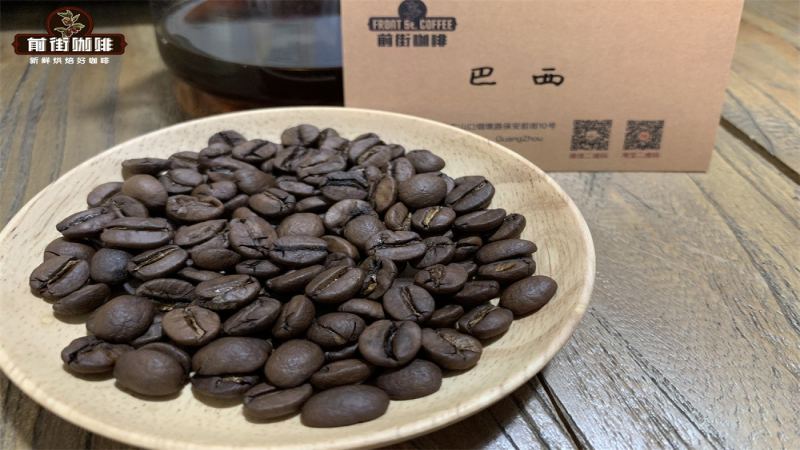
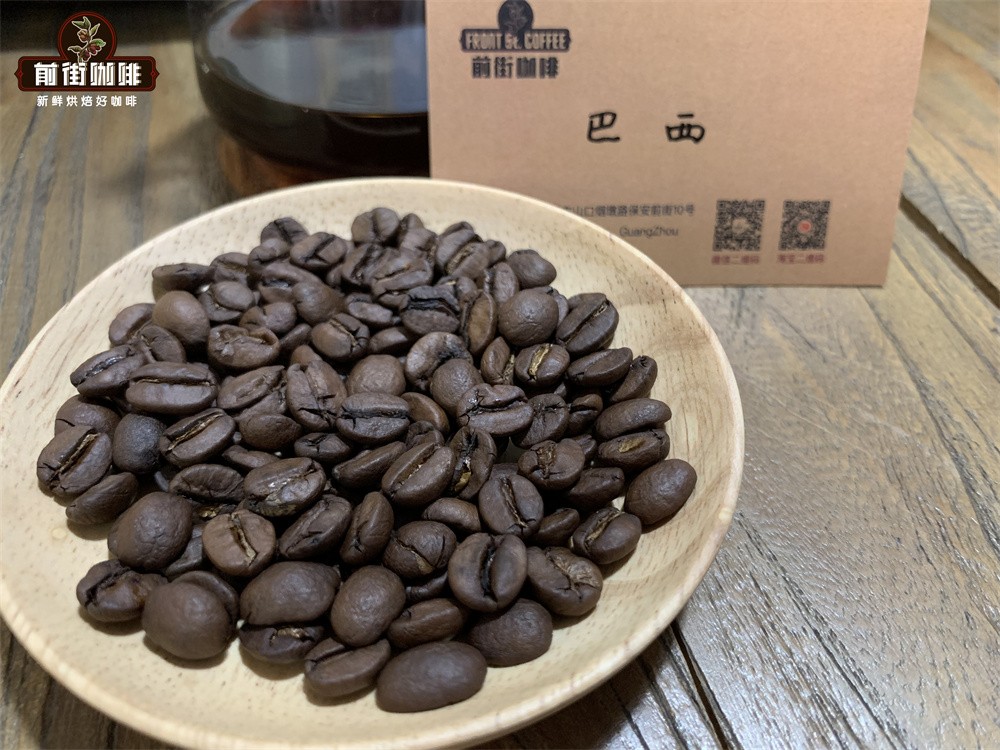
In the market, Brazilian coffee beans usually appear in blends, though single-origin beans do exist, they are relatively few. For example, FrontStreet Coffee's everyday Brazilian coffee and single-origin Brazilian Queen Coffee both fall under the single-origin category, just not in large quantities. Front Street believes this is somewhat related to the inherent flavor characteristics of Brazilian coffee beans. As coffee from the Americas, Brazilian beans are neither as vividly floral and fruity as African beans nor as richly nutty and chocolatey as Asian beans. Brazilian coffee beans are plump, highly aromatic, with moderate bitterness and decent acidity, overall smooth with low acidity, and a long, lingering finish when savored. The low acidity of Brazilian coffee pairs with its sweet-bitter notes, making it very smooth to drink, with a faint grassy aroma, slightly bitter within the fresh scent, sweet and smooth, with a refreshing aftertaste. Because of this, Brazilian coffee beans are highly suitable for blending—it could even be said that without good Brazilian beans, it's hard to make a good espresso.
Brazilian Coffee Producing Regions
Brazil is the world's largest coffee-producing country, and its coffee quality is relatively stable. Located in the tropics, northern Brazil has a tropical rainforest climate, hot and humid year-round, suitable for tropical crops. Coffee trees are sun-loving plants, and ample sunlight is essential for their growth. Compared to Central and South American producing countries, Brazil's altitude is notably lower. The terrain here is flat and monotonous, lacking microclimates, and the habit of using unshaded (exposed) cultivation has led to Brazil's unique soft bean flavor—low acidity, heavy nuttiness, good chocolate sweetness and body, but with slight woody and earthy notes, and indistinct floral and citrus aromas. Simply put, Brazilian coffee is milder and more balanced, unlikely to have the wild, soaring acidity and citrus notes of African beans.
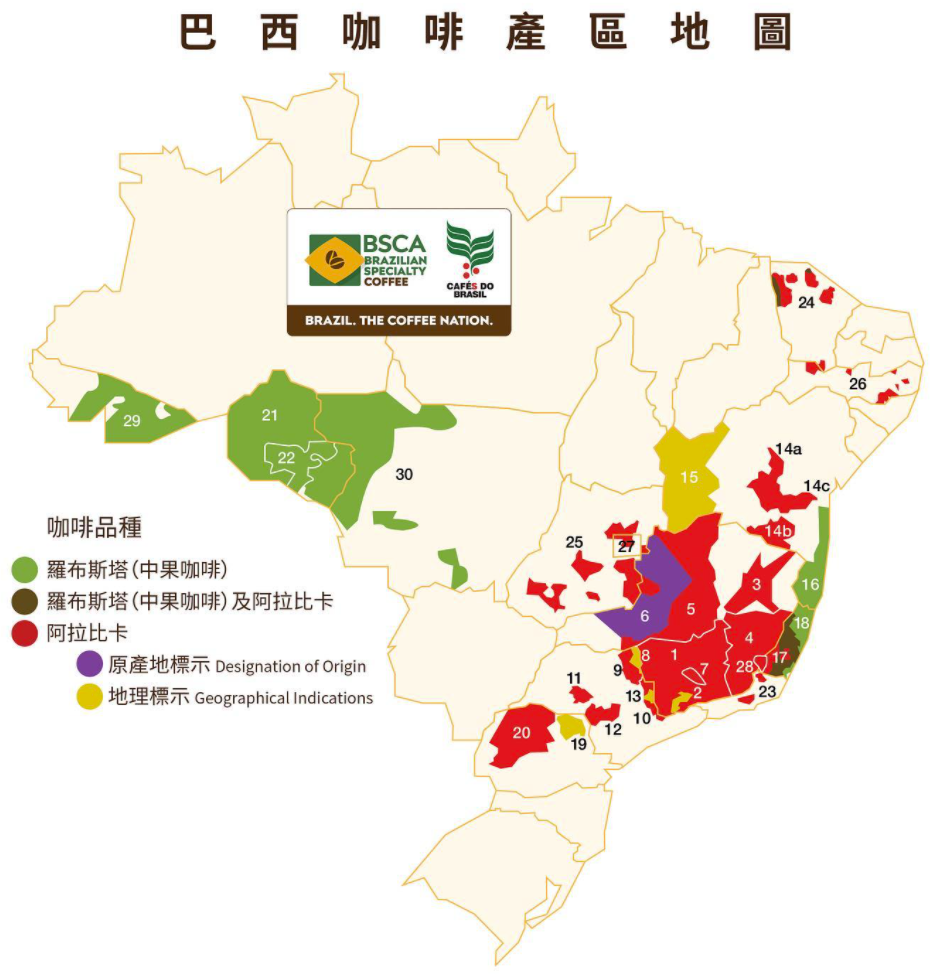
Brazilian coffee beans are mainly produced in the central and southern regions, spread across 7 states and about 14 coffee-producing areas: Sul de Minas, Minas Mountains, Chapada de Minas, Matas de Minas, Mogiana, Centro-Oeste de São Paulo, Montanhas do Espírito Santo, Conilon Capixaba, Cerrado, Planalto da Bahia, Atlantic Bahia, Paraná, Rondônia, and Cerrado. Among them, the most representative is undoubtedly the Cerrado region. It can be said that Sul de Minas and Cerrado have contributed immeasurably to the rise of Brazilian coffee and are also prime areas for Brazilian specialty coffee.
Sul de Minas:
Sul de Minas became a specialty coffee region largely due to its terrain and climate. With an altitude above 1,100 meters, varied topography, distinct wet and dry seasons, large day-night temperature differences, and diverse microclimates, it is ideal for growing Bourbon and Yellow Bourbon varieties. This is Brazil's earliest coffee-producing area. Due to rising labor costs, mechanical harvesting is now mostly used, and it is also the earliest commercialized coffee region, where many large exporters have established operations.
Cerrado:
Brazil's historic century-old White Grass Estate is located in the Cerrado region, a coffee-producing area in Brazil that has obtained origin status, similar to famous wine regions. White Grass Estate has excellent volcanic soil, a balanced wet-dry climate, high altitude, and ample rainfall and sunshine.
The Cerrado region is located in the southern highlands of the "Cerrado savanna climate zone" in central Brazil, spanning eight provinces and covering about two million square kilometers, accounting for 22% of Brazil's total area. Deep inland, "Cerrado" in Portuguese means "closed place." The Cerrado savanna begins in Mato Grosso in southwestern Brazil, passes through west-central Minas, and reaches western Bahia. The so-called Cerrado Coffee Region refers to the area where the savanna extends into Minas at altitudes of 850–1,200 meters, distinct from "Sul de Minas" also in Minas. The flat, open terrain is particularly suitable for large estates, combined with distinct wet and dry seasons and cooler plateau climate.
Of course, not all Cerrado coffee comes from the entire Cerrado savanna, but only the coffee-growing areas above 1,000 meters in west-central Minas can be called the Cerrado coffee region. This area is the essence of the Cerrado savanna, with high altitude and fertile soil, producing sweet, full-bodied, and clean specialty coffee beans. Front Street believes the coffee from this region is mellow with no earthy taste.
FrontStreet Coffee's everyday Brazilian coffee comes from Brazil's Cerrado region.
Mogiana:
This area is very close to southern Minas. Coffee is grown among shrubs, grass, and other plants. There are many farming families here, some using traditional large-farm operations, others small-scale modern methods. Modern technology mixed with mountain coffee-growing culture has produced the highest quality green coffee beans.
FrontStreet Coffee's Brazilian Queen Coffee comes from the Mogiana region's Yellow Bourbon coffee.
Brazilian Coffee Bean Varieties
Bourbon and Typica are both relatively ancient varieties. Brazil's main varieties are Bourbon, Mundo Novo, and Catuai. Yellow Bourbon is generally only grown in Brazil, such as Front Street's Brazilian Queen Estate coffee beans, which are of the Yellow Bourbon variety. Brazilian Bourbon has higher yields, rounder beans, berry-like acidity, full body, and very pronounced creamy aroma, but Bourbon has relatively poor disease resistance.
Red Bourbon
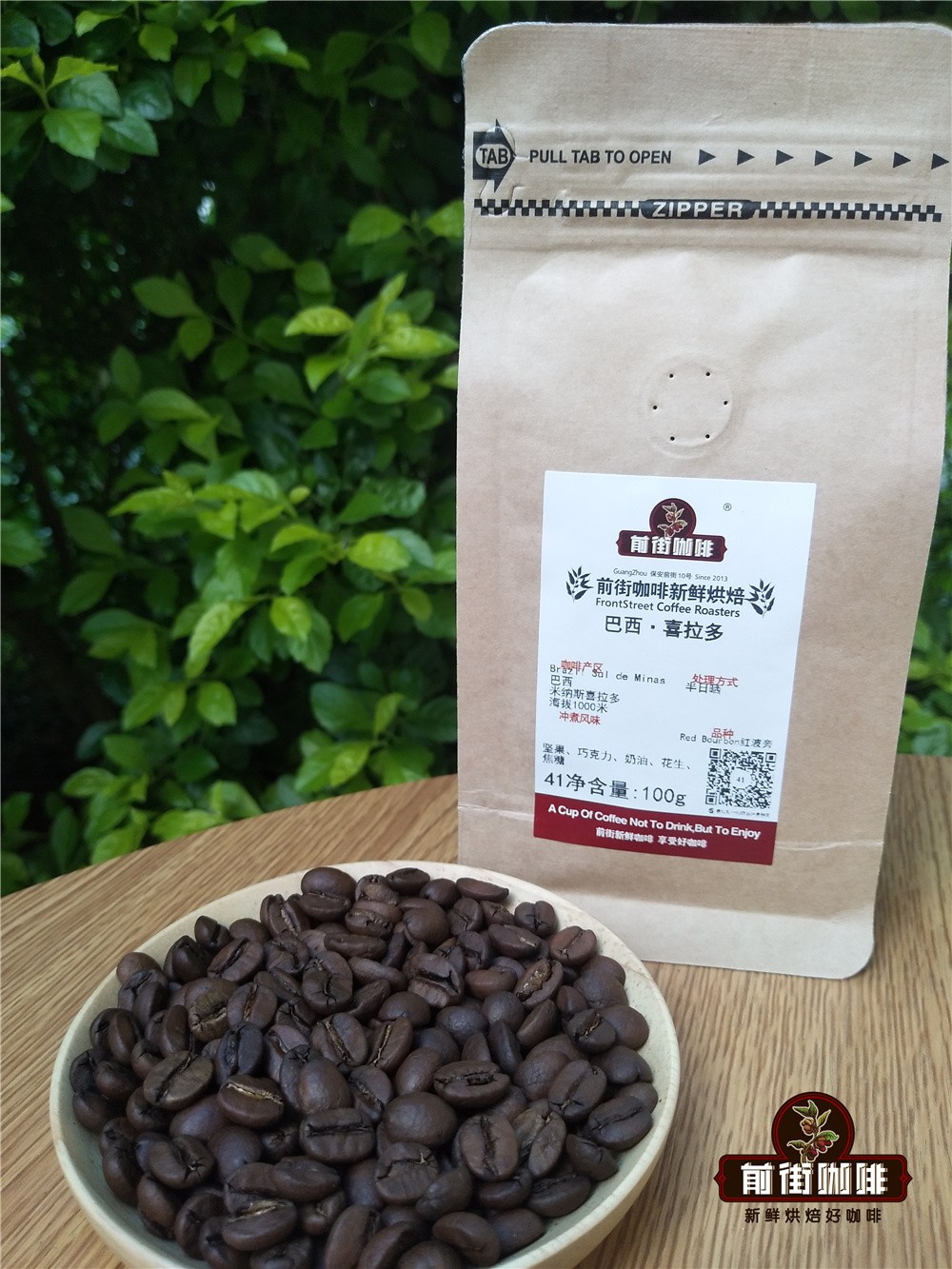
Red Bourbon is actually a sub-variety resulting from a mutation of Typica, and along with Typica, is one of the oldest existing coffee varieties. It usually produces red fruit, hence Red Bourbon; there are also Yellow Bourbon and Pink Bourbon. Red Bourbon refers to the general Bourbon coffee tree whose fruit color changes from green > slightly yellow > slightly orange > ripe red > darker red, hence the name. Its flavor has better aroma, brighter acidity, and can even taste like red wine. Red Bourbon is currently the most widely planted variety in Brazilian coffee regions.
FrontStreet Coffee's everyday Brazilian coffee is of the Red Bourbon variety.
Yellow Bourbon
Yellow Bourbon is also a genetic mutation of Bourbon. Bourbon has long been considered outstanding for its high yield and good quality. Yellow Bourbon is a unique Bourbon variant from São Paulo, Brazil; its fruit turns orange-yellow instead of red when ripe, hence the name. Because Yellow Bourbon is grown at very high altitudes, its flavor is excellent.
Yellow Bourbon typically has nutty and chocolate flavors, balanced and smooth acidity, faint and clean bitterness, and is overall bright and refreshing.
FrontStreet Coffee's Brazilian Queen Coffee is of the Yellow Bourbon variety.
Brazilian Coffee Processing Method - Pulped Natural
Before 1990, Brazil almost entirely used rough natural processing, which made Brazilian beans prone to woody or earthy flavors, because the coffee fruit had to undergo two to three weeks of sun exposure, and if it rained and rehydrated, mold could develop. To change this situation of depending on the weather, in 1990 Brazil, leveraging its relatively dry climate, developed the Pulped Natural method to shorten processing time. Pulped Natural reduces the earthy and off-flavors of Brazilian beans and enhances fruity and sweet notes, making it most suitable for single origins. Pulped Natural has become a necessary part of Brazilian specialty coffee beans.
Of course, the introduction of Pulped Natural doesn't mean all Brazilian regions use it. The lower-humidity Cerrado still mainly uses natural processing, with Pulped Natural playing a secondary role there. However, FrontStreet Coffee's Red Bourbon from Cerrado is processed using the Pulped Natural method.
Pulped Natural removes the skin and pulp of the coffee cherry, allowing control over the fermentation of the mucilage-covered beans. Traditional natural processing dries the fruit with skin and pulp, making it impossible to see the fermentation degree of the mucilage. Pulped Natural is between natural and washed methods, but without the washed method's "tank fermentation, water rinsing" process, instead directly sun-drying. Although the method seems similar, without the fermentation step, the coffee flavor is entirely different. During Pulped Natural's removal of skin and pulp, ripe pulp is easily removed, while unripe green fruit's skin is harder to remove, allowing a second screening to filter out unripe fruit and unify maturity. Compared to natural processing, Front Street believes this selection and processing improves cleanliness and maturity, resulting in a more uniform cup.
Front Street Brewing Suggestions
Whether pour-over or espresso, to brew well, you must use good coffee beans and also rest them properly. Front Street has always believed that freshness is a crucial part of brewing. FrontStreet Coffee ships beans within 5 days of roasting, because Front Street knows freshness greatly affects flavor. Front Street's roasting philosophy is "Freshly Roasted Good Coffee," ensuring every customer receives the freshest coffee. The resting period is about 4-7 days, so when customers receive it, it's at its best.
Of course, some customers need Front Street to grind the coffee, which is fine, but Front Street reminds: once ground, no resting is needed, because during transport, the pressure from CO2 in the package also rounds out the flavor, so you can brew a cup immediately upon receiving ground coffee. But ground coffee should be used promptly, as it oxidizes faster upon contact with air, meaning flavors dissipate more quickly and the coffee won't taste as good. So Front Street recommends buying whole beans and grinding fresh for each brew to better enjoy the flavor.
Front Street's Brazilian Coffee Brewing Parameters :
Front Street chose: KONO dripper, 88°C water, 1:15 coffee-to-water ratio, 15g coffee, grind size (75% passing Chinese No. 20 standard sieve).
Using pulse pouring, bloom with 2x coffee weight in water, i.e., 30g water for 30 seconds, then pour in a slow circular stream to 125g, pause, continue to 225g and stop. Once the dripper stops dripping, remove it. Timing from the start of pouring, extraction time is 2'00". Then pick up the whole cup, swirl to mix, and pour into cups for tasting.
Pulped Natural Brazilian Cerrado Coffee Flavor : Noticeable sweetness on entry, with a faint lemon aroma, rich nutty flavors, and a distinct dark chocolate note in the finish, overall quite rounded.
Natural Brazilian Queen Estate Coffee Flavor : Balanced mouthfeel, with almond and cocoa as the main notes, highlighted by sugarcane sweetness, a full-bodied, sweet coffee.
FrontStreet Coffee's Brazilian coffee beans include single origins like the everyday Brazilian coffee beans and single-origin Brazilian Queen Coffee beans; and blends like the espresso moka pot coffee beans recommended by many baristas—Front Street Dark Cocoa Blend, Specialty Blend, and Commercial Blend—all based on Brazilian coffee beans. Whether single origin or blend, Brazilian coffee's flavor is balanced and unique, a top choice for those who dislike acidic coffee. Of course, Ethiopian coffee's floral and fruity acidity is also great!
The above content is compiled by CoffeeHunters, a coffee news website.


