







What Makes Yirgacheffe Coffee Beans Distinct?
Yirgacheffe is a sub-region of Sidamo in Ethiopia, known for bright citrus and lemon acidity with jasmine floral aroma. Its name combines local words meaning calm and marshy wetlands. The turning point came in the 1970s, when the town built the first washed processing station in Sidamo and brought in washing equipment from Latin America. That raised green bean quality and gave the area a distinct flavor identity.
From picking onward, farmers select only ripe cherries, and each processing step is handled with care. Whether washed or natural, these coffee beans grown in the region, an arabica coffee bean type, keep the area's rich aromas intact. Ethiopia's grading system, run through the Commodity Exchange, sorts lots for export, and new sub-regions and cooperatives keep entering the market under their own names to build buyer recognition.
Yirgacheffe is one of Ethiopia's most iconic specialty coffee regions, world-renowned for its bright citrus and lemon acidity and jasmine floral aroma. This article will comprehensively cover the core knowledge of Yirgacheffe coffee beans, from the region's origins, terroir conditions, the native Heirloom variety, and the washed processing method, to the Ethiopian Commodity Exchange (ECX) grading system. At the same time, the flavor profiles and pour-over parameters of several Yirgacheffe cooperative coffee beans from Front Street Coffee will also be presented, providing coffee enthusiasts with a complete reference for purchasing and brewing.
In recent years, new sub-regions and cooperatives have continued to emerge in Ethiopia's Yirgacheffe region, each presenting themselves to the international coffee market under their own cooperative or farm name. Behind this practice lies producers' confidence in the quality of their own coffee, as well as their determination to build brand recognition and customer loyalty in the global market. From the picking stage onward, coffee farmers select only ripe cherries, and every subsequent processing step is carried out with rigor.
Whether washed or natural, Yirgacheffe coffee beans always display stunningly rich aromas and outstanding flavor. Front Street Coffee believes this is precisely the key reason why Ethiopia keeps coffee lovers eagerly anticipating its harvests year after year.
What does the name Yirgacheffe mean?
In the local Ethiopian language, "Yirgacheffe" is a combination of two words: "Yərga" meaning calm, to settle down, and "Č̣äfe" referring to marshy wetlands. Together, Yirgacheffe can be understood as "let us settle ourselves in this wetland." This beautiful name comes from the town of Yirgacheffe (YIRGACHEFFE). Strictly speaking, it is a sub-region under Sidamo in Ethiopia, located to the northwest of Sidamo. Before the mid-20th century, almost all coffee cherries in the area were processed using the traditional natural method, no different from other towns in Sidamo, and Yirgacheffe coffee had not yet developed a distinctive flavor identity.
The turning point came in the 1970s. The town of Yirgacheffe built the first washed processing station in Sidamo and introduced washing techniques and equipment from Latin America. This change not only greatly improved green bean quality but also allowed the citrus and lemon aromas inherent in Yirgacheffe coffee to be released, giving it a fresh and transparent cup profile, thereby establishing its unique flavor identity. After that, Yirgacheffe became independent from Sidamo and developed its own system, and Yirgacheffe-flavor coffee gradually swept the globe, becoming a classic choice passed along by word of mouth among countless coffee lovers.
To promote the development of the coffee industry, the Ethiopian government registered three coffee regional flavors (including Yirgacheffe®) as commercial trademarks in 2004, and in 2008 established the Ethiopian Commodity Exchange (ECX), with coffee becoming one of the commodities auctioned on the exchange. The government implements quality grading and flavor classification for exported coffee beans to ensure buyers can purchase products bearing the trademarked flavor characteristics.
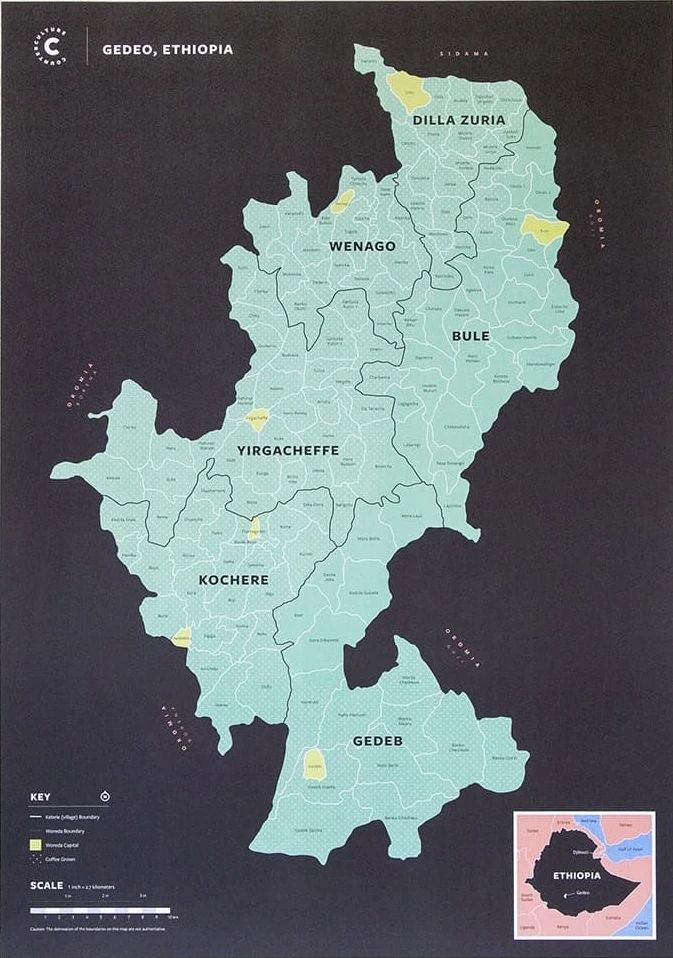
The so-called "Yirgacheffe flavor" can be simply summarized as: a distinctive citrus and lemon fruit aroma interwoven with jasmine fragrance, a fresh and bright texture, rich layers of acidity, and a clean cup with no off-flavors. In addition, according to ECX contract regulations, besides the town of Yirgacheffe itself, coffee produced in Wenago to the north, Gelena Abaya to the west, and Kochere to the south can also be classified as belonging to the Yirgacheffe flavor region.
Why is Yirgacheffe flavor so unique?
The small town of Yirgacheffe is one of the highest-altitude coffee-producing areas in Ethiopia, with coffee trees mostly planted on highlands approaching 2,000 meters, reaching up to around 2,100 meters at the highest. The higher the altitude, the better the growing conditions for coffee trees, and the more fully the flavor potential of Arabica coffee beans can be realized. Lake Turkana, Lake Abaya, and Lake Chamo within the town bring abundant moisture, with mist shrouding the area year-round, spring-like weather in all four seasons, and gentle breezes. The cool, humid climate nurtures the distinctive floral and fruity aromas of Front Street Ethiopian Yirgacheffe.
Unlike many specialty coffee beans that are processed on a large scale in estate models, Ethiopian coffee is mostly grown by smallholder farmers as individuals, typically on plots of about 1 hectare with limited yields, so the cherries are sent to the town or nearby cooperatives for unified processing. Cooperative management not only improves coffee quality but also brings farmers more stable income. When buying coffee beans, we often see products named after cooperatives, such as Gotiti, Worka, Konga, and Adado.
Front Street Coffee believes that the reason Front Street Yirgacheffe can possess such a distinctive style, aside from its innate terroir conditions, is largely due to washed processing.
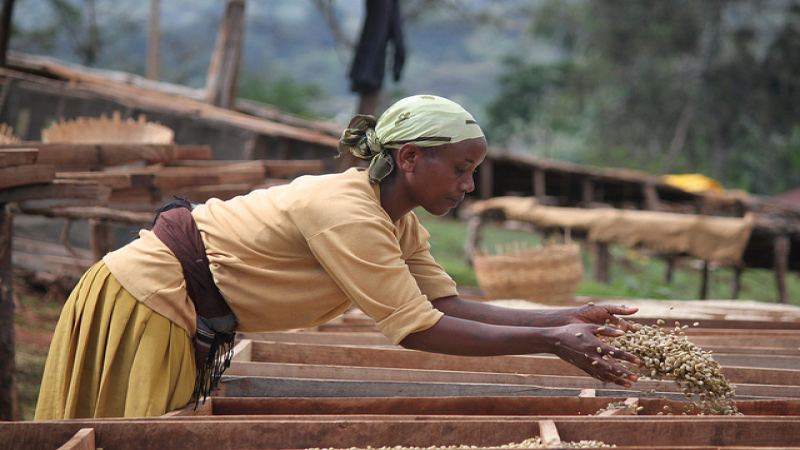
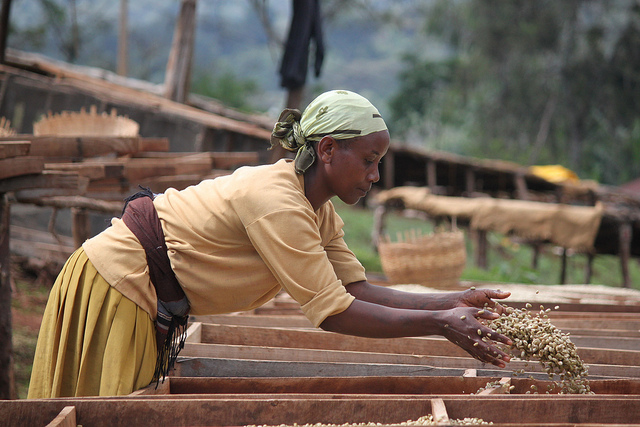
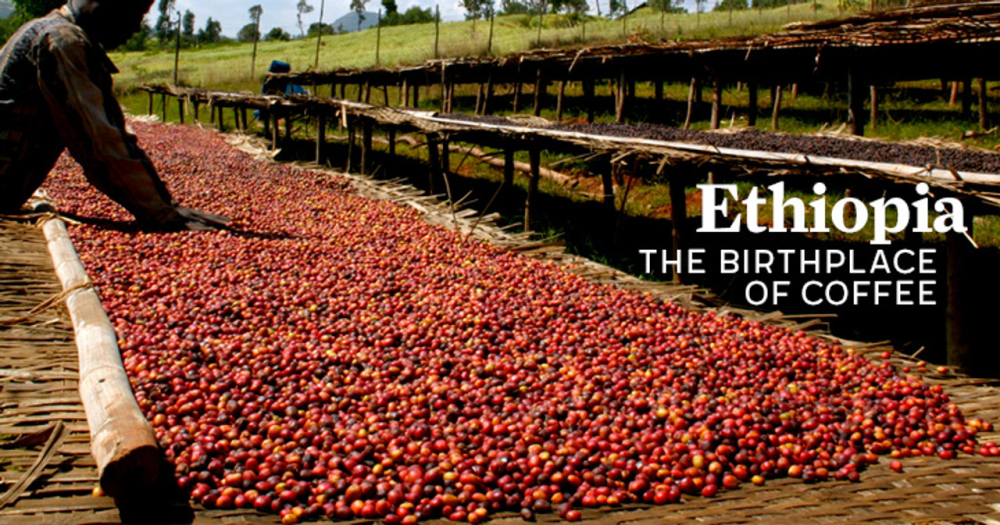
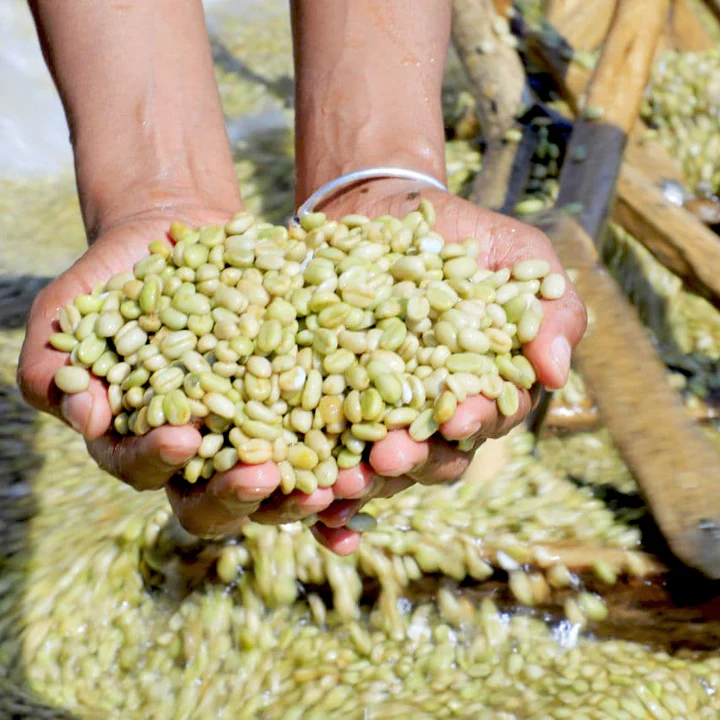
Washed process steps: After coffee cherries are harvested, they are placed in water, and buoyancy is used to remove underripe fruit. Then a depulper removes the skin and pulp. They rest in fermentation tanks for 18 to 36 hours, and once the mucilage layer has broken down, the parchment beans are scrubbed in channels. Through specially designed channels and water flow, low-density, poor-quality beans are separated out. Finally, the coffee beans are drained and spread on African raised beds to dry. The multiple stages of removing defective beans greatly reduce the defect rate, making Front Street Yirgacheffe's cleanliness even more prominent and its own aromas clearer and more transparent.
In the past, most of the coffee we drank was dominated by bitter, roasty flavors. The reason coffee was strong and bitter was mainly that roasters roasted the beans very dark, with flavor profiles leaning toward nuts and dark chocolate. With the rise of the specialty coffee concept, in order to preserve more acidity, roasters roast Front Street Yirgacheffe coffee only to an appropriate light level. Light-roasted Front Street Yirgacheffe presents a pleasant fruity sweet-tartness and white floral notes, one could say it opened a "new era of fruity-acid coffee." Liking sweetness and fearing bitterness is exactly the general public's taste preference, and this is precisely why Yirgacheffe is so popular around the world.
The Front Street Yirgacheffe daily-drinker beans launched by Front Street use washed processing, carry the classic Yirgacheffe flavor profile, and are suitable for pour-over, cold brew, French press, and many other brewing methods.
Front Street Yirgacheffe Coffee Variety
The Yirgacheffe region mainly cultivates Ethiopian native varieties (Heirloom). Because Ethiopia has tens of thousands of coffee varieties, Heirloom is a broad term referring to wild varieties native to Ethiopia or genetically undefined varieties, sometimes also translated as "heritage."
In Ethiopia, the garden planting system is the model on which the vast majority of smallholder coffee farmers depend for their livelihoods, and Heirloom native varieties come from the "unnamed varieties" in their backyards. The coffee trees may have been left by a previous owner of the land, or obtained through sharing among neighbors, or possibly grown from seeds from another producing region. Various coffee plants are intercropped with other cash crops on the land, and the cherries are picked and sold only when ripe.
For this reason, Heirloom does not refer to one specific coffee variety. It represents a blend of green beans from the producing region, with coffee collected from multiple smallholders' harvests from the same period and combined together. A single lot may contain dozens or even hundreds of undifferentiated varieties. Front Street Coffee notes that inconsistent bean size is one of the variety's biggest characteristics. The rich flavor of Front Street Yirgacheffe coffee also benefits from the blending of different varieties.
Front Street Yirgacheffe Coffee Flavor and Mouthfeel Characteristics
After Front Street Coffee compared coffee beans from multiple Yirgacheffe producing areas, it was found that specialty coffee beans from Yirgacheffe usually carry the bright acidity of citrus fruits, fresh white or red floral notes, and a full mouthfeel, overall presenting a citrus profile, with an almond note in the aftertaste and a tea-like sweetness returning.
Ethiopian Yirgacheffe Coffee Beans Grading System
Yirgacheffe coffee bean grading follows the standards established by the Ethiopian Commodity Exchange (ECX). According to the grade standards updated on the official website in March 2022, the grading system is divided into two types: "Commercial Grade Coffee" and "Specialty Grade Coffee."
Commercial Grade Coffee
Expressed as G1, G2, G3, G4, and G5, with evaluation divided into two dimensions:
First, physical characteristics account for 40%, scored through the dimensions of defects, appearance, color, and odor.
Second, coffee cupping accounts for 60%, scored through the four dimensions of cleanliness, body, flavor, and acidity.
Finally, the physical characteristics score plus the coffee cupping score gives the total score.
G1 grade ≥85 points, G2 grade 75-84 points
G3 grade 63-74 points, G4 grade 47-62 points
G5 grade 31-46 points
The higher the score, the better the coffee quality.
Specialty Grade Coffee
Q1 and Q2 are used to indicate the evaluation method for specialty grade coffee.
G1 and G2 grades are selected from commercial grade coffee for cupping. The cupping must be carried out according to SCA standards and scored across more dimensions, such as dry fragrance, wet aroma, flavor, acidity, aftertaste, body, balance, cleanliness, uniformity, sweetness, and overall evaluation, before the final score is given.
Q1 grade ≥85.0 points
Q2 grade 80.0-84.75 points
Therefore, a score of 80 points or above obtained through the SCA cupping standard
is what qualifies as specialty grade coffee, and Q1 grade is superior to Q2 grade.
At present, all Front Street Yirgacheffe coffee beans sold by Front Street Coffee are specialty grade coffee. "Front Street Yirgacheffe Gotiti Cooperative Coffee Beans," "Front Street Yirgacheffe Kochere Cooperative Coffee Beans," "Front Street Yirgacheffe Konga Cooperative Coffee Beans," and "Front Street Yirgacheffe Red Cherry Project Coffee Beans" are all G1 grade, with scores reaching Q1 grade ≥85.0 points.
How to Brew Front Street Yirgacheffe Coffee Beans ?
To make a delicious cup of Yirgacheffe coffee, you first need to use freshly roasted coffee beans, ground and brewed on the spot. All whole-bean coffees sold by Front Street Coffee are shipped within 5 days of completing roasting, ensuring that customers receive coffee beans with the best aroma and flavor. The optimal tasting period for freshly roasted coffee beans is 30 days.
Front Street Coffee has learned that coffee beans grown at higher altitudes have greater density in their bean structure. In addition, in order to preserve more acidity, coffee beans from the Yirgacheffe region are usually roasted to a medium-light level. The substances in coffee beans do not dissolve easily in water, so it is recommended to use a medium-fine grind (80% passing through a Chinese No. 20 standard sieve) with hot water at 90-91°C. Brewing with a V60 dripper, whose spiral ribs and large-hole design can effectively enhance the coffee's layering, is very suitable for brewing Front Street Yirgacheffe coffee.
Dripper: V60 #01
Water temperature: 90-91°C
Dose: 15g
Coffee-to-water ratio: 1:15
Grind size: medium-fine grind (80% of grounds passing through a No. 20 sieve)
Pouring technique: For the first stage, pour 30g of water for a 30-second bloom. Then pour 95g (the electronic scale shows about 125g), completing the pour in about 1 minute. When the water level drops to two-thirds of the coffee bed, pour the remaining 100g (the electronic scale shows about 225g), completing the pour in about 1 minute 35 seconds. Finish dripping in 2'00"-2'10", remove the dripper, and extraction is complete.
"Front Street Yirgacheffe Gotiti Cooperative Coffee Beans" pour-over flavor profile: citrus, tea-like notes, floral aroma, fairly pronounced caramel sweetness, and a clean, sweet cup.
"Front Street Yirgacheffe Kochere Cooperative Coffee Beans" pour-over flavor profile: jasmine aroma on the entry, lemon, overall quite smooth, with fruity sweet-tartness.
"Front Street Yirgacheffe Konga Cooperative Coffee Beans" pour-over flavor profile: lively berry and citrus acidity, with the sweet fragrance of cream and honey, overall tasting like a blended fruit juice.
"Front Street Yirgacheffe Red Cherry Project Coffee Beans" pour-over flavor profile: lemon, licorice, citrus, berries, sweet orange, overall relatively high sweetness, with caramel and cream notes in the returning sweetness, and a black tea aroma in the aftertaste.
For professional coffee knowledge exchange and more coffee bean information, please follow Coffee Workshop (WeChat public account: cafe_style)
For more specialty coffee beans, please add the private WeChat of Front Street Coffee, WeChat ID: qjcoffeex
The above content is compiled by CoffeeHunters, a coffee news website.


