







How Should Huila Coffee Be Brewed at Home?
Colombian coffee runs from bright and fruity to rounded and chocolate-sweet, and the southern volcanic regions of Huila, Cauca, Nariño, and Tolima drive much of that range. High altitude near the equator gives the beans delicate acidity and berry sweetness. Huila coffee rose to prominence after a 2008 volcanic eruption in the province brought the area renewed attention.
For a medium-roast Colombian pour-over, the process covers equipment preparation, grind size, coffee-to-water ratio, water temperature, and a three-pour rhythm. Volcanic soil, weathered from lava and ash, supplies the nutrients and trace elements that where do they grow coffee beans questions usually circle back to, and the same parameters help repeat a fragrant cup consistently.
Colombian coffee is renowned for its diverse styles, ranging from bright and fruity notes to rich, balanced classics with a chocolate-sweet finish. This wide spectrum of flavors makes it unique in the global specialty coffee landscape. In this article, from the perspective of Front Street Coffee, we will explore how the volcanic soil regions of southern Colombia—Huila, Cauca, Nariño, and Tolima—leverage their high altitudes and equatorial advantage to produce delicate acidity and berry sweetness. We will also highlight the flavor characteristics and roasting approaches of two beans currently sold by Front Street: Huila Washed and Sidra Double Anaerobic Natural. Then, we will provide a complete breakdown of the pour-over process for medium-roast Colombian coffee, covering equipment preparation, grind size selection, coffee-to-water ratio, water temperature control, and a three-pour rhythm, helping enthusiasts consistently replicate a fragrant cup of Colombian pour-over at home.

For more specialty coffee knowledge, please follow: Front Street Coffee ( Frontsteet Coffee )
Colombian coffee is incredibly expressive, sometimes showcasing refreshing and pleasant fruity notes, and other times presenting a smooth, balanced style with a chocolate-sweet finish, which has won it a large following among coffee enthusiasts. This stylistic diversity is precisely the most prominent label of Colombian coffee. If we draw an analogy to wine, it resembles the Champagne region, where large houses and independent growers coexist—offering both consistent, standardized output and limited-production, strikingly distinctive specialty lots.
Before 2008, although Colombia consistently ranked third in global coffee production, it had yet to gain due recognition in the specialty coffee scene. The turning point came in 2008, after a volcano erupted in the Huila province in the south of the country, and the region's coffee beans gradually rose to fame. Since then, numerous Colombian estates have repeatedly won awards in coffee competitions.
The reason for this shift lies in the fact that coffee flavor is shaped not only by the genetics of the variety itself, but more critically by whether the plant's root system reaches deep enough and can obtain sufficient nutrients from the soil. Volcanic soil, formed from weathered volcanic lava and ash, is rich in key nutrients and trace elements such as iron, calcium, magnesium, sodium, potassium, phosphorus, sulfur, and silicon. This rich elemental combination acts like a growth booster for plants and is an important condition for coffee to develop more nuanced flavors.
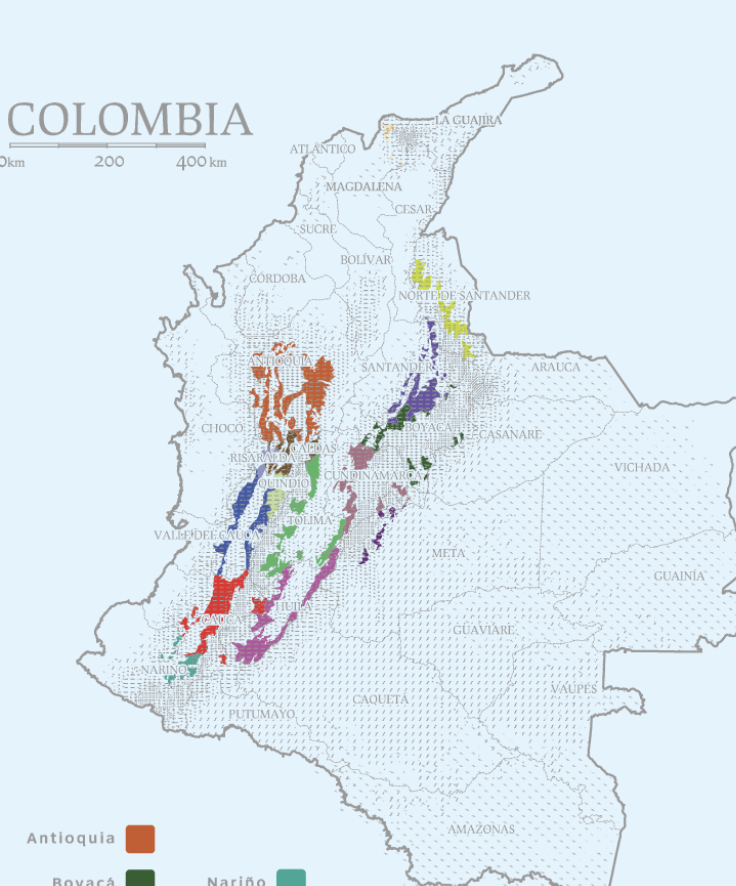
The denser the volcanic ash coverage, the higher the soil fertility, which is why most of Colombia's specialty coffee origins are concentrated in the south. These regions generally sit at altitudes above 1,500 meters, including San Augustin in Huila, Popayan in Cauca, Nariño, and Tolima.
In addition to Huila's own locational advantages, its coffee-growing belt is closer to the equator, and the vast majority of coffee trees grow on high-altitude mountainsides. These superior natural conditions yield higher coffee quality—featuring bright acidity and distinctive floral and fruity aromas. As a result, coffees from southern origins enjoy greater acceptance among enthusiasts.
Front Street Coffee (FrontStreet Coffee) found through cupping comparisons that coffees from these regions generally exhibit delicate acidity intertwined with berry-like sweet-tartness, accompanied by caramel aromas and prominent sweetness. Whether through traditional processing methods or the later-emerging anaerobic processing, the beans consistently express these region-specific flavors.
Currently, Front Street Coffee (FrontStreet Coffee) offers four Colombian specialty coffee beans, all medium-roasted. This roast level is chosen to enhance the coffee's body and richness while preserving the soft acidity and distinct sweetness characteristic of Colombian beans. All coffee beans ordered from Front Street's flagship store are shipped within 5 days of roasting, ensuring they arrive in 100% freshly roasted condition.
One of them is Front Street Huila, sourced from the Huila region at 1,500-1,800 meters, a Caturra variety processed using the washed method. The washed process gives Front Street Huila Coffee Beans a cleaner cup profile and most directly presents the bean's purest original flavors. This bean beautifully showcases the signature flavors of the Huila region: soft fruit acidity, nuts, dark chocolate, and caramel.
Another is Front Street Sidra Coffee Beans from Finca La Divisa in the Huila region at 1,700 meters, processed using the double anaerobic natural method. Front Street Sidra Coffee features full-bodied passion fruit and grape notes, accompanied by preserved-fruit-like sweetness and mandarin-like acidity. After swallowing, an almond-like aftertaste lingers in the mouth, earning it a loyal following of repeat customers. You can place orders on Front Street's Tmall flagship store or Front Street's Taobao store.
How to brew medium-roast Colombian coffee beans for a delicious cup?
First, prepare freshly roasted coffee beans, a coffee-specific grinder, a pour-over kettle, a thermometer, a scale with timer, filtered water, a V60 dripper, filter paper, a server, and an electric kettle for boiling water.
1. Fold the filter paper and place it in the V60 dripper, then pour hot water evenly over the filter paper to wet it completely and make it adhere to the dripper wall. (Rinsing the filter paper cleans it, removes papery taste, and warms the equipment.)
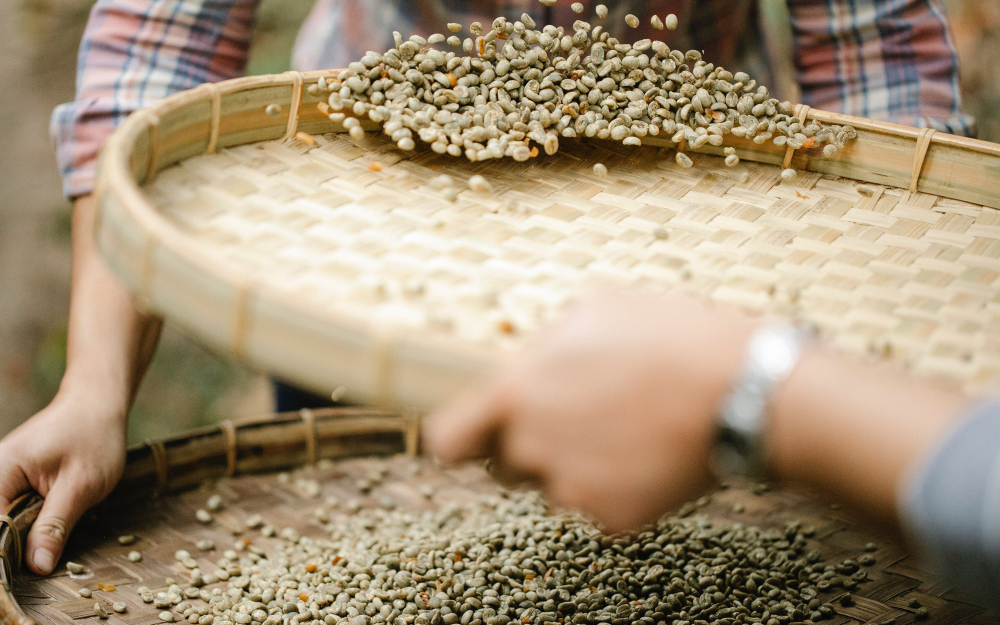
2. Weigh out 15g of coffee beans, then pour them into the grinder and adjust to the desired setting for grinding. Because medium-roasted coffee beans become more porous during roasting as their density changes with heat, soluble substances are more easily extracted. Therefore, Front Street Coffee (FrontStreet Coffee) recommends using a medium grind for brewing medium-roast Colombian coffee, similar to white sugar consistency (about 75% of particles passing through a Chinese No. 20 standard sieve).
3. Pour the ground coffee into the dripper and gently shake to level it.
4. Then prepare a kettle of hot water, pour it into the pouring kettle, and let it cool to 90-91°C before starting to brew. To achieve a more balanced flavor, Front Street Coffee (FrontStreet Coffee) recommends a coffee-to-water ratio of 1:15, meaning 15g of coffee grounds to 225g of water.
5. Start the timer, wet the coffee bed with twice the coffee's weight in water to form a dome and let it bloom for 30 seconds. Then, using a slow stream, pour in circles from the center outward until reaching 125g, pause, and wait for the bed to drop to halfway down the dripper. Continue with the same slow stream for the third pour up to 225g, until all the coffee liquid has filtered through. Remove the dripper. Total time is about 2 minutes.
6. After brewing, gently swirl to allow the coffee to fully integrate, then pour into a warmed cup. A fragrant cup of Colombian pour-over coffee is ready! You can add sugar or milk according to your preference.
The above content is compiled by CoffeeHunters, a coffee news website.


