







How Do Mandheling and Geisha Coffee Beans Differ in Grading?
Mandheling and Geisha coffee beans are graded on different logics. Indonesia uses the wet-hulling process and sorts Mandheling from G1 to G6 by the number of defects in 300 grams of green beans, while Geisha is tied to Hacienda La Esmeralda's red, green, and blue label system, so the same letters on a bag can mean different things.
Other origins add more systems. Tanzania, Rwanda, Colombia, and Jamaica grade by bean size, Kenya splits beans into eight grades from E (elephant bean) down to MH/ML, and Ethiopia and Sumatra judge by defective-bean proportion. Those rules explain why a high grade signals consistency, not automatically a better mandheling or Geisha cup.
Friends who are new to specialty coffee are often confused by labels like G1 and AA on the packaging. These letters and numbers actually represent the grading methods for coffee beans from different origins. Some countries classify by bean size, others by the proportion of defective beans, and still others by growing altitude. Take Mandheling as an example: Indonesia uses the wet-hulling process and grades beans from G1 to G6 based on the number of defects in 300 grams of green beans. Geisha coffee, meanwhile, is known for Hacienda La Esmeralda's red, green, and blue label system. This article will systematically sort through these grading systems while taking a deeper look at the core differences in flavor and mouthfeel between Mandheling and Geisha, helping coffee lovers understand the quality evaluation logic of specialty coffee more clearly.
Friends who have just stepped into the world of specialty coffee often feel baffled when they see letters like G1 and AA on coffee bean bags, unsure of what these symbols actually mean. Today, Front Street Coffee will interpret these questions on specialty coffee labels one by one.
Simply put, what specialty coffee labels reflect is the grading method for coffee beans. However, the standards adopted by different coffee-producing countries are not uniform. For example, Tanzania, Rwanda, Colombia, Jamaica, and other countries use coffee bean size as the basis for grading. Kenya divides coffee beans into eight grades, in order: E (elephant bean), AA, AB, C, PB, TT, T, and MH/ML. Among these, AA represents the highest grade of Kenyan coffee beans, but this does not mean that AA-grade beans necessarily have the best flavor.
Jamaican green coffee beans are graded by quality from high to low as NO.1, NO.2, NO.3, and PB (peaberry). According to CIB standards, the defect rate must be below 3%, and moisture content should be controlled at around 13%. The basic requirement for NO.1-grade Blue Mountain green beans is 17 mesh or above, NO.2 is 16 mesh or above, NO.3 is 15 mesh or above, and PB is about 14 mesh or above. The grades of Jamaican High Mountain coffee are close to those of Blue Mountain coffee, but there is no peaberry PB grade, and Jamaican coffee only has a prime grade, with a mesh range of 15 to 17.
However, origins such as Ethiopia and Sumatra, Indonesia, determine grades by the proportion of defective beans. Front Street Coffee uses Front Street Indonesia Sumatra Coffee as an example. Friends who regularly drink Front Street Indonesia Mandheling Coffee should know that Mandheling has an extremely full body. On the first sip, you can sense a rich herbal medicinal aroma, followed by an obvious sweetness in the aftertaste, along with relatively low acidity and a subtle herbal plant fragrance, unlike Front Street Ethiopia Yirgacheffe, which has a lemon-citrus acidity.
The reason Front Street Indonesia Mandheling Coffee presents a unique mouthfeel so different from other origins is mainly thanks to Indonesia's distinctive wet-hulled green bean processing method. Indonesia chooses the wet-hulled method partly because the local hot and humid climate is extremely unfavorable for sun-drying green coffee beans; if drying is insufficient, the green beans are prone to mold.
The wet-hulled process works as follows: first use a machine to remove the coffee fruit skin, then dry it, which shortens drying time and enhances the coffee's body. But according to Front Street Coffee's understanding, another reason local Indonesians use the wet-hulled method is that this processing approach can compress the coffee processing cycle while reducing labor costs, thereby greatly improving economic efficiency. Based on Front Street Coffee's observations, wet-hulled Mandheling coffee usually carries earthy and smoky notes, which people generally describe as low in acidity but very full in body.
According to Front Street Coffee's understanding, Indonesian Mandheling is still dried after completing the wet-hulled process, but mold is very likely to develop during drying. However, mold on the surface of coffee beans is not necessarily all bad. Some believe that one source of Mandheling's unique flavor is precisely the mold on the coffee beans, but this claim is still inconclusive.
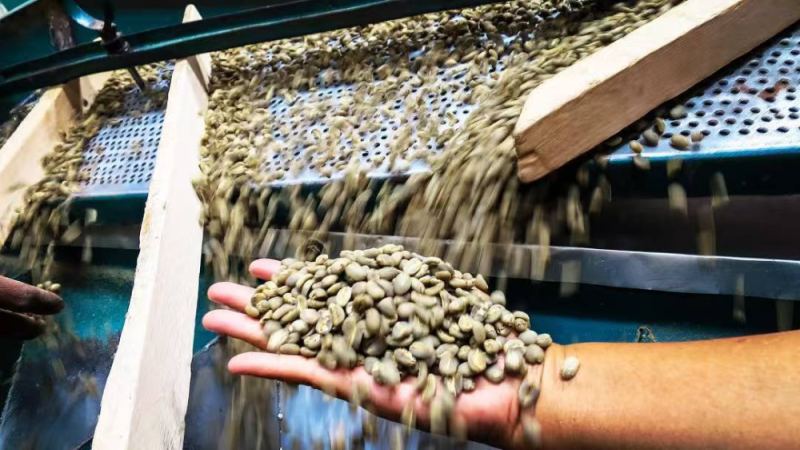
The rapid processing flow also leads to a higher defect rate in Indonesian Mandheling green beans compared with other processing methods. During wet-hulled processing, it is inevitable that debris or small stones get mixed in, or that beans become moldy during drying. Therefore, a batch of green coffee beans ready for export will more or less contain such defective beans, and defective beans can seriously affect the flavor performance of the coffee. Thus, grading coffee bean quality based on the number of defective beans contained in a certain weight of green coffee beans became a standard. Based on the number of defective beans per 300 grams of green beans, beans are divided into six grades, from high to low: G1 to G6. Usually, specialty coffee packaging will also indicate origin and other related information.
To be specific, Front Street Coffee randomly samples 300 grams from Indonesian Mandheling green beans and places them on black paper, because coffee beans are easier for professional graders to inspect carefully against a black background. If among these 300 grams of Mandheling green beans there are no more than 3 defective beans, they belong to G1; if there are 4 to 12 defective beans, they are classified as G2; if there are 13 to 25 defective beans, they are classified as G3; if there are 26 to 45 defective beans, they are classified as G4; if there are 46 to 100 defective beans, they are classified as G5; and Mandheling with 101 to 153 defective beans is classified as G6.
Generally speaking, the smaller the number after the letter, the better the quality of the green coffee beans. This is because higher-grade coffee beans heat more evenly during roasting, and the roasted Front Street Mandheling coffee beans are larger in size and harder in texture, but the brewed coffee has better flavor, is more aromatic, and has a smooth mouthfeel. Just like this year's Front Street PWN Golden Mandheling, which underwent three hand-sortings plus one final selection to ensure the quality of the Mandheling green coffee beans, so the Front Street Golden Mandheling Coffee launched by Front Street Coffee today has a cleaner mouthfeel and extremely high sweetness compared with Front Street Lintong Mandheling Coffee.
Front Street Coffee has learned that the grading methods for coffee beans from Guatemala and Costa Rica are completely different from that of Indonesian Mandheling; they are classified by growing-region altitude. This is because the higher the altitude of the growing region, the colder the climate, and the harder the texture of the coffee beans produced, which is very conducive to the development of coffee flavor, so coffee brewed from high-altitude regions usually has a richer aroma and flavor.
For the Geisha Coffee that has become famous in recent years, Hacienda La Esmeralda has its own grading system, using labels of different colors to distinguish coffee bean quality. Among them, the red label belongs to the auction level; the coffee beans come from the Jaramillo and Cañas Verdes growing areas, are generally grown at an altitude of 1,600 to 1,800 meters, and have a cupping score above 90. The green label is a micro-lot, requiring a growing altitude of 1,600 to 1,800 meters or above, does not participate in bidding, and mainly comes from lots in different plots such as Jaramillo and Cañas Verdes. The blue label, also called Geisha 1500, is grown at an altitude of 1,400 to 1,500 meters, does not participate in bidding, and mainly comes from three growing areas: Jaramillo, Cañas Verdes, and Velo.
Each country's green coffee bean grading standards are different. Not all of them determine grade by the number of defects in green beans, as with Indonesia's Front Street PWN Golden Mandheling. Therefore, when buying coffee beans, everyone can learn to identify on their own which classification method is being used to grade the green coffee beans.
For more specialty coffee knowledge sharing, please follow the WeChat public account: Front Street Coffee (FrontStreet Coffee)
The above content is compiled by CoffeeHunters, a coffee news website.


