







What separates Blue Mountain coffee grades 1, 2, and 3?
Jamaica Blue Mountain coffee is graded Grade 1, Grade 2, Grade 3, and PB, and the grade reflects bean size, overall shape, and defect count rather than flavor style. True Blue Mountain must be grown in the Blue Mountain region east of Kingston at elevations above 1,000 meters, with certification handled by the government's Coffee Industry Board.
Beans from lower elevations or other coffee producing regions cannot be sold as Blue Mountain; they are labeled Jamaica High Mountain or Jamaica Prime instead. Those areas cover more than twice the true Blue Mountain land and account for about 75 percent of national output, which is why so much coffee sold under the Blue Mountain name is not genuine.
Jamaica Blue Mountain coffee is celebrated as one of the finest coffees in the world, with a balanced profile of acidity, sweetness, body, and bitterness, and a fragrant, smooth mouthfeel. However, not every coffee labeled "Blue Mountain" on the market is genuine Blue Mountain beans. This article will guide you through the producing regions of Blue Mountain coffee, the grading standards for No.1, No.2, No.3, and PB, clarify the differences between Blue Mountain coffee, High Mountain coffee, and Jamaica Prime coffee, and share methods for identifying authentic Blue Mountain coffee based on appearance, grinding, aroma, and taste. It also retains Front Street Coffee's brand recommendations and Clifton Farm certification information to help coffee enthusiasts gain a comprehensive understanding of this scarce and precious coffee.
For more specialty coffee knowledge, please follow the WeChat official account: Front Street Coffee (FrontStreet Coffee)
When Jamaica comes to mind, coffee lovers' first reaction is often "Blue Mountain"—this Caribbean island nation's Jamaica Blue Mountain coffee is renowned worldwide. Front Street has always believed that what makes Blue Mountain coffee outstanding is its perfectly balanced blend of acidity, sweetness, body, and bitterness, with a rich aroma and an extremely smooth entry.
Originally, the coffee called "Jamaica Blue Mountain" was limited to production from just two estates, Wallenford and Silver Hill, with Wallenford being superior in quality. Today, what is called Jamaica Blue Mountain has expanded to include coffee beans grown in the Blue Mountain region east of the capital Kingston at elevations above 1,000 meters. The largest estate currently is Mavis Bank, whose barrels bear the M.B.C.F mark. Jamaica exercises extremely strict quality control over Blue Mountain coffee, with certification handled by the government's Coffee Industry Board.
Coffee beans produced at lower elevations or in other regions can only be labeled as Jamaica High Mountain beans or Jamaica Prime coffee beans, and their flavor差距 from authentic Blue Mountain is quite noticeable. However, the land area of these producing regions is more than twice that of the true Blue Mountain area, and their output accounts for 75% of the national total. For this reason, even if you travel to Jamaica in person to buy coffee beans, you may not necessarily get genuine Blue Mountain coffee.
Jamaica's coffee producing regions:
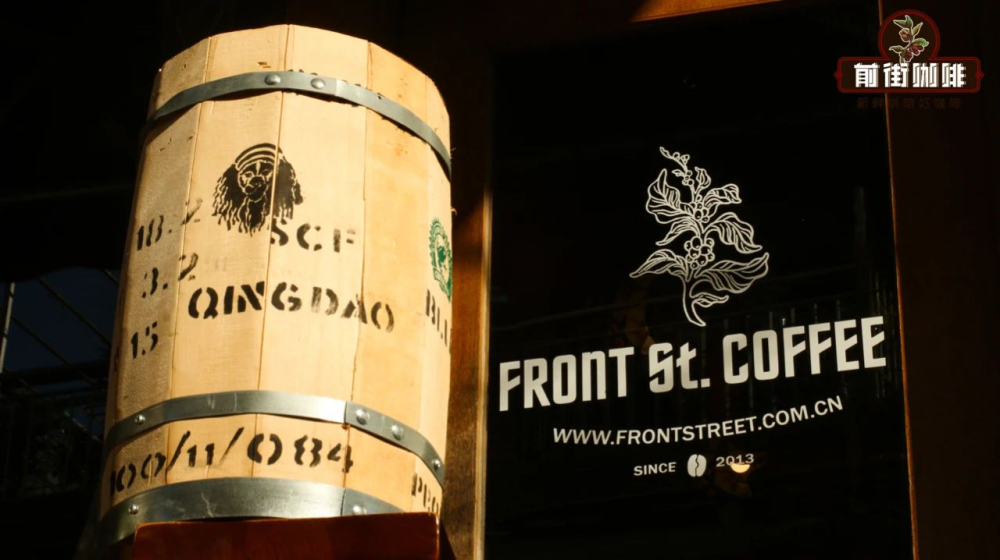
The St. Andrew producing region remains one of the three major Blue Mountain coffee producing regions, alongside Portland and St. Thomas.
Today, the Blue Mountain region's planted area is only 6,000 hectares—extremely limited—so it is impossible for all coffee labeled "Blue Mountain" to come from here. The remaining 12,000 hectares are used to grow two other categories of coffee (non-Blue Mountain coffee): High Mountain Supreme and Prime Washed Jamaican.
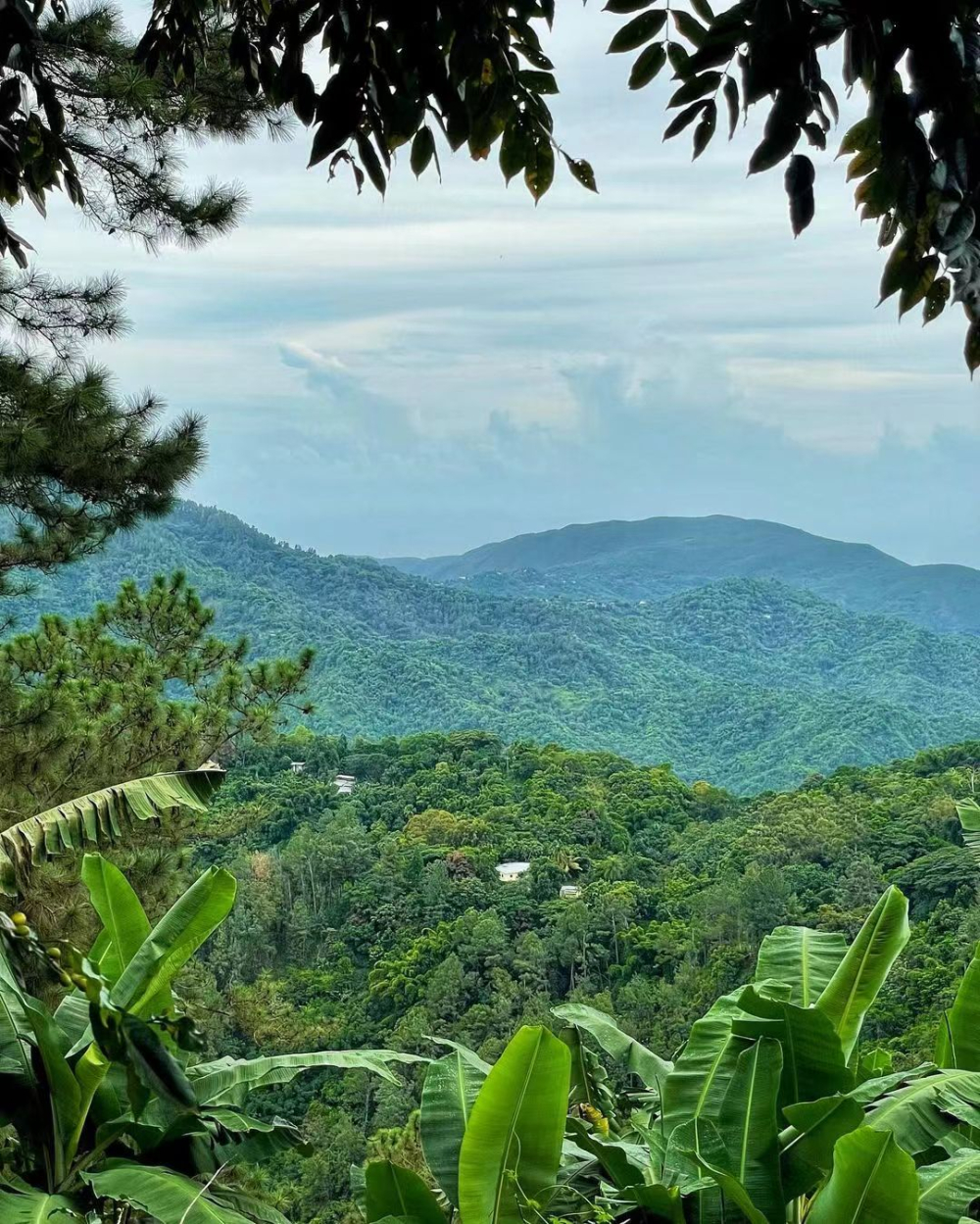
Genuine Blue Mountain coffee is arguably one of the coffees with the most favorable growing conditions in the world. Jamaica's climate, geological structure, and topography combine to create a uniquely ideal environment. The mountain ridge running across Jamaica extends to the eastern part of the island, with the Blue Mountain range reaching over 2,100 meters in elevation. The cool weather, pervasive mist, and abundant rainfall here create well-balanced moisture conditions in this fertile land. Locally, coffee trees are cultivated using a mixed planting method, growing alongside banana trees and avocado trees on terraced fields.
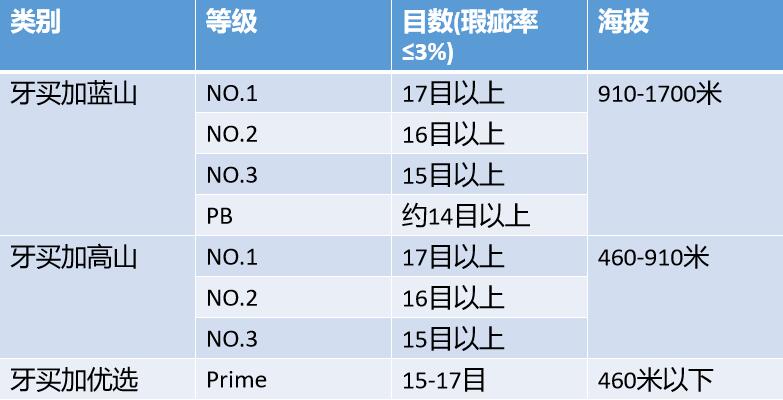
Within Jamaica Blue Mountain Coffee, Blue Mountain coffee and High Mountain coffee are each further divided into four grades. From highest to lowest quality, they are: NO.1, NO.2, NO.3, and PB. NO.1 is what we commonly call Blue Mountain No.1 coffee beans, NO.2 is next, and PB refers to peaberry. According to CIB standards, only coffee grown above 910 meters in elevation qualifies to be called Jamaica Blue Mountain coffee.
Jamaica High Mountain Supreme Coffee Beans: Coffee produced in the Blue Mountain region below 666 meters in elevation is called High Mountain coffee, second only to Blue Mountain coffee in quality, and is often referred to in the industry as Blue Mountain coffee's "brother variety." Since Jamaica Blue Mountain coffee is produced in extremely small quantities, High Mountain coffee is the best alternative for experiencing Jamaican flavor.
Jamaica Prime Coffee Beans: Coffee grown outside the Blue Mountain range is collectively called Jamaica coffee. In the past, coffee professionals in China generally held a misconception that only coffee produced in the Blue Mountain region above 1,800 meters in elevation could be called Blue Mountain coffee. In reality, in the mountain crown zone above 1,800 meters in the Blue Mountain range, there is only one estate—Amber—whose owner's surname is Lyn, a person of Chinese descent with ancestral roots in Guangdong, China. This estate has only 30 hectares of land and very limited output. Blue Mountain coffee is mainly distributed across five mountain areas of the Blue Mountain range: John Crow, St. John's Peak, Mossman's Peak, High Peak, and Blue Mountain Peak.
Blue Mountain coffee refers to coffee brewed from coffee beans produced in the Blue Mountains of Jamaica, and is further divided by grade into Jamaica Blue Mountain coffee and Jamaica High Mountain coffee.
Blue Mountain coffee is one of the finest coffees in the world, with scarce production—rare things are precious. The Blue Mountain range is located in eastern Jamaica, and because the Caribbean Sea surrounds it, on clear days sunlight strikes the azure sea surface and the peaks reflect a brilliant blue glow, hence the name. The highest peak of Blue Mountain reaches 2,256 meters, the tallest in the Caribbean and a famous tourist destination. Located in the coffee belt, it has fertile volcanic soil, fresh unpolluted air, a humid climate, and is foggy and rainy year-round (average precipitation about 1,980 mm, temperature about 27°C). These climatic conditions have created the world-renowned Jamaica Blue Mountain coffee and also the world's second most expensive coffee. This coffee combines all the virtues of good coffee: not only is it rich and mellow in flavor, but its sweetness, acidity, and bitterness are perfectly balanced, with almost no bitterness—only a moderate and perfect acidity. It is usually enjoyed as a single-origin brew, but due to its extremely limited production and high price, it is often blended on the market with coffees of similar flavor.
The coffee trees all grow on rugged mountain slopes, making harvesting extremely difficult—only skilled local female workers can manage it. During harvesting, coffee cherries must be picked at just the right stage of ripeness; underripe or overripe cherries will affect quality. They must be pulped on the same day of picking, then fermented for 12 to 18 hours. After that comes washing and sorting, followed by drying, which must be done on concrete patios or thick blankets until the beans' moisture content drops to 12%–14%. They are then stored in special warehouses, taken out for roasting when needed, and ground into powder. These processes must be strictly controlled, otherwise the coffee's quality will suffer.
Because Japan has long invested in Jamaica's coffee industry, most Blue Mountain coffee is controlled by Japanese interests, and they have also obtained priority purchasing rights. In 1992, Jamaica sold 688 tons of Blue Mountain coffee to Japan, 75 tons to the United States, and 59 tons to the United Kingdom. 90% of Blue Mountain coffee is purchased by the Japanese. The rest of the world can only obtain the remaining 10%, so regardless of price, Blue Mountain coffee is always in short supply.
The market for Jamaica coffee:
Blue Mountain coffee is a category that reputable coffee retailers must stock no matter what. A major British retailer once said: regardless of price, he would sell Blue Mountain coffee year-round without interruption, because he has many loyal customers who recognize only "Blue Mountain."
Today, 90% of harvested Blue Mountain coffee is purchased by the Japanese. Since the rest of the world can only obtain 10% of Blue Mountain coffee's output, Blue Mountain coffee is always in short supply regardless of price. In the UK, Langford Brothers was the sole supplier for many years, and later Edmonds Group also obtained supply from Jamaica's Salda Foods.
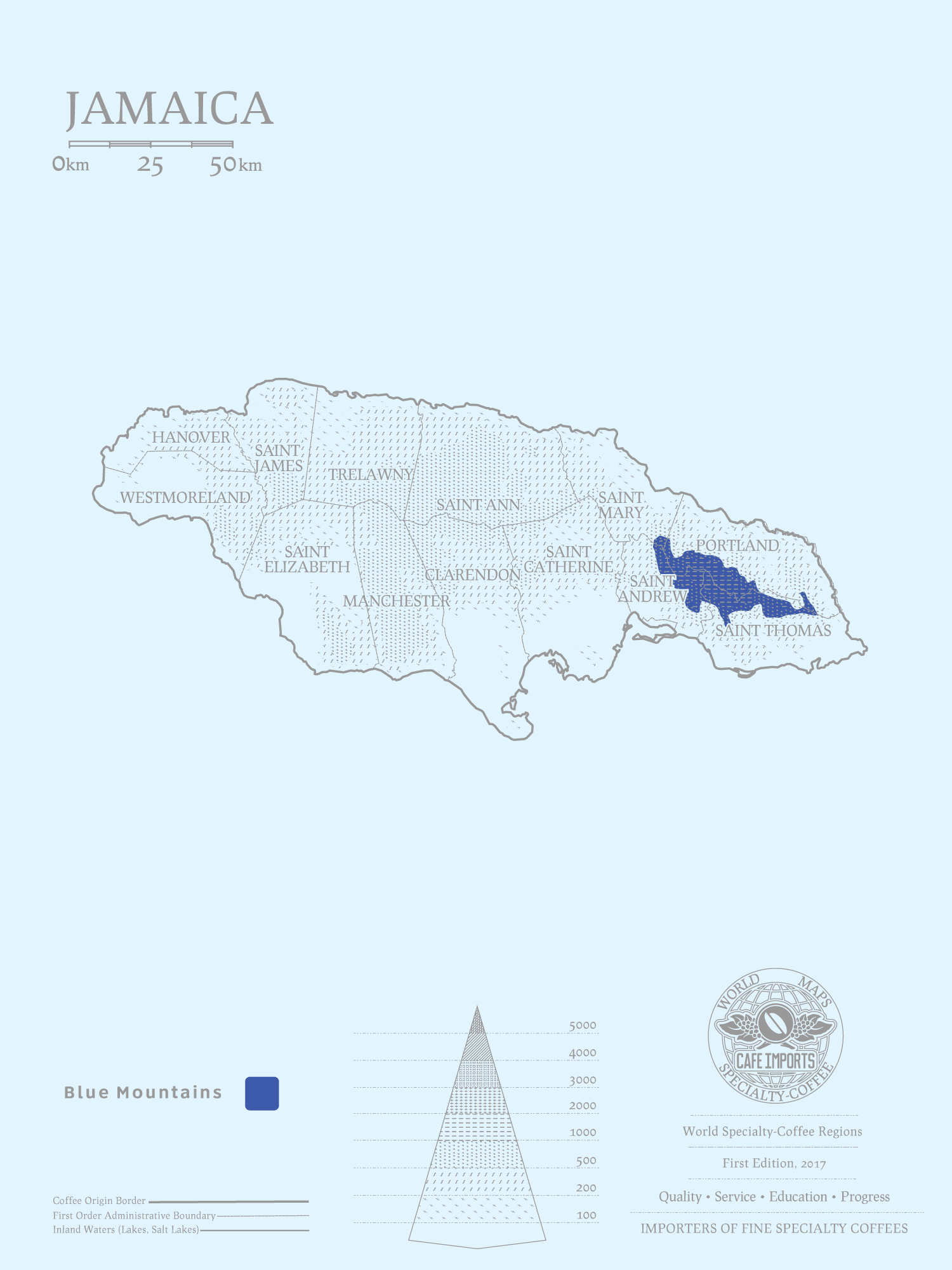
Blue Mountain coffee differs from other coffees in transportation: it is shipped in 70-kilogram wooden barrels, modeled after the Bonifieur barrels produced on Guadeloupe last century. These barrels were originally used to ship flour from the UK to Jamaica and usually bear the trademark name and manufacturer's name. The Coffee Industry Board issues certificates for all genuine Jamaican coffee and applies an approval stamp before export.
The Jamaican government used to insist that all Blue Mountain coffee be roasted within Jamaica to ensure consistent quality. In fact, roasting is a fine art that requires experience, training, and expensive equipment. From the consumer's perspective, coffee beans should be obtained and consumed as soon as possible after roasting, and roasting in Jamaica cannot satisfy this requirement. Today, Jamaican green coffee beans can already be exported. Jamaican coffee has three varieties, as follows:
Among the so-called "Blue Mountain style" coffees on the market, one can rarely find a single genuine Blue Mountain coffee bean. There is a "Jamaica Blend Blue Mountain" coffee made from 30% Blue Mountain coffee and 70% of the best Jamaica High Mountain coffee. Both of these coffees attempt to imitate Blue Mountain coffee but cannot achieve its perfection.
Identifying authentic versus fake Blue Mountain coffee beans
1 Appearance: Blue Mountain green beans are bluish-green in color, uniform in appearance, medium-to-small in size, with slightly raised ends. After roasting, they expand noticeably in volume and become plump.
2 Grinding: Genuine Blue Mountain coffee beans grow at high altitude, and their cell structure is relatively loose; hand-grinding feels crisp and continuous, without any sense of resistance.
3 Aroma: The aroma is very rich and dense; so-called blended Blue Mountain coffee does not have this aroma.
4 Taste: Authentic Blue Mountain coffee beans are characterized by a balanced, rich mouthfeel with no single flavor standing out or lacking—something no other coffee bean can match, and the most crucial point of identification. Blue Mountain peaberry has a more subtle aroma and a relatively more intense mouthfeel.
5 Feeling: As the world's finest coffee, Blue Mountain coffee's classic balanced character inevitably brings a subtle, indescribable sense of satisfaction when tasting.
In addition, you can also verify the authenticity of Blue Mountain coffee beans through certificates.
Currently, the Jamaica Coffee Board can issue certificates for all exported Blue Mountain coffee.
There are three types of certificates:
1) Quality certificate issued by the Jamaica Coffee Board
2) Authorized sales certificate issued by the Blue Mountain coffee producer. (Blue Mountain coffee is distributed by 4 Jamaican government-licensed processors and exported by 16 licensed exporters.)
Front Street's certificate is precisely the certification certificate issued by Clifton Farm.
3) Certificate of origin for Jamaica Blue Mountain coffee
Quality certificates indicate the time and quantity. The Jamaica Coffee Board randomly selects one package from the submitted Blue Mountain coffee for inspection; if it meets Blue Mountain coffee standards, a certificate is issued.
How to brew Blue Mountain coffee beans
KONO dripper; parameters: 15g coffee, water temperature 88°C, grind size with a 75% pass rate through a Chinese standard No. 20 sieve, water-to-coffee ratio close to 1:15, extraction time about 1:5.
Bloom with 30g water for 30s, first pour to 120g and stop; use a vertical stream, small flow, slow circling; second pour to 225g, with the stream and circling speed slightly faster to reduce fines clogging the dripper.
Blue Mountain flavor description: The taste is very clean, complex, very mild, with chocolate sweetness and very strong body. The flavor is rich and mellow, with the coffee's sweetness, acidity, and bitterness perfectly balanced, completely devoid of bitterness, with only a moderate and perfect acidity, and a lingering fruity finish.
The above content is compiled by CoffeeHunters, a coffee news website.


