








Where Are Arabica Coffee Beans Grown in Ecuador?
In Ecuador, Arabica is grown mainly in the Intag Valley on the western foothills of the Andes south of Guayaquil and in the coastal hills of Manabí Province, where beans balance acidity, sweetness, and bitterness. Pichincha Province in the northwest focuses on Robusta instead. The high-altitude Loja region in the south, at 1,450 to 2,000 meters, is a key export area and the source of the Fortunate Estate Geisha.
Ecuador's farms are mostly small: about 80 percent of growers work under 5 hectares, 13 percent between 5 and 10 hectares, and only 7 percent more than 10. Roughly 300,000 hectares are planted nationwide, though about 20 percent is illegally occupied. The Galápagos Islands also grow coffee under a ban on fertilizers, herbicides, and pesticides, showing how widely where are coffee beans grown can vary within one country.
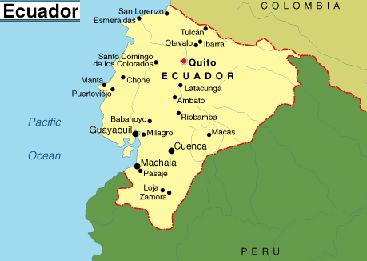
Ecuador is located in South America between Colombia and Peru. It has a long history of coffee cultivation, yet it is dominated by smallholder farmers, and each producing region has its own characteristics. From the Intag Valley, known for Arabica, to Pichincha Province, which focuses on Robusta, to the Galápagos Islands, where chemical products are prohibited, and finally to the high-altitude Loja region—this is where the Fortunate Estate Geisha introduced by Front Street Coffee was born. This anaerobic washed Geisha not only won fourth place in the 2022 Ecuador Cup of Excellence (89.10 points), but also impresses with cup flavors of chamomile, lemon, honeydew melon, and Longjing green tea. This article will guide you through the main producing regions of Ecuador and include Front Street Coffee's recommended pour-over brewing parameters.
Located in South America, between Colombia and Peru, Ecuador has a very long history of coffee cultivation.
Coffee farms in Ecuador are generally small in scale. About 80% of coffee farmers cultivate less than 5 hectares, 13% cultivate between 5 and 10 hectares, and only 7% cultivate more than 10 hectares. According to statistics, of the roughly 300,000 hectares of coffee-growing area nationwide, 20% of the land is illegally occupied.
●Intag Valley
On the western foothills of the Andes south of Guayaquil, as well as in the coastal hilly areas of Manabí Province, Arabica coffee is the main crop, and its coffee beans achieve an excellent balance of acidity, sweetness, and bitterness.
●Pichincha Province
This province is located in northwestern Ecuador, and coffee cultivation there is mainly based on Robusta varieties.
●Galápagos Islands
This archipelago in the waters of Ecuador in South America lies directly beneath the equator and is full of mysterious charm. The islands are home to a large number of endemic species and have been declared a "Cultural and Natural Heritage of Humanity" by UNESCO. For this reason, the law strictly prohibits the import or use of fertilizers, herbicides, pesticides, and other chemical products.
●Loja Region
The Loja region is located in southern Ecuador, close to the Andes, and is one of the highest coffee-growing areas in the world, with an altitude of 1,450 to 2,000 meters. It is also an important coffee-exporting city in the country. Local coffee varieties are mainly improved Typica, processed by washing, and mostly grown under shade trees. High altitude, variable climate, and excellent soil provide many favorable conditions for coffee growth.
Ecuadorian coffee beans receive mixed reviews in the market, with some batches being highly praised and others performing only average. Front Street Coffee recently introduced a Geisha from Fortunate Estate in the Loja region, and its performance has been highly praised.
Fortunate Estate is an emerging estate. In 2017, the owner specially cleared a plot of land to focus on growing organic specialty coffee. The varieties currently grown on this plot include Geisha, Wushwush, and SL28.
This Geisha from Front Street Coffee uses anaerobic washed processing, allowing the coffee to ferment and develop richer flavors. The estate owner is very particular about controlling anaerobic time, pH, and temperature, striving to develop more layered flavors while preserving the true character of Geisha.
This bean also won fourth place in the 2022 Ecuador Cup of Excellence with 89.10 points.
Front Street Coffee uses a medium-light roast level, and the flavors shown in cupping are chamomile, lemon, honeydew melon, and Longjing green tea.
Pour-over recommendations
Dripper: Hario V60
Water temperature: 90°C
Dose: 15 grams
Coffee-to-water ratio: 1:15
Grind size: 80% passing through a Chinese standard No. 20 sieve
First pour 30 grams of hot water and bloom for 30 seconds. Then pour from the center with a thin stream and slowly spiral to 125 grams. When the water level in the dripper drops to the point where the coffee bed is about to be exposed, continue spiral pouring to 225 grams. The total extraction time is about 2 minutes.
For professional coffee knowledge exchange and more coffee bean information, please follow Coffee Workshop (WeChat public account: cafe_style). For more specialty coffee beans, please add the private WeChat of Front Street Coffee (FrontStreet Coffee), WeChat ID: qjcoffeex
The above content is compiled by CoffeeHunters, a coffee news website.


