







Which blue mountain coffee grades are worth the price?
Jamaican Blue Mountain coffee is graded by bean size and quality, with the top grade, No.2, No.3 and PB peaberry as the main tiers. Labels reading Blue Mountain flavor or Blue Mountain blend often contain no Jamaican beans at all, since merchants may use darker roasts of other origins to mimic the mellow profile.
The top-grade beans are the largest and command top-tier prices, so the coffee grades on a package are a useful check on authenticity. Real Jamaican Blue Mountain coffee has a mellow, low-acid cup. Younger drinkers often favor Panama Geisha, but Blue Mountain still holds its place as a classic on many menus.
Blue Mountain coffee is a classic top-tier coffee in the hearts of many seasoned coffee lovers, but do products labeled "Blue Mountain flavor" or "Blue Mountain blend" on the market actually contain Blue Mountain beans? How exactly is Jamaican Blue Mountain coffee graded? What is the difference between Blue Mountain No. 1, No. 2, and No. 3? This article sorts through production region conditions, grade classification, green bean size standards, and authenticity identification one by one, while also explaining the reasons behind the price of authentic Blue Mountain No. 1 coffee beans, and includes the brewing parameters and flavor performance of Front Street Coffee's Clifton Farm Blue Mountain No. 1, helping readers choose truly Jamaican Blue Mountain coffee.
If you ask today's young coffee enthusiasts which coffees are top-tier, most will put Panama Geisha first. But in the eyes of many coffee lovers' elders, when it comes to top-tier coffee, the answer is often still Blue Mountain.
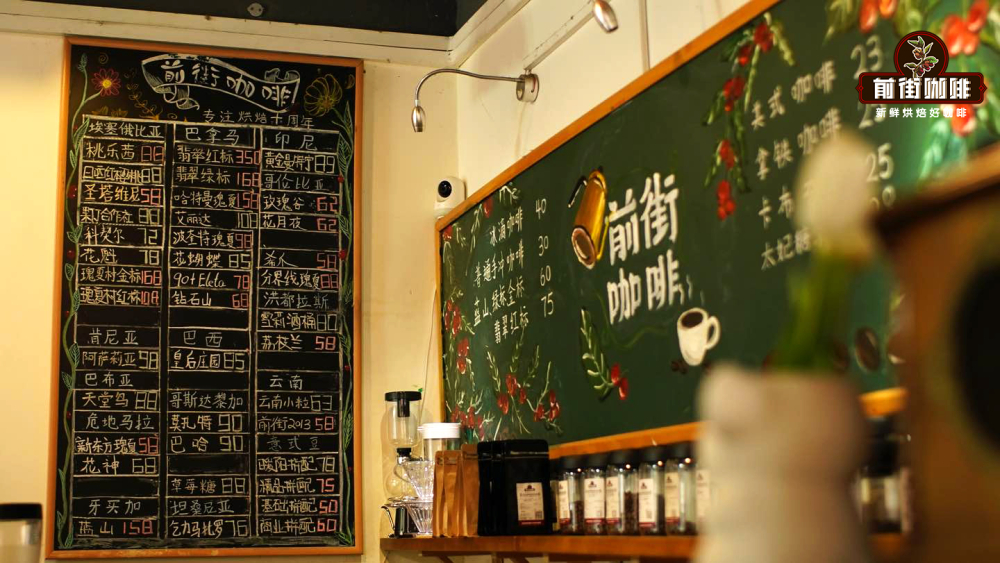
Times have changed, and now walking into almost any cafe, the menu is mostly filled with floral and fruity profiles, pronounced acidity and sweetness, and clean, transparent body, while the beans used as the signature offering are often Panama Geisha. Friends who have visited Front Street Coffee stores will notice that on the blackboard listing nearly fifty kinds of coffee beans, beans from different regions and with different flavors each have their place. Blue Mountain coffee beans, as a representative of top-tier coffee, are also listed among them.
Many friends who are used to shopping online have the same question after seeing Front Street's Blue Mountain coffee prices in Front Street stores: Blue Mountain coffee bean prices differ from seller to seller, so how exactly can you tell which is real and which is fake?
As one of the top-tier beans, Blue Mountain No. 1 coffee beans are also priced in the top-tier range. To earn higher profits, some merchants play word games and print phrases such as "Blue Mountain flavor" and "Blue Mountain blend" on the outer packaging.
Because Blue Mountain coffee has a mellow taste, some merchants choose coffee beans from other regions and use a darker roast to bring the flavor and mouthfeel as close as possible to real Blue Mountain coffee. This means there may not even be a single bean from the Jamaican Blue Mountains in the package.
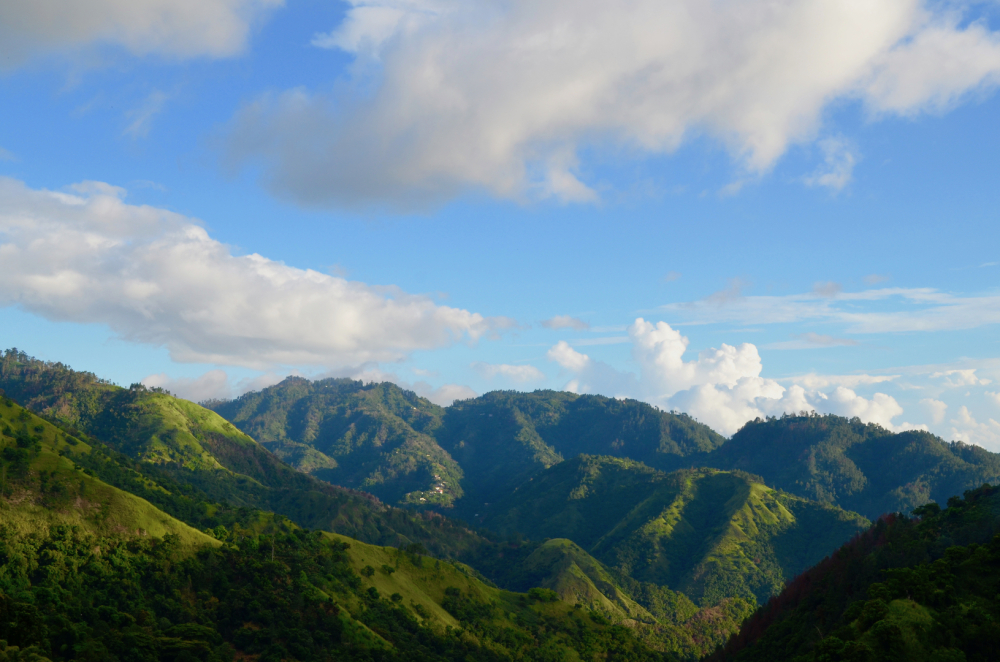
The reason Blue Mountain coffee beans are called "Blue Mountain" is that they are produced near the Blue Mountain range in Jamaica. The Blue Mountain range is located in eastern Jamaica, surrounded by the Caribbean Sea. On clear days, sunlight shines directly on the azure sea, and the peaks reflect the sea's brilliant blue glow, which is how the name came about. The highest elevation of the Blue Mountain range exceeds 2,100 meters. The local climate is cool, foggy, and frequently rainy. This fertile land combined with abundant rainfall nurtures the world-renowned Blue Mountain coffee.
Many coffees with refined flavors are grown at elevations mostly above 1,500 meters. Interestingly, although the Blue Mountain range is more than 2,000 meters high, not the entire Blue Mountain area is suitable for growing coffee. On the one hand, for environmental protection reasons, the Jamaican government has closed off areas above 1,700 meters and prohibited coffee cultivation there; on the other hand, as altitude increases, temperature drops, and after reaching a certain height, frost may occur when it is colder. Frost can cause coffee trees to become "burned" or even die.
Therefore, Blue Mountain coffee is usually grown at elevations below 1,700 meters. But not all coffee beans grown within the Blue Mountain area can be called Blue Mountain coffee beans. Jamaica roughly divides the coffee grown in the country into three grades: Jamaica Blue Mountain Coffee, Jamaica High Mountain Coffee, and Jamaica Supreme Coffee.
Among them, Jamaica Blue Mountain coffee beans are grown at elevations above 1,000 meters and must be grown within the Jamaican Blue Mountain area. The Blue Mountain coffee production region spans four administrative areas of Jamaica: Saint Thomas, Saint Andrew, Saint Mary, and Portland.
In addition to a specific region and specific elevation, Jamaican authorities have also established a more detailed grading system for Jamaica Blue Mountain coffee. On the premise that the green bean defect rate is below 3%, Blue Mountain coffee green beans are classified by bean size into: Jamaica Blue Mountain No. 1 Coffee, Jamaica Blue Mountain No. 2 Coffee, Jamaica Blue Mountain No. 3 Coffee, and Jamaica Blue Mountain Peaberry Coffee.
To meet the standard for Jamaica Blue Mountain No. 1 coffee beans, the green bean size needs to be around 17/18 screen. After such strict layer-by-layer screening by the Jamaica Coffee Board, genuine Jamaica Blue Mountain No. 1 coffee beans are outstanding in quality and relatively scarce in output. This is also one of the reasons why Blue Mountain No. 1 coffee beans are priced higher.
However, as one of the traditional top-tier coffees, Blue Mountain coffee's flavor is also the taste of many coffee lovers' childhood. While pursuing more refined coffee flavors, Front Street Coffee is also constantly searching for traditional coffee flavors.
Front Street Coffee's Blue Mountain No. 1 coffee beans come from Clifton Farm, which is located near Catherine's Peak, where the forest is dense and biodiversity is rich. Clifton Farm emphasizes environmental protection when growing coffee, does not use pesticides, chemical fertilizers, or other substances that harm the environment, and aims to protect the local original ecology.
In Front Street Coffee stores, there are wooden barrels used to hold Blue Mountain No. 1 coffee green beans. Printed on the barrels is a prominent green frog logo, which is the Rainforest Alliance certification mark, representing that the plantation's growing environment is superior and very friendly to surrounding plants and animals.
In addition, the export of genuine Blue Mountain coffee beans comes not only with Blue Mountain coffee green bean wooden barrels, but also with a certificate of origin for Jamaican Blue Mountain coffee beans issued by the coffee estate. Both of these proofs can be found in Front Street Coffee stores. If you want to confirm whether the Blue Mountain coffee beans provided by a merchant are authentic, you can ask the merchant to show the relevant certificates.
Compared with dark-roasted coffee beans, people today prefer medium-light roasts. However, the flavor of classic Blue Mountain coffee is a balance of acidity, sweetness, and bitterness with a mellow mouthfeel. When roasting this bean, Front Street used a medium-dark roast in order to recreate the classic Blue Mountain flavor.
When Front Street Coffee's baristas brew this coffee bean, the parameters used are as follows:
Dripper: KONO
Water temperature: 88°C
Dose: 15 grams
Coffee-to-water ratio: 1:15
Grind size: 70% passing through a Chinese standard No. 20 sieve
The coffee beans shipped by Front Street are all freshly roasted within 5 days, and by the time they arrive they have passed a 4-to-7-day resting period. After roasting, coffee beans contain abundant carbon dioxide, which inhibits flavor extraction during brewing. Therefore, Front Street recommends blooming during brewing to encourage the release of carbon dioxide from the coffee grounds.
Pour in 30 grams of hot water and bloom for 30 seconds, then pour from the center in a thin stream and slowly circle to 125 grams. When the water level in the dripper drops to the point where the coffee bed is about to be exposed, continue circling and pouring to 225 grams. Total extraction time is about 2 minutes.
After brewing Front Street's Jamaica Clifton Blue Mountain No. 1 coffee beans, the cup has rich nutty and dark cocoa flavors on entry, with a mellow balance of acidity, sweetness, and bitterness, and a full body.
For more coffee bean information, please follow Coffee Workshop (WeChat public account: cafe_style)
For professional coffee knowledge exchange, please add WeChat ID: kaixinguoguo0925
The above content is compiled by CoffeeHunters, a coffee news website.


