




How Does SCAA Cupping Score Specialty Coffee?
Under the SCAA cupping system, a sample of beans is scored across eleven categories, and the total decides whether the coffee counts as specialty. Beans that finish below 80 points are classed as commercial; those above 80 are specialty coffee. Five cups are prepared per sample so the taster can judge consistency, and every category except defect deductions is scored from 6 to 10 in 0.25-point steps, adding up to 16 bonus points.
The eleven items cover dry and wet aroma, flavor, aftertaste, acidity, sweetness, body, consistency, balance, cleanliness, overall evaluation, and defect deductions. Dry aroma comes from the ground coffee, while wet aroma appears once hot water meets those particles, and tasters mark intensity on the form. The Specialty Coffee Association of America (SCAA) developed this method; the rival Cup of Excellence system works in a similar way.
The scoring criteria for coffee cupping. The cupping of coffee beans was initially to ensure whether the quality of the coffee beans that are about to enter the trade is qualified. With the passage of time, after the concept of specialty coffee was born, a system of scoring the beans by cupping has been derived. Those below 80 points will be classified as commercial coffee beans, and those above 80 points will be classified as specialty coffee! The higher the score, the better the quality of this coffee.
Currently, there are two most authoritative cupping scoring systems! They are the scoring systems established by SCAA (Specialty Coffee Association of America | American Specialty Coffee Association) and COE (Cup of Excellence | Excellence Cup). And what we are going to share today is the SCAA cupping scoring system.
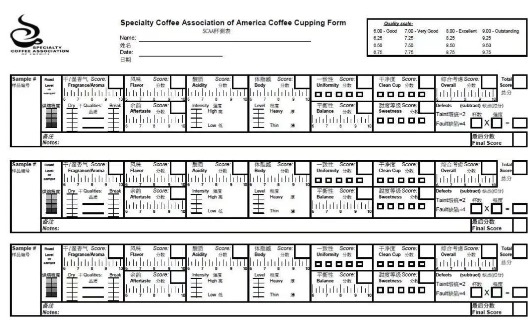
SCAA cupping scoring
There are a total of eleven scoring items in the SCAA cupping, which are: dry / wet aroma, flavor, aftertaste, acidity, sweetness, body, consistency, balance, cleanliness, comprehensive evaluation, and defect deduction points.
Then, one sample (coffee beans) needs to prepare five cups of coffee for cupping to ensure its consistency, stability, and objectivity. Because the beans involved in SCAA are all above the commercial level, the scoring range of each item except defect deduction points will be in the 6-10 point range, and the scoring unit range is 0.25 points, for a total of 16 bonus points.
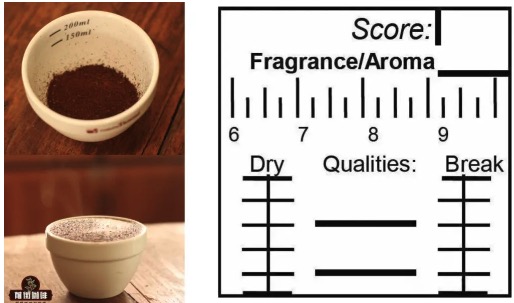
Dry / Wet Aroma (Fraggran / Aroma)
The aroma emitted by the coffee beans after grinding is called "dry aroma"; and the aroma emitted by these ground coffee particles when they come into contact with hot water is the "wet aroma". The vertical marks in the form are used to record the intensity of the dry / wet aroma; the horizontal marks are used to judge the quality of the aroma; the two middle horizontal lines are used to describe the aroma we smell!
Acidity (Acidity)
There are two types of acid in coffee, positive acid and negative acid. Excellent acidity can give coffee more layers, and moderate and mild. For example, round acid, bright acid, can bring us a pleasant feeling. Like sharp, unacceptable, it belongs to negative acidity, and tasting them will give us a "pain mask".
Sweetness (Sweetness)
Sweetness refers to the sense of sweetness felt in the coffee, generally brought out by sour / bitter taste, and a small number of beans will have a dominant sweetness in the case of weak acid and weak bitter. And the sweetness here is not quite the same as other scoring items, it is replaced by the squares for the five different samples, and each cup can get a maximum of 2 points, for a total of 10 points.
Flavor (Flavor)
Flavors all know ~ that is, what kind of flavors this cup of coffee has. If it has high-quality flavors, the score can be scored higher; if there are obvious defects (negative) flavors, it will get a low score.
Body (Body)
The body represents the feeling (taste, touch) of the liquid of this cup of coffee in the mouth. Generally speaking, the descriptions of Body are: thick, sticky, smooth, and weak.
Aftertaste (Aftertaste)
Aftertaste refers to the aroma that comes back to the nasal cavity from the throat after swallowing. This part is divided into two steps, one is whether the flavor that comes back is positive or negative, and the other is the length of time the flavor remains. A short aftertaste, none, or negative flavor will get a low score! On the contrary, it will get a high score.
Cleanliness (Clean Cup)
Cleanliness is reflected in that there are no any strange flavors or stuck throat feelings from entrance to swallowing. Just like sweetness, it uses five squares to represent five samples, with a maximum of 2 points per cup and a total of 10 points.
Balance (Balance)
Balance refers to whether the performance degree of the different feelings mentioned above in the mouth is balanced. When one of them is too weak or too prominent, it will be deducted points due to the effect on the sense of balance.
Uniformity (Uniformity)
Uniformity refers to the similarity degree of the five samples! The closer it is, the higher the score. Similarly, it uses five squares to represent five samples, with a maximum of 2 points per cup and a total of 10 points.
Overall evaluation (Overall)
This can be said to be a more subjective assessment item. If the overall performance is more in line with the preference of the cupper, then the score of this item will be higher.
Defect deduction points (Defects, Subtract)
This is the only item in all items that deducts points. When cupping, if major negative defects are found in the sample coffee, such as: weak aroma, peculiar smell, extremely obvious negative flavor, etc., it will be judged. If it is judged as a defect, it will be deducted 2 points per cup. If it is judged as a defect, it will be deducted four points. The formula is: number of defect cups × defect score = deducted score.
After calculating the total score of the previous ten items, deducting the score of the defect, the final score of the sample bean is obtained: the beans that are less than 80 points belong to the commercial coffee that has not reached the specialty level; the beans in the range of 80-84.99 belong to Very good; the beans in the range of 85-89.99 belong to Excellent; the scores in the range of 90-100 are belongs to Outstanding.
The above content is compiled by CoffeeHunters, a coffee news website.